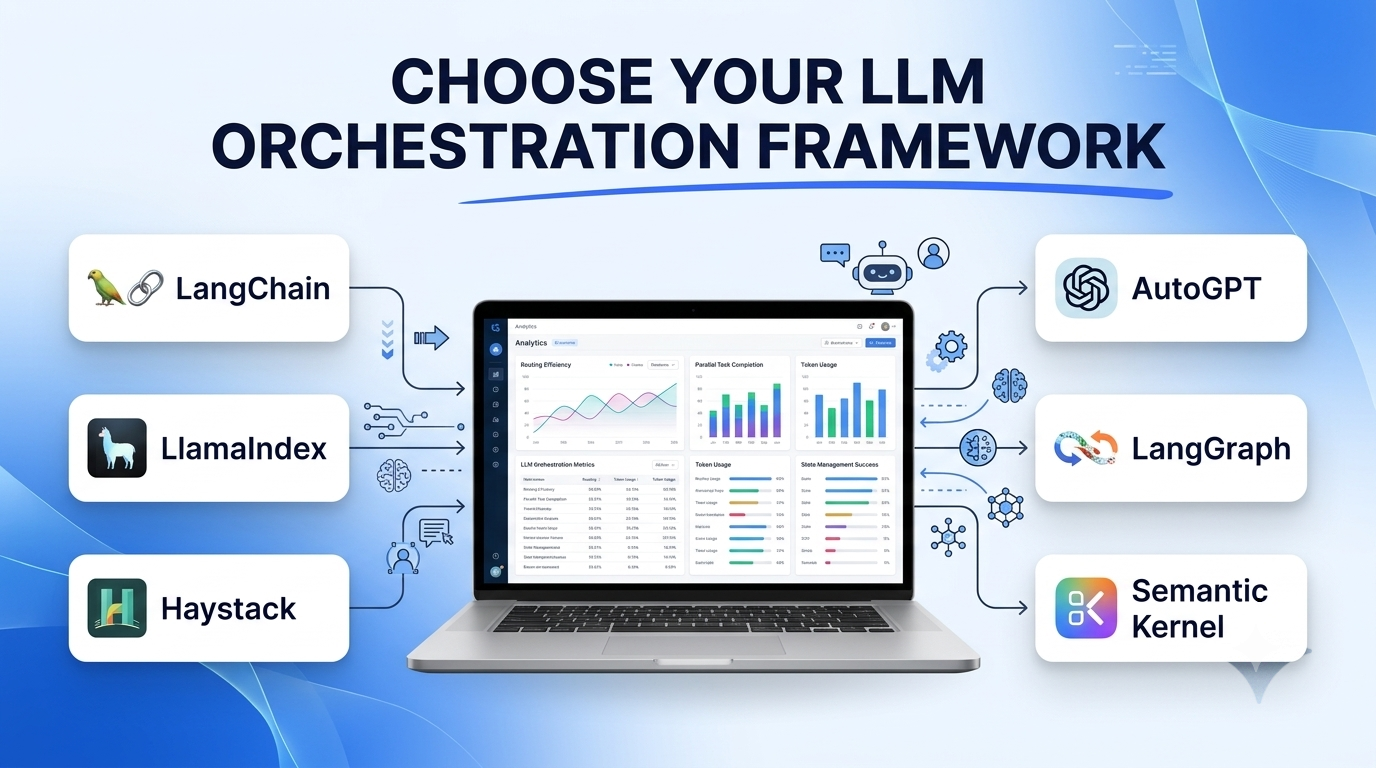
Calling a language model is a single HTTP request, yet production AI applications rarely stop at one call. Real workloads chain document retrieval, structured data extraction, conditional routing, external tool execution, retry loops, and human approval checkpoints.
At the same time, the rise of standardized tool protocols (MCP) and native structured outputs has eliminated the original justification for bloated wrapper frameworks—forcing engineering teams to answer a critical architectural question: how much abstraction do you actually need? Evaluating LLM orchestration frameworks requires distinguishing durable stateful graph runtimes, data-centric RAG and pipeline engines, type-safe thin Python/TypeScript SDKs, and programmatic prompt compilers.
The Core Architectural Divide: Deterministic Pipelines vs. Autonomous Loops
The single most common mistake in AI architecture is choosing a framework built for open-ended autonomous agents when your problem actually calls for a deterministic workflow—or vice versa:
- Deterministic Workflows (Code Controls the Path): Your application code defines the exact sequence of steps—fetch invoice, extract JSON fields, validate totals against ERP rules, escalate exceptions to a human. The LLM fills in specific cognitive steps, while control flow remains predictable, testable, and easy to debug.
- Autonomous Agent Loops (The Model Controls the Path): You give the model a goal and a set of tools, and the model dynamically decides which tools to call and how many turns to iterate. This unlocks flexible problem-solving but introduces non-determinism, variable latency, and token-budget risks.
- Durability and Checkpoint Resumption: When a multi-step workflow pauses for 18 hours waiting for a manager’s Slack approval—or crashes mid-run due to a rate limit—durable frameworks persist state so execution resumes from the exact failed step rather than re-running expensive upstream LLM calls from scratch.
Leading LLM Orchestration Frameworks
LangChain and LangGraph
The LangChain ecosystem splits orchestration into two distinct layers:
- LangChain provides a vast catalog of 700+ standardized integrations (document loaders, vector stores, model wrappers) and composable chains via LangChain Expression Language (LCEL).
- LangGraph serves as the production execution runtime—modeling workflows and multi-agent systems as stateful, cyclical directed graphs with built-in persistence, streaming, fault-tolerant checkpointing, and human-in-the-loop interrupts.
Teams building complex stateful agents or multi-step workflows that require durable checkpointing and native LangSmith observability standardize on LangGraph. Engineers writing simple linear API calls often find LangChain’s historical class hierarchies unnecessarily heavy compared to thin typed SDKs.
PydanticAI
Built by the team behind Pydantic, PydanticAI takes a “thin, type-safe Python” philosophy—bringing the ergonomics of FastAPI to LLM orchestration. Rather than inventing proprietary chain DSLs, it uses standard Python control flow (async/await), dependency injection, and strict Pydantic schema validation for tool inputs and structured outputs across OpenAI, Anthropic, Gemini, Bedrock, and local models.
Python backend engineers who want full IDE static type-checking, clean unit testing, and zero magic abstractions favor PydanticAI for both structured extraction pipelines and tool-using agents.
LlamaIndex (and LlamaIndex Workflows)
LlamaIndex specializes in data-centric AI and complex Retrieval-Augmented Generation (RAG). Beyond basic vector search, it provides sophisticated indexing structures (property graphs, hierarchical trees, hybrid dense/sparse retrievers), high-precision document parsing (LlamaParse for complex tables and PDFs), and event-driven Workflows for orchestrating multi-step document agents.
Organizations building knowledge-intensive applications over messy enterprise PDFs, financial filings, and multi-source data warehouses gain immediate leverage from LlamaIndex’s retrieval abstractions.
Haystack (by deepset)
Haystack is an open-source, production-focused Python framework designed around explicit, inspectable directed acyclic graphs (DAGs) and cyclical pipelines. Every pipeline is composed of strongly typed components (retrievers, rankers, prompt builders, generators, routers) whose connections are validated before execution and serialized cleanly to YAML for reproducible deployment.
Enterprise search and NLP engineering teams that value explicit pipeline topology, modular component swapping, and clean YAML configuration over opaque agent magic rely heavily on Haystack.
Microsoft Agent Framework (AutoGen + Semantic Kernel)
Microsoft unified its enterprise Semantic Kernel (C#, Python, Java) and research-driven AutoGen multi-agent framework into the Microsoft Agent Framework—combining enterprise plugin governance, dependency injection, and Azure identity integration with asynchronous multi-agent orchestration.
Enterprise engineering teams building in .NET/C# or standardized on Azure AI Foundry gain first-class corporate support and cross-language consistency.
Mastra and Vercel AI SDK (TypeScript Ecosystem)
For full-stack TypeScript and Next.js teams, Vercel AI SDK and Mastra provide native JavaScript ergonomics:
- Vercel AI SDK delivers unified model streaming, structured
generateObjectschemas, and frontend UI hooks (useChat) with minimal overhead. - Mastra builds a full TypeScript agent and workflow framework on top of modern JS primitives—adding durable multi-step workflows, memory, RAG pipelines, and local dev playgrounds without forcing TypeScript teams into Python microservices.
DSPy (Programmatic Prompt & Pipeline Compilation)
Created at Stanford NLP, DSPy treats LLM pipelines like neural networks rather than hand-crafted prompt templates. Developers define typed input/output signatures and evaluation metrics, and DSPy’s optimizers automatically compile and tune few-shot demonstrations and instructions against your validation dataset.
LLM Orchestration Frameworks Comparison
| Framework | Core Abstraction | Language Ecosystem | Durability & State Persistence | Key Differentiator | Primary Trade-Off |
|---|---|---|---|---|---|
| LangGraph | Stateful directed graphs & super-step checkpoints | Python & TypeScript | Native durable checkpointers (Postgres/Redis) | Best-in-class state persistence, cycles & human interrupts | Steeper conceptual model than plain Python functions |
| PydanticAI | Type-safe agents, tools & dependency injection | Python | Application-managed state | Native Python types, FastAPI-style ergonomics & low overhead | Fewer pre-built document loaders than LangChain/LlamaIndex |
| LlamaIndex | Data connectors, property graphs & event workflows | Python & TypeScript | Workflow context serialization | Unmatched document parsing & advanced RAG indexing | Less focused on general non-data orchestration |
| Haystack | Strongly typed modular pipelines (YAML/Python) | Python | Pipeline serialization & component state | Inspectable, validated pipeline topology & enterprise search | Smaller consumer-agent template ecosystem than LangChain |
| Microsoft Agent Framework | Enterprise plugins + multi-agent orchestration | C# (.NET), Python, Java | Enterprise state & Azure integration | First-class .NET/C# support & Azure governance | Heavier enterprise structure for lightweight scripts |
| Mastra / Vercel AI SDK | TypeScript workflows, agents & UI streaming | TypeScript / JavaScript | Built-in workflow suspend/resume (Mastra) | End-to-end TypeScript stack without Python sidecars | Younger ecosystem than Python AI tooling |
| DSPy | Declarative signatures + metric-driven optimizers | Python | Stateless/composable modules | Algorithmic prompt & few-shot optimization | Requires labeled evaluation metrics to shine |
When You Should Use No Framework at All
Before importing any orchestration library, apply a simple complexity test:
- Skip Frameworks for Linear 1–3 Step Calls: If your workflow fetches context, calls an LLM with a JSON schema, and saves the result to a database, plain Python or TypeScript using official provider SDKs (or LiteLLM) plus native MCP clients is faster to debug, easier to upgrade, and immune to framework breaking changes.
- Adopt a Framework When State, Cycles, or Durability Appear: Introduce LangGraph, Mastra, or Haystack once your system requires cyclical self-correction loops, multi-day human approval pauses, parallel fan-out/fan-in branches, or complex multi-index retrieval.
