Introduction
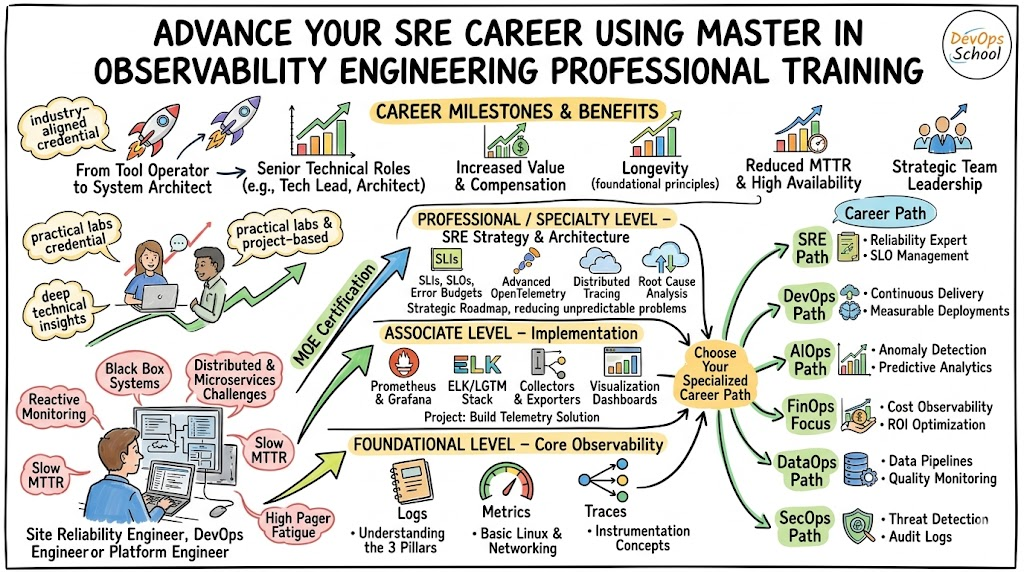
The Master in Observability Engineering (MOE) is a comprehensive program designed to bridge the gap between traditional monitoring and modern, high-cardinality telemetry analysis. This guide is crafted for engineers and technical leaders who recognize that as systems become more distributed and complex, simply knowing that a system is “up” or “down” is no longer sufficient for maintaining reliability. By pursuing this certification through DevOpsSchool, professionals gain the deep technical insights required to navigate cloud-native architectures, microservices, and serverless environments with confidence.
Modern software delivery relies heavily on the ability to debug unpredictable problems in production without redeploying code. This guide serves as a strategic roadmap for those looking to master the art of visibility, helping you understand how to implement robust telemetry pipelines that provide actionable insights. Whether you are navigating the transition from monolithic systems or scaling a global platform engineering team, this resource clarifies the learning path, the technical rigor involved, and the career milestones associated with becoming a certified expert in the field.
What is the Master in Observability Engineering (MOE)?
The Master in Observability Engineering (MOE) represents a shift from reactive monitoring to proactive system introspection, focusing on the deep analysis of logs, metrics, and traces. It is an industry-aligned credential that validates an engineer’s ability to build and manage telemetry systems that can handle the massive scale of modern cloud environments. Rather than focusing on theoretical concepts, the program emphasizes real-world application, teaching students how to instrument code, manage high-cardinality data, and utilize distributed tracing to solve performance bottlenecks.
This program exists because modern enterprise practices require more than just dashboards; they require the ability to ask arbitrary questions about a system’s internal state. It aligns with the latest engineering workflows by integrating observability into the CI/CD pipeline, ensuring that every deployment is measurable and manageable. By mastering these practices, engineers ensure that their organizations can maintain high availability and performance even as architecture complexity grows exponentially.
Who Should Pursue Master in Observability Engineering (MOE)?
The Master in Observability Engineering (MOE) is primarily designed for Site Reliability Engineers (SREs), DevOps professionals, and Platform Engineers who are responsible for the health of production systems. Cloud architects and software developers who want to take full ownership of their code’s behavior in production will also find this curriculum highly beneficial. It is equally relevant for security professionals who need granular visibility for threat detection and data engineers who manage complex data processing pipelines.
For beginners, this certification provides a structured path into the world of cloud-native operations, while experienced engineers can use it to formalize their knowledge of advanced telemetry tools like OpenTelemetry and Prometheus. Engineering managers and technical leaders should pursue this to better understand how to build cultures of observability within their teams. Given the global demand for uptime and the rapid digital transformation in India, this certification holds significant weight for professionals looking to work in high-growth tech hubs and multinational enterprises.
Why Master in Observability Engineering (MOE) is Valuable
The value of the Master in Observability Engineering (MOE) lies in its focus on a skill set that is increasingly becoming a mandatory requirement for senior technical roles. As enterprises adopt Kubernetes, serverless, and multi-cloud strategies, the demand for engineers who can manage these “black box” systems is at an all-time high. This certification ensures longevity in a career by teaching foundational principles of telemetry that remain relevant even as specific vendors or tools change over time.
Investing time in this program offers a significant return on career growth, as it moves a professional from being a “tool operator” to a “system architect.” Companies are willing to pay a premium for experts who can reduce Mean Time To Resolution (MTTR) and improve the overall reliability of their digital services. By becoming a certified MOE, you demonstrate an ability to save the organization money through optimized resource usage and enhanced operational efficiency, making you an indispensable asset to any modern engineering team.
Master in Observability Engineering (MOE) Certification Overview
The Master in Observability Engineering (MOE) program is delivered via the official course page and is hosted on the DevOpsSchool platform, a leader in professional technical training. The certification is structured to guide learners through various levels of expertise, starting from core telemetry concepts and moving toward complex architectural design. The assessment approach is heavily weighted toward practical labs and project-based evaluations, ensuring that candidates can actually perform the tasks they are tested on.
The ownership of the curriculum lies with industry veterans who update the content regularly to reflect shifts in the cloud-native ecosystem. Unlike many generic certifications, this program focuses on a multi-tool approach, covering everything from open-source standards to enterprise-grade observability platforms. This structure provides a clear path for professional development, allowing engineers to specialize in specific areas like distributed tracing or automated incident response while maintaining a broad understanding of the entire observability stack.
Master in Observability Engineering (MOE) Certification Tracks & Levels
The MOE program is divided into three distinct levels: Foundational, Associate, and Professional/Specialty, each designed to build upon the last. The Foundational level covers the “three pillars” of observability—metrics, logs, and traces—and introduces the core philosophy of system visibility. The Associate level moves into the implementation phase, focusing on how to set up collectors, manage data storage, and create meaningful visualizations for different stakeholders.
Advanced levels and specialization tracks allow engineers to align their learning with specific career goals, such as SRE-focused observability or FinOps-focused monitoring. These tracks ensure that the learning experience is not one-size-fits-all but can be tailored to the needs of a Cloud Engineer, a Security Analyst, or a Platform Architect. This tiered approach mirrors the natural career progression of a modern engineer, moving from basic operational tasks to complex, high-level system design and leadership.
Complete Master in Observability Engineering (MOE) Certification Table
| Track | Level | Who it’s for | Prerequisites | Skills Covered | Recommended Order |
| Core Observability | Foundational | Aspiring DevOps/SREs | Basic Linux & Networking | Metrics, Logs, Traces | 1 |
| Implementation | Associate | Systems Administrators | Foundational Level | Prometheus, Grafana, ELK | 2 |
| SRE Strategy | Professional | Senior SREs | Associate Level | SLIs, SLOs, Error Budgets | 3 |
| Cloud-Native | Specialty | Platform Engineers | Associate Level | OpenTelemetry, Kubernetes | 4 |
| AIOps Mastery | Advanced | Data/ML Engineers | Professional Level | Predictive Analytics, ML | 5 |
| FinOps Focus | Specialty | Cloud Economists | Associate Level | Cost Observability, ROI | 6 |
Detailed Guide for Each Master in Observability Engineering (MOE) Certification
Foundational Level
Master in Observability Engineering (MOE) – Foundation
What it is
This certification validates a candidate’s understanding of the fundamental concepts of system visibility and the core differences between traditional monitoring and modern observability.
Who should take it
It is ideal for junior engineers, developers, and IT support staff who are new to cloud-native environments and need a solid base in telemetry.
Skills you’ll gain
- Understanding the Three Pillars: Logs, Metrics, and Traces.
- Differentiating between black-box and white-box monitoring.
- Basic understanding of alerting strategies and incident lifecycle.
- Introduction to telemetry data types and collection methods.
Real-world projects you should be able to do
- Configure a basic monitoring agent on a Linux server.
- Create a simple dashboard to track CPU and Memory utilization.
- Set up basic log aggregation for a web server application.
Preparation plan
- 7–14 days: Focus on reading core documentation and understanding the vocabulary of observability.
- 30 days: Complete basic labs involving tool installation and dashboard creation.
- 60 days: Deep dive into the philosophy of observability and how it differs from monitoring.
Common mistakes
- Confusing simple dashboards with true observability.
- Over-alerting on non-actionable metrics.
- Ignoring the importance of structured logging.
Best next certification after this
- Same-track option: MOE – Associate Level.
- Cross-track option: Certified Kubernetes Administrator (CKA).
- Leadership option: ITIL Foundation.
Associate Level
Master in Observability Engineering (MOE) – Implementation Associate
What it is
This certification confirms the ability to deploy, configure, and maintain the most common open-source and commercial observability tools used in production today.
Who should take it
This is designed for DevOps engineers and system administrators who are responsible for the day-to-day operations of an observability stack.
Skills you’ll gain
- Installation and configuration of Prometheus and Grafana.
- Managing the ELK (Elasticsearch, Logstash, Kibana) or LGTM stack.
- Implementing exporters and collectors for various services.
- Querying telemetry data using PromQL and Lucene.
Real-world projects you should be able to do
- Build a full-stack monitoring solution for a microservices application.
- Implement a centralized logging system that handles high-volume traffic.
- Create complex Grafana dashboards with templating and variables.
Preparation plan
- 7–14 days: Intensive hands-on labs with Prometheus and Grafana.
- 30 days: Learn to build custom exporters and instrument code with client libraries.
- 60 days: Focus on scaling the observability infrastructure and managing data retention.
Common mistakes
- Failing to manage the storage costs of high-cardinality data.
- Creating overly complex dashboards that are difficult to interpret.
- Neglecting the security and access control of telemetry data.
Best next certification after this
- Same-track option: MOE – Professional SRE.
- Cross-track option: AWS Certified DevOps Engineer.
- Leadership option: Certified SRE Practitioner.
Professional/Specialty Level
Master in Observability Engineering (MOE) – SRE & Platform Professional
What it is
This advanced certification validates the ability to design high-scale observability architectures and integrate visibility into the core SRE and platform engineering practices.
Who should take it
Senior SREs, Platform Architects, and Lead Engineers who manage large-scale distributed systems and need to define operational standards.
Skills you’ll gain
- Designing for high availability in observability systems.
- Implementing distributed tracing across complex service meshes.
- Defining and measuring SLIs, SLOs, and Error Budgets.
- Advanced use of OpenTelemetry for vendor-neutral instrumentation.
Real-world projects you should be able to do
- Design a multi-region telemetry pipeline that handles millions of spans per second.
- Implement an automated incident response system triggered by SLO breaches.
- Build a platform-wide observability service for multiple development teams.
Preparation plan
- 7–14 days: Reviewing case studies of observability failures in large-scale systems.
- 30 days: Master the implementation of OpenTelemetry and Jaeger/Tempo.
- 60 days: Conduct architectural reviews and design a resilient telemetry backbone.
Common mistakes
- Focusing too much on tools and not enough on cultural change and SLOs.
- Ignoring the performance overhead of instrumentation on the application.
- Building a “siloed” observability team rather than empowering developers.
Best next certification after this
- Same-track option: MOE – AIOps Specialist.
- Cross-track option: Google Professional Cloud DevOps Engineer.
- Leadership option: Engineering Manager Certification.
Choose Your Learning Path
DevOps Path
The DevOps path focuses on integrating observability directly into the software development lifecycle. Engineers learn how to automate the deployment of monitoring agents and ensure that every release is accompanied by the necessary telemetry. This path is essential for teams aiming to achieve high deployment frequency while maintaining stability through automated feedback loops.
DevSecOps Path
In this path, observability is viewed through the lens of security and compliance. Professionals learn how to use telemetry data to detect anomalies that might indicate a security breach and how to maintain audit logs in cloud-native environments. It bridges the gap between traditional SIEM (Security Information and Event Management) and modern observability practices.
SRE Path
The SRE path is deeply rooted in reliability and the quantitative measurement of system performance. It focuses heavily on Service Level Objectives (SLOs) and using observability data to manage error budgets and perform root cause analysis. This is the most technical path, requiring a deep understanding of distributed systems and performance engineering.
AIOps Path
This path explores the use of machine learning and artificial intelligence to manage the overwhelming volume of telemetry data. Engineers learn how to implement automated anomaly detection, predictive alerting, and intelligent incident correlation. It is designed for those looking to build the next generation of self-healing systems and automated operations.
MLOps Path
Observability in the MLOps path is specialized for monitoring machine learning models in production. Professionals learn how to track model drift, data quality, and inference latency to ensure that AI-driven features remain accurate and reliable. This path is crucial for organizations that are scaling their data science and AI initiatives.
DataOps Path
The DataOps path focuses on the visibility of data pipelines and large-scale data processing engines. It ensures that data engineers can monitor the health of Spark jobs, Kafka streams, and database performance to prevent data silos or corruption. This path ensures that the “data supply chain” is as observable as the application code.
FinOps Path
The FinOps path uses observability to provide transparency into cloud spending and resource utilization. Engineers learn how to link technical telemetry with financial metrics to identify waste and optimize cloud costs. This path is becoming vital for engineering organizations that need to balance high-speed innovation with fiscal responsibility.
Role → Recommended (Topic name) Certifications
| Role | Recommended Certifications |
| DevOps Engineer | MOE Foundational, MOE Associate, MOE Cloud-Native |
| SRE | MOE Associate, MOE SRE Strategy, MOE AIOps Mastery |
| Platform Engineer | MOE Associate, MOE Cloud-Native, MOE SRE Strategy |
| Cloud Engineer | MOE Foundational, MOE Associate, MOE FinOps Focus |
| Security Engineer | MOE Foundational, MOE Associate, MOE DevSecOps |
| Data Engineer | MOE Foundational, MOE Associate, MOE DataOps Path |
| FinOps Practitioner | MOE Foundational, MOE FinOps Focus |
| Engineering Manager | MOE Foundational, MOE SRE Strategy |
Next Certifications to Take After Master in Observability Engineering (MOE)
Same Track Progression
Once you have mastered the professional level, the logical step is to move into extreme specializations. This might include deep-diving into specific observability backends like Mimir or Thanos for high-scale metrics, or becoming an expert in eBPF-based observability for kernel-level insights. Continued learning in this track keeps you at the forefront of the “Observability 2.0” movement, where data is more granular and actionable.
Cross-Track Expansion
Observability is a horizontal skill, meaning it pairs perfectly with certifications in Cloud Architecture (AWS, Azure, GCP) or Container Orchestration (Kubernetes). Expanding your knowledge into these areas allows you to understand the underlying infrastructure that you are making observable. A cross-track approach makes you a more versatile engineer who can not only monitor a system but also fix the structural issues discovered by the telemetry.
Leadership & Management Track
For those looking to move into management, the next step involves certifications focused on engineering leadership and strategic operations. This includes learning how to build and lead “Observability Centers of Excellence” within large organizations. You will focus less on the configuration of tools and more on the cultural transformation required to make observability a core value of the engineering department.
Training & Certification Support Providers for Master in Observability Engineering (MOE)
- DevOpsSchool
As the primary host for the MOE program, this provider offers an exhaustive curriculum that spans from foundational telemetry to advanced AIOps. They are known for their hands-on approach, providing students with access to real-world lab environments where they can experiment with production-grade observability stacks. Their trainers are industry veterans who bring years of SRE and DevOps experience, ensuring that the learning is practical and immediately applicable to enterprise challenges. - Cotocus
This organization specializes in specialized technical training and offers significant support for engineers preparing for high-level observability certifications. They focus on the practical implementation of tools like Prometheus and OpenTelemetry, helping candidates bridge the gap between theory and practice through intensive workshops. Their support includes personalized mentoring and mock exams that are designed to simulate the rigor of the actual MOE assessment process, making them a reliable choice for professional growth. - Scmgalaxy
With a deep focus on the software supply chain and configuration management, this provider offers unique perspectives on integrating observability into the CI/CD pipeline. They provide a wealth of community resources, blogs, and tutorials that complement the MOE curriculum, helping learners stay updated on the latest open-source trends. Their approach is particularly beneficial for DevOps engineers who want to ensure that visibility is baked into the automation process from the very beginning of the lifecycle. - BestDevOps
This provider is recognized for its focused training modules that target specific skills within the observability domain, such as distributed tracing and log management. They offer flexible learning options that cater to working professionals, including weekend bootcamps and self-paced video courses. Their curriculum is highly structured, ensuring that students can master complex topics in a relatively short timeframe without feeling overwhelmed by the depth of the material. - devsecopsschool.com
Focusing on the intersection of security and operations, this site provides essential training for the DevSecOps path within the MOE framework. They emphasize the role of observability in maintaining a strong security posture, teaching students how to monitor for threats and manage compliance through telemetry. Their courses are vital for engineers who need to ensure that their visibility tools also serve the needs of the security and audit teams. - sreschool.com
Dedicated entirely to the principles of Site Reliability Engineering, this provider offers deep-dive courses into the SRE path of the MOE certification. They focus on the high-level strategy of observability, including the management of SLOs, error budgets, and the implementation of automated incident response systems. For those aiming for the Professional level of the MOE, this school provides the strategic context needed to manage reliability at a massive scale. - aiopsschool.com
As the world moves toward automated operations, this provider focuses on the AIOps and machine learning tracks of the observability world. They teach engineers how to utilize AI to sift through mountains of telemetry data to find the “signal in the noise.” Their training is forward-looking, preparing candidates to work with advanced predictive analytics and intelligent alerting systems that are becoming standard in modern enterprise environments. - dataopsschool.com
This site offers specialized training for the DataOps path, ensuring that observability is applied to the complex world of data engineering. They focus on monitoring data pipelines, ensuring data quality, and maintaining the health of large-scale data processing clusters. Their support is invaluable for data professionals who need to bring the same level of operational rigor to their data platforms as DevOps engineers bring to their applications. - finopsschool.com
Addressing the growing need for cloud cost management, this provider supports the FinOps track of the MOE certification. They teach students how to use observability data to gain granular visibility into cloud spending and how to optimize resources for maximum ROI. Their training bridges the gap between the engineering team and the finance department, providing a common language for discussing system performance and cost efficiency.
Frequently Asked Questions
1. How difficult is the Master in Observability Engineering (MOE) exam?
The exam is considered moderately difficult because it requires a balance of conceptual understanding and practical, hands-on skill with various telemetry tools.
2. How much time does it take to complete the MOE certification?
Most professionals spend between three to six months completing the full track, depending on their prior experience with SRE and DevOps practices.
3. What are the prerequisites for starting the MOE program?
While there are no strict barriers for the foundational level, a basic understanding of Linux, networking, and cloud-native concepts is highly recommended for success.
4. What is the ROI of getting the MOE certification?
The ROI is significant, often leading to roles with higher compensation and greater responsibility, as observability is a high-demand, specialized skill set in the industry.
5. Do I need to learn specific tools like Prometheus for this certification?
Yes, the MOE program covers several key industry-standard tools, including Prometheus, Grafana, and OpenTelemetry, as part of its practical implementation requirements.
6. Is the MOE certification recognized globally?
Yes, the certification is designed to meet international engineering standards and is highly regarded by tech companies in India, the US, Europe, and beyond.
7. Can I take the MOE exams online?
The program is designed to be accessible globally through the DevOpsSchool platform, allowing for flexible online learning and remote assessment options for professionals.
8. How often is the MOE curriculum updated?
The curriculum is updated annually to include the latest advancements in cloud-native technology, ensuring that the skills you learn remain at the cutting edge.
9. Is there a recertification requirement for MOE?
To maintain the high standard of the credential, professionals are encouraged to engage in continuous learning or advance to higher levels of the certification every few years.
10. How does MOE differ from a standard DevOps certification?
While DevOps covers the entire lifecycle, MOE deep-dives specifically into the “Operate” and “Monitor” phases, providing much greater technical depth in system visibility.
11. Are there lab environments provided during the training?
Yes, the program includes extensive lab access where you can practice instrumenting applications and configuring telemetry pipelines in a safe, sandboxed environment.
12. Does the MOE certification help in moving into SRE roles?
Absolutely, as observability is one of the core pillars of Site Reliability Engineering, this certification is often seen as a direct pathway into SRE positions.
FAQs on Master in Observability Engineering (MOE)
1. What specific observability tools are emphasized in the MOE program?
The program focuses heavily on the open-source ecosystem, particularly the CNCF landscape. You will gain deep expertise in OpenTelemetry for instrumentation, Prometheus for metrics collection, Grafana for visualization, and Jaeger or Tempo for distributed tracing. Additionally, it covers the ELK/LGTM stack for log management. The goal is to provide a vendor-neutral foundation that allows you to work with any enterprise-grade observability platform later in your career.
2. How does the MOE certification address the challenge of high-cardinality data?
High cardinality is a core technical challenge in modern observability, and the MOE curriculum dedicates significant time to managing it. You will learn how to design label strategies that provide detail without exploding storage costs or slowing down query performance. The course covers advanced topics like metrics aggregation, sampling strategies for traces, and how to use modern time-series databases to handle massive volumes of unique telemetry data points effectively.
3. Is there a focus on “Observability as Code” within the curriculum?
Yes, the MOE program aligns with modern DevOps practices by teaching you how to manage your observability infrastructure using code. This includes using Terraform or Pulumi to deploy monitoring stacks and managing Grafana dashboards as code. You will also learn how to automate the configuration of alerting rules and SLO definitions, ensuring that your observability setup is versioned, repeatable, and integrated into your GitOps workflows.
4. Does the MOE program cover observability for serverless and containerized environments?
The curriculum is built for the cloud-native era, meaning Kubernetes and serverless architectures are central themes. You will learn how to instrument Lambda functions, manage sidecar containers for telemetry collection in Kubernetes, and use eBPF for transparent monitoring of containerized workloads. The course addresses the unique challenges of ephemeral infrastructure, where traditional agent-based monitoring often fails to provide the necessary visibility into short-lived processes.
5. How are SLIs and SLOs integrated into the Master in Observability Engineering?
Defining the right Service Level Indicators (SLIs) and Service Level Objectives (SLOs) is a critical part of the MOE – SRE track. You will learn how to move beyond simple “uptime” metrics to create user-centric SLOs that reflect the actual experience of your customers. The course teaches you how to calculate error budgets and how to use observability data to drive data-driven decisions about when to freeze deployments or focus on reliability.
6. Can software developers benefit from the MOE certification?
Software developers are increasingly responsible for the operational health of their code, making the MOE certification highly valuable. It teaches developers how to write “observable code” by properly using client libraries, adding meaningful context to logs, and creating custom traces. By understanding how telemetry is collected and analyzed, developers can debug production issues much faster and contribute more effectively to the overall reliability of the application.
7. Does the program cover AIOps and automated incident response?
The advanced tracks of the MOE certification dive deep into AIOps, teaching you how to use machine learning to automate the detection of system anomalies. You will learn how to reduce “alert fatigue” by implementing intelligent correlation and how to build automated remediation scripts that can resolve common issues without human intervention. This prepares you for the future of “NoOps,” where the observability system acts as a self-healing brain for the infrastructure.
8. What is the final capstone project required for the MOE certification?
The Professional level of the MOE certification culminates in a comprehensive capstone project where you must design and implement a full-stack observability solution for a distributed application. You will be required to set up telemetry collection, define SLOs, create stakeholder-specific dashboards, and demonstrate how the system handles a simulated production failure. This project ensures that you have the practical skills and architectural mindset required of a true Master in Observability Engineering.
Final Thoughts: Is Master in Observability Engineering (MOE) Worth It?
If you are looking for an honest assessment of whether this certification is worth your time, consider the current state of software engineering. We have reached a point where systems are too complex for any single person to understand by just looking at the code. Observability is the only way to gain the “ground truth” of what is happening in production. Choosing to master this discipline is not just about learning a few new tools; it is about changing your entire approach to how you build and run software.
For those in the India market and the global tech scene, the MOE certification provides a clear signal to employers that you possess a rare and highly valued skill set. While the path requires a genuine commitment to hands-on learning and a deep dive into complex distributed systems, the career impact is undeniable. You move from being someone who reacts to fires to someone who builds the systems that prevent them from happening in the first place. If you are serious about a long-term career in SRE, Platform Engineering, or Senior DevOps, this program is one of the most practical and high-impact investments you can make.

Mastering observability engineering frameworks optimizes real-time cloud-native infrastructure logistics, ensuring proactive system visibility and automated microservices performance intelligence.
Helpful and well-structured guide on observability engineering certification.
This article provides a clear understanding of observability engineering and its importance in modern systems. A helpful guide for professionals looking to expand their technical knowledge.
A well-explained guide that highlights the importance of observability skills and provides useful direction for career growth.