Introduction
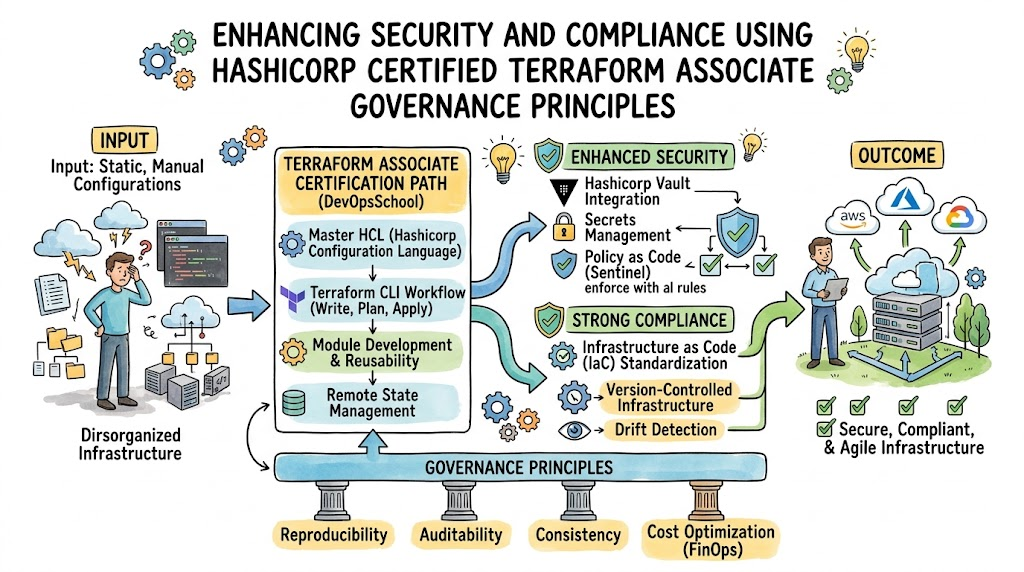
Modern infrastructure demands a radical shift from manual configuration to programmatic automation. This shift centers on Infrastructure as Code (IaC), where the Hashicorp Certified Terraform Associate serves as the primary validation for engineers worldwide. Mastering this tool allows you to define and provision data center infrastructure using a high-level configuration language. This guide provides a clear roadmap for those seeking to solidify their expertise through the Hashicorp Certified Terraform Associate program available at DevOpsSchool. This journey helps engineers and managers navigate the complexities of cloud-native architectures while ensuring long-term career growth in the competitive tech sector.
What is the Hashicorp Certified Terraform Associate?
The Hashicorp Certified Terraform Associate validates an individual’s ability to use the HashiCorp Configuration Language (HCL) to automate resource deployment. It represents a fundamental shift in how organizations perceive IT operations. Instead of manually clicking through cloud consoles, engineers write declarative code that describes the desired final state of their infrastructure. Terraform then calculates the necessary changes and executes them safely.
This certification proves that a professional understands the core lifecycle of infrastructure management. It covers everything from initializing a working directory to managing complex state files that act as a source of truth for the environment. By focusing on production-grade workflows, the program ensures that practitioners can handle real-world challenges, such as resource drift and dependency management, within an enterprise setting.
Who Should Pursue Hashicorp Certified Terraform Associate?
Software engineers, cloud architects, and systems administrators who want to transition into DevOps or Site Reliability Engineering (SRE) roles find this certification indispensable. It bridges the gap between traditional operations and modern software development. Even security professionals and data engineers benefit from understanding how to provision their own specialized environments using a standardized, auditable process.
Managers and technical leads also gain significant advantages by pursuing this track. It provides them with the conceptual framework needed to lead teams during massive cloud migrations or digital transformation projects. In the context of the global market, including the high-demand sectors in India, holding this credential marks you as a forward-thinking professional capable of implementing scalable, automated solutions that reduce operational overhead and human error.
Why Hashicorp Certified Terraform Associate is Valuable
Organizations today prioritize speed and reliability, and Terraform delivers both by treating infrastructure like software. This certification holds immense value because it remains vendor-agnostic. While cloud providers have their own specific tools, Terraform allows you to manage resources across AWS, Azure, Google Cloud, and dozens of other platforms using a single, unified workflow. This portability ensures that your skills remain relevant regardless of which cloud provider an employer chooses.
Beyond technical utility, the certification offers a high return on investment for your time. It demonstrates a commitment to professional excellence and modern engineering standards. As companies move toward platform engineering and internal developer portals, the ability to build reusable Terraform modules becomes a core competency. This expertise often leads to higher salary brackets, more significant responsibilities, and the opportunity to work on high-impact architectural designs.
Hashicorp Certified Terraform Associate Certification Overview
This certification consists of a multiple-choice examination that tests your practical understanding of the Terraform CLI and HCL syntax. HashiCorp maintains and updates the exam to reflect the latest software versions, ensuring that certified associates possess current, applicable knowledge.
The assessment measures your ability to handle the entire lifecycle of an infrastructure project. It probes your understanding of providers, variables, outputs, and the critical role of the state file. Candidates must demonstrate that they can troubleshoot common errors and optimize configurations for performance and security. This structured approach ensures that anyone who passes the exam can contribute immediately to an organization’s automation efforts with minimal oversight.
Hashicorp Certified Terraform Associate Certification Tracks & Levels
The certification structure follows a logical progression that aligns with an engineer’s increasing responsibility within a technical organization. Each level builds upon the previous one, expanding from basic resource provisioning to advanced governance and multi-team collaboration strategies.
- Foundational Level: This entry point covers the basic philosophy of Infrastructure as Code. It introduces the HashiCorp ecosystem and explains why declarative workflows matter for modern business agility.
- Associate Level: This is the flagship certification. it confirms that a practitioner can write, plan, and apply Terraform configurations in a production environment while managing state and modules effectively.
- Professional/Specialty Level: This advanced tier focuses on enterprise-scale challenges. It includes managing Terraform Cloud or Enterprise, implementing policy-as-code through Sentinel, and handling complex organizational hierarchies.
Complete Hashicorp Certified Terraform Associate Certification Table
| Track | Level | Who it’s for | Prerequisites | Skills Covered | Recommended Order |
| Core Automation | Foundational | Beginners/Students | General IT Literacy | IaC Concepts, HCL Syntax | 1 |
| Cloud Operations | Associate | DevOps/SREs | Basic Cloud Knowledge | CLI, State, Modules, Providers | 2 |
| Enterprise Lead | Professional | Architects/Leads | Associate Certification | Sentinel, RBAC, API usage | 3 |
| Compliance Tech | Specialty | Security Teams | Associate Certification | Secrets, Policy, Audit Logs | 4 |
Detailed Guide for Each Hashicorp Certified Terraform Associate Certification
Foundational Level
Hashicorp Certified Terraform Associate – Foundational Knowledge
What it is
This introductory level validates your grasp of the core concepts of automated infrastructure. It ensures you understand the difference between imperative scripts and declarative configurations.
Who should take it
Aspiring cloud engineers, students, or non-technical stakeholders who need to understand how modern engineering teams manage cloud resources should start here.
Skills you’ll gain
- Defining Infrastructure as Code (IaC) principles.
- Understanding the benefits of state management.
- Identifying key HashiCorp products and their roles.
- Reading basic HCL configuration blocks.
Real-world projects you should be able to do
- Articulate the business value of automation to leadership.
- Review a basic configuration file for syntax errors.
- Explain the role of a provider in a multi-cloud strategy.
Preparation plan
- 7–14 days: Read the official HashiCorp “Introduction to IaC” whitepapers.
- 30 days: Complete basic tutorials on the Terraform “Learn” platform.
- 60 days: Not required; this level focuses on conceptual awareness.
Common mistakes
- Confusing Terraform with configuration management tools like Ansible.
- Ignoring the importance of version control for infrastructure.
Best next certification after this
- Same-track option: Associate Level.
- Cross-track option: AWS Certified Cloud Practitioner.
- Leadership option: ITIL Foundation.
Associate Level
Hashicorp Certified Terraform Associate – Core Certification
What it is
This credential proves your ability to use the Terraform CLI to build and manage production-ready infrastructure. It confirms your mastery of the fundamental workflow and state handling.
Who should take it
Working DevOps engineers, Cloud Architects, and SREs who need to formalize their skills and prove their competence to current or future employers.
Skills you’ll gain
- Executing the core Terraform workflow (Init, Plan, Apply, Destroy).
- Managing state files and implementing remote backends for team collaboration.
- Creating reusable modules to standardize infrastructure components.
- Utilizing dynamic blocks and complex expressions for flexible configurations.
Real-world projects you should be able to do
- Deploy a highly available web cluster on a major cloud provider.
- Migrate local state to a secure remote backend with locking.
- Refactor monolithic code into a modular architecture.
Preparation plan
- 7–14 days: Review exam objectives and practice with the Terraform CLI.
- 30 days: Build and destroy 10 unique infrastructure scenarios.
- 60 days: Implement a complete CI/CD pipeline for infrastructure changes.
Common mistakes
- Storing secrets in plain text within HCL files.
- Forgetting to run ‘terraform fmt’ for clean, readable code.
Best next certification after this
- Same-track option: Professional/Enterprise Level.
- Cross-track option: Certified Kubernetes Administrator (CKA).
- Leadership option: Platform Engineering Manager.
Professional/Specialty Level
Hashicorp Certified Terraform Associate – Enterprise Specialist
What it is
This advanced specialization focuses on scaling Terraform within large organizations. It emphasizes governance, security, and the use of Terraform Cloud and Enterprise.
Who should take it
Senior Engineers, Solutions Architects, and Team Leads who define the automation standards for their entire department or company.
Skills you’ll gain
- Writing and enforcing Policy-as-Code using Sentinel.
- Managing organizations, teams, and RBAC in Terraform Cloud.
- Developing private module registries for internal consumption.
- Optimizing large-scale state migrations and troubleshooting.
Real-world projects you should be able to do
- Design a global governance framework for cloud resources.
- Automate complex drift detection and remediation workflows.
- Integrate Terraform Enterprise with corporate identity providers.
Preparation plan
- 7–14 days: Focus on Sentinel syntax and API-driven workflows.
- 30 days: Run trial versions of Terraform Cloud/Enterprise to test features.
- 60 days: Implement a full-scale landing zone with automated compliance checks.
Common mistakes
- Over-engineering policies that block developer productivity.
- Neglecting the cost implications of large-scale automation.
Best next certification after this
- Same-track option: HashiCorp Certified Vault Professional.
- Cross-track option: Google Cloud Professional Architect.
- Leadership option: CTO or Head of Infrastructure roles.
Choose Your Learning Path
DevOps Path
Engineers on the DevOps path focus on speed and integration. You will learn to treat infrastructure as a part of the application lifecycle, ensuring that environment changes happen alongside code deployments. This path prioritizes the automation of the entire delivery pipeline, using Terraform to spin up ephemeral environments for testing and promotion.
DevSecOps Path
The DevSecOps path emphasizes security as a foundational component of automation. You will focus on scanning HCL code for vulnerabilities, enforcing encryption standards, and managing secrets securely. This learning journey ensures that you build infrastructure that is not only functional but also compliant with strict industry security standards.
SRE Path
Site Reliability Engineers use Terraform to maintain system uptime and performance. On this path, you focus heavily on state management, disaster recovery, and drift detection. You will learn to create resilient infrastructure that automatically recovers from failures and remains consistent across various geographic regions.
AIOps Path
The AIOps path explores how artificial intelligence can optimize infrastructure management. You will use Terraform to provision the complex GPU-intensive clusters and high-performance storage systems required for AI operations. This path prepares you to manage self-healing systems that use machine learning to predict and prevent infrastructure outages.
MLOps Path
MLOps professionals focus on the specific needs of machine learning lifecycles. On this path, you use Terraform to create repeatable environments for data scientists to train and deploy their models. You will learn to manage the underlying compute and data pipelines that ensure machine learning models remain accurate and accessible in production.
DataOps Path
The DataOps path centers on the reliable flow of information through an organization. You will use Terraform to provision data warehouses, streaming platforms, and analytical engines. This path ensures that data infrastructure remains consistent, allowing data engineers to focus on building pipelines rather than manual server configuration.
FinOps Path
The FinOps path teaches you to balance technical performance with financial accountability. You will use Terraform to implement cost-tracking tags, resource limits, and automated shutdown schedules for non-production environments. This path is crucial for organizations looking to maximize their cloud investment while minimizing wasted spending.
Role → Recommended Hashicorp Certified Terraform Associate Certifications
| Role | Recommended Certifications |
| DevOps Engineer | Associate + Certified Kubernetes Administrator |
| SRE | Associate + Professional + SRE Foundations |
| Platform Engineer | Associate + Professional + Cloud Solutions Architect |
| Cloud Engineer | Foundational + Associate + Cloud Specialist |
| Security Engineer | Associate + DevSecOps + Vault Associate |
| Data Engineer | Associate + DataOps + Big Data Specialty |
| FinOps Practitioner | Associate + FinOps Certified Practitioner |
| Engineering Manager | Foundational + Associate (Knowledge Level) |
Next Certifications to Take After Hashicorp Certified Terraform Associate
Same Track Progression
Deepening your expertise within the HashiCorp suite is the most effective way to become an automation master. After completing the Terraform track, you should pursue the HashiCorp Certified Vault Associate. Vault manages the secrets and sensitive data that your Terraform configurations often need. Mastering both tools allows you to build a complete, secure infrastructure-as-code ecosystem that handles both provisioning and security flawlessly.
Cross-Track Expansion
Broadening your technical horizon helps you solve more diverse engineering challenges. The Certified Kubernetes Administrator (CKA) is a perfect companion to Terraform, as you will often use Terraform to build the clusters that Kubernetes manages. Alternatively, obtaining a professional-level cloud certification from AWS or Microsoft Azure allows you to apply your Terraform skills to more complex, provider-specific services and architectures.
Leadership & Management Track
For those aiming for executive or management roles, the focus should shift toward governance and business alignment. Pursuing a Certified Cloud FinOps Practitioner credential helps you manage the financial aspects of automation. Additionally, a Certified Information Systems Security Professional (CISSP) designation can help you move into high-level security leadership where you oversee the policy-as-code frameworks implemented by your technical teams.
Training & Certification Support Providers for Hashicorp Certified Terraform Associate
- DevOpsSchool
DevOpsSchool stands out as a leading provider of technical education, offering specialized bootcamps for Terraform and related cloud technologies. Their curriculum emphasizes hands-on projects and real-world scenarios, ensuring that students gain practical experience alongside theoretical knowledge. With a deep bench of expert instructors, they provide the mentorship needed to navigate complex automation challenges. Their focus on the latest industry trends makes them a preferred partner for both individual learners and corporate teams globally. - Cotocus
Cotocus offers comprehensive consulting and training services aimed at accelerating digital transformation. Their Terraform certification support includes customized training modules that align with specific organizational needs. They focus on helping teams migrate from manual processes to fully automated DevOps workflows. By providing expert-led sessions and practical labs, they ensure that engineers can implement Terraform effectively in high-stakes production environments, making them a key player in the tech training space. - Scmgalaxy
Scmgalaxy provides a vast community-driven platform filled with tutorials, guides, and resources for DevOps professionals. Their Terraform training is designed to be accessible yet rigorous, catering to both beginners and advanced practitioners. They emphasize the role of Software Configuration Management (SCM) within the infrastructure lifecycle. Their extensive library of case studies and community insights provides a unique perspective on how to solve the day-to-day challenges of infrastructure automation across various industries. - BestDevOps
BestDevOps focuses on delivering top-tier training for the modern software delivery lifecycle. Their Terraform programs are built around the concept of “learning by doing,” with intensive lab environments that simulate real-world cloud architectures. They help professionals master the nuances of HCL and CLI operations, ensuring high success rates for certification candidates. Their commitment to quality and student outcomes has earned them a reputation as one of the most reliable training providers in the DevOps field. - devsecopsschool.com
devsecopsschool.com specializes in the critical intersection of security and automation. Their Terraform training includes a heavy emphasis on building secure pipelines and implementing policy-as-code. They teach students how to use tools like Sentinel and Vault to protect infrastructure from the ground up. This security-first approach is essential for engineers working in regulated industries like finance and healthcare, where compliance is as important as technical performance. - sreschool.com
sreschool.com focuses on the principles of Site Reliability Engineering, teaching how to use Terraform to achieve high availability and system resilience. Their curriculum covers advanced state management, drift remediation, and automated recovery strategies. They prepare engineers to handle the scale and complexity of global web services. By focusing on the operational health of systems, they ensure that their students can build infrastructure that is not only easy to deploy but also simple to maintain. - aiopsschool.com
aiopsschool.com leads the way in training engineers for the future of AI-driven operations. Their Terraform courses explore how to automate the complex, high-compute environments required for modern artificial intelligence workloads. They focus on the elastic infrastructure needs of machine learning training and inference. This forward-looking approach ensures that their students remain at the cutting edge of the technology sector, ready to lead the next wave of infrastructure innovation. - dataopsschool.com
dataopsschool.com caters to the specific needs of data engineering and analytics teams. They teach how to use Terraform to provision and manage data warehouses, streaming platforms, and analytical engines. Their goal is to bring the rigor of DevOps to the world of data management. By mastering infrastructure-as-code through their programs, data professionals can ensure that their data pipelines are as reliable and scalable as their application code. - finopsschool.com
finopsschool.com focuses on the financial management of cloud resources, using Terraform as a primary tool for cost control. Their training shows how to implement automated budgeting, resource tagging, and cost-optimization policies directly into the code. They help organizations bridge the gap between engineering, finance, and business leadership. This expertise is vital for companies looking to maintain a healthy bottom line while continuing to grow their cloud footprint.
Frequently Asked Questions (General)
1. Is the Terraform Associate exam considered difficult for beginners?
While the exam is achievable, it requires a practical understanding of CLI commands and HCL syntax that beginners can only gain through hands-on practice.
2. How much time should I dedicate to studying for this certification?
Most professionals find that 30 to 45 days of consistent study, including several hours of lab work each week, provides enough preparation to pass.
3. Are there any prerequisites I must complete before the exam?
HashiCorp does not require any specific prerequisites, but having a basic understanding of at least one cloud provider like AWS or Azure is highly beneficial.
4. What is the format of the Terraform Associate examination?
The exam consists of multiple-choice, multiple-answer, and true/false questions, along with some interactive “fill-in-the-blank” scenarios that test your CLI knowledge.
5. How long does the Terraform Associate certification remain valid?
Your certification remains valid for two years, after which you must retake the exam to keep your status current with the latest software updates.
6. Can I take the exam from my home?
Yes, the exam is offered through an online proctored service, allowing you to complete it from any quiet location with a stable internet connection.
7. Does the exam focus more on theory or practical application?
The exam focuses heavily on practical application, asking questions that require you to understand how the tool behaves in specific production scenarios.
8. What resources does DevOpsSchool provide for preparation?
DevOpsSchool offers a comprehensive suite of study guides, practice exams, and instructor-led bootcamps designed to cover every objective on the exam.
9. How does Terraform differ from cloud-specific tools like CloudFormation?
Terraform is cloud-agnostic, meaning you can use the same language and workflow to manage multiple different cloud providers simultaneously.
10. What is a passing score for the certification?
HashiCorp does not publicly disclose the exact passing percentage, but candidates generally need to score around 70-75% to receive their credential.
11. Is knowledge of GitHub or GitLab required for the exam?
While not a direct requirement, understanding basic version control concepts is essential for managing Terraform configurations in a real-world team environment.
12. Will I need to write code during the actual examination?
You will not write extensive code from scratch, but you must be able to read HCL blocks and identify correct syntax or missing arguments in provided samples.
FAQs on Hashicorp Certified Terraform Associate
1. How does the Terraform state file function during a team project?
The state file tracks the mapping between your HCL code and the actual resources in the cloud; in team projects, you must store this file in a remote backend with locking to prevent two people from making conflicting changes at the same time.
2. What is the primary difference between a Provider and a Module in Terraform?
A Provider is a plugin that enables Terraform to communicate with a specific API, while a Module is a collection of resources grouped together to create a reusable, standardized component for your infrastructure.
3. Why would an engineer use ‘Terraform Plan’ before ‘Terraform Apply’?
The ‘plan’ command creates an execution plan, showing you exactly what changes Terraform will make to your infrastructure without actually performing them, which helps prevent accidental deletions or costly mistakes.
4. Can Terraform manage on-premises infrastructure as well as cloud?
Yes, as long as there is a provider available for the technology (such as VMware, OpenStack, or Nutanix), Terraform can automate on-premises resources just as easily as public cloud resources.
5. How does Terraform handle sensitive information like passwords?
Engineers should mark variables as ‘sensitive’ to prevent them from appearing in CLI output, and they should use secure backends and secret management tools like HashiCorp Vault to keep sensitive data out of plain text files.
6. What role does the ‘.terraform’ directory play in a project?
This local directory is created during the ‘init’ phase and contains the provider plugins and backend configuration required for Terraform to operate within that specific project folder.
7. What is ‘Resource Drift’ and how does Terraform solve it?
Drift occurs when someone changes infrastructure manually outside of Terraform; running ‘terraform plan’ detects these differences and suggests the necessary changes to bring the real-world resources back in line with your code.
8. Is it possible to import existing infrastructure into Terraform?
Yes, you can use the ‘terraform import’ command to bring resources that were created manually or by other tools under Terraform’s management, though you must still write the corresponding HCL code.
Final Thoughts: Is Hashicorp Certified Terraform Associate Worth It?
Navigating a career in the modern cloud era requires more than just knowing how to navigate a dashboard. It requires the ability to build systems that are repeatable, scalable, and resilient. The Hashicorp Certified Terraform Associate provides the essential foundation for this transformation. It is not just about learning a specific tool; it is about adopting a philosophy that treats infrastructure with the same respect and rigor as application code.
Pursuing this certification sends a clear signal to the industry that you are ready to handle the complexities of enterprise-scale automation. Whether you are an engineer looking to climb the technical ladder or a manager aiming to streamline your team’s output, the knowledge gained through this program is invaluable. My advice to you is simple: don’t just study to pass the test—study to master the craft. The expertise you build today will become the bedrock of your career for many years to come. There has never been a better time to embrace the power of Infrastructure as Code.

Well explained
Adopting Terraform Associate governance principles optimizes infrastructure-as-code deployment logistics, ensuring secure multi-cloud automation and automated continuous compliance workflows.
Great insights on using Terraform for better security and compliance in modern infrastructure.
A well-explained article covering Terraform governance and its role in improving security and compliance. The insights shared are helpful for professionals working with modern infrastructure practices.
A helpful article that explains how Terraform governance principles can strengthen security and compliance. The practical insights make it a worthwhile read for cloud professionals.