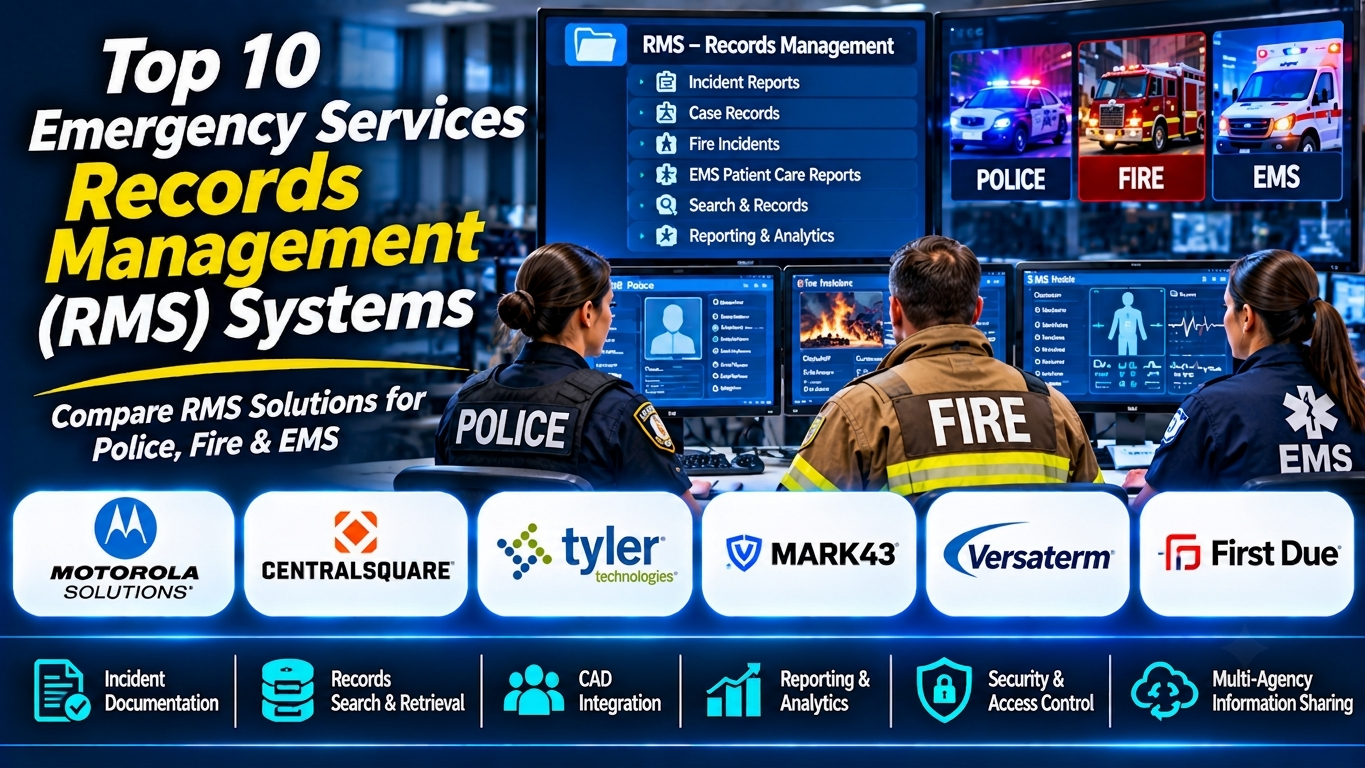
Introduction
Emergency services organizations generate important records every day. Police departments document incidents, fire departments record responses and inspections, and emergency medical services maintain information about calls and patient care.
Managing these records accurately is essential for operations, accountability, reporting, and regulatory compliance. When agencies depend on paper forms, disconnected spreadsheets, or outdated databases, staff can spend considerable time locating information and correcting inconsistent records.
Emergency Services Records Management Systems, commonly called RMS platforms, help agencies organize incident reports, personnel information, operational records, and related documentation. Depending on the product, they may also support investigations, inspections, analytics, records sharing, and integrations with dispatch systems.
Different emergency services have different documentation requirements. Police departments often prioritize incident and investigative records, while fire and EMS organizations may require specialized incident reporting, inspections, and patient care documentation.
Selecting suitable RMS software requires careful consideration of security, access permissions, interoperability, reporting standards, migration requirements, and long-term support. Agencies should also evaluate how easily personnel can complete records during demanding operational schedules.
This guide compares ten software platforms relevant to emergency services records management. It explains their features, benefits, limitations, applications, and suitability for different public safety organizations.
What Is Emergency Services Records Management Software?
Emergency Services Records Management Software is a digital system used to create, organize, retrieve, manage, and report information generated by emergency response organizations.
An RMS may store incident narratives, case information, personnel activities, response details, administrative records, and supporting documents. The exact information depends on the agency and software category.
For example, a police department may use RMS software to document a reported theft, connect related incidents, and maintain investigative records. A fire department may use a specialized system to document fire responses, inspections, apparatus activity, and operational statistics.
RMS platforms often integrate with Computer-Aided Dispatch systems, mobile applications, analytics tools, and other public safety technologies. These connections help reduce duplicate data entry and improve information consistency.
Common Applications
- Incident Reporting: Create structured reports describing emergency responses, incidents, and operational activities.
- Case Documentation: Organize investigations, related records, and follow-up actions.
- CAD Integration: Transfer relevant dispatch information into records workflows.
- Fire Incident Records: Document fire responses, equipment use, and incident details.
- EMS Documentation: Maintain authorized emergency medical response and patient care records.
- Records Search: Retrieve relevant information through structured searches and filters.
- Compliance Reporting: Prepare information for applicable reporting requirements.
- Operational Analytics: Review incident trends, workload, response activities, and record completion.
Top 10 Emergency Services Records Management (RMS) Software
The following platforms cover different parts of emergency services records management. Some focus on law enforcement, while others specialize in fire and EMS operations. They are not all direct substitutes.
1. Motorola Solutions Records Management
Short Description
Motorola Solutions offers records management capabilities within its broader public safety technology portfolio. These solutions help law enforcement organizations document incidents, organize records, and connect information with related operational systems.
Its records management products are relevant to agencies using Motorola dispatch, mobile, and other public safety technologies. Depending on the selected product, organizations may be able to coordinate incident records and related administrative workflows.
A major advantage is the opportunity to evaluate records management alongside an established public safety technology ecosystem. This can be important when agencies want to reduce disconnected systems.
However, Motorola Solutions offers multiple product lines. Buyers should confirm the exact RMS product, current availability, supported integrations, and deployment requirements rather than assuming all portfolio capabilities are included.
Key Features
- Incident Records: Maintains structured law enforcement incident documentation.
- Case Information: Organizes related investigative records.
- CAD Connectivity: Supports information exchange with compatible dispatch systems.
- Records Search: Helps authorized users retrieve relevant information.
- User Permissions: Restricts access according to assigned roles.
- Operational Reporting: Provides relevant agency activity information.
- Mobile Integration: Supports compatible field information workflows.
- Administrative Records: Organizes selected agency documentation.
- System Integration: Connects with supported public safety applications.
Benefits
- Centralizes law enforcement records.
- Reduces fragmented incident information.
- Supports dispatch-to-records workflows.
- Improves information retrieval.
- Helps maintain access controls.
- Supports agency reporting.
- Connects related public safety technologies.
Pros
- Established public safety provider.
- Broad technology ecosystem.
- CAD integration opportunities.
- Law enforcement specialization.
- Structured records workflows.
- Enterprise deployment options.
Cons
- Product lines differ in capabilities.
- Implementation can be complex.
- Licensing requires detailed evaluation.
- Migration may involve substantial effort.
- Integration compatibility must be confirmed.
Use Cases
- Police Incident Reports: Document calls requiring formal reports.
- Investigations: Organize related case information.
- County Agencies: Maintain shared operational records.
- CAD/RMS Integration: Reduce duplicate incident entry.
- Records Administration: Manage authorized access and retrieval.
- Technology Modernization: Replace aging records platforms.
Best For: Police departments, sheriff’s offices, regional law enforcement agencies, existing Motorola customers, enterprise public safety organizations, and CAD/RMS modernization projects.
2. CentralSquare Records Management
Short Description
CentralSquare provides records management solutions as part of its public safety software portfolio. Its products support law enforcement agencies that need structured incident documentation, records administration, and connections with dispatch operations.
The platform is relevant to municipal police departments, county agencies, and regional public safety organizations. Agencies can evaluate records workflows alongside compatible CAD and other public safety applications.
A potential advantage is coordinated information management across operational departments. When configured appropriately, connected systems can reduce repeated entry of incident information.
CentralSquare offers different products and deployment environments. Agencies should verify the specific RMS solution proposed and review its reporting, security, integration, and support capabilities.
Key Features
- Incident Reporting: Organizes police incident records.
- Case Management: Supports relevant investigative documentation.
- CAD Integration: Connects with compatible dispatch systems.
- Records Retrieval: Helps personnel search authorized information.
- User Access Controls: Supports role-based information access.
- Agency Reporting: Provides records-related operational information.
- Mobile Workflows: Connects with supported field applications.
- Data Management: Maintains structured agency records.
- Integration Options: Supports selected public safety technologies.
Benefits
- Improves records organization.
- Supports incident documentation.
- Connects dispatch and records.
- Reduces fragmented information.
- Improves search capabilities.
- Supports reporting.
- Helps coordinate agency workflows.
Pros
- Public safety specialization.
- CAD and RMS portfolio.
- Municipal and county relevance.
- Incident and case workflows.
- Integration possibilities.
- Operational reporting.
Cons
- Capabilities vary by product.
- Data migration requires planning.
- Enterprise configuration may be demanding.
- Pricing requires a vendor proposal.
- Training is necessary.
Use Cases: Municipal police reporting, county law enforcement records, incident documentation, case administration, CAD/RMS integration, and records modernization.
Best For: Municipal agencies, county departments, regional public safety organizations, law enforcement records teams, existing CentralSquare customers, and agencies seeking connected CAD/RMS workflows.
3. Tyler Technologies Enterprise Records
Short Description
Tyler Technologies Enterprise Records is a law enforcement records management solution within Tyler’s public safety portfolio. It helps agencies organize information created during incident response and investigative activities.
The platform is relevant to agencies seeking structured reporting, records retrieval, and coordination with compatible public safety applications.
Its relationship with Tyler’s broader government technology ecosystem may be useful for organizations already using related software. However, the suitability of integrations depends on the products and deployment involved.
Agencies should assess data migration, user permissions, reporting, security requirements, and long-term administration before choosing the system.
Key Features
- Incident Documentation: Maintains structured reports.
- Case Records: Organizes related investigative information.
- CAD Connectivity: Supports compatible dispatch integrations.
- Records Search: Retrieves authorized records.
- Reporting: Provides agency activity information.
- Security Permissions: Controls user access.
- Mobile Information Exchange: Supports compatible field workflows.
- Administrative Management: Organizes selected records processes.
- System Integration: Connects supported Tyler applications.
Benefits
- Centralizes agency records.
- Improves reporting consistency.
- Supports records retrieval.
- Connects operational information.
- Helps reduce duplicate entry.
- Supports administrative accountability.
- Provides a structured information environment.
Pros
- Public sector software experience.
- Law enforcement records specialization.
- CAD integration opportunities.
- Reporting capabilities.
- Structured case information.
- Enterprise applicability.
Cons
- Implementation requires planning.
- Product integration varies.
- Training is necessary.
- Costs require formal evaluation.
- Legacy data cleanup may be substantial.
Use Cases: Police incident records, investigative documentation, CAD/RMS projects, agency reporting, records administration, and municipal technology modernization.
Best For: Municipal police departments, county agencies, public safety IT teams, Tyler customers, records administrators, and law enforcement modernization programs.
4. Mark43 RMS
Short Description
Mark43 RMS is a modern law enforcement records management platform designed to help agencies organize reports, investigations, and operational information.
Its cloud-oriented approach is relevant to organizations evaluating alternatives to older locally maintained systems. The platform supports structured records workflows and connections with compatible Mark43 public safety products.
A distinguishing characteristic is its focus on modern software architecture and user experience. Agencies may evaluate it when reducing manual reporting and disconnected records are major priorities.
Cloud deployment does not eliminate operational responsibilities. Buyers must still assess resilience, data protection, migration, integrations, and continuity arrangements.
Key Features
- Incident Reports: Organizes law enforcement documentation.
- Case Records: Maintains related investigative information.
- Structured Data Entry: Supports consistent reporting.
- Records Search: Helps authorized users locate information.
- CAD Integration: Connects with compatible Mark43 dispatch workflows.
- Cloud-Oriented Architecture: Supports modern deployment models.
- User Permissions: Controls information access.
- Reporting: Provides operational records insights.
- Information Sharing: Supports approved data exchange.
Benefits
- Supports modernization.
- Organizes incident information.
- Reduces fragmented records.
- Connects compatible CAD workflows.
- Supports structured reporting.
- Improves authorized information retrieval.
- Provides modern administration options.
Pros
- Modern RMS architecture.
- Cloud-oriented approach.
- CAD/RMS ecosystem.
- Structured reporting.
- Search capabilities.
- Law enforcement specialization.
Cons
- Connectivity resilience requires review.
- Migration can be demanding.
- Integrations must be tested.
- Enterprise procurement may be lengthy.
- Configuration and training remain important.
Use Cases: Police records modernization, incident reporting, investigative documentation, CAD/RMS integration, authorized information retrieval, and agency reporting.
Best For: Modernizing police departments, cloud-oriented public safety programs, regional agencies, records teams, CAD/RMS transformation projects, and organizations replacing legacy systems.
5. Versaterm RMS
Short Description
Versaterm provides law enforcement records management software within its broader public safety portfolio. Its products support agencies responsible for documenting incidents, investigations, and operational activity.
The platform can be relevant to organizations seeking coordinated records and dispatch processes. Connected workflows may help maintain consistent information between communications centers and law enforcement personnel.
Its distinguishing value lies in its public safety specialization and related software offerings. Agencies should evaluate the specific modules and integrations relevant to their needs.
As with other enterprise RMS products, implementation quality depends on data preparation, configuration, training, and operational governance.
Key Features
- Incident Reporting: Maintains structured law enforcement reports.
- Case Documentation: Organizes investigative information.
- CAD Integration: Connects supported dispatch workflows.
- Records Search: Supports authorized retrieval.
- User Permissions: Helps control sensitive information.
- Operational Reporting: Provides records activity information.
- Field Connectivity: Supports compatible mobile applications.
- Administrative Workflows: Organizes relevant records tasks.
- Information Exchange: Supports selected integrations.
Benefits
- Improves records consistency.
- Supports investigations.
- Connects dispatch and reporting.
- Helps organize agency information.
- Improves retrieval.
- Supports reporting.
- Reduces disconnected processes.
Pros
- Public safety specialization.
- CAD/RMS capabilities.
- Structured incident records.
- Case documentation.
- Integration options.
- Agency workflow support.
Cons
- Configuration requires planning.
- Licensing is proposal-based.
- Migration can be complex.
- Integrations vary.
- Staff training is essential.
Use Cases: Police records administration, incident reporting, investigative case documentation, dispatch-to-records workflows, regional law enforcement information management, and RMS replacement.
Best For: Police agencies, sheriff’s offices, regional departments, law enforcement records personnel, existing Versaterm customers, and CAD/RMS modernization teams.
6. CivicEye
Short Description
CivicEye provides cloud-based public safety software, including records management capabilities designed for law enforcement agencies.
Its platform is relevant to departments seeking modern digital workflows for incident reporting, records administration, and related operational information.
A potential advantage is its focus on contemporary records management for agencies that may not require the same infrastructure as a large metropolitan deployment.
Agencies should review the exact available modules, integration options, security arrangements, and service commitments before purchasing.
Key Features
- Incident Records: Organizes agency reports.
- Case Information: Supports related investigative documentation.
- Cloud-Based Access: Provides supported online workflows.
- Records Search: Helps users locate authorized information.
- Reporting: Supports agency activity analysis.
- User Permissions: Restricts access to appropriate personnel.
- Administrative Workflows: Helps coordinate records tasks.
- Data Organization: Maintains structured information.
- Integration Options: Supports selected public safety connections.
Benefits
- Modernizes records processes.
- Reduces dependence on paper.
- Supports consistent reporting.
- Improves information retrieval.
- Helps organize investigations.
- Supports administrative visibility.
- Provides cloud-oriented deployment options.
Pros
- Law enforcement focus.
- Cloud-based approach.
- Records administration.
- Structured workflows.
- Search capabilities.
- Modernization relevance.
Cons
- Integration requirements need review.
- Current modules must be confirmed.
- Migration needs preparation.
- Subscription costs require evaluation.
- Agency-specific requirements may need configuration.
Use Cases: Municipal police records, incident documentation, investigative information, records modernization, administrative reporting, and agency workflow digitization.
Best For: Small and midsize police departments, municipal agencies, law enforcement records teams, cloud-oriented modernization projects, public safety administrators, and agencies replacing manual processes.
7. ESO Fire RMS
Short Description
ESO provides software for fire departments and emergency medical organizations. Its fire records management capabilities help departments organize incident information and operational documentation.
Unlike general law enforcement RMS platforms, ESO Fire RMS focuses on fire service requirements. This distinction matters because fire departments often need specialized reporting structures and operational information.
The software is relevant to departments seeking coordinated incident reporting, data management, and performance analysis.
Agencies should evaluate applicable reporting standards, migration requirements, and integrations with their dispatch and operational systems.
Key Features
- Fire Incident Reporting: Organizes fire response records.
- Structured Documentation: Supports consistent incident entry.
- Reporting Workflows: Helps prepare relevant agency reports.
- Operational Analytics: Supports analysis of fire service activity.
- Data Management: Maintains incident information.
- User Access Controls: Supports appropriate permissions.
- Integration Options: Connects selected fire service technologies.
- Records Retrieval: Helps users locate relevant reports.
- Department Administration: Supports operational information management.
Benefits
- Supports fire-specific documentation.
- Improves report consistency.
- Reduces fragmented records.
- Helps prepare required reporting.
- Provides operational insights.
- Supports department administration.
- Improves historical information access.
Pros
- Fire service specialization.
- Incident reporting.
- Structured records.
- Operational analytics.
- Public safety relevance.
- Related EMS technology portfolio.
Cons
- Not a general police RMS.
- Integration capabilities require verification.
- Migration needs preparation.
- Pricing depends on deployment.
- Training is necessary.
Use Cases: Fire incident reporting, department performance analysis, incident record retrieval, operational documentation, reporting modernization, and fire service data management.
Best For: Municipal fire departments, fire districts, fire service administrators, fire incident reporting teams, emergency response organizations, and departments modernizing records systems.
8. ImageTrend Elite
Short Description
ImageTrend Elite is a platform used for emergency medical services and related public safety data workflows. It is especially relevant to electronic patient care reporting and EMS operational information.
EMS organizations must document clinical and operational information accurately while protecting sensitive patient data. Specialized systems help support these requirements.
ImageTrend Elite provides structured electronic documentation and data management capabilities for eligible emergency medical workflows.
Because EMS records differ from police and fire records, agencies should evaluate the platform against their specific clinical, regulatory, reporting, and integration requirements.
Key Features
- Electronic Patient Care Reports: Supports structured EMS documentation.
- Incident Information: Maintains relevant response details.
- Clinical Data Fields: Organizes authorized patient care information.
- Data Validation: Supports reporting consistency.
- Operational Reporting: Provides relevant EMS activity information.
- User Permissions: Restricts access to sensitive records.
- Integration Options: Connects supported emergency service systems.
- Data Submission: Supports applicable reporting workflows.
- Records Retrieval: Helps authorized personnel access documentation.
Benefits
- Improves EMS documentation.
- Supports structured patient care records.
- Reduces paper-based processes.
- Helps maintain reporting consistency.
- Supports operational analysis.
- Improves information retrieval.
- Provides specialized EMS workflows.
Pros
- EMS specialization.
- Electronic patient care reporting.
- Structured clinical records.
- Data management.
- Reporting capabilities.
- Emergency service applicability.
Cons
- Not a general law enforcement RMS.
- Clinical configuration requires expertise.
- Data privacy requirements are substantial.
- Integrations must be validated.
- Training and implementation require planning.
Use Cases: Ambulance patient care reports
