Introduction
AI models can produce convincing answers while still making factual errors, ignoring instructions, or failing important application requirements.
A model that performs well on a public benchmark may behave poorly when deployed in a customer support chatbot, research assistant, or document analysis workflow.
This makes evaluation a critical part of AI development.
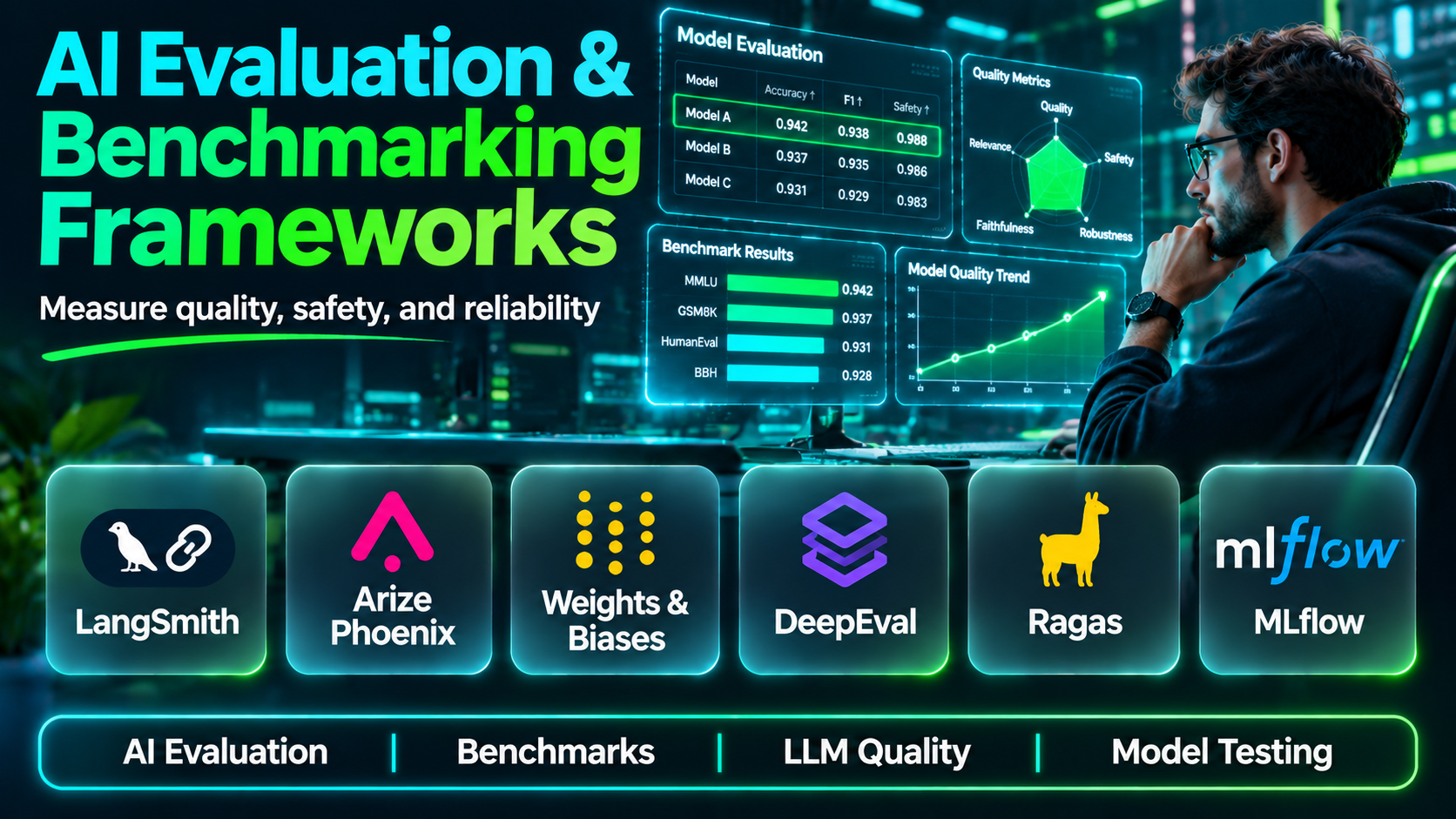
AI evaluation and benchmarking frameworks help teams measure model quality, compare configurations, identify regressions, and test behavior before production deployment.
Some platforms focus on language model evaluation. Others specialize in retrieval-augmented generation, automated test cases, human review, or standardized research benchmarks.
No single metric can capture every dimension of AI quality. Effective evaluation combines task-specific measurements, representative datasets, human judgment, and operational testing.
This guide compares ten AI evaluation frameworks and explains how to build a practical evaluation strategy.
What Are AI Evaluation & Benchmarking Frameworks?
AI evaluation frameworks are tools that measure how well models or AI applications perform against defined requirements.
Benchmarking frameworks typically compare models using standardized datasets, tasks, and scoring procedures.
Evaluation may measure correctness, relevance, factual grounding, instruction following, safety, latency, consistency, and cost.
Different approaches include:
- Exact-match scoring.
- Classification metrics.
- Semantic similarity.
- Model-based grading.
- Human evaluation.
- Retrieval relevance.
- Groundedness testing.
- Regression testing.
- Adversarial testing.
- Standardized model benchmarks.
A reliable evaluation process must account for the limitations of each method. Model-based graders can be inconsistent, public benchmarks can be contaminated, and human reviewers may disagree.
Top 10 AI Evaluation & Benchmarking Frameworks
1. DeepEval
Short Description
DeepEval is an open-source framework designed for evaluating LLM applications through automated tests and metrics.
It is particularly relevant to developers who want to integrate evaluation into familiar software testing workflows.
A team building a customer support assistant may create test cases containing user questions, expected behavior, and evaluation criteria.
DeepEval can help automate checks for selected quality dimensions and identify regressions after prompt or model changes.
Its testing-oriented approach makes it useful in continuous integration environments.
However, automated metrics should not be treated as perfect representations of user satisfaction or factual correctness.
Key Features
- LLM Evaluation Metrics: Supports selected quality measurements.
- Test Cases: Defines repeatable evaluation inputs.
- Automated Testing: Runs checks against application outputs.
- RAG Evaluation: Supports retrieval-related assessment.
- Regression Testing: Detects changes in application behavior.
- Model-Based Evaluation: Uses supported evaluator models.
- CI Integration: Fits software development testing workflows.
- Custom Metrics: Allows application-specific evaluation logic.
- Reporting: Helps developers inspect evaluation outcomes.
Benefits
DeepEval makes AI quality testing more repeatable and easier to integrate into development.
Pros
- Open-source.
- Testing-oriented.
- Useful RAG metrics.
- Custom evaluation support.
- Developer-friendly workflows.
Cons
- Automated graders have limitations.
- Evaluation calls may create costs.
- Test quality depends on datasets.
- Requires careful metric selection.
Use Cases
LLM regression testing, chatbot evaluation, RAG quality checks, and CI pipelines.
Best For: Developers building automated AI test suites.
2. Ragas
Short Description
Ragas is an evaluation framework particularly associated with retrieval-augmented generation and LLM application assessment.
It helps teams measure aspects of retrieval and response quality.
A company developing a document question-answering system may use Ragas to evaluate whether retrieved information is relevant and whether generated answers are supported by the available context.
This distinction matters because poor answers may originate from retrieval failures rather than the language model itself.
Ragas supports evaluation workflows that help identify such weaknesses.
However, metric definitions and evaluator behavior should be reviewed carefully, particularly when comparing results across versions.
Key Features
- RAG evaluation.
- Retrieval quality metrics.
- Response relevance assessment.
- Faithfulness-related evaluation.
- Dataset-based testing.
- LLM-based evaluators.
- Custom evaluation workflows.
- Experiment comparison.
- Framework integrations.
Benefits
Ragas helps teams distinguish retrieval problems from generation problems.
Pros
- Strong RAG focus.
- Useful evaluation metrics.
- Open-source.
- Customizable workflows.
- Supports iterative improvement.
Cons
- Evaluation quality varies by metric.
- Requires representative datasets.
- LLM grading can be inconsistent.
- Not a complete enterprise monitoring platform.
Use Cases
Document assistants, enterprise search, RAG optimization, and retrieval evaluation.
Best For: Teams developing retrieval-augmented AI applications.
3. promptfoo
Short Description
promptfoo is an open-source tool for evaluating prompts, models, and LLM application behavior.
It supports configuration-driven testing and comparisons across different prompt or model combinations.
A product team may use promptfoo to compare two prompts across a collection of customer questions.
The evaluation can reveal whether a new prompt improves instruction following while introducing failures elsewhere.
promptfoo is also associated with security-oriented and adversarial testing workflows.
Its flexibility makes it useful for developers who prefer repeatable configuration-based experiments.
Key Features
- Prompt evaluation.
- Model comparison.
- Test configuration.
- Automated assertions.
- Custom grading.
- Regression testing.
- Red-team testing capabilities.
- CI workflows.
- Result comparison.
Benefits
promptfoo helps teams compare AI configurations systematically rather than relying on informal manual testing.
Pros
- Open-source.
- Flexible test configuration.
- Model comparisons.
- Security testing orientation.
- CI integration.
Cons
- Requires test design.
- Configuration can become complex.
- Automated assertions need validation.
- Not every metric reflects real-world quality.
Use Cases
Prompt engineering, model comparison, regression testing, and AI security evaluation.
Best For: Developers running repeatable prompt and model experiments.
4. LangSmith
Short Description
LangSmith is an LLM application development and observability platform associated with the LangChain ecosystem.
It provides tracing, datasets, evaluation workflows, and tools for analyzing application behavior.
A team building an AI agent may use LangSmith to inspect execution traces and compare performance across versions.
Its integration with application traces is particularly valuable when an output depends on multiple model calls and tool interactions.
LangSmith can help connect evaluation results with the underlying execution steps.
However, organizations should assess data retention, platform integration, and subscription requirements.
Key Features
- Execution tracing.
- Evaluation datasets.
- Experiment management.
- Automated evaluators.
- Human feedback workflows.
- Application debugging.
- Regression analysis.
- Prompt-related workflows.
- LangChain ecosystem integration.
Benefits
LangSmith combines application observability with structured evaluation.
Pros
- Strong tracing.
- Evaluation and debugging together.
- Dataset management.
- Agent workflow visibility.
- Useful developer integrations.
Cons
- Commercial plan considerations.
- Platform dependency.
- Instrumentation effort.
- Evaluation design still requires expertise.
Use Cases
AI agent testing, LLM debugging, experiment comparison, and production evaluation.
Best For: Teams needing tracing and evaluation in one platform.
5. Arize Phoenix
Short Description
Arize Phoenix is an open-source observability and evaluation platform for AI applications.
It supports tracing and evaluation workflows that help developers understand model behavior.
A RAG application team may use Phoenix to examine retrieval steps, model responses, and selected quality metrics.
Its observability orientation helps connect evaluation failures with execution details.
Phoenix is particularly relevant to teams seeking open-source AI monitoring and analysis capabilities.
However, deploying a useful evaluation process still requires appropriate datasets, instrumentation, and interpretation.
Key Features
- AI tracing.
- LLM observability.
- Evaluation workflows.
- RAG analysis.
- Dataset inspection.
- Experiment analysis.
- OpenTelemetry integration.
- Open-source deployment.
- Application debugging.
Benefits
Phoenix helps teams investigate why AI applications produce particular results.
Pros
- Open-source.
- Strong observability.
- RAG relevance.
- Tracing integration.
- Useful debugging workflows.
Cons
- Requires instrumentation.
- Evaluation setup takes effort.
- Self-hosting considerations.
- Not a universal benchmark leaderboard.
Use Cases
RAG debugging, agent tracing, evaluation, and AI observability.
Best For: Developers combining evaluation with detailed tracing.
6. MLflow
Short Description
MLflow is an open-source platform for managing machine learning and AI development workflows.
Its evaluation and experiment tracking capabilities make it relevant to teams comparing model performance.
A machine learning team may use MLflow to record model versions, evaluation metrics, parameters, and experiment outcomes.
For generative AI applications, MLflow also provides capabilities related to tracing and evaluation in supported workflows.
Its broader lifecycle orientation distinguishes it from tools focused exclusively on prompt testing.
However, organizations may need additional task-specific evaluators or benchmarking datasets.
Key Features
- Experiment tracking.
- Evaluation metrics.
- Model management.
- Run comparison.
- Artifact tracking.
- Model versioning.
- AI tracing capabilities.
- Deployment ecosystem integration.
- Open-source workflows.
Benefits
MLflow connects model evaluation with broader experiment and lifecycle management.
Pros
- Open-source.
- Established ML workflows.
- Experiment tracking.
- Model management.
- Broad ecosystem.
Cons
- Configuration effort.
- Some evaluations need custom implementation.
- Platform complexity.
- Not exclusively LLM-focused.
Use Cases
ML model comparison, experiment management, and AI lifecycle evaluation.
Best For: Teams managing both traditional ML and generative AI.
7. OpenAI Evals
Short Description
OpenAI Evals is an open-source evaluation framework associated with testing language model behavior.
It provides patterns for constructing evaluation datasets and scoring model outputs.
A research team may use evaluation frameworks of this kind to test whether a model follows instructions or solves selected tasks.
Its importance lies in repeatable measurement rather than informal examples.
However, the framework’s current maintenance status and supported integrations should be verified before new adoption.
Teams should also distinguish the open-source Evals repository from evaluation features offered through other OpenAI products and APIs.
Key Features
- Evaluation definitions.
- Test datasets.
- Model output assessment.
- Custom evaluation logic.
- Repeatable test execution.
- Benchmark-oriented workflows.
- Model comparison.
- Research evaluation patterns.
- Open-source reference implementation.
Benefits
OpenAI Evals provides reusable concepts for structured language model evaluation.
Pros
- Open-source reference.
- Flexible evaluation patterns.
- Research relevance.
- Custom test design.
- Repeatability.
Cons
- Current maintenance should be checked.
- Setup may require development.
- Not a complete production observability suite.
- Evaluation quality depends on task design.
Use Cases
Language model experiments, custom benchmarks, and evaluation research.
Best For: Researchers building specialized model tests.
8. EleutherAI Language Model Evaluation Harness
Short Description
The Language Model Evaluation Harness, commonly called lm-evaluation-harness, is an open-source framework for benchmarking language models on standardized tasks.
It is widely relevant to researchers comparing model capabilities across datasets.
A model development team may use the harness to evaluate a new checkpoint against established benchmarks.
Its standardized task approach improves repeatability, although comparisons still depend on consistent settings.
Differences in prompt templates, few-shot examples, model precision, and evaluation versions can affect scores.
Key Features
- Standardized benchmark tasks.
- Language model evaluation.
- Dataset integration.
- Model backend support.
- Configurable evaluation settings.
- Reproducible workflows.
- Batch evaluation.
- Research benchmarking.
- Result reporting.
Benefits
The harness supports systematic comparison of language model performance.
Pros
- Open-source.
- Broad research use.
- Standardized tasks.
- Reproducible configurations.
- Useful model comparison.
Cons
- Public benchmarks have limitations.
- Results depend on configuration.
- Not a complete application evaluator.
- Dataset contamination is possible.
Use Cases
Model research, checkpoint comparison, and standardized benchmarking.
Best For: Researchers evaluating foundation models.
9. HELM
Short Description
Holistic Evaluation of Language Models, or HELM, is a benchmarking initiative and framework associated with Stanford’s Center for Research on Foundation Models.
Its approach emphasizes evaluating language models across multiple dimensions rather than relying on one accuracy score.
A research organization may use HELM methodologies to understand how models compare across selected tasks and evaluation criteria.
This broader perspective is useful because models may differ in accuracy, robustness, efficiency, or other important characteristics.
However, benchmark coverage and published results should be interpreted in relation to their specific evaluation settings.
Key Features
- Multi-dimensional evaluation.
- Benchmark scenarios.
- Standardized measurements.
- Model comparison.
- Research methodology.
- Evaluation reporting.
- Reproducibility focus.
- Multiple assessment dimensions.
- Foundation model analysis.
Benefits
HELM encourages broader and more transparent model evaluation.
Pros
- Research-oriented.
- Multi-dimensional perspective.
- Structured methodology.
- Useful comparative analysis.
- Transparency emphasis.
Cons
- Research complexity.
- Not a turnkey application testing service.
- Benchmark scope limitations.
- Implementation effort.
Use Cases
Foundation model research, comparative evaluation, and benchmark methodology.
Best For: Research teams seeking holistic model assessment.
10. Inspect AI
Short Description
Inspect AI is an open-source framework for evaluating language models, developed within the UK AI Security Institute ecosystem.
It supports structured evaluation tasks, datasets, scoring, and agent-oriented workflows.
A safety research team may use Inspect AI to test model behavior under controlled conditions.
Its framework approach is particularly relevant to evaluations involving tools, multi-step interactions, or specialized scoring procedures.
However, designing meaningful tests requires expertise in evaluation methodology and the target risk or capability being measured.
Key Features
- Evaluation tasks.
- Dataset management.
- Scoring.
- Model integration.
- Agent evaluation.
- Tool-use testing.
- Experiment configuration.
- Evaluation logs.
- Open-source development.
Benefits
Inspect AI supports structured and reproducible evaluation of language model behavior.
Pros
- Open-source.
- Flexible task definitions.
- Agent evaluation support.
- Research-oriented.
- Structured logging.
Cons
- Learning curve.
- Requires evaluation expertise.
- Not a complete commercial monitoring platform.
- Custom tests require development.
Use Cases
AI safety evaluation, agent testing, and model capability research.
Best For: Research and safety teams developing structured evaluations.
AI Evaluation & Benchmarking Frameworks Comparison Table
| Framework | Main Strength | Best For | Limitation |
|---|---|---|---|
| DeepEval | Automated LLM tests | Developers | Grader reliability |
| Ragas | RAG evaluation | Retrieval teams | Metric interpretation |
| promptfoo | Prompt comparison | Prompt engineers | Test configuration |
| LangSmith | Tracing and evaluation | AI application teams | Platform costs |
| Arize Phoenix | Open-source observability | RAG developers | Instrumentation |
| MLflow | Experiment management | ML teams | Setup complexity |
| OpenAI Evals | Custom evaluation patterns | Researchers | Maintenance verification |
| LM Evaluation Harness | Standard benchmarks | Model researchers | Benchmark limitations |
| HELM | Holistic assessment | Research organizations | Research complexity |
| Inspect AI | Structured model evaluation | Safety teams | Technical learning curve |
How to Choose the Right AI Evaluation Framework
1. Define the Evaluation Objective
Decide whether you are testing a foundation model, chatbot, RAG system, or autonomous agent.
2. Choose Representative Data
Evaluation datasets should reflect actual users and production tasks.
3. Select Meaningful Metrics
Use measurements aligned with correctness, relevance, safety, or business requirements.
4. Include Human Review
Automated scoring should be validated against expert judgment.
5. Test Failure Cases
Include ambiguous questions, missing information, and difficult inputs.
6. Control Experimental Variables
Keep prompts, model versions, settings, and datasets consistent.
7. Measure Operational Performance
Quality alone is insufficient; latency and cost also matter.
8. Track Regressions
Compare new configurations against established baselines.
9. Review Security
Protect sensitive evaluation data and restrict access appropriately.
10. Maintain Evaluation Datasets
Update tests when applications, user needs, and model capabilities change.
Best AI Evaluation Framework by User Type
| User Type | Recommended Framework | Reason |
|---|---|---|
| LLM application developer | DeepEval | Automated testing |
| RAG engineer | Ragas | Retrieval metrics |
| Prompt engineer | promptfoo | Configuration comparisons |
| AI agent developer | LangSmith | Trace-based evaluation |
| Observability-focused team | Arize Phoenix | Tracing and debugging |
| ML platform engineer | MLflow | Experiment tracking |
| Custom benchmark researcher | OpenAI Evals | Evaluation patterns |
| Foundation model researcher | LM Evaluation Harness | Standardized tasks |
| Academic research team | HELM | Multi-dimensional methodology |
| AI safety evaluator | Inspect AI | Structured safety testing |
Practical Example: Evaluating a Document Question-Answering Assistant
Step 1: Collect representative user questions.
Step 2: Identify trustworthy reference documents.
Step 3: Create expected answers or grading criteria.
Step 4: Establish a baseline model and retrieval configuration.
Step 5: Measure retrieval relevance.
Step 6: Evaluate whether answers are supported by retrieved content.
Step 7: Test questions with missing or contradictory evidence.
Step 8: Add human review for difficult examples.
Step 9: Measure latency and inference cost.
Step 10: Compare alternative prompts and models.
Step 11: Record results and identify regressions.
Step 12: Repeat evaluation before major production changes.
Frequently Asked Questions
1. What is AI evaluation?
The process of measuring how well an AI system meets defined requirements.
2. What is AI benchmarking?
Comparing systems using standardized tasks and measurements.
3. What is a benchmark dataset?
A collection of examples used for evaluation.
4. What is an evaluation metric?
A measurement used to assess a particular aspect of performance.
5. What is exact-match accuracy?
The proportion of outputs matching expected answers exactly.
6. Is exact-match suitable for every LLM task?
No. Many valid answers can use different wording.
7. What is an LLM judge?
A language model used to assess another model’s output.
8. Are LLM judges always reliable?
No. They can exhibit bias and inconsistency.
9. What is groundedness?
The degree to which an answer is supported by available evidence.
10. What is faithfulness in RAG evaluation?
Whether generated claims align with the provided context.
11. What is retrieval relevance?
How closely retrieved information matches the user’s information need.
12. What is regression testing?
Checking whether a change reduces previously established performance.
13. What is human evaluation?
Assessment performed by people using defined criteria.
14. Why do human reviewers disagree?
Judgment can vary because of ambiguity and differing interpretations.
15. What is inter-rater agreement?
A measure of consistency among evaluators.
16. What is benchmark contamination?
When evaluation material overlaps with information encountered during model training.
17. Can benchmark contamination distort results?
Yes.
18. What is adversarial evaluation?
Testing systems using deliberately challenging or manipulative inputs.
19. What is red teaming?
Structured testing intended to discover weaknesses or unsafe behavior.
20. Can evaluation be automated?
Many parts can be automated.
21. Should evaluation run in CI pipelines?
It is useful when tests are sufficiently reliable and efficient.
22. What is a baseline model?
A reference system used for comparison.
23. What is an evaluation threshold?
A defined performance level required to pass a test.
24. Do higher benchmark scores guarantee better products?
No.
25. Can AI agents be evaluated?
Yes, including tool use and multi-step behavior.
26. What is task success rate?
The proportion of tasks completed according to defined criteria.
27. Why evaluate latency?
Slow responses can reduce application usefulness.
28. Why include inference cost?
Model quality must be balanced against operational expense.
29. How often should evaluations be updated?
Whenever requirements, models, prompts, or user behavior change significantly.
30. Which AI evaluation framework is best?
The best choice depends on application type, evaluation methodology, and workflow integration.
Final Thoughts
Reliable AI evaluation requires a combination of representative datasets, meaningful metrics, human judgment, and repeatable testing.
DeepEval, Ragas, and promptfoo support application-oriented evaluation. LangSmith and Phoenix connect quality assessment with observability.
MLflow helps manage broader experiments, while the Language Model Evaluation Harness, HELM, OpenAI Evals, and Inspect AI provide different research-oriented approaches.
The strongest evaluation system measures what matters to actual users rather than relying exclusively on public benchmark scores.
