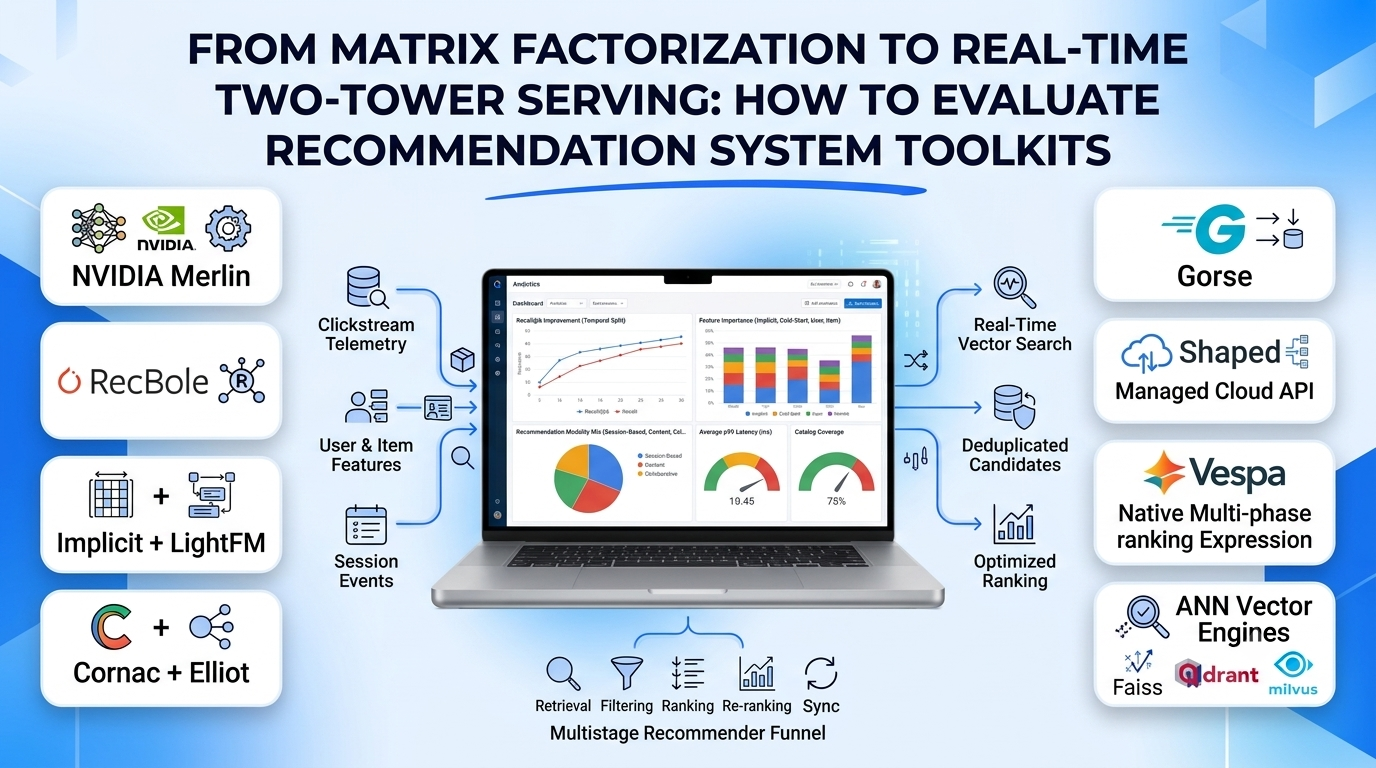
Building a recommendation engine that predicts top-10 items in an offline Jupyter notebook is straightforward; serving personalized, fresh recommendations to millions of users in under 50 milliseconds—while handling cold-start items, filtering out-of-stock inventory, and avoiding popularity echo chambers—is a multi-stage systems engineering problem.
Modern production recommenders rarely rely on a single monolithic model. Instead, they operate as a multi-stage funnel: Candidate Generation (Retrieval) narrows millions of items down to a few hundred using two-tower neural networks or Approximate Nearest Neighbor (ANN) vector indexes, Filtering enforces business rules and inventory constraints, Scoring/Ranking predicts click-through or conversion probability using deep interaction models, and Re-ranking optimizes list diversity and novelty. Evaluating recommendation system toolkits requires distinguishing lightweight collaborative filtering libraries, deep learning research benchmarking suites, GPU-accelerated enterprise frameworks, and real-time serving engines.
Five Core Capabilities of Production Recommendation Toolkits
When evaluating toolkits for e-commerce, media streaming, job marketplaces, or content feeds, look beyond offline RMSE scores to inspect five practical capabilities:
- Implicit vs. Explicit Feedback Support: Real users rarely rate items on a 1–5 star scale; systems must learn primarily from implicit signals—clicks, watch time, skips, cart additions, and purchases—with proper negative sampling.
- Cold-Start Handling via Hybrid Side-Information: Pure collaborative filtering fails completely on newly published videos or newly listed products with zero interaction history. Production toolkits incorporate content features (text descriptions, categories, visual embeddings, user demographics) alongside interaction matrices.
- Sequential and Session-Based Modeling: User intent shifts rapidly within a single browsing session. Modern toolkits support sequential architectures (such as SASRec, GRU4Rec, or Transformers4Rec) that model ordered event sequences rather than static bag-of-items histories.
- GPU Acceleration and Scalable Data Loaders: Training deep tabular and embedding models over hundreds of millions of interaction rows chokes standard Pandas/PyTorch data loaders. Enterprise toolkits optimize Parquet ingestion, categorical hashing, and multi-GPU embedding tables.
- Two-Tower Retrieval and Real-Time Feature Serving Compatibility: Clean export of user and item tower embeddings into vector indexes (Faiss, Milvus, Qdrant, Vespa) alongside sub-50ms online feature stores for real-time ranking.
Leading Recommendation System Toolkits
NVIDIA Merlin (and HugeCTR / Transformers4Rec)
NVIDIA Merlin is an end-to-end, GPU-accelerated framework purpose-built for large-scale production recommender systems. Spanning the entire pipeline—NVTabular for high-speed GPU feature engineering and categorical encoding, Merlin Models for two-tower retrieval and deep ranking architectures (DLRM, DCN-v2), Transformers4Rec for sequential session-based recommendations, and Merlin Systems for low-latency Triton Inference Server deployment—it eliminates CPU preprocessing bottlenecks on massive clickstream datasets.
High-traffic e-commerce, advertising, and media enterprises training deep recommendation models on hundreds of millions of daily events gain major throughput and serving efficiency from Merlin. Smaller teams without GPU clusters or massive interaction logs will find its infrastructure footprint heavier than necessary.
RecBole
RecBole is the most comprehensive open-source Python benchmarking and research toolkit for recommender systems, built on PyTorch. Implementing over 90 standardized recommendation algorithms—spanning general collaborative filtering, sequential models (SASRec, BERT4Rec), context-aware CTR models (DeepFM, DCN), and knowledge-graph-based recommenders—under unified data loaders and evaluation protocols (Recall@k, NDCG@k, MRR), RecBole allows ML teams to benchmark competing model families fairly before committing to production engineering.
Data science teams evaluating which algorithmic paradigm best fits their interaction sparsity and sequence structure use RecBole as an experimental workbench. Because it is designed primarily for reproducible offline experimentation rather than distributed real-time serving, winning architectures are typically re-implemented or exported for production deployment.
Implicit and LightFM (Lightweight Python Baselines)
Not every recommendation problem requires deep neural networks. Two classic open-source Python libraries remain indispensable for fast, CPU-friendly baselines and mid-scale production systems:
- Implicit provides ultra-fast Cython/CUDA implementations of Alternating Least Squares (ALS), Bayesian Personalized Ranking (BPR), and item-item nearest neighbors tailored specifically for large sparse implicit-feedback matrices.
- LightFM combines collaborative and content-based filtering into a hybrid matrix-factorization model—allowing teams to incorporate user and item metadata features directly into factor embeddings so new cold-start items receive accurate recommendations immediately.
Cornac and Elliot
For academic and applied researchers focused on multimodal recommendation (incorporating text, images, and social graphs) or beyond-accuracy metrics (catalog coverage, novelty, serendipity, and provider fairness), Cornac (by Preferred.AI) and Elliot provide structured experimentation pipelines with rich multi-objective evaluation suites.
Real-Time Recommender Serving & Vector Engines (Gorse, Shaped, Vespa, Qdrant)
Training embeddings is only half the architecture; teams also need an engine to serve candidates in real time:
- Gorse is an open-source, Go-based standalone recommender system engine that ingests items, users, and feedback via REST APIs, runs automated background collaborative/hybrid model training, and serves low-latency recommendations out of the box.
- Shaped provides a managed AI ranking and recommendation API that connects directly to cloud data warehouses (Snowflake, BigQuery, Redshift) and streaming events to train and serve real-time personalized feeds without managing ML infrastructure.
- Vespa and Qdrant serve as high-throughput real-time retrieval and multi-phase ranking backbones when teams deploy custom two-tower neural embeddings in production.
Recommendation System Toolkits Comparison
| Toolkit / Engine | Primary Architectural Role | Supported Model Families | Cold-Start & Side Features | Scale & Serving Readiness | Best Fit |
| NVIDIA Merlin | End-to-end GPU recommender & serving suite | Two-tower, DLRM, DCN-v2, Transformers4Rec | Strong (NVTabular feature pipelines + categorical hashes) | Enterprise scale (Triton Inference Server + multi-GPU) | High-traffic enterprises scaling deep recommenders on GPUs |
| RecBole | Comprehensive PyTorch research & benchmarking library | 90+ models (CF, sequential, CTR, knowledge-graph) | Supported across context-aware & KG model families | Offline experimentation & standardized evaluation | ML teams benchmarking model families before production build |
| Implicit / LightFM | Fast CPU/GPU sparse matrix factorization libraries | ALS, BPR, item-item KNN (Implicit); Hybrid MF (LightFM) | Strong in LightFM via user/item metadata features | Fast training & exportable embeddings for mid-scale apps | Teams needing fast, interpretable, production-ready baselines |
| Cornac | Multimodal & multi-objective recommender framework | Collaborative, visual/text multimodal & neural models | Built-in image, text & graph modality fusion | Offline experimentation with diversity/fairness metrics | Teams working with rich multimodal item content & diversity goals |
| Gorse | Turnkey open-source recommender engine | Collaborative filtering, factorization machines & HNSW | Supports item labels & user features out of the box | Built-in REST API serving & Redis/ClickHouse storage | Engineering teams wanting an all-in-one self-hosted engine |
| Shaped / Vespa | Managed SaaS recommender (Shaped) / Serving engine (Vespa) | Two-tower, sequential transformers & tensor rankers | Real-time behavioral & contextual feature streams | Sub-50ms production APIs at massive scale | Teams prioritizing turnkey SaaS (Shaped) or custom serving (Vespa) |
Common Recommendation Engineering Pitfalls
- Optimizing Offline AUC While Hurting Online Diversity: A model trained purely on historical clicks quickly learns to recommend only the top 1% most popular items—maximizing offline click prediction while boring users with repetitive feeds. Always measure catalog coverage, intra-list diversity, and novelty alongside NDCG.
- Data Leakage Through Random Train/Test Splits: Splitting interaction logs randomly instead of chronologically allows the model to “predict” a user’s Monday purchase using signals from Wednesday. Always evaluate recommendation models using strict temporal (out-of-time) splits.
- Forgetting Business Rules and Real-Time Suppression: Showing a user an item they purchased ten minutes ago—or an item that just went out of stock—destroys trust immediately. Pair model scoring with a fast real-time filtering layer backed by Redis or an online feature store.
Selecting the Right Recommendation System Toolkit
Start simple and add architectural complexity only when offline and online A/B metrics justify it:
- For Your First Production Recommender (Fast Time-to-Value): Start with Implicit (for pure behavioral data), LightFM (when item metadata is needed for cold start), or Gorse if you want a self-contained open-source REST service.
- For Systematic Algorithm Exploration: Use RecBole (or Cornac for multimodal data) to benchmark sequential vs. matrix-factorization vs. CTR models under strict temporal splits.
- For Enterprise-Scale Real-Time Personalization: Standardize on NVIDIA Merlin paired with Triton Inference Server and a vector/ranking engine like Vespa—or adopt Shaped if you want managed warehouse-native personalization without dedicated ML infra teams.
