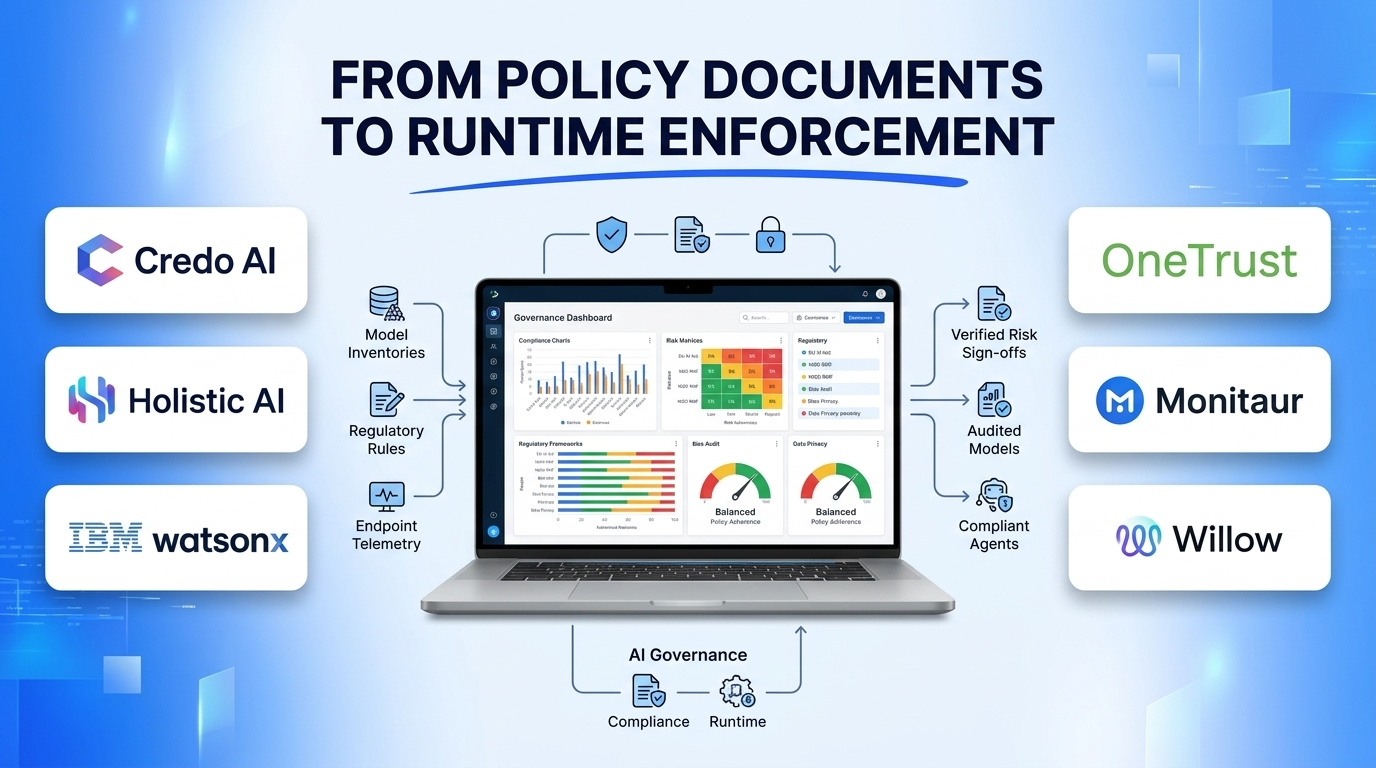
Most enterprise AI initiatives stall not because models lack intelligence, but because legal, risk, and security teams have no centralized system to answer basic audit questions: Which AI models and autonomous agents are running in production? What customer data do they touch? Which regulatory obligations apply across jurisdictions? And what stops an employee from connecting an unapproved agent to live corporate systems?
When buyers search for “AI governance and policy tools,” they encounter two fundamentally different product categories that solve different halves of the problem. Model & System Governance platforms act as the system of record for AI systems your organization builds or procures—managing risk assessments, regulatory mapping, bias audits, and compliance evidence. AI Usage & Agent Access Governance tools enforce real-time policy at the network, endpoint, or MCP gateway layer—controlling what employees and autonomous agents actually do in live traffic.
Five Core Capabilities of Enterprise AI Governance Platforms
Evaluating an AI governance platform requires looking past static policy templates to inspect automated discovery, regulatory mapping, and continuous evidence collection:
- Automated AI & Agent Inventory Discovery: Relying solely on manual intake questionnaires leaves shadow AI models, third-party SaaS AI features, and developer-deployed agents undocumented. Effective platforms combine structured intake workflows with cloud/API scanning (AWS Bedrock, Azure AI, Vertex AI, Hugging Face) and endpoint/gateway telemetry to maintain a live registry of models and agents.
- Multi-Jurisdictional Regulatory & Framework Mapping: Mapping a single AI use case once against overlapping frameworks—such as the EU AI Act, NIST AI Risk Management Framework (AI RMF), ISO/IEC 42001, HIPAA, and financial model-risk rules (SR 11-7)—so teams reuse compliance evidence instead of duplicating spreadsheets across audits.
- Pre-Deployment Gateways and Technical Risk Evidence: Integrating automated fairness, bias, hallucination, and adversarial robustness test results directly into release approval gates—blocking promotion to production until required risk sign-offs are recorded.
- Agent Identity and Runtime Policy Enforcement: As organizations deploy autonomous agents and MCP servers, governance must extend beyond static models to cover agentic identity, least-privilege tool scoping, and inline policy enforcement across live agent actions.
- Continuous Post-Deployment Drift and Incident Monitoring: Tracking live production telemetry for data drift, demographic bias shifts, policy violations, and audit-ready reporting packs for internal boards and external regulators.
Leading AI Governance & Policy Platforms
Credo AI
Credo AI is a dedicated enterprise AI governance platform built as a centralized system of record for models, generative AI applications, and autonomous agents. Through its Policy Packs (covering ISO 42001, EU AI Act, and NIST AI RMF), structured use-case intake workflows, Agent Registry with dependency graphs, and automated governance assistant, Credo AI translates technical evaluation artifacts from engineering tools into board- and regulator-ready compliance documentation.
Enterprises scaling cross-functional governance across legal, risk, and engineering teams—where clear approval workflows and executive regulatory reporting are the primary bottleneck—favor Credo AI.
Holistic AI
Holistic AI combines enterprise governance workflows with deep in-house technical auditing capabilities. Alongside AI inventory management and regulatory compliance mapping, it executes over 40 specialized technical risk tests covering algorithmic bias, fairness, toxicity, hallucination, prompt injection, and jailbreak resistance—supporting both pre-deployment validation and real-time oversight.
Organizations in regulated sectors such as hiring, lending, insurance, and healthcare—where regulators or enterprise customers demand rigorous, documented statistical bias and safety audits—gravitate toward Holistic AI.
IBM watsonx.governance
IBM watsonx.governance provides broad regulatory coverage and end-to-end model lifecycle governance across multi-cloud and hybrid environments. Supporting models built on IBM, AWS, Azure, Google Cloud, or open-source stacks, it tracks lineage, automates compliance mapping across more than 200 regulatory frameworks, monitors drift and fairness metrics, and generates audit-ready factsheets.
Large multinational enterprises with complex hybrid cloud infrastructure and strict multi-jurisdictional audit requirements benefit from IBM’s regulatory breadth, though on-premises deployments via Cloud Pak for Data require substantial infrastructure planning.
OneTrust AI Governance
OneTrust extends its established Governance, Risk, and Compliance (GRC) and privacy platform into AI governance. By embedding AI model and use-case inventories directly into the same data model used for privacy impact assessments (PIAs), data governance, and third-party vendor risk, OneTrust allows risk teams to trace how personal data flows into training datasets and third-party AI vendors.
Enterprises already standardized on OneTrust for privacy and GRC gain the lowest-friction path to unified risk reporting, whereas leaner teams without a dedicated GRC function may find the broader suite heavy to administer.
Monitaur
Monitaur specializes in auditable, full-lifecycle model governance tailored specifically to heavily regulated industries such as insurance, financial services, and healthcare. Focusing on policy templates, pre-deployment simulation grading, and continuous production validation for drift and bias, Monitaur emphasizes transparent, regulator-defensible audit trails.
Runtime Usage & Agentic Access Governance (Willow, dope.security, Zscaler / Netskope)
Because traditional GRC registries do not sit inline on employee laptops or agent tool calls, many enterprises pair their system-of-record governance platform with runtime enforcement tools:
- Willow focuses specifically on agentic access and shadow-AI discovery—using lightweight endpoint sensors to detect unauthorized local API keys or rogue MCP servers on employee machines while enforcing identity-bound policies over what production systems agents can reach.
- dope.security, Zscaler, and Netskope govern employee AI usage at the browser and endpoint layer—discovering unsanctioned SaaS AI tools, blocking personal consumer logins, and preventing customer PII uploads via inline Data Loss Prevention (DLP).
AI Governance & Policy Platforms Comparison
| Platform | Primary Governance Focus | Regulatory & Framework Coverage | Technical Testing & Runtime Enforcement | Deployment Model | Best Fit |
| Credo AI | System-of-record AI & agent governance workflow | Strong (ISO 42001, EU AI Act, NIST AI RMF) | Integrates external evals + Agent Registry | Enterprise Cloud SaaS | Enterprises aligning legal, risk & engineering on AI compliance |
| Holistic AI | Technical AI risk auditing & governance | EU AI Act, NIST, NYC Local Law 144 & global standards | 40+ native bias, fairness, safety & adversarial tests | Enterprise Cloud SaaS | Regulated hiring, finance & healthcare teams needing deep audits |
| IBM watsonx.governance | Multi-cloud enterprise model & AI lifecycle governance | 200+ global regulatory frameworks & factsheets | Automated drift, quality & fairness monitoring | IBM Cloud, AWS & on-prem (Cloud Pak for Data) | Large regulated enterprises with hybrid cloud estates |
| OneTrust AI Governance | Unified GRC, privacy & third-party AI vendor risk | Integrated with OneTrust privacy & global compliance packs | Intake workflows, data lineage & vendor risk assessments | Enterprise Cloud SaaS | Organizations already running OneTrust for privacy & GRC |
| Monitaur | Regulated industry model governance & audit trails | Financial, insurance & healthcare model-risk standards | Pre-release simulation grading & live drift/bias validation | Enterprise Cloud / Private deployment | Insurance, banking & healthcare actuarial/ML teams |
| Willow / dope.security | Runtime agentic identity & employee AI usage DLP | Enforces corporate acceptable-use & data-boundary policies | Endpoint discovery, personal account blocking & PII DLP | Endpoint agent / SaaS control plane | Security/IT teams stopping shadow AI & governing live agent access |
Common AI Governance Implementation Mistakes
- Buying a Registry When You Need Runtime Enforcement (or Vice Versa): A governance registry documents whether an internal model passed its EU AI Act risk assessment, but it will not stop an employee from pasting source code into a personal ChatGPT tab or running an unvetted MCP server locally. Most mature organizations combine a system-of-record governance platform with endpoint/gateway enforcement.
- Treating Governance as a One-Time Pre-Launch Checklist: Prompts, foundation model snapshots, and RAG knowledge bases change weekly. Governance controls must ingest continuous evaluation and drift telemetry from production observability tools rather than relying on static launch-day PDFs.
- Over-Governing Low-Risk Internal Productivity Tools: Applying the same multi-committee sign-off workflow to an internal meeting summarizer and a customer-facing credit underwriting agent creates bureaucratic bottlenecks that drive engineers toward shadow AI. Implement tiered risk classification from day one.
Selecting the Right AI Governance & Policy Tool
Anchor your selection on where your immediate compliance and operational exposure lives:
- If You Already Use OneTrust for Privacy and Vendor Risk: Extend OneTrust AI Governance so AI inventories share your existing data and vendor risk taxonomy.
- If You Need Cross-Functional Regulatory Workflows and ISO 42001 / EU AI Act Readiness: Evaluate Credo AI for business-wide governance orchestration or IBM watsonx.governance for multi-cloud regulatory coverage.
- If Statistical Bias Audits and Adversarial Safety Testing Are Mandatory: Choose Holistic AI (or Monitaur in financial/insurance environments) for built-in technical risk testing.
- If Your Urgent Risk Is Shadow AI and Uncontrolled Employee Agents: Deploy runtime endpoint and agentic access governance such as Willow or dope.security alongside your governance registry.
