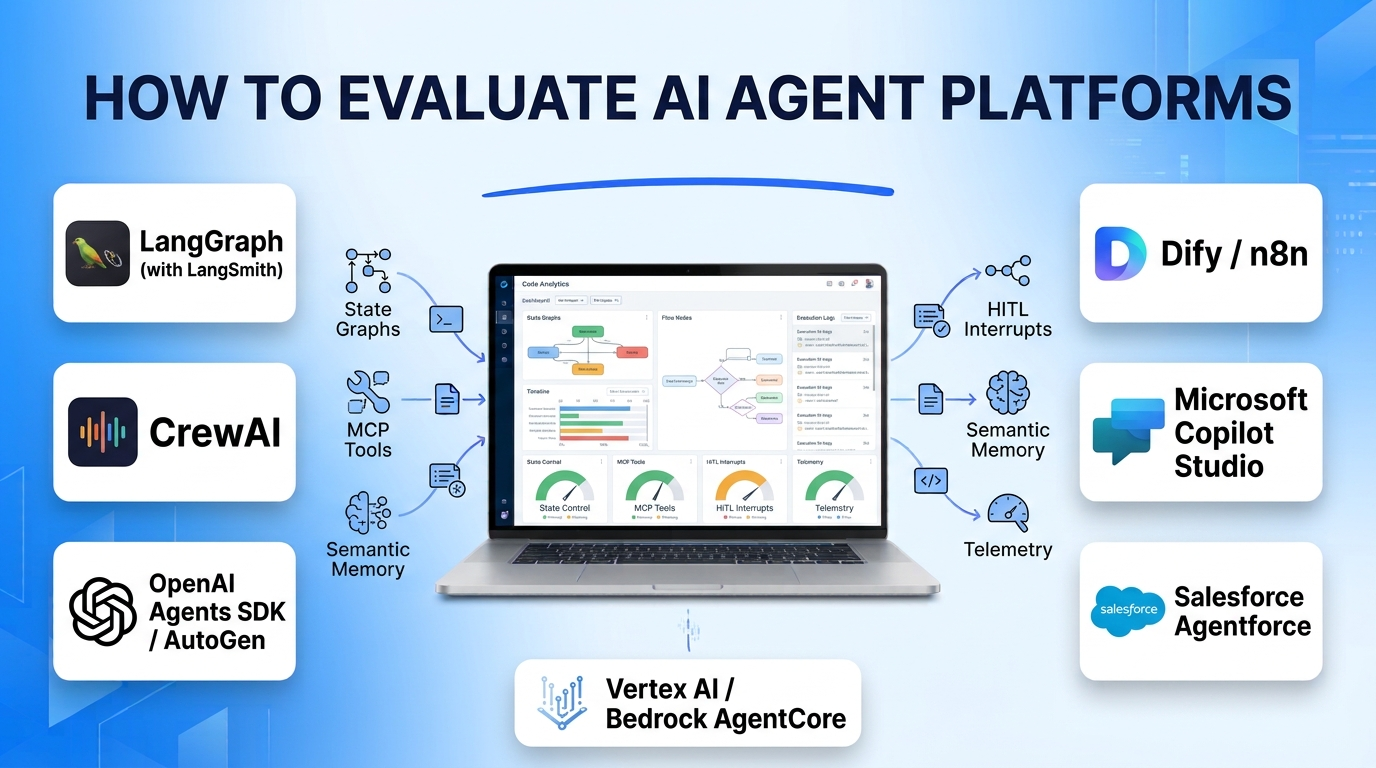
Connecting an LLM to a prompt template is easy; deploying an autonomous AI agent that queries internal databases, calls third-party APIs, recovers from tool failures, respects role-based permissions, and pauses for human approval before issuing a refund is an infrastructure engineering challenge.
As organizations move from single-turn chatbots to multi-step autonomous workflows, the market has fractured into three distinct layers: code-first agent orchestration frameworks for software engineers, visual low-code workflow builders for operations teams, and enterprise SaaS agent suites embedded directly into CRM and workplace platforms.
Five Core Capabilities of Production Agent Platforms
Evaluating an AI agent platform requires looking past conversational demos to inspect runtime reliability and governance:
- Deterministic State Management and Control Flow: Purely autonomous loops can spin indefinitely or drift off-task. Production frameworks provide explicit state graphs, conditional branching, retry policies, and durable execution checkpoints that survive server restarts.
- Standardized Tool and Protocol Interoperability: Native support for function calling, OpenAPI schemas, and the Model Context Protocol (MCP)—allowing agents to discover and invoke external tools, databases, and enterprise apps without brittle custom glue code.
- Human-in-the-Loop (HITL) Interrupts: The ability to pause execution mid-workflow, serialize agent state, surface a proposed action (such as sending an external email or modifying a financial record) to a human reviewer, and resume cleanly upon approval.
- Memory Architecture: Separating short-term thread state from persistent cross-session semantic memory (user preferences, resolved facts, organizational knowledge) with strict tenant isolation.
- Observability, Tracing, and Evaluation: Granular span-level telemetry showing every LLM call, token count, latency spike, retrieved document chunk, and tool payload—paired with regression evaluation datasets to catch prompt or model regressions before deployment.
Leading AI Agent Platforms Across Architectural Tiers
LangGraph (and LangSmith)
LangGraph is an open-source, code-first orchestration framework (available in Python and TypeScript) designed for developers who need deterministic control over complex, cyclical agent workflows. Modeling agent execution as a directed graph of nodes and edges with shared typed state, LangGraph natively supports streaming, multi-agent supervisor hierarchies, fault-tolerant checkpointing, and human-in-the-loop interrupts. Paired with LangSmith for tracing, evaluation, and managed cloud deployment, it has become a standard backbone for custom production agent backends.
Engineering teams building customer-facing or mission-critical agents where predictable state transitions and deep observability matter most favor LangGraph. Its trade-off is a steeper upfront engineering investment compared to visual drag-and-drop builders.
CrewAI
CrewAI focuses on intuitive multi-agent collaboration modeled around organizational roles. Developers define specialized agents with distinct roles, goals, backstories, and tools, then orchestrate them sequentially or hierarchically under a manager agent. Supporting MCP servers, CrewAI Flows for deterministic event-driven routing, and both an open-source Python framework and a managed enterprise control plane, it bridges rapid prototyping and structured execution.
Teams decomposing research, content synthesis, or operational triage into specialized sub-agents appreciate CrewAI’s clear mental model. Highly intricate stateful branching can still require dropping down into explicit flow logic.
OpenAI Agents SDK and Microsoft AutoGen
For developers seeking lightweight, minimal-abstraction SDKs, two major ecosystems stand out:
- OpenAI Agents SDK provides a streamlined Python and TypeScript primitives layer built around Agents, Handoffs (delegating control between specialized agents), Guardrails (parallel input/output validation checks), and built-in tracing—while remaining compatible with over 100 non-OpenAI models via standard interfaces.
- Microsoft AutoGen (and the unified Microsoft Agent Framework) specializes in asynchronous, event-driven multi-agent conversations, excelling in code-execution sandboxes, automated data analysis, and collaborative problem-solving across distributed agents.
Dify and n8n (Open-Source Visual & Hybrid Orchestrators)
Organizations that want visual workflow design without sacrificing self-hosting control frequently choose between Dify and n8n:
- Dify is an open-source LLM app and agent development platform combining visual workflow orchestration, built-in RAG (Retrieval-Augmented Generation) pipelines, prompt management, model routing, and API publishing.
- n8n extends its source-available node-based workflow automation engine with native AI agent nodes, memory stores, MCP tool triggers, and over 400 deterministic SaaS integrations—ideal when an AI agent needs to sit inside a broader webhook and ETL pipeline.
Microsoft Copilot Studio and Salesforce Agentforce
Enterprise organizations prioritizing out-of-the-box identity governance, compliance, and native CRM/workplace data access often adopt platform-native agent suites:
- Microsoft Copilot Studio enables IT and business builders to create agents grounded in Microsoft Graph, SharePoint, and Dynamics 365, inheriting existing Entra ID permissions and publishing directly into Microsoft Teams.
- Salesforce Agentforce embeds autonomous service and sales agents directly inside Salesforce Customer 360, leveraging Data Cloud context and the Atlas Reasoning Engine to resolve customer inquiries, qualify leads, and trigger Salesforce Flows under strict guardrails.
Google Vertex AI Agent Builder and Amazon Bedrock AgentCore
Cloud-native engineering teams running on GCP or AWS gain managed infrastructure primitives through Vertex AI Agent Builder (integrating Google’s Agent Development Kit, grounding in enterprise search/BigQuery, and Agent2Agent interoperability) and Amazon Bedrock AgentCore (providing serverless runtime isolation, persistent memory, identity brokering, and observability for custom agents deployed on AWS).
AI Agent Platforms Comparison
| Platform | Primary Abstraction | Target Builder | Hosting & Licensing | Key Differentiator | Primary Limitation |
| LangGraph | Stateful directed graphs & checkpoints | Backend & AI engineers (Python/TS) | Open-source (MIT) + LangSmith SaaS/Self-hosted | Granular state control, HITL interrupts & deep tracing | Requires software engineering expertise |
| CrewAI | Role-based multi-agent crews & Flows | Python developers & hybrid teams | Open-source (MIT) + Enterprise cloud | Fast role-oriented multi-agent delegation + MCP | Complex branching requires Flow state tuning |
| OpenAI Agents SDK | Lightweight agents, handoffs & guardrails | Developers wanting minimal overhead | Open-source SDK (model-agnostic) | Built-in parallel guardrails & simple handoff primitives | Fewer batteries-included visual/RAG tools |
| Dify / n8n | Visual canvas + RAG / 400+ app connectors | Technical ops & full-stack builders | Source-available self-hosted + Cloud SaaS | Rapid visual prototyping with self-hosted data control | Less suited for bespoke low-level state algorithms |
| Microsoft Copilot Studio | Low-code topics, actions & Graph grounding | Enterprise IT & M365 business teams | Managed Microsoft SaaS | Inherits SharePoint/Entra ID permissions natively | Tightly coupled to Microsoft 365 ecosystem |
| Salesforce Agentforce | CRM-grounded reasoning & Flow actions | Salesforce admins & RevOps teams | Managed Salesforce SaaS | Direct access to CRM records, Data Cloud & service channels | High conversation/credit cost outside CRM use cases |
| Vertex AI / Bedrock AgentCore | Managed cloud agent runtimes & SDKs | Cloud platform & enterprise ML teams | Managed GCP / AWS infrastructure | Enterprise IAM, VPC isolation & cloud-native grounding | Cloud vendor lock-in |
Operational Risks and Hidden Cost Drivers
Before moving an AI agent from pilot to production traffic, engineering and procurement teams must account for three common failure modes:
- Recursive Loop Token Spikes: Unlike a single chatbot prompt, an autonomous agent caught in a tool-error retry loop can execute 20 LLM calls in ten seconds. Always enforce hard recursion limits, per-run token budgets, and circuit breakers.
- Permission Escalation (The “Confused Deputy” Problem): If an agent connects to internal wikis or databases using a shared service account rather than delegated user OAuth tokens, a user can ask the agent to summarize restricted HR or financial records they lack permission to view.
- Evaluation Drift Across Model Updates: Upgrading an underlying foundation model can subtly alter how reliably an agent formats tool arguments. Maintain an automated evaluation suite of real multi-step trajectories to benchmark tool-selection accuracy before swapping models.
Selecting the Right AI Agent Platform
Choose your foundation based on where your data lives and who will maintain the system:
- For Custom Software Products Requiring Deterministic Control: Build on LangGraph (with LangSmith) or the OpenAI Agents SDK so engineers have full version-controlled authority over state, retries, and guardrails.
- For Internal Operations Connecting Dozens of SaaS Apps: Use n8n or Dify to combine visual workflow triggers, self-hosted privacy, and rapid integration.
- For Standardized Enterprise Workplace or CRM Automation: Leverage Microsoft Copilot Studio if your knowledge base lives in SharePoint/Teams, or Salesforce Agentforce if your primary workflows execute inside Salesforce.
