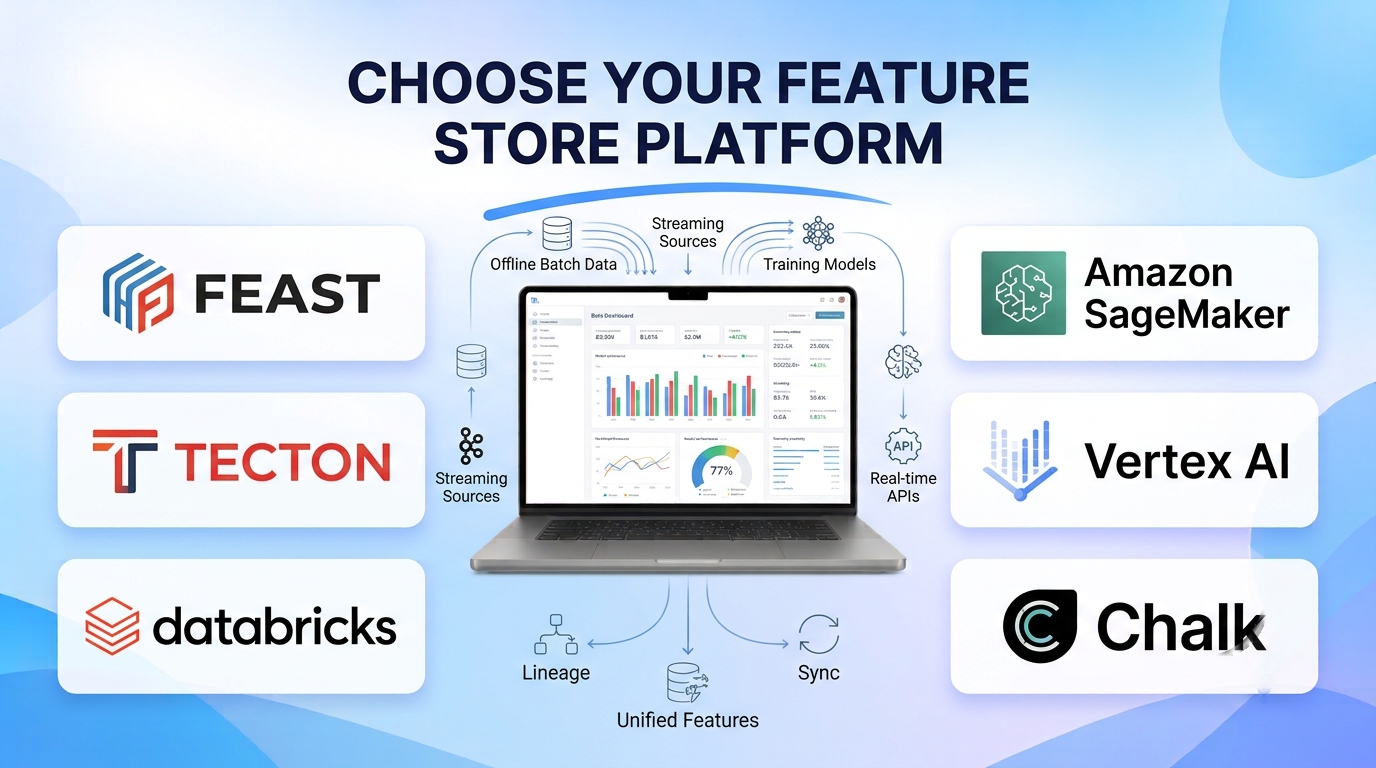
In almost every organization scaling machine learning beyond a handful of models, data scientists spend more time rewriting feature pipelines than improving algorithms. An analyst writes a SQL query to compute a customer’s 30-day rolling transaction average for model training; six months later, a backend engineer rewrites that logic in Python or Java for real-time API inference—introducing subtle timestamp bugs, missing-value mismatches, and duplicated effort across teams.
Feature store platforms solve two core engineering problems: eliminating training-serving skew by maintaining a single source of truth for offline batch training and low-latency online inference, and enabling feature reuse across teams through a centralized, governed catalog. However, operating a dedicated feature store adds real infrastructure complexity—making it essential to know when you actually need one and which architecture fits your stack.
Offline Store vs. Online Store: How Feature Stores Work
A complete feature store coordinates two storage engines behind a unified feature definition layer:
- Offline Feature Store: Backed by cloud data warehouses or lakehouses (Snowflake, BigQuery, Databricks Delta Lake, Apache Iceberg on S3). Optimized for high-throughput batch reads and point-in-time joins (as-of joins) that reconstruct exact historical feature values at the precise timestamp each training event occurred—preventing future data leakage.
- Online Feature Store: Backed by low-latency key-value or in-memory databases (Redis, Amazon DynamoDB, Cassandra, PostgreSQL, or Bigtable). Optimized for single-entity lookups (
user_id = 48192) returning feature vectors in single-digit milliseconds during live inference. - Transformation and Materialization Engine: Computes batch, streaming, or on-demand features and keeps the offline and online stores synchronized automatically.
Leading Feature Store Platforms and Architectural Models
Feast (Open Source)
Feast (Feature Store) is the leading open-source, cloud-agnostic feature store maintained under the Linux Foundation’s LF AI & Data foundation. Rather than forcing organizations to migrate into proprietary storage, Feast acts as a lightweight orchestration and metadata layer over existing infrastructure—connecting offline stores (BigQuery, Snowflake, Redshift, Spark, Parquet) with online stores (Redis, DynamoDB, PostgreSQL, SQLite) and exposing consistent Python/gRPC retrieval APIs for training and inference.
Engineering teams that already operate modern cloud warehouses and key-value databases—and want vendor-neutral control over their feature registry and point-in-time joins without heavy commercial licensing—consistently adopt Feast. Because Feast focuses primarily on feature storage, serving, and point-in-time retrieval rather than managing complex streaming transformation engines itself, teams pair it with dbt, Spark, or Flink for upstream feature computation.
Tecton
Co-founded by the creators of Uber’s Michelangelo ML platform, Tecton is an enterprise-grade, fully managed feature platform engineered for complex real-time, streaming, and batch feature engineering. Tecton defines features declaratively in Python (“Features-as-Code”) and orchestrates the full lifecycle—executing scheduled batch aggregations on Spark/Snowflake, running continuous streaming window aggregations (such as 5-minute fraud velocity counts) over Kafka/Kinesis, synchronizing offline/online stores, and monitoring feature freshness and serving latency.
Organizations running latency-critical, real-time operational ML—such as payment fraud detection, dynamic marketplace pricing, and real-time personalization where streaming aggregations must update within seconds—gain massive engineering leverage from Tecton. Its commercial enterprise pricing and deep architectural scope make it overkill for teams whose models rely solely on daily batch features.
Databricks Feature Engineering (Unity Catalog)
Databricks integrates feature management natively into its lakehouse governance layer via Feature Engineering in Unity Catalog. Any Delta table with a primary key in Unity Catalog can be registered directly as a feature table, enabling automatic lineage tracking between upstream data pipelines, trained MLflow models, and online inference endpoints—with one-click synchronization to managed online tables for low-latency serving.
Enterprises already running data engineering and ML on Databricks gain a major architectural advantage: they avoid standing up a separate standalone feature store vendor while inheriting Unity Catalog’s unified access controls and column-level lineage. Teams outside the Databricks ecosystem will naturally look toward cloud-native or open-source alternatives.
Amazon SageMaker Feature Store
Amazon SageMaker Feature Store provides AWS’s fully managed repository for storing, discovering, and sharing ML features across offline (Amazon S3 in Parquet/Iceberg format) and online (low-latency in-memory or DynamoDB-backed) tiers. Integrated tightly with SageMaker Pipelines, SageMaker Studio, and AWS IAM security policies, it supports both streaming ingestion via PutRecord APIs and batch ingestion from Spark or SageMaker Data Wrangler.
AWS-standardized enterprises seeking managed online/offline feature synchronization with strict VPC isolation and IAM governance benefit from SageMaker Feature Store’s turnkey AWS integration. Like Feast, complex streaming window aggregations require pairing with external engines such as Managed Service for Apache Flink or Spark.
Google Cloud Vertex AI Feature Store
Vertex AI Feature Store connects BigQuery directly to low-latency online serving backed by Google Cloud Bigtable or optimized vector/key-value serving nodes. Instead of duplicating offline data into a separate proprietary format, Vertex AI Feature Store treats BigQuery tables and views directly as the offline source of truth, syncing selected feature columns on schedule to online serving endpoints with built-in drift monitoring and embedding vector search support.
Teams standardized on BigQuery and Google Cloud—especially those combining structured tabular features with vector similarity search for recommendation or RAG systems—gain clean operational simplicity without managing separate Redis or Cassandra clusters.
Hopsworks
Hopsworks is an open-source-core and commercial enterprise feature store and AI lakehouse platform built around Apache Hudi, RonDB (an ultra-low-latency in-memory NDB database), and Python-centric feature engineering APIs. Hopsworks supports Python/Pandas, Spark, and Flink feature pipelines, provides point-in-time correct training dataset creation, and delivers high-throughput, sub-millisecond online feature retrieval.
Organizations needing extreme online serving throughput—or seeking a self-hosted, cloud-portable feature platform that bundles its own high-performance online key-value store rather than requiring external Redis/DynamoDB administration—find Hopsworks uniquely capable.
Chalk
Chalk represents a modern, developer-focused approach to real-time feature engineering designed for Python engineers. Rather than splitting batch ETL from online microservices, Chalk lets developers define features using standard typed Python functions (@online, @offline) that execute on demand during live inference—fetching fresh API signals, running Python transformations, and caching results automatically—while replaying the exact same Python functions against historical warehouse snapshots to generate leak-free training datasets.
Fintech, risk underwriting, and real-time decisioning teams that rely heavily on live external API calls (such as credit bureau pulls or device signals) alongside warehouse history value Chalk’s unified Python execution model and rapid local-to-production iteration.
Feature Store Platform Comparison
| Platform | Deployment & Licensing | Transformation Capabilities | Offline / Online Backends | Best Fit | Key Trade-Off |
| Feast | Open-source (Apache 2.0) | Delegates transformations to dbt, Spark, Flink | Pluggable (BigQuery/Snowflake/S3 + Redis/DynamoDB/Postgres) | Cloud-agnostic teams wanting lightweight registry & serving | Does not orchestrate complex streaming aggregations natively |
| Tecton | Commercial managed SaaS / BYOC | Managed batch, streaming (Kafka), and on-demand | Connects to Snowflake/Databricks + managed online store | Real-time fraud, pricing, and streaming velocity features | Enterprise commercial cost; heavy for batch-only ML |
| Databricks Feature Engineering | Integrated in Databricks platform | Native Spark, Delta Live Tables, and Python/SQL | Unity Catalog Delta tables + managed online tables | Teams already running data and ML on Databricks | Coupled to Databricks lakehouse ecosystem |
| SageMaker Feature Store | Managed AWS service | Ingests from Spark, Flink, or SDK APIs | Amazon S3 (Parquet/Iceberg) + managed online store | AWS-centric organizations prioritizing IAM/VPC governance | Streaming window compute requires external AWS services |
| Vertex AI Feature Store | Managed GCP service | Uses BigQuery SQL/views + Vertex pipelines | BigQuery directly + Bigtable/managed online serving | BigQuery users and hybrid tabular + vector search workloads | Tied to Google Cloud BigQuery infrastructure |
| Hopsworks | Open-source core + Commercial Enterprise | Supports Python, Spark, and Apache Flink | Apache Hudi offline + ultra-fast RonDB online store | High-throughput self-hosted or multi-cloud feature platforms | Self-hosting requires operating Hopsworks/RonDB stack |
| Chalk | Commercial cloud / BYOC | Unified typed Python functions for online & offline | Connects to Snowflake/BigQuery + managed low-latency cache | Fintech/risk teams blending live API calls with historical data | Commercial platform; Python-centric authoring model |
When You Do—and Do Not—Need a Feature Store
Before adding a dedicated feature store to your architecture, apply a practical litmus test:
- Skip a Dedicated Feature Store If: All your models run as scheduled daily or hourly batch jobs reading directly from your data warehouse. Standard dbt models in Snowflake, BigQuery, or Databricks already provide versioned SQL transformations, lineage, and reuse without online key-value serving overhead.
- Adopt a Feature Store When:
- Models serve real-time predictions via low-latency APIs (under 50ms) requiring precomputed historical aggregations or streaming window features.
- Multiple ML teams repeatedly rebuild identical customer, product, or merchant features in separate silos.
- Subtle timestamp leakage bugs during historical training joins have caused production model regressions.
Selecting the Right Feature Platform
Align your choice with your existing data gravity and real-time latency requirements. If your organization already centralizes data on Databricks or Google BigQuery, enabling Feature Engineering in Unity Catalog or Vertex AI Feature Store eliminates extra infrastructure while keeping governance unified. For cloud-agnostic engineering teams that already maintain Redis or DynamoDB and need clean point-in-time joins, open-source Feast offers the cleanest entry path. Finally, when real-time business outcomes depend on sub-second streaming aggregations or live API feature computation—such as fraud prevention or instant credit decisioning—purpose-built platforms like Tecton or Chalk pay for themselves in engineering velocity and prevented skew.
