For growing organizations, personnel data inevitably scatters across a messy digital ecosystem. Employee contact information lives in a spreadsheet, onboarding paperwork sits in an email archive, paid time off is tracked in a calendar plugin, and payroll runs through an entirely separate accounting portal.
When human resources administrators spend more time reconciling data between these disparate silos than supporting organizational growth, leadership begins evaluating a Human Resource Information System (HRIS).
However, entering the HRIS market can be disorienting. Vendor terminology often blurs the lines between core HR data systems, applicant tracking systems, payroll processors, and massive enterprise HCM suites. Choosing the right platform requires cutting through marketing jargon and understanding how different software architectures manage employee data integrity, security boundaries, and operational scale.
The Functional Boundary: What an HRIS Actually Is
Before comparing products, it is vital to establish what an HRIS is—and what it is not.
In modern technical parlance, an HRIS serves primarily as the system of record for personnel data. It stores employee master data: legal names, addresses, tax classifications, emergency contacts, employment history, compensation records, benefits elections, and organizational reporting structures.
While many modern platforms have expanded into applicant tracking (ATS), performance management, and time tracking, the defining characteristic of a true HRIS is its authoritative database of employee records.
Confusing an HRIS with adjacent software categories usually leads to implementation friction:
- HRIS vs. Payroll Software: While many systems bundle payroll, a pure HRIS focuses on personnel data governance, whereas payroll platforms specialize in tax calculations, wage disbursements, and statutory filings.
- HRIS vs. HCM Suites: An HRIS is typically a component of, or a lighter alternative to, a broader Human Capital Management (HCM) suite. HCM suites incorporate deeper strategic tools like global talent management, workforce planning, and succession modeling.
- HRIS vs. HRMS: In historical software nomenclature, HRMS (Human Resource Management Systems) often implied time, attendance, and benefits administration features bundled into the core record database. Today, HRIS and HRMS are largely used interchangeably.
Evaluating Core Architectural Approaches
HRIS platforms generally fall into three distinct architectural models, each suited to a different stage of organizational maturity:
1. Unified Mid-Market HRIS Platforms
These systems are built to consolidate core HR, benefits administration, onboarding, and time tracking into a single, intuitive database. They prioritize user interface design, rapid implementation, and straightforward administrative workflows.
- Architectural Trade-Off: Highly accessible for HR generalists, but can become constrained when organizations scale into complex multi-entity, multi-state, or international regulatory structures.
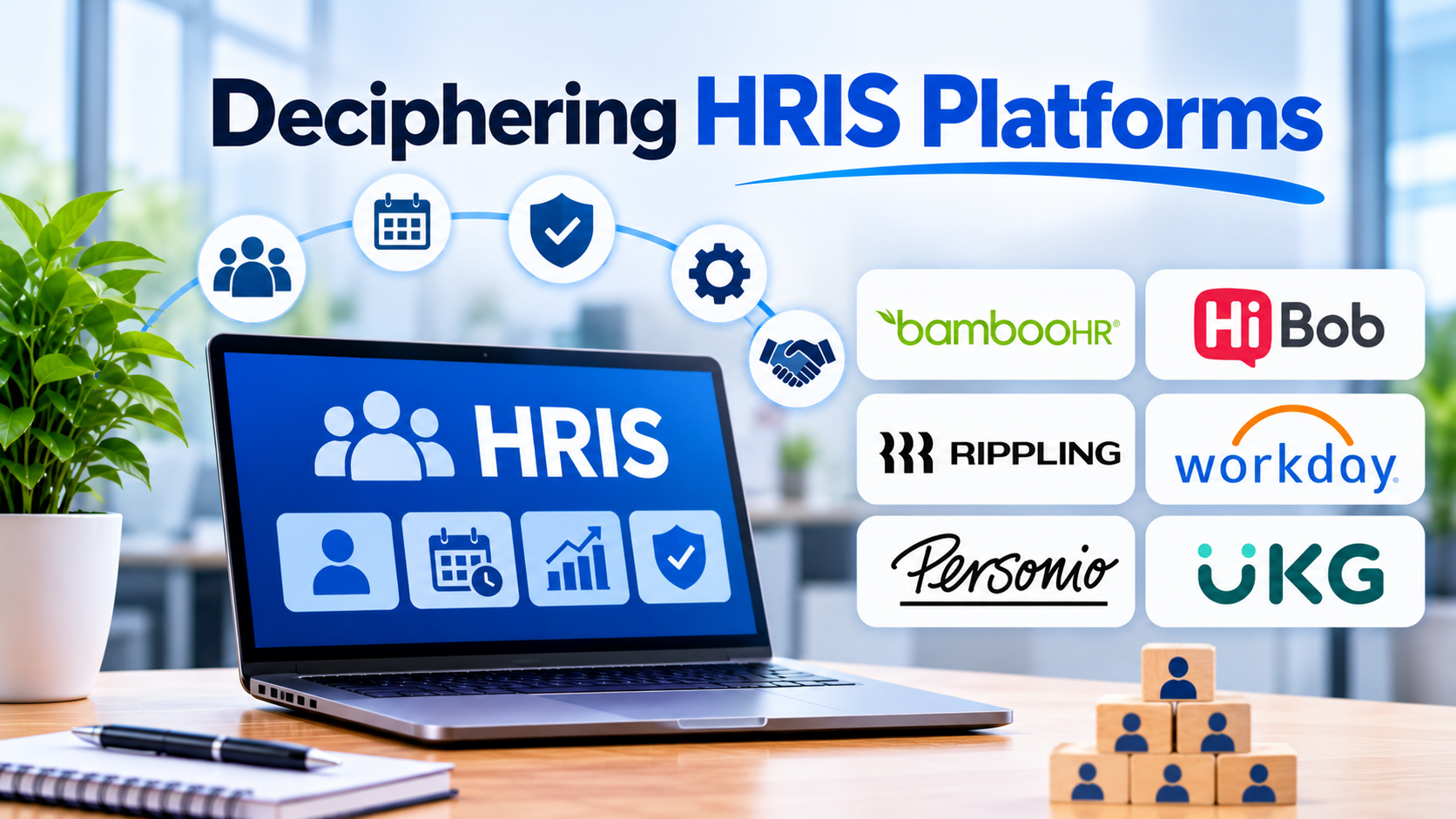
- Representative Examples: BambooHR, HiBob, Personio.
2. Programmatic Graph and Automation Engines
A newer breed of HR platforms approaches employee data not as static tables, but as a dynamic graph connected across HR, IT device management, and financial software. When an employee’s role changes, the system programmatically updates software access, security permissions, and payroll rules simultaneously.
- Architectural Trade-Off: Exceptional automation capabilities, but requires disciplined management of internal triggers and data rules during initial setup.
- Representative Example: Rippling.
3. Enterprise Core HRIS and HCM Suites
Engineered for large corporations, these platforms handle complex global hierarchies, stringent data security compliance, multi-currency payroll, and deep integration with enterprise resource planning (ERP) systems.
- Architectural Trade-Off: Unmatched depth and scalability, but accompanied by high total cost of ownership, long implementation cycles, and heavy configuration overhead.
- Representative Examples: Workday HCM, UKG Pro, SAP SuccessFactors.
6 Leading HRIS Platforms Compared
| Platform | Architectural Approach | Primary Strength | Core Limitation |
| BambooHR | Streamlined mid-market core HRIS | Clean, intuitive user experience with rapid onboarding and robust reporting | Less suited for complex global enterprise compliance or heavy industrial scheduling |
| HiBob (Bob) | Culture-forward mid-market HRIS | Excellent customization for distributed and global remote teams with strong engagement tools | Implementation requires careful mapping of custom fields and localized policies |
| Rippling | Programmatic cross-departmental automation | Instantaneous synchronization across HR, IT device management, and payroll | Requires rigorous initial setup of automated workflows and triggers |
| Workday HCM | Cloud-native enterprise object model | Unmatched global analytics, financial integration, and object-oriented flexibility | High total cost of ownership and intensive configuration requirements |
| Personio | European-focused SMB HRIS | Exceptional handling of European regional compliance, data privacy, and localized leave rules | Less optimized for complex US multi-state tax and benefit structures |
| UKG Pro | Deeply integrated enterprise HR & labor engine | Robust time tracking, scheduling, and complex union compliance management | Interface can feel sprawling; requires dedicated administrative oversight |
Critical Evaluation Factors Beyond the Feature List
When evaluating HRIS platforms through standard vendor demonstrations, buyers frequently focus on user interface aesthetics while overlooking structural constraints that determine long-term success.
- API Openness and Integration Architecture: No HRIS manages every specialized HR workflow. Verify whether the platform offers robust REST APIs, webhooks, and pre-built connectors to integrate applicant tracking systems, learning management tools, or accounting software without breaking core security boundaries.
- Data Privacy and Compliance Governance: With data privacy regulations expanding globally, evaluate how the platform handles data residency, role-based access permissions, audit logs, and secure document storage for sensitive employee files.
- Workflow Customization and Approval Chains: Organizations operate differently. Determine whether the platform allows you to build custom approval workflows (e.g., multi-tier sign-offs for compensation changes or time-off requests) without requiring custom software development.
- Employee Self-Service (ESS) Usability: Adoption rates depend heavily on the end-user experience. If employees and managers find the mobile application sluggish or confusing when viewing pay stubs, requesting time off, or updating personal details, administrative overhead will persist.
Common Implementation Pitfalls to Avoid
Migrating to a new HRIS is an operational milestone fraught with predictable stumbling blocks:
- Migrating Dirty Data: Shifting inaccurate, duplicate, or outdated employee records from legacy spreadsheets into a new HRIS simply codifies old errors in an expensive new database. Clean and audit your personnel data thoroughly before data mapping begins.
- Over-Customizing Early: Attempting to program every historical, non-standard company policy into your new HRIS during initial deployment will stall implementation timelines. Adopt standard out-of-the-box workflows where possible and customize incrementally.
- Neglecting Change Management: Implementing an HRIS changes how employees interact with human resources. Without proper training and clear communication regarding data privacy and self-service portals, adoption rates will lag.
Making the Final Decision
Selecting an HRIS is an exercise in matching organizational maturity to system architecture. If your growing company needs a reliable, intuitive system of record that gets up and running quickly, a mid-market platform like BambooHR or HiBob provides immediate relief. If your organization operates across remote, tech-forward environments where HR, IT, and finance must sync automatically, Rippling offers unique architectural advantages. For multinational enterprises managing complex global compliance and deep financial hierarchies, enterprise suites like Workday or UKG Pro are essential.
Begin your evaluation by mapping your organization’s highest administrative bottleneck—whether that is manual onboarding delays, fragmented data audits, or multi-state compliance tracking—and select the platform architecture designed to eliminate that specific friction point.
