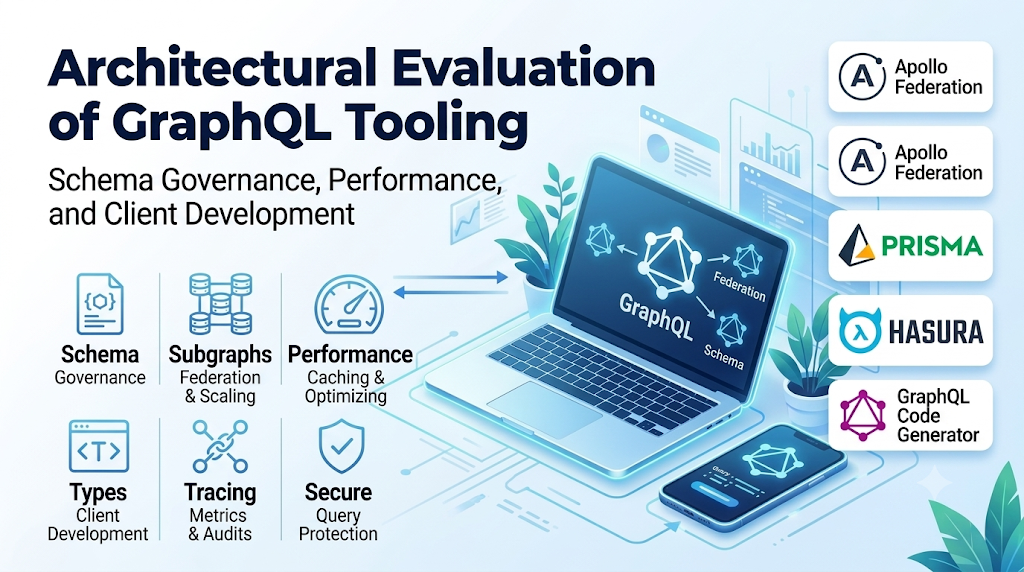
Adopting GraphQL offers frontend engineering teams unprecedented flexibility by allowing clients to request precisely the data they need in a single round-trip. However, scaling GraphQL beyond a single monolithic server introduces architectural complexities. Without proper tooling, engineering organizations quickly encounter unbounded query depth, unoptimized database queries (the classic N+1 problem), fragmented schema governance across microservices, and lack of type safety between server and client.
Choosing the right GraphQL tooling stack requires evaluating schema federation capabilities, caching mechanics, automated type generation, and production security controls. This guide examines leading GraphQL development, gateway, and operational tools, analyzing their architectural strengths, trade-offs, and enterprise implementation considerations.
Core Evaluation Criteria for GraphQL Tooling Architecture
Selecting GraphQL infrastructure and development utilities involves balancing developer velocity against server performance and security governance.
- Schema Federation and Composition: The ability to stitch or federate multiple disparate microservice schemas into a single unified graph for client consumption.
- N+1 Query Resolution and Caching: Built-in mechanisms or utilities (such as data loaders and persisted queries) to optimize database access patterns and reduce redundant network payload.
- Type Safety and Client Code Generation: Automated utilities that convert GraphQL schemas and queries into strongly typed client code (TypeScript, Swift, Kotlin) to catch integration errors at compile time.
- Security and Query Complexity Limiting: Automated enforcement of query depth limits, cost analysis algorithms, and rate limiting to prevent malicious clients from overwhelming backend services with deeply nested queries.
Leading GraphQL Tooling and Platforms Compared
Different engineering challenges—ranging from building client applications to managing enterprise-scale federated supergraphs—demand distinct tooling ecosystems. Below is an examination of six prominent GraphQL solutions.
Apollo Federation (Router and Supergraph)
- Primary Focus: Enterprise-grade schema federation, microservices composition, and unified API gateway management.
- Deployment Model: Containerized gateway (Rust-based Apollo Router) and managed cloud control plane.
- Technical Strengths: Unmatched capability for scaling microservices into a single cohesive supergraph, high-performance Rust-based routing engine, robust distributed tracing, and automated schema composition checks.
- Considerations: Significant architectural complexity and governance overhead; unnecessary for small-scale or monolithic applications.
GraphQL Code Generator
- Primary Focus: Automated type safety and client SDK generation from GraphQL schemas and operations.
- Deployment Model: Build-time CLI tool and plugin ecosystem.
- Technical Strengths: Generates fully typed React hooks, TypeScript interfaces, and native client models automatically, eliminating manual type synchronization between frontend and backend teams.
- Considerations: Requires careful configuration of plugins and build pipelines to ensure generated code stays synchronized during rapid schema iterations.
Hasura GraphQL Engine
- Primary Focus: Instant GraphQL API generation directly from existing relational databases.
- Deployment Model: Self-hosted container or Hasura Cloud.
- Technical Strengths: Instantly generates secure, high-performance GraphQL and REST APIs from PostgreSQL, MySQL, or SQL Server databases, complete with granular role-based access control (RBAC).
- Considerations: Business logic tied heavily to database views and triggers; highly customized application logic may require accompanying custom microservices.
Prisma ORM
- Primary Focus: Type-safe database client and schema migration toolkit for Node.js and TypeScript.
- Deployment Model: Build-time library and database connector.
- Technical Strengths: Intuitive declarative data modeling (
schema.prisma), bulletproof type safety, seamless migration management, and excellent developer experience when building GraphQL resolvers. - Considerations: Primarily focused on the database layer; not a complete API gateway or GraphQL server framework on its own.
Yoga (Guild GraphQL Yoga)
- Primary Focus: Modern, extensible, and spec-compliant GraphQL server for JavaScript and TypeScript.
- Deployment Model: Serverless, Node.js, or edge runtime (Cloudflare Workers).
- Technical Strengths: Works seamlessly across any JavaScript runtime, built-in support for subscriptions, defer, stream, and file uploads out of the box, with a modular plugin architecture.
- Considerations: Requires manual configuration of resolvers, data loaders, and database bindings for complex enterprise applications.
GraphiQL and Apollo Sandbox
- Primary Focus: Interactive API exploration, documentation browsing, and query testing IDEs.
- Deployment Model: Browser-based or embedded developer tools.
- Technical Strengths: Essential tools for exploring schema documentation, testing queries in real time, inspecting headers, and debugging response payloads during local development.
- Considerations: Exclusively developer-facing tooling; provides no backend execution or production traffic management capabilities.
Comparative Technical Overview
| Tool / Platform | Primary Function | Architecture Model | Ecosystem Integration | Best Suited For |
| Apollo Federation | Microservices supergraph gateway | Rust-based proxy + Control Plane | Universal GraphQL ecosystem | Enterprise teams scaling distributed microservices |
| GraphQL Code Generator | Client & server type generation | Build-time CLI / Compiler | TypeScript, React, Mobile SDKs | Frontend teams demanding end-to-end type safety |
| Hasura | Instant database-to-GraphQL APIs | Containerized database proxy | PostgreSQL, SQL Server, MySQL | Rapid prototyping and data-heavy internal tools |
| Prisma | Type-safe database ORM & migrations | Node.js / TypeScript library | Relational databases | TypeScript backend developers building resolvers |
| GraphQL Yoga | Universal GraphQL server runtime | JavaScript / Edge runtime | Web frameworks, Node, Workers | Developers building custom GraphQL servers |
| GraphiQL / Sandbox | Interactive API query IDEs | Browser client interface | Any GraphQL endpoint | Developers exploring and testing API schemas |
Implementation and Security Considerations
Deploying GraphQL tooling into production requires establishing strict security governance and performance guardrails.
- Query Complexity and Depth Limiting: Unlike rigid REST endpoints, GraphQL clients can request deeply nested, recursive relationships that exhaust database memory. Always implement query cost analysis and depth-limiting middleware at the gateway level.
- N+1 Database Query Mitigation: Utilize DataLoader patterns or database batching utilities in your resolver layer to prevent individual queries from triggering hundreds of redundant database round-trips.
- Persisted Queries for Performance: For production mobile and web clients, implement persisted queries (hashing query strings on the client and referencing them by hash on the server) to reduce network payload sizes and protect against arbitrary query execution attacks.
Summary and Selection Framework
Choosing the right GraphQL tooling depends on your architectural scale, database setup, and team workflow requirements.
- Choose Apollo Federation when managing a massive enterprise architecture with multiple teams contributing schemas across distributed microservices.
- Choose GraphQL Code Generator and Prisma when your engineering stack is built on TypeScript and demands end-to-end type safety from database to frontend client.
- Choose Hasura when you need to instantly expose relational databases via secure GraphQL APIs without writing repetitive boilerplate resolver code.
- Choose GraphQL Yoga when building a custom, high-performance GraphQL server across modern serverless or edge runtimes.
Evaluate your database architecture, team skill sets, and security compliance mandates before committing to a GraphQL tooling stack.
