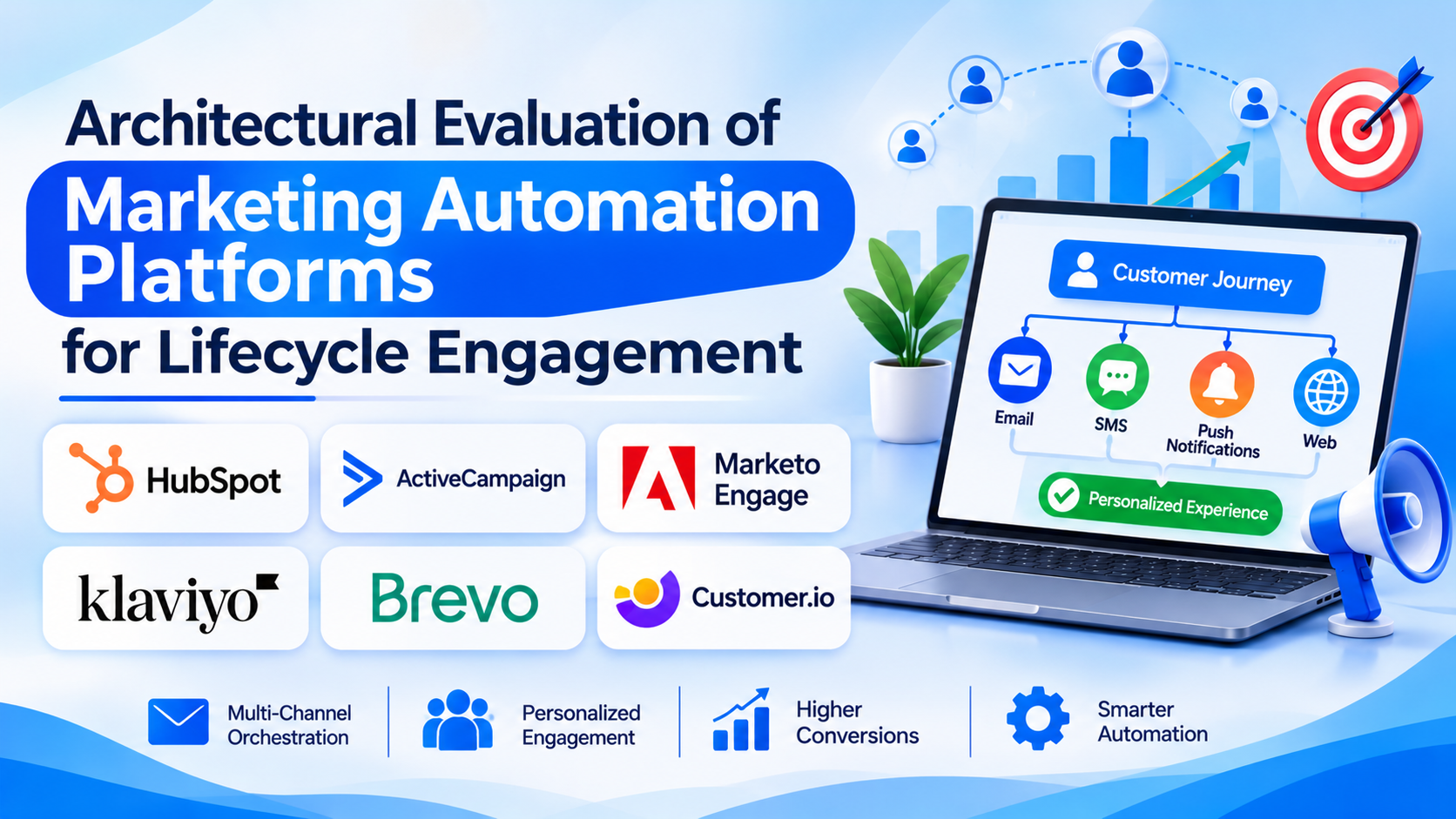
Scaling customer acquisition and nurturing leads manually quickly becomes unsustainable as businesses expand their digital footprint. Sending batch-and-blast email newsletters no longer meets consumer expectations for individualized, timely communication. Modern marketing automation platforms (MAPs) orchestrate multi-channel customer journeys across email, SMS, push notifications, and web touchpoints, triggering personalized messages based on real-time user behavior, intent signals, and CRM data.
Choosing a marketing automation platform requires looking beyond basic template builders and evaluating multi-channel orchestration capabilities, CRM synchronization limits, data attribution models, and contact-based pricing structures. This guide examines leading marketing automation platforms, analyzing their architectural strengths, workflow engines, and enterprise integration trade-offs.
Core Evaluation Criteria for Marketing Automation Architecture
Selecting a marketing automation platform involves balancing campaign complexity against ease of use and infrastructure integration.
- Workflow Builder and Logic Flexibility: The capacity to construct complex, multi-branching customer journeys driven by conditional splits, wait timers, behavioral triggers, and custom event properties.
- CRM and Data Synchronization: The reliability and speed of bidirectional data syncs with major Customer Relationship Management systems (such as Salesforce or HubSpot) to keep lead scoring and contact properties up to date.
- Deliverability Infrastructure: Built-in sender reputation management, dedicated IP options, SPF/DKIM authentication support, and compliance tools to ensure high inbox placement rates.
- Multi-Channel Orchestration: The ability to seamlessly coordinate messaging across email, SMS, in-app messaging, web push, and paid advertising channels within a single automated flow.
Leading Marketing Automation Platforms Compared
Different organization sizes, business models (B2B versus B2C), and technical requirements demand distinct marketing automation architectures. Below is an examination of six prominent platforms.
HubSpot Marketing Hub
- Primary Focus: Inbound marketing, unified CRM integration, and end-to-end lead management.
- Deployment Model: Cloud SaaS.
- Technical Strengths: Unmatched user interface, seamless native integration with HubSpot CRM, powerful landing page and content management tools, and intuitive visual workflow automation.
- Considerations: Licensing costs scale steeply as database contacts grow and advanced enterprise marketing features are unlocked.
ActiveCampaign
- Primary Focus: Advanced visual automation builders, email marketing, and built-in sales CRM.
- Deployment Model: Cloud SaaS.
- Technical Strengths: Highly flexible multi-branching automation logic, robust machine learning predictive sending, excellent deliverability rates, and affordable entry-level pricing for growing businesses.
- Considerations: Complex automation trees with hundreds of nested conditions can become difficult to audit and maintain over time.
Marketo Engage (Adobe)
- Primary Focus: Enterprise B2B lead management, account-based marketing (ABM), and complex sales alignment.
- Deployment Model: Adobe Experience Cloud SaaS.
- Technical Strengths: Industry standard for enterprise B2B demand generation, sophisticated lead scoring models, advanced revenue attribution reporting, and deep Salesforce/Microsoft Dynamics integrations.
- Considerations: Steep learning curve and complex administration requirements that necessitate dedicated marketing operations (MOps) professionals.
Klaviyo
- Primary Focus: E-commerce behavioral marketing, SMS integration, and revenue-driven email automation.
- Deployment Model: Cloud SaaS.
- Technical Strengths: Deep, real-time native integrations with e-commerce platforms (Shopify, WooCommerce), advanced product recommendation blocks, and pre-built revenue attribution dashboards.
- Considerations: Highly specialized for transactional e-commerce workflows; less suited for complex long-cycle B2B enterprise sales pipelines.
Brevo (formerly Sendinblue)
- Primary Focus: Cost-effective multi-channel marketing (Email, SMS, WhatsApp) for small to mid-sized businesses.
- Deployment Model: Cloud SaaS.
- Technical Strengths: Unique pricing model based on message volume rather than contact database size, built-in chat widget, and straightforward transactional email capabilities.
- Considerations: Advanced behavioral tracking and multi-step branching logic are less robust compared to dedicated enterprise heavyweights like Marketo or HubSpot.
Customer.io
- Primary Focus: Data-driven product and lifecycle marketing triggered by real-time user events.
- Deployment Model: Cloud SaaS.
- Technical Strengths: Built for developers and product-led growth companies, allowing complex segmentation and messaging workflows driven directly by custom event streams and API calls.
- Considerations: Requires technical setup and clean event instrumentation; less friendly for non-technical marketers relying on drag-and-drop templates.
Comparative Technical Overview
| Platform | Primary Use Case | Target Audience | Pricing Model | Best Suited For |
| HubSpot | Inbound marketing & CRM alignment | Mid-market to Enterprise | Tiered contacts + user seats | B2B companies wanting unified sales and marketing |
| ActiveCampaign | SMB automation & email marketing | Small to Mid-sized Business | Tiered contacts & features | Growing businesses needing powerful automation builders |
| Marketo Engage | Enterprise B2B demand generation | Large Enterprise | Database volume & features | Enterprise B2B teams managing complex sales funnels |
| Klaviyo | E-commerce retention & revenue | E-commerce & Retail | Contact database volume | Online retailers driving repeat purchases via Shopify/Woo |
| Brevo | Volume-based multi-channel messaging | Small to Mid-sized Business | Message send volume | Budget-conscious teams sending high email/SMS volumes |
| Customer.io | Event-driven product lifecycle messaging | SaaS & Tech Companies | Event & profile volume | Product-led growth teams triggering messages from user apps |
Implementation and Deliverability Considerations
Deploying a marketing automation platform successfully requires careful technical configuration to protect sender reputation and data integrity.
- Email Authentication (SPF, DKIM, DMARC): Ensure proper DNS records are configured for custom sending domains to prevent emails from landing in spam folders and to protect against domain spoofing.
- Data Hygiene and Suppression Lists: Regularly clean inactive subscribers and hard bounces from the database. High spam complaint rates or sending to unverified purchased lists will quickly destroy sender reputation across shared or dedicated IPs.
- CRM Field Mapping: Establish clear naming conventions and data types when syncing custom properties between the marketing automation platform and the core CRM to prevent data overwriting and syncing errors.
Summary and Selection Framework
Choosing the right marketing automation platform depends heavily on your business model, data complexity, and team expertise.
- Choose HubSpot when seeking an all-in-one platform that unifies inbound marketing, sales CRM, and customer service into a single intuitive interface.
- Choose Marketo Engage when operating within a large enterprise B2B organization that requires advanced account-based marketing and complex multi-touch attribution.
- Choose Klaviyo when managing an e-commerce storefront that requires deep transactional data integration and revenue-focused email automation.
- Choose ActiveCampaign or Brevo when seeking flexible, cost-effective automation tools for growing small-to-medium businesses.
- Choose Customer.io when building product-led SaaS applications that require messaging triggered by granular in-app user events.
Evaluate your primary communication channels, database growth projections, and internal technical resources before committing to a marketing automation platform.
