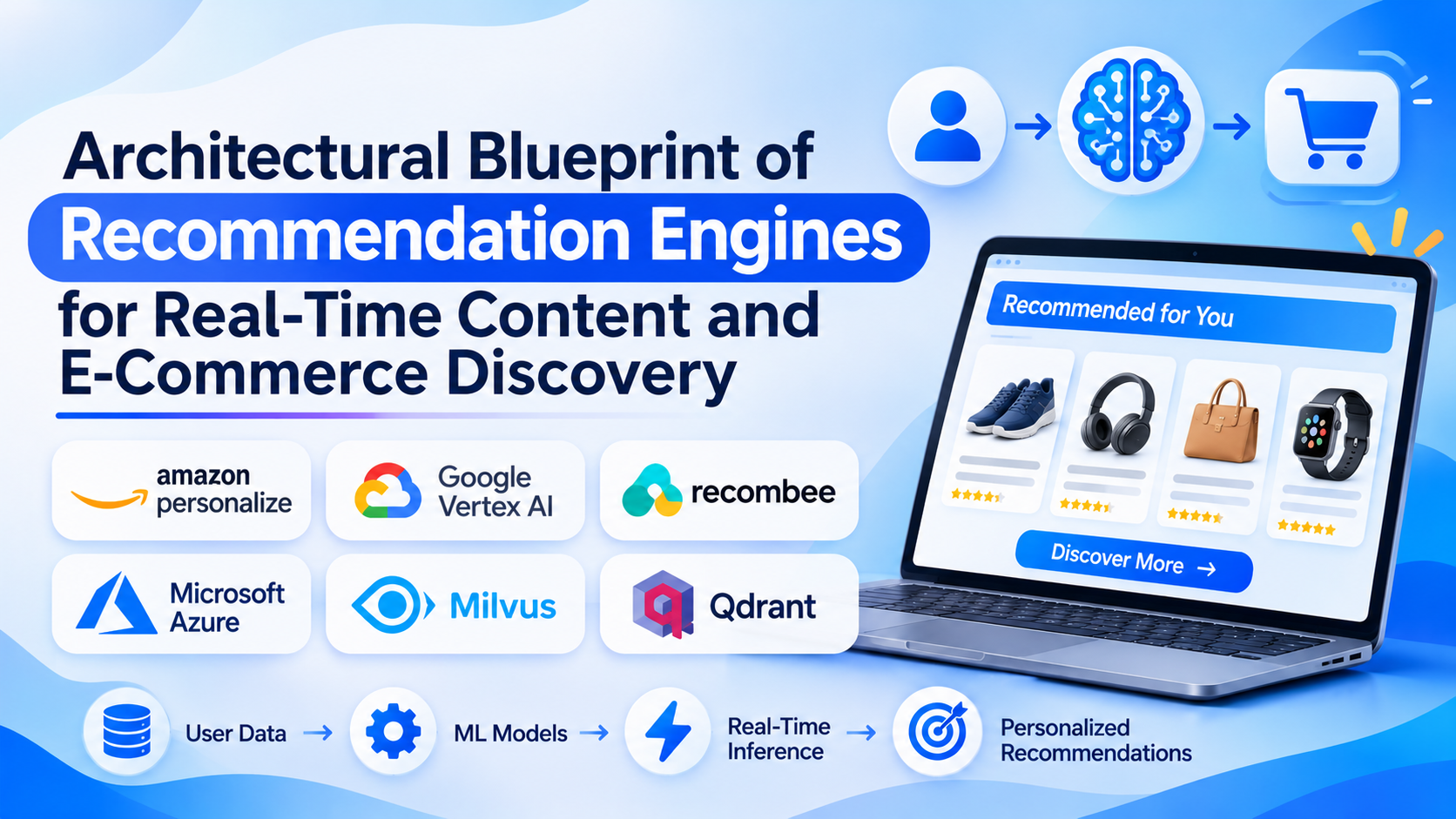
In modern digital ecosystems, user engagement depends heavily on relevance. Whether a visitor is browsing an e-commerce catalog with millions of SKUs or navigating a streaming library of video assets, static categorization fails to capture shifting individual preferences. Recommendation engines solve this information overload by predicting user intent and surfacing tailored items dynamically.
Implementing an effective recommendation system requires navigating complex architectural choices, balancing collaborative filtering algorithms against vector-based deep learning models, managing inference latency budgets, and handling cold-start problems for new users or catalog items. This guide examines leading recommendation platforms and algorithmic architectures, analyzing their technical foundations, data pipelines, and operational trade-offs for production environments.
Core Algorithmic Paradigms in Recommendation Architecture
Building or selecting a recommendation system requires understanding the underlying computational approaches used to score and rank items.
- Collaborative Filtering: Relies on historical user-item interactions (ratings, purchases, clicks). By identifying patterns across user behavior matrices, the system recommends items liked by users with similar historical profiles (user-based) or items frequently purchased together (item-based).
- Content-Based Filtering: Recommends items sharing similar metadata attributes (genres, tags, descriptions, category vectors) with items a user has previously engaged with, bypassing the need for peer-group history.
- Deep Learning and Neural Collaborative Filtering: Employs neural networks to capture non-linear relationships between users and items, incorporating contextual signals such as time of day, device type, and session inertia.
- Vector Embeddings and Approximate Nearest Neighbors (ANN): Maps users and items into dense vector spaces using models like two-tower neural networks, enabling lightning-fast similarity lookups via vector databases.
Leading Recommendation Platforms and Infrastructure Compared
Organizations can choose between managed cloud AI services, specialized commercial recommendation SaaS, and open-source frameworks requiring custom engineering.
Amazon Personalize
- Primary Focus: Fully managed machine learning recommendation service powered by Amazon’s proprietary retail algorithms.
- Deployment Model: AWS Managed Cloud Service.
- Technical Strengths: Eliminates the need for internal data science teams to build and train custom models. Automatically handles data ingestion from S3, model selection (user personalization, similar items, personalized ranking), and real-time API inference scaling.
- Considerations: Tied strictly to the AWS cloud ecosystem, with operational costs scaling based on data storage volume and real-time transaction requests.
Google Vertex AI Matching Engine (Vector Search)
- Primary Focus: Ultra-low-latency vector similarity matching for massive-scale recommendation pipelines.
- Deployment Model: Google Cloud Platform (GCP).
- Technical Strengths: Industry-leading ANN (Approximate Nearest Neighbors) indexing capable of scaling to billions of high-dimensional embeddings with sub-millisecond retrieval times.
- Considerations: Requires engineering teams to build custom data preprocessing and embedding generation pipelines before feeding vectors into the matching index.
Recombee
- Primary Focus: As-a-service recommendation engine featuring real-time AI-driven personalization and automated A/B testing.
- Deployment Model: Cloud SaaS.
- Technical Strengths: Rapid API-first integration, automated feature engineering, multi-objective optimization (balancing click-through rate against profit margin), and built-in analytics dashboard.
- Considerations: SaaS subscription model can become expensive for extremely high-volume, low-margin transaction catalogs.
Microsoft Azure AI Recommender / Custom Solutions
- Primary Focus: Enterprise machine learning model orchestration within Azure Databricks or Azure Machine Learning.
- Deployment Model: Microsoft Azure Cloud.
- Technical Strengths: Full architectural control over custom PyTorch or TensorFlow recommendation models, seamless integration with enterprise data lakes and Databricks clusters.
- Considerations: High engineering overhead required to design, train, monitor, and deploy models into production.
Milvus / Qdrant (Open-Source Vector Databases)
- Primary Focus: Open-source vector database infrastructure powering modern embedding-based retrieval.
- Deployment Model: Self-hosted or Cloud Managed.
- Technical Strengths: Purpose-built for storing and searching dense vector embeddings, offering unmatched flexibility for custom RAG and recommendation architectures.
- Considerations: Demands deep machine learning engineering expertise to generate high-quality user and item embeddings and manage cluster health.
Comparative Technical Overview
| Platform / Approach | Primary Architecture | Core Methodology | Deployment Model | Best Suited For |
| Amazon Personalize | Managed AWS ML service | Hybrid deep learning & collaborative filtering | AWS Cloud | Enterprises wanting proven retail recommendation models without ML overhead |
| Google Vertex AI | Vector similarity engine | ANN vector embeddings | Google Cloud | Massive-scale semantic retrieval and custom embedding pipelines |
| Recombee | Cloud SaaS recommendation engine | Real-time behavioral AI & multi-objective optimization | Cloud SaaS | E-commerce and media sites needing fast API integration |
| Microsoft Azure | Enterprise ML workspace | Custom neural networks & collaborative filtering | Azure Cloud | Organizations building custom-tailored proprietary algorithms |
| Milvus / Qdrant | Open-source vector DB | Vector similarity search (ANN) | Self-hosted or Cloud | Engineering teams designing custom two-tower embedding models |
Architectural Implementation Challenges
Deploying a recommendation engine into production introduces critical engineering and data governance hurdles.
- The Cold-Start Problem: New users with zero browsing history and newly added catalog items lack interaction data. Systems must gracefully fall back to trending items, contextual rules, or content-based attribute matching until sufficient interaction data accumulates.
- Inference Latency Budgets: Real-time web pages and mobile feeds require recommendation scores to be computed and returned in milliseconds. Production architectures typically decouple heavy batch model training from lightweight, real-time candidate retrieval and ranking.
- Data Freshness and Pipeline Synchronization: Catalog changes (price updates, out-of-stock items, newly published videos) must propagate into the recommendation index immediately via event-driven streaming pipelines (e.g., Apache Kafka) rather than slow batch jobs.
Summary and Selection Framework
Selecting the right recommendation engine or architecture depends heavily on team composition, infrastructure commitments, and catalog scale.
- Choose Amazon Personalize or Recombee when engineering resources are focused on product development rather than machine learning research, and rapid cloud deployment is paramount.
- Choose Google Vertex AI or open-source vector databases (Milvus, Qdrant) when data science teams require granular control over vector embeddings, two-tower models, and massive-scale semantic retrieval.
- Choose custom model development on Azure or AWS when proprietary business logic and specialized multi-objective optimization models cannot be met by off-the-shelf SaaS solutions.
Evaluate your data readiness, real-time latency constraints, and internal engineering bandwidth before committing to a recommendation architecture.
