Introduction
Managing institutional and multi-asset investment portfolios has outgrown the era of batch-processed spreadsheets and disconnected end-of-day accounting files. Whether overseeing an institutional asset management firm, a multi-family office, a wealth advisory practice, or a hybrid public-private fund, portfolio managers face an operational reality where intraday market volatility, complex derivative exposures, and multi-jurisdictional regulatory mandates collide simultaneously.
At the center of this operational stack sits the Portfolio Management System (PMS). While an Order Management System (OMS) focuses on capturing, routing, and allocating trades, the PMS answers the fundamental investment question: “What do we currently own, what is our true risk and liquidity exposure right now, and how should we construct or rebalance our holdings?”. Choosing the wrong PMS architecture—or confusing a front-office Investment Book of Record (IBOR) with a back-office Accounting Book of Record (ABOR)—creates chronic reconciliation breaks, delayed client reporting, and blind spots in factor or currency exposure.
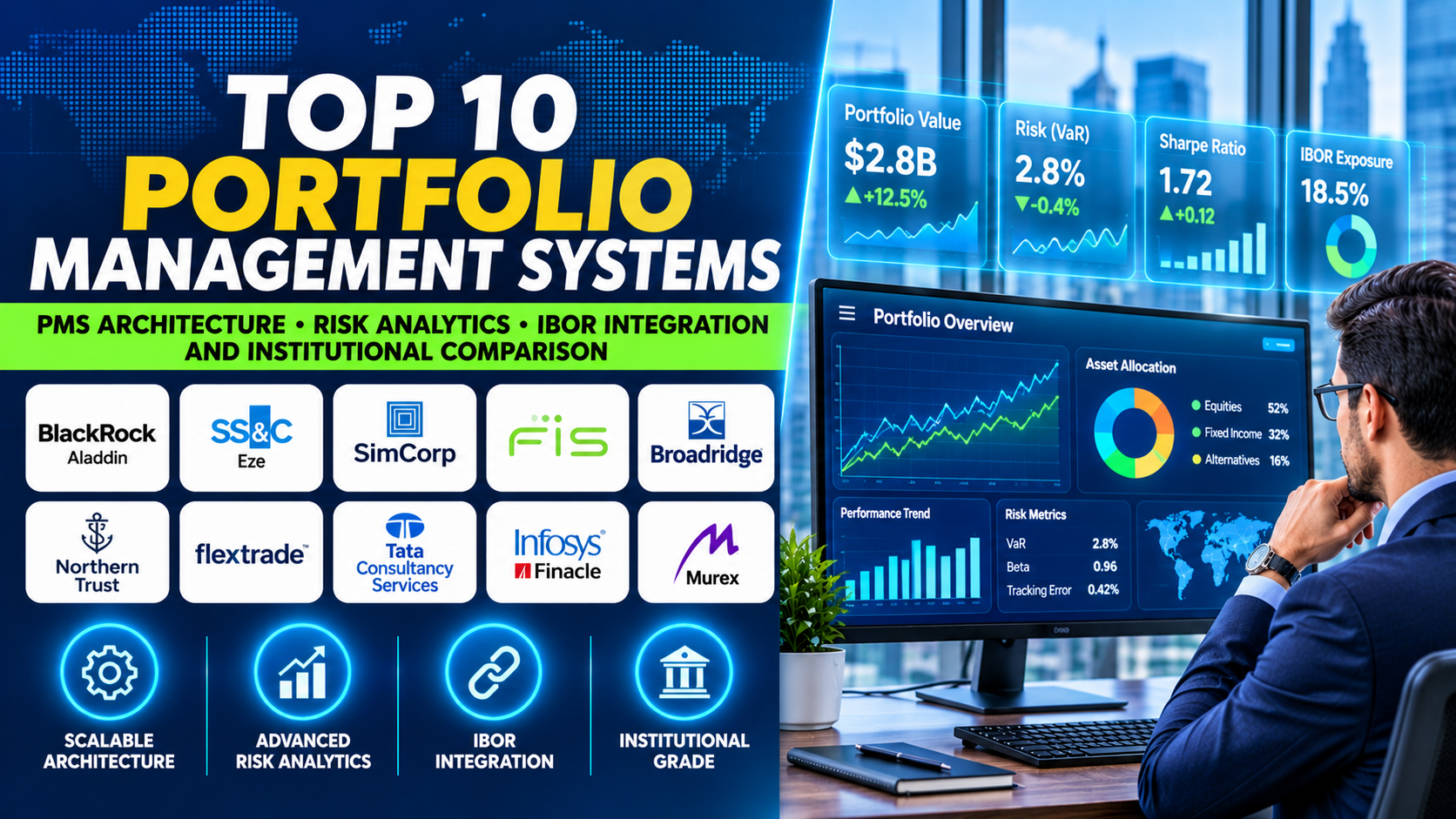
This guide examines ten leading Portfolio Management Systems across institutional asset management, multi-asset wealth platforms, cloud-native investment hubs, and private-capital specialists. We break down their underlying data models, risk and attribution capabilities, integration architectures, strengths, limitations, and optimal organizational fits so investment leaders can align technology selection with actual portfolio complexity.
Why Legacy Portfolio Tracking Fails Modern Investment Teams
Relying on manual spreadsheet models, custodian web portals, or rigid legacy accounting ledgers introduces severe structural friction as assets under management (AUM), strategy diversity, and client customization scale:
- The IBOR vs. ABOR Timing Gap: Back-office accounting systems (ABOR) are built for historical accuracy, tax-lot certification, and official Net Asset Value (NAV) sign-off—often finalizing T+1 or later. Front-office portfolio managers making intraday allocation decisions cannot wait until tomorrow morning to see how yesterday’s fills, corporate actions, or FX fluctuations altered their net exposure.
- Multi-Asset and Private Market Blind Spots: Traditional equity-centric systems struggle to model private equity capital calls, unlisted credit waterfalls, complex derivatives Greeks, and multi-currency look-through exposures in the same ledger as listed stocks and bonds.
- Manual Rebalancing and Drift Risk: Adjusting hundreds of bespoke client accounts or sleeve-based models against shifting benchmark weights without automated drift detection and tax-aware optimization leads to execution errors, unintended tracking error, and preventable capital gains distributions.
- Fragile Custodian and Fund Administrator Reconciliations: Every prime broker, custodian bank, and third-party fund administrator formats position, cash, and corporate action feeds differently. Without automated exception-based reconciliation engines, middle-office operations teams burn hours manually hunting down breaks before markets open.
Modern Portfolio Management Systems eliminate these bottlenecks by maintaining a real-time Investment Book of Record (IBOR), automating multi-custodian data aggregation, embedding quantitative risk and performance attribution, and integrating directly with downstream order execution rails.
Core Architectural Pillars of a Modern Portfolio Management System
Evaluating a PMS requires inspecting four foundational engineering and analytical layers that determine how accurately the platform models holdings, calculates risk, and scales across asset classes:
1. Real-Time Investment Book of Record (IBOR)
A true front-office PMS maintains a continuous, intraday IBOR that updates positions, cash balances, pending trades, and corporate actions in real time. Unlike an end-of-day accounting ledger, an IBOR gives portfolio managers immediate visibility into settled, unsettled, and projected cash across currencies so they never accidentally over-allocate liquidity or breach mandate limits.
2. Multi-Asset Portfolio Construction and Rebalancing
Leading platforms support rule-based model portfolios, factor-tilted optimization, sleeve management, and “what-if” pre-trade scenario simulations. Before generating orders, a portfolio manager should be able to simulate how adding a fixed-income duration hedge or trimming an overweight sector impacts overall portfolio Value-at-Risk (VaR), tracking error, and cash drag.
3. Performance Attribution and Risk Analytics
Institutional stakeholders demand more than simple time-weighted or money-weighted returns. Modern PMS platforms compute granular Brinson-Fachler equity attribution, fixed-income yield-curve decomposition, stress-test shocks, and multi-level look-through analytics across fund-of-funds or ETF holdings.
4. Open APIs and Custodian/OMS Interoperability
A PMS rarely operates in isolation. It must ingest automated feeds from global custodians, prime brokers, and market data vendors while pushing target orders cleanly to an internal or external Order Management System (OMS) via FIX or modern REST APIs without custom middleware fragility.
Evaluating the Portfolio Management Software Landscape
The PMS market divides into four primary architectural tiers based on firm size, asset class complexity, and front-to-back operational scope:
| Platform Category | Primary Strengths | Best Suited For | Key Limitation |
| Institutional Front-to-Back Suites | Deep cross-asset risk modeling, integrated OMS/IBOR/ABOR, and global regulatory coverage. | Tier-1 asset managers, sovereign funds, and large institutional multi-asset firms. | High multi-year total cost of ownership and lengthy, consultant-heavy implementations. |
| Cloud-Native Front-to-NAV Platforms | Unified golden-source database, modern web UI, rapid deployment, and no-code integrations. | Growing asset managers and multi-strategy funds seeking operational agility without legacy IT debt. | Less extensive legacy on-premise customization compared to decades-old institutional monoliths. |
| Wealth & Multi-Family Office Platforms | Complex trust/SPV entity hierarchies, private-market waterfall tracking, and white-label client portals. | Multi-family offices, ultra-high-net-worth (UHNW) RIAs, and private wealth managers. | Not engineered for high-frequency intraday institutional trading or complex derivatives market-making. |
| Private Capital & Alternative Specialists | Commitment/drawdown ledgers, IRR/TVPI/DPI waterfalls, and LP reporting automation. | Private equity, private credit, real estate, and venture capital investment firms. | Narrower fit for high-turnover public equity or liquid fixed-income trading desks. |
Top 10 Portfolio Management Systems (PMS)
Below is a detailed evaluation of ten leading Portfolio Management Systems, covering enterprise institutional platforms, cloud-native investment hubs, wealth management engines, and specialized portfolio suites.
1. BlackRock Aladdin
- Core Focus: Enterprise end-to-end investment management, institutional risk analytics, and portfolio construction.
- Standout Capability: Industry-defining multi-asset risk modeling and Monte Carlo stress testing unified on a single institutional data model spanning public and private markets.
- In-Depth Analysis: Aladdin serves as the operational backbone for many of the world’s largest asset managers, pension funds, and insurers. By uniting portfolio management, order execution, compliance, and deep quantitative risk analytics in one ecosystem, it eliminates data translation friction between portfolio managers and risk officers. Its integrated AI assistant (Aladdin Copilot) accelerates natural-language portfolio querying and risk drill-downs across massive multi-asset books.
- Pros: Gold-standard fixed-income and multi-asset risk analytics; vast network of pre-built custodian and broker integrations; unified public and private asset visibility.
- Cons: Multi-million-dollar annual licensing commitments; multi-year enterprise implementation timelines requiring dedicated internal teams.
- Best For: Large institutional asset managers, insurance general accounts, and global multi-asset funds prioritizing quantitative risk governance.
2. Charles River IMS (State Street Alpha)
- Core Focus: Institutional front- and middle-office portfolio management, order execution, and automated compliance.
- Standout Capability: Tightly coupled portfolio construction, real-time pre-trade compliance rule enforcement, and seamless middle-office custody/accounting synchronization via State Street Alpha.
- In-Depth Analysis: Charles River Investment Management Solution (IMS) excels at managing complex institutional mandates across equities, fixed income, FX, and derivatives. Portfolio managers can rebalance thousands of institutional separate accounts simultaneously against intricate client investment guidelines while its compliance engine screens every proposed trade against regulatory and prospectus limits in real time.
- Pros: Unrivaled pre- and post-trade compliance rule engine; deep middle-office and custodian integration; proven scalability across high-volume institutional separate accounts.
- Cons: User interface feels more traditional than modern cloud-native entrants; advanced customization and upgrades require significant operational resources.
- Best For: Mid-to-large institutional asset managers, wealth firms managing thousands of separate accounts, and organizations within the State Street ecosystem.
3. SimCorp One (formerly SimCorp Dimension)
- Core Focus: Integrated front-to-back investment management system anchored by a unified IBOR and ABOR database.
- Standout Capability: Single-database architecture that eliminates reconciliation between front-office investment positions (IBOR) and back-office multi-GAAP accounting ledgers (ABOR) across complex global asset classes.
- In-Depth Analysis: Built for operational precision across global institutional investors, SimCorp One handles intricate fixed-income instruments, OTC derivatives, multi-currency accounting, and European/global regulatory reporting within one unified core. Because both front-office portfolio managers and back-office fund accountants read from the exact same data model, investment decisions always reflect accurate settled and unsettled cash.
- Pros: True unified IBOR and ABOR data integrity; exceptional support for complex derivatives and multi-currency accounting; strong global regulatory compliance coverage.
- Cons: Heavy implementation footprint and steep configuration learning curve; premium enterprise pricing structure.
- Best For: Large institutional asset owners, pension funds, insurers, and global asset managers with complex multi-asset instruments.
4. Enfusion (a Clearwater Analytics company)
- Core Focus: Cloud-native, front-to-back investment management platform unifying PMS, OMS, and fund accounting.
- Standout Capability: True multi-tenant SaaS architecture operating on a single golden-source dataset, enabling real-time P&L, exposure tracking, and automated daily custodian reconciliations without on-premise servers.
- In-Depth Analysis: Enfusion modernized investment technology by replacing fragmented legacy modules with a single browser-accessible platform where every trade, corporate action, and market tick updates portfolio analytics and the general ledger simultaneously. Now operating under Clearwater Analytics, it pairs agile front-office portfolio modeling with institutional-grade investment accounting and managed middle-office services.
- Pros: Rapid cloud deployment compared to legacy enterprise monoliths; eliminates front-to-back reconciliation breaks via a shared data core; intuitive web and mobile access.
- Cons: Standardized SaaS data model offers less radical bespoke schema modification than custom on-premise installations; historically stronger in hedge fund and alternative workflows than traditional long-only retail separate accounts.
- Best For: Hedge funds, multi-strategy alternative managers, and modern asset managers seeking rapid cloud-native front-to-back deployment.
5. SS&C Advent Geneva & Advent Genesis
- Core Focus: Institutional portfolio accounting, real-time IBOR/ABOR management, and cloud portfolio construction.
- Standout Capability: Advent Geneva’s time-aware, transaction-based general ledger delivers unmatched accounting accuracy for complex global funds, complemented by Advent Genesis for cloud-native portfolio modeling and rebalancing.
- In-Depth Analysis: SS&C Advent powers a massive share of global asset managers, prime brokers, and fund administrators. Geneva serves as the authoritative accounting and position-keeping engine for complex multi-currency, multi-entity funds, while Genesis provides portfolio managers with a streamlined cloud interface to construct models, monitor drift, and execute tax-aware rebalancing across thousands of accounts.
- Pros: Gold-standard institutional accounting and multi-currency ledger accuracy; deep integration with SS&C Eze OMS and global fund administrators; scalable from boutique firms to global institutions.
- Cons: Full Geneva implementations require experienced accounting operations staff; legacy components can feel heavier than pure-play modern SaaS newcomers.
- Best For: Global asset managers, hedge funds, and wealth firms demanding institutional-grade portfolio accounting paired with modern rebalancing.
6. Addepar
- Core Focus: Data aggregation, portfolio analytics, and performance reporting for multi-asset wealth management and family offices.
- Standout Capability: Granular ownership-hierarchy modeling that effortlessly maps complex trusts, SPVs, multi-tiered partnerships, and private-market investments alongside liquid public holdings.
- In-Depth Analysis: Addepar solved one of wealth management’s hardest data engineering problems: consolidating fragmented custodian feeds, private equity capital calls, real estate valuations, and alternative fund-of-fund layers into a single accurate net-worth view. Its Scenario Modeling engine allows advisors to stress-test liquidity commitments and exit timelines, while its white-label client portal delivers interactive, institutional-grade reporting.
- Pros: Unrivaled modeling of complex legal entity hierarchies and alternative assets; clean, modern client portals and visual analytics; open REST and GraphQL APIs.
- Cons: Not built as a high-frequency institutional order execution workstation; premium six-figure annual pricing geared toward established RIAs and family offices.
- Best For: Multi-family offices, ultra-high-net-worth wealth advisors, endowments, and foundations managing complex public-private portfolios.
7. Limina
- Core Focus: Cloud-native front-to-NAV Investment Management System engineered around exception-based operational workflows.
- Standout Capability: No-code ETL integration builder and automated morning exception workflows that surface only genuine position, cash, or compliance breaks rather than forcing teams to manually verify clean data.
- In-Depth Analysis: Limina targets growing and mid-sized investment managers caught between fragile spreadsheets and overpriced legacy monoliths. Its modular cloud platform spans portfolio construction, pre-trade compliance, order management, and shadow NAV oversight with over 300 real-time portfolio risk and exposure measures. Operations teams can connect new custodians or fund administrators in minutes using its no-code data mapping tools.
- Pros: Transparent, scalable pricing without multi-million-dollar entry barriers; rapid no-code custodian and admin integrations; exception-based workflows dramatically cut daily middle-office manual checks.
- Cons: Smaller global footprint than legacy incumbents like BlackRock or State Street; less suited for massive sovereign institutions requiring custom on-premise mainframe deployments.
- Best For: Growing institutional asset managers, boutique multi-asset funds, and modern investment firms scaling from spreadsheets to institutional infrastructure.
8. Orion Portfolio Solutions (Orion Advisor Tech)
- Core Focus: All-in-one wealth management portfolio accounting, automated rebalancing, and client engagement platform.
- Standout Capability: High-scale sleeve-level portfolio accounting and tax-intelligent rebalancing (Eclipse) tightly integrated with financial planning, CRM, and billing workflows.
- In-Depth Analysis: Orion is purpose-built for Registered Investment Advisors (RIAs) and enterprise wealth networks managing thousands of retail and high-net-worth households. Its Eclipse trading and rebalancing engine automates tax-loss harvesting, cash-flow management, and household-level asset location across multiple custodial accounts simultaneously, freeing advisors from manual trade-ticket generation.
- Pros: Deep automated tax-loss harvesting and household-level rebalancing; broad direct custodian feeds (Schwab, Fidelity, Pershing, etc.); comprehensive advisor billing and client portal tools.
- Cons: Focused squarely on wealth advisory workflows rather than institutional hedge fund derivatives or multi-currency global trading desks.
- Best For: Independent RIAs, hybrid broker-dealers, and enterprise wealth management networks.
9. Black Diamond Wealth Platform (by SS&C)
- Core Focus: Cloud-based portfolio management, performance reporting, and client experience platform for wealth advisors and family offices.
- Standout Capability: Highly intuitive client-facing wealth portal paired with automated daily data reconciliation across hundreds of custodians and alternative investment data aggregators.
- In-Depth Analysis: Designed around advisor productivity and investor storytelling, Black Diamond combines accurate daily portfolio accounting and performance reporting with flexible sleeve management and rebalancing integrations. Its data aggregation team handles daily custodial feed scrubbing behind the scenes, ensuring advisors start every morning with reconciled holdings and clean performance metrics.
- Pros: Exceptional client portal user experience and customizable reporting packs; reliable outsourced daily custodial reconciliation; strong ecosystem integrations with planning and CRM tools.
- Cons: Less suited for complex institutional fixed-income risk analytics or proprietary quantitative portfolio optimization.
- Best For: Wealth management firms, private banks, and family offices prioritizing client reporting clarity and streamlined daily operations.
10. Allvue Systems
- Core Focus: End-to-end portfolio monitoring, fund accounting, and investor reporting tailored specifically for private capital and alternative credit.
- Standout Capability: Purpose-built commitment, capital-call, and waterfall accounting engine paired with granular portfolio company KPI tracking and CLO/private-debt compliance modeling.
- In-Depth Analysis: General-purpose public equity systems break down when applied to private equity, venture capital, and private credit funds. Allvue bridges front-office deal pipeline tracking, portfolio company financial monitoring, and multi-currency double-entry fund accounting on a unified cloud platform, automating complex LP capital notices and performance metrics (IRR, TVPI, DPI).
- Pros: Deep native support for private equity, venture capital, private debt, and CLOs; unified deal-to-accounting data flow; strong self-service LP investor portal.
- Cons: Not designed for liquid public market intraday trading or active equity/FX portfolio rebalancing.
- Best For: Private equity firms, private credit funds, venture capital managers, and alternative asset administrators.
Deep Comparison Matrix: Selecting the Right Portfolio Management Architecture
To match a Portfolio Management System to your firm’s asset classes, operational scale, and technical infrastructure, compare their core structural profiles below:
| Platform | Core Architectural Focus | IBOR / ABOR Scope | Primary Asset Strength | Deployment & Hosting | Target Firm Profile |
| BlackRock Aladdin | End-to-End Institutional PMS & Risk | Integrated IBOR & Risk Core | Global Multi-Asset, Fixed Income, Private Markets | Managed Cloud Enterprise | Tier-1 Asset Managers, Insurers, Pension Funds |
| Charles River IMS | Front/Middle-Office IMS & Compliance | Real-Time IBOR + Middle Office | Equities, Fixed Income, Separate Accounts | Cloud / Hybrid Managed | Mid-to-Large Institutional Asset Managers |
| SimCorp One | Unified Database Front-to-Back | Unified Single-DB IBOR & ABOR | Complex Fixed Income, Derivatives, Multi-Currency | Cloud / Enterprise Hosted | Large Asset Owners, Global Institutions |
| Enfusion | Cloud-Native SaaS Front-to-Back | Single Golden-Source IBOR & ABOR | Global Equities, Derivatives, Alternatives | Multi-Tenant Cloud SaaS | Hedge Funds & Modern Multi-Strategy Managers |
| SS&C Advent Geneva/Genesis | Institutional Accounting + Cloud Modeling | Institutional ABOR + Cloud IBOR | Global Funds, Complex Multi-Currency Ledgers | Cloud / Hosted / On-Prem | Global Asset Managers, Hedge Funds, Fund Admins |
| Addepar | Wealth Aggregation & Entity Modeling | Multi-Entity Investment Book | Public/Private Wealth, Trusts, Alternatives | Cloud SaaS | Multi-Family Offices, UHNW RIAs, Endowments |
| Limina | Exception-Based Front-to-NAV SaaS | Real-Time IBOR + Shadow NAV | Multi-Asset Institutional Portfolios | Cloud-Native SaaS | Growing & Mid-Sized Asset Managers |
| Orion Portfolio Solutions | RIA Portfolio Accounting & Rebalancing | Wealth Accounting & Sleeve Book | US Equities, ETFs, Mutual Funds, SMAs | Cloud SaaS | Independent RIAs & Enterprise Wealth Networks |
| Black Diamond | Wealth Reporting & Client Experience | Daily Reconciled Portfolio Book | Diversified Wealth & Managed Accounts | Cloud SaaS | Wealth Management Firms & Family Offices |
| Allvue Systems | Private Capital & Credit Suite | Commitment & Fund Accounting Ledger | Private Equity, Private Debt, VC, CLOs | Cloud SaaS | Private Equity, Venture & Credit Managers |
Implementation Pitfalls to Avoid
Migrating to a new Portfolio Management System is one of the highest-impact technology initiatives an investment firm undertakes—and one of the easiest to derail without disciplined governance:
- Conflating Front-Office IBOR Needs with Back-Office ABOR Accounting: If your fund administrator already maintains the official tax and audit ledger (ABOR), forcing your front-office portfolio managers to work inside a rigid accounting interface slows down investment decision-making. Conversely, running a front-office analytics tool without automated daily reconciliation against your administrator’s ABOR creates silent NAV drift.
- Underestimating Security Master and Historical Data Migration: Moving years of historical transactions, corporate actions, and custom benchmark composites into a new security master requires meticulous data cleansing. Allocate dedicated data engineering time during discovery to map instrument identifiers (ISIN, CUSIP, FIGI) before running parallel testing.
- Ignoring Custodian and OMS Integration Maintenance: A PMS is only as current as its external data pipes. Verify whether the vendor maintains managed, out-of-the-box adapters for your specific prime brokers, custodians, and Order Management Systems—or whether adding a new counterparty requires expensive custom consulting.
Choosing the Right Path Forward
Selecting the right Portfolio Management System begins with mapping your firm’s actual investment complexity rather than buying for hypothetical future scale:
- What asset classes drive your core strategy—liquid global equities and fixed income, complex OTC derivatives, or illiquid private equity and credit commitments?
- Do you need a unified front-to-back platform that combines portfolio modeling, order execution, and official fund accounting under one roof, or a dedicated front-office IBOR that integrates cleanly with an external OMS and third-party fund administrator?
- How much internal IT and data engineering bandwidth can you commit to ongoing maintenance versus choosing a managed cloud SaaS platform with out-of-the-box custodial reconciliation?
Run a structured proof-of-concept using your own most complex holdings—such as multi-currency bonds, options spreads, or private capital commitments—to validate how cleanly each system handles corporate actions, risk exposure calculations, and daily reconciliations before signing a multi-year contract.
Frequently Asked Questions
What is the difference between a Portfolio Management System (PMS) and an Order Management System (OMS)?
A Portfolio Management System (PMS) focuses on investment decision-making, asset allocation, risk exposure monitoring, performance attribution, and maintaining the Investment Book of Record (IBOR). An Order Management System (OMS) manages the execution lifecycle of trades—capturing target orders from the PMS, running pre-trade compliance checks, routing orders to brokers or execution venues, and allocating filled block trades back across accounts.
What is the difference between IBOR and ABOR in portfolio management?
An Investment Book of Record (IBOR) provides an intraday, real-time view of positions, pending trades, and projected cash balances so portfolio managers can make accurate trading and liquidity decisions throughout the day. An Accounting Book of Record (ABOR) is the official, reconciled accounting ledger used to calculate final Net Asset Value (NAV), financial statements, and tax reporting on a T+1 or periodic basis.
Can mid-sized asset managers and family offices adopt institutional PMS platforms without spending millions?
Yes. While legacy Tier-1 suites like BlackRock Aladdin or SimCorp One carry seven-figure annual enterprise contracts, modern cloud-native platforms such as Limina, Enfusion, and Addepar offer modular SaaS pricing, rapid deployment timelines, and automated custodian integrations tailored to growing investment managers and family offices.
