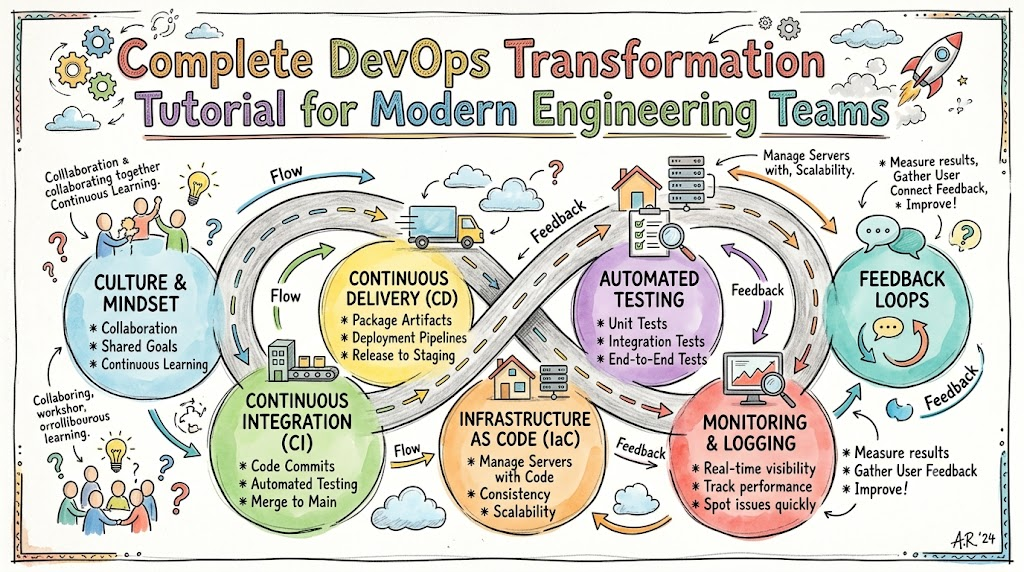
Introduction
Modern software organizations are under constant pressure to release faster, reduce downtime, improve security, control cloud costs, and support distributed engineering teams. DevOps is no longer only a technical practice; it has become a complete operating model for software delivery, infrastructure automation, reliability, security, and continuous improvement.
However, many companies fail at DevOps because they treat it as a tool installation project. They buy CI/CD tools, move workloads to cloud, adopt Kubernetes, or create automation scripts, but still struggle with slow releases, unstable environments, poor monitoring, security gaps, and team silos.
A successful DevOps transformation needs the right combination of people, process, tools, automation, culture, measurement, and expert guidance. This tutorial explains a practical, step-by-step approach to building a mature DevOps ecosystem for real enterprise environments.
What Is DevOps in Real Enterprise Practice?
DevOps is a way of working that brings development, operations, QA, security, cloud, and business teams together to deliver software faster and more reliably. It focuses on automation, collaboration, continuous feedback, and measurable improvement.
In simple terms, DevOps helps organizations move from manual, slow, and risky delivery to automated, repeatable, and reliable software delivery.
A mature DevOps system usually includes:
- Version control for all code and configuration
- Automated build and test pipelines
- Continuous integration and continuous delivery
- Infrastructure as Code
- Containerization and orchestration
- Cloud provisioning and cost control
- Security checks inside delivery pipelines
- Monitoring, logging, tracing, and alerting
- Incident management and reliability practices
- Continuous learning across teams
DevOps is not only about Jenkins, Docker, Kubernetes, Terraform, or AWS. These tools are important, but DevOps success depends on how teams use them to improve speed, quality, security, and reliability.
Why Organizations Need DevOps Transformation
Many organizations start DevOps transformation because they face repeated delivery and operations problems. Common issues include delayed releases, manual deployments, environment mismatch, poor rollback planning, weak testing, unclear ownership, and production incidents.
Without DevOps maturity, software teams often experience:
- Long release cycles
- Frequent deployment failures
- Poor coordination between teams
- Manual approval bottlenecks
- Delayed bug detection
- Unstable infrastructure
- Security checks added too late
- High operational cost
- Lack of production visibility
- Slow incident response
DevOps solves these problems by creating a reliable software delivery system. The goal is not just faster deployment. The real goal is faster, safer, measurable, and sustainable delivery.
A strong DevOps approach helps companies reduce risk, improve engineering productivity, create consistent environments, and build confidence in production releases.
Step 1: Start With DevOps Assessment and Current-State Analysis
Before selecting tools or redesigning pipelines, organizations should first understand their current maturity. A DevOps assessment helps identify gaps across people, process, technology, automation, security, and reliability.
A proper assessment should review:
- Source code management practices
- Branching and merging strategy
- Build process maturity
- Test automation coverage
- Deployment frequency
- Release approval process
- Environment provisioning method
- Infrastructure automation level
- Cloud usage and cost visibility
- Security integration in pipelines
- Monitoring and logging maturity
- Incident response process
- Team ownership and collaboration model
This stage is important because every organization has different problems. Some teams need CI/CD modernization. Some need Kubernetes adoption. Some need cloud migration. Some need SRE practices. Some need DevSecOps maturity.
A good DevOps consultant or trainer does not start by forcing one tool. They first understand business goals, delivery pain points, existing architecture, team skills, and production risks.
Step 2: Build a Strong Source Code and Branching Strategy
Version control is the foundation of DevOps. Without proper source control practices, automation becomes difficult and risky.
Every organization should store application code, infrastructure code, configuration files, pipeline definitions, scripts, Helm charts, Kubernetes manifests, and documentation in version control.
Popular tools include Git, GitHub, GitLab, Bitbucket, Gerrit, and Azure Repos.
A good branching strategy should support:
- Clean collaboration between developers
- Fast code review
- Stable release preparation
- Easy rollback
- Clear traceability
- Automation-friendly workflows
Common branching models include GitFlow, trunk-based development, feature branching, and release branching. For high-performing teams, trunk-based development often works well because it encourages small changes, frequent integration, and faster feedback.
However, the best strategy depends on team size, product complexity, compliance needs, and release frequency.
Step 3: Implement Continuous Integration
Continuous Integration, or CI, means developers frequently merge code into a shared repository where automated builds and tests run quickly.
The goal of CI is simple: detect problems early.
A strong CI pipeline usually includes:
- Code checkout
- Dependency installation
- Static code analysis
- Compilation or build
- Unit testing
- Code quality scanning
- Security scanning
- Artifact creation
- Artifact publishing
Popular CI tools include Jenkins, GitLab CI, GitHub Actions, Azure DevOps, TeamCity, Bamboo, and CircleCI.
Jenkins remains widely used in enterprise environments because of its flexibility, plugin ecosystem, and ability to integrate with many tools. However, modern teams also use GitLab CI, GitHub Actions, and cloud-native CI systems depending on their environment.
A good CI pipeline should be fast, reliable, visible, and repeatable. If CI takes too long or fails randomly, developers stop trusting it. Therefore, pipeline performance and stability are important parts of DevOps maturity.
Step 4: Design Continuous Delivery and Deployment Pipelines
Continuous Delivery means software is always in a deployable state. Continuous Deployment means approved changes can automatically move to production after passing required checks.
A mature delivery pipeline should include:
- Build validation
- Automated testing
- Artifact versioning
- Environment deployment
- Smoke testing
- Security validation
- Approval workflow where needed
- Rollback process
- Deployment audit trail
Deployment strategies may include:
- Rolling deployment
- Blue-green deployment
- Canary deployment
- Feature flag-based deployment
- Progressive delivery
For production systems, safe deployment is more important than blind automation. Teams must design rollback, monitoring, and validation before they automate production releases.
A common mistake is automating deployment without improving testing and observability. This only makes failures faster. A mature DevOps pipeline should make releases faster and safer.
Step 5: Use Infrastructure as Code
Infrastructure as Code, or IaC, allows teams to manage infrastructure using code instead of manual console changes.
IaC improves consistency, repeatability, reviewability, and auditability. It also reduces environment drift between development, testing, staging, and production.
Common IaC tools include:
- Terraform
- Ansible
- CloudFormation
- Pulumi
- Chef
- Puppet
Terraform is widely used for cloud provisioning across AWS, Azure, Google Cloud, Kubernetes, and many third-party platforms. Ansible is commonly used for configuration management, server automation, and application setup.
A strong IaC approach should include:
- Modular code structure
- Naming standards
- Remote state management
- Secure secrets handling
- Code review before changes
- Automated validation
- Environment-specific variables
- Change approval for production
- Drift detection
Infrastructure should be treated like application code. It should be versioned, reviewed, tested, and released through controlled workflows.
Step 6: Adopt Containers and Kubernetes Carefully
Containers help package applications with their dependencies so they can run consistently across environments. Docker made containers practical for many engineering teams, while Kubernetes became the standard platform for managing containerized applications at scale.
Kubernetes helps with:
- Application deployment
- Scaling
- Service discovery
- Load balancing
- Self-healing
- Configuration management
- Secret management
- Rolling updates
- Workload scheduling
However, Kubernetes is powerful but complex. Organizations should not adopt Kubernetes only because it is popular. They should adopt it when they need scalable container orchestration, platform standardization, cloud-native deployment, multi-service architecture, or better workload management.
A practical Kubernetes roadmap should include:
- Container fundamentals
- Docker image creation
- Kubernetes architecture
- Pods, Deployments, and Services
- ConfigMaps and Secrets
- Ingress and networking
- Persistent storage
- Helm charts
- RBAC and security
- Monitoring and logging
- GitOps-based deployment
- Production operations
Kubernetes success requires training, governance, security, cost awareness, and strong operational discipline.
Step 7: Introduce DevSecOps From the Beginning
DevSecOps means integrating security into every stage of the software delivery lifecycle. Instead of checking security only before release, teams build security into planning, coding, building, testing, deployment, and operations.
DevSecOps practices include:
- Secure coding standards
- Dependency scanning
- Static application security testing
- Dynamic application security testing
- Container image scanning
- Infrastructure code scanning
- Secret detection
- Policy as Code
- Runtime security monitoring
- Compliance automation
Security should not slow down delivery. The purpose of DevSecOps is to make security faster, earlier, and more automated.
A mature DevSecOps pipeline helps teams identify vulnerabilities before they reach production. It also improves accountability because developers, operations engineers, security teams, and platform teams work from shared visibility.
Step 8: Build SRE Practices for Reliability
Site Reliability Engineering, or SRE, brings software engineering principles into operations. It focuses on reliability, automation, measurement, incident response, and continuous improvement.
SRE helps organizations answer important questions:
- How reliable should this service be?
- What are the most important user-facing indicators?
- How much downtime or error rate is acceptable?
- When should teams prioritize reliability over new features?
- How should incidents be handled and reviewed?
Core SRE concepts include:
- Service Level Indicators
- Service Level Objectives
- Error budgets
- Incident response
- Post-incident reviews
- Toil reduction
- Automation
- Capacity planning
- Reliability testing
SRE is especially important for cloud-native systems, microservices, SaaS platforms, payment systems, healthcare platforms, financial systems, and any product where downtime directly affects users.
DevOps improves delivery. SRE improves reliability. Together, they create a balanced engineering model.
Step 9: Implement Observability and Monitoring
Monitoring tells teams whether a system is working. Observability helps teams understand why something is happening.
Modern systems generate huge amounts of data across applications, containers, infrastructure, networks, databases, APIs, and cloud services. Without observability, teams struggle to diagnose production problems.
A strong observability stack should include:
- Metrics
- Logs
- Traces
- Dashboards
- Alerts
- Service maps
- User experience monitoring
- Synthetic monitoring
- Business-level indicators
Popular tools include Prometheus, Grafana, ELK Stack, OpenTelemetry, Datadog, New Relic, Splunk, Nagios, and cloud-native monitoring tools.
Good monitoring should focus on user impact, not just server health. For example, CPU usage is useful, but checkout failure rate, API latency, payment success rate, and login error rate are more meaningful for business-critical applications.
Alerting should also be designed carefully. Too many alerts create alert fatigue. Too few alerts create blind spots. The best alerts are actionable, urgent, and tied to real service impact.
Step 10: Use GitOps for Cloud-Native Delivery
GitOps is a modern operating model where Git becomes the source of truth for infrastructure and application deployment.
In a GitOps workflow, teams define the desired state of the system in Git. A GitOps controller then continuously compares the desired state with the actual state and applies changes automatically.
Common GitOps tools include:
- Argo CD
- Flux CD
- GitLab Agent
- Jenkins X
GitOps improves:
- Deployment consistency
- Auditability
- Rollback
- Change tracking
- Security
- Collaboration
- Kubernetes operations
For Kubernetes environments, GitOps is highly useful because Kubernetes itself is declarative. Teams can manage manifests, Helm charts, Kustomize overlays, and environment configurations through Git-based workflows.
GitOps also supports platform engineering because it gives development teams a controlled and repeatable way to request and manage infrastructure changes.
Step 11: Move Toward Platform Engineering
Platform engineering is the next stage of DevOps maturity for many organizations. It focuses on building internal developer platforms that make software delivery easier, safer, and more standardized.
Instead of every team building its own pipelines, infrastructure scripts, deployment templates, and monitoring dashboards, a platform team creates reusable services and golden paths.
A developer platform may include:
- Self-service environment provisioning
- Standard CI/CD templates
- Kubernetes deployment templates
- Approved container base images
- Observability dashboards
- Security scanning workflows
- Secrets management
- Service catalog
- Documentation portal
- Cost visibility
- Compliance controls
Platform engineering does not replace DevOps. It scales DevOps practices across large organizations.
The goal is to reduce cognitive load for developers while maintaining governance, security, and operational reliability.
Step 12: Add CloudOps and FinOps Maturity
Cloud adoption gives organizations flexibility, but it also introduces cost, governance, security, and operational challenges.
CloudOps focuses on managing cloud infrastructure efficiently. FinOps focuses on cloud cost accountability and financial visibility.
CloudOps practices include:
- Cloud architecture standards
- Automated provisioning
- Backup and disaster recovery
- Identity and access management
- Security baseline enforcement
- Cloud monitoring
- Resource tagging
- Capacity planning
- Multi-cloud governance
FinOps practices include:
- Cost allocation
- Budget alerts
- Resource optimization
- Rightsizing
- Reserved instance planning
- Cloud waste reduction
- Team-level cost visibility
A mature DevOps transformation should include cloud cost awareness from the beginning. Otherwise, automation may create faster delivery but uncontrolled spending.
Step 13: Prepare for AIOps and MLOps
As environments become more complex, many organizations are adopting AIOps and MLOps practices.
AIOps applies AI and automation to IT operations. It helps with anomaly detection, alert correlation, incident prediction, root cause analysis, and automated remediation.
MLOps applies DevOps principles to machine learning systems. It helps teams manage data pipelines, model training, model deployment, monitoring, versioning, and governance.
AIOps and MLOps are important because modern businesses increasingly depend on AI-driven systems, data pipelines, and intelligent automation.
However, teams should not jump into AIOps or MLOps without DevOps basics. Strong CI/CD, observability, cloud automation, security, and platform engineering practices create the foundation for successful AI-driven operations.
DevOps Transformation Roadmap
A practical DevOps roadmap can be divided into five maturity levels.
| Maturity Level | Focus Area | Key Outcome |
|---|---|---|
| Level 1 | Source control and basic CI | Code is versioned and builds are automated |
| Level 2 | CI/CD and test automation | Releases become faster and safer |
| Level 3 | IaC, containers, and cloud automation | Environments become consistent and repeatable |
| Level 4 | Kubernetes, DevSecOps, and observability | Production systems become scalable, secure, and visible |
| Level 5 | SRE, GitOps, platform engineering, AIOps | Teams achieve mature reliability and self-service delivery |
This roadmap should not be treated as a rigid sequence. Some organizations may already have Kubernetes but poor CI/CD. Others may have cloud automation but weak observability. The roadmap should be customized based on the current-state assessment.
DevOps Tools Comparison
| Category | Common Tools | Purpose |
| Version Control | Git, GitHub, GitLab, Bitbucket | Code collaboration and change tracking |
| CI/CD | Jenkins, GitLab CI, GitHub Actions, Azure DevOps | Build, test, and deployment automation |
| Containers | Docker, Podman | Application packaging |
| Orchestration | Kubernetes, OpenShift, EKS, AKS, GKE | Container management at scale |
| IaC | Terraform, Ansible, CloudFormation | Infrastructure automation |
| Monitoring | Prometheus, Grafana, ELK, Datadog, New Relic | System visibility and alerting |
| Security | SonarQube, Trivy, Snyk, Checkov | Code and infrastructure security |
| GitOps | Argo CD, Flux CD | Declarative deployment automation |
| Cloud | AWS, Azure, Google Cloud | Scalable infrastructure and services |
The right tool depends on team skill, business requirement, existing ecosystem, compliance needs, and long-term maintainability.
Role of a DevOps Trainer and Consultant
A DevOps trainer helps engineers, managers, and teams learn modern DevOps practices through structured training, hands-on labs, real-world examples, and guided learning paths.
A DevOps consultant helps organizations design and implement DevOps transformation in real environments.
The trainer improves skills. The consultant improves systems.
In many enterprise situations, both roles are needed. Teams need training to understand tools and principles. Organizations need consulting to apply those practices correctly across architecture, security, cloud, CI/CD, Kubernetes, and operations.
A strong DevOps trainer and consultant should bring:
- Real production experience
- Tool expertise
- Architecture understanding
- Coaching ability
- Enterprise transformation experience
- Security awareness
- Cloud and Kubernetes knowledge
- SRE and observability maturity
- Ability to simplify complex topics
This is where expert-led guidance becomes valuable, especially for teams moving from traditional IT operations to modern cloud-native engineering.
Why Expert Guidance Matters in DevOps Adoption
DevOps transformation is complex because it touches many areas at once. It changes how teams write code, test applications, provision infrastructure, deploy software, monitor production, respond to incidents, and manage security.
Without experienced guidance, organizations may face:
- Wrong tool selection
- Overcomplicated Kubernetes setup
- Poor pipeline design
- Weak security controls
- High cloud cost
- Failed automation
- Low team adoption
- Lack of measurable improvement
An experienced DevOps consultant can help avoid these mistakes by creating a practical roadmap, selecting the right tools, training teams, designing automation workflows, and aligning technology with business goals.
The best DevOps transformation is not the one with the most tools. It is the one that improves delivery speed, reliability, security, cost efficiency, and developer productivity.
Common DevOps Mistakes to Avoid
Treating DevOps as Only a Toolchain
Tools are important, but DevOps is mainly about improving how teams work. Installing Jenkins or Kubernetes does not automatically create DevOps maturity.
Ignoring Culture and Ownership
If development and operations teams still blame each other, automation alone will not solve the problem. Teams need shared ownership and shared goals.
Automating Broken Processes
Automation should improve a process, not hide its weakness. Before automation, teams should simplify and standardize workflows.
Skipping Security
Security should not be added at the end. DevSecOps should be included from planning to production.
Poor Monitoring
Without observability, teams cannot confidently run modern distributed systems.
Overusing Kubernetes
Kubernetes is powerful, but it is not always required for every application. Teams should adopt it with clear use cases and proper skills.
No Measurement
DevOps improvement must be measured. Teams should track deployment frequency, lead time, change failure rate, recovery time, reliability, and customer impact.
Practical DevOps Learning Path for Engineers
For engineers who want to build a strong DevOps career, the learning path should be practical and progressive.
Beginner Level
Start with:
- Linux basics
- Networking basics
- Git and GitHub
- Shell scripting
- Build tools
- Basic CI/CD concepts
Intermediate Level
Move to:
- Jenkins or GitLab CI
- Docker
- Kubernetes basics
- Terraform
- Ansible
- AWS, Azure, or Google Cloud
- Monitoring basics
Advanced Level
Learn:
- Kubernetes production operations
- Helm
- GitOps
- DevSecOps
- SRE
- Observability
- Cloud cost optimization
- Platform engineering
- AIOps and MLOps foundations
Professional Level
Focus on:
- Enterprise architecture
- Multi-cloud strategy
- Security governance
- Incident management
- Internal developer platforms
- Team mentoring
- Transformation leadership
This learning path helps professionals move from tool users to DevOps engineers, then to SREs, platform engineers, DevSecOps engineers, cloud architects, and DevOps consultants.
Practical DevOps Transformation Checklist
Before starting a DevOps transformation, organizations can use this checklist:
- Is all code stored in version control?
- Are builds automated?
- Are tests automated?
- Are artifacts versioned?
- Are deployments repeatable?
- Is infrastructure managed as code?
- Are secrets managed securely?
- Are environments consistent?
- Are containers scanned?
- Are pipelines monitored?
- Are production metrics visible?
- Are logs centralized?
- Are alerts meaningful?
- Are SLOs defined?
- Are incidents reviewed?
- Are cloud costs tracked?
- Are teams trained?
- Is there a clear platform strategy?
If the answer is “no” for many of these questions, the organization needs a structured DevOps roadmap.
How to Choose the Right DevOps Training or Consulting Partner
Choosing the right DevOps trainer or consultant is important because poor guidance can lead to wasted time, wrong architecture, and low adoption.
Organizations should evaluate:
- Real-world project experience
- Enterprise DevOps background
- Training and mentoring ability
- Cloud and Kubernetes expertise
- CI/CD implementation experience
- Security and compliance knowledge
- SRE and observability understanding
- Ability to customize training
- Practical hands-on labs
- Post-training support
- Consulting roadmap capability
The best partner should be able to explain complex topics simply, connect tools to business outcomes, and guide both engineers and managers.
Conclusion
DevOps transformation is not a one-time project. It is a continuous journey toward better software delivery, stronger reliability, improved security, faster feedback, and higher engineering maturity.
Organizations that succeed with DevOps do not focus only on tools. They build the right culture, automate the right processes, measure the right outcomes, and train teams to operate modern systems confidently.
A complete DevOps roadmap should include CI/CD, Infrastructure as Code, containers, Kubernetes, cloud automation, DevSecOps, SRE, observability, GitOps, platform engineering, FinOps, AIOps, and MLOps readiness.
For companies planning serious DevOps adoption, expert-led training and consulting can reduce mistakes, accelerate implementation, and help teams build long-term capability. The goal is not just to deploy faster. The goal is to deliver better software with confidence, security, reliability, and continuous improvement.
FAQs
1. What is DevOps transformation?
DevOps transformation is the process of improving software delivery by combining automation, collaboration, CI/CD, cloud practices, monitoring, security, and reliability engineering.
2. Is DevOps only for large companies?
No. DevOps is useful for startups, mid-size companies, and enterprises. The tools and roadmap may differ, but the principles are useful for any software team.
3. What is the first step in DevOps adoption?
The first step is a current-state assessment. Teams should understand existing gaps before choosing tools or redesigning pipelines.
4. Which tools are important for DevOps?
Common tools include Git, Jenkins, GitLab CI, Docker, Kubernetes, Terraform, Ansible, Prometheus, Grafana, ELK, SonarQube, Argo CD, AWS, Azure, and Google Cloud.
5. Is Kubernetes required for DevOps?
No. Kubernetes is useful for container orchestration, but DevOps can start with source control, CI/CD, automation, testing, and monitoring before Kubernetes adoption.
6. What is the difference between DevOps and SRE?
DevOps focuses on collaboration and delivery automation. SRE focuses on reliability, SLOs, error budgets, automation, and incident management. Both complement each other.
7. Why is DevSecOps important?
DevSecOps helps teams integrate security early in the software lifecycle. It reduces risk by automating security checks in code, pipelines, containers, infrastructure, and runtime systems.
8. What is platform engineering?
Platform engineering focuses on building internal developer platforms that provide reusable tools, templates, automation, and self-service workflows for engineering teams.
9. How long does DevOps transformation take?
The timeline depends on team size, current maturity, architecture, tools, and business goals. DevOps is a continuous improvement journey, not a fixed-duration activity.
10. Who should attend DevOps training?
Software engineers, system administrators, cloud engineers, QA engineers, release managers, SREs, security engineers, platform engineers, managers, and architects can benefit from DevOps training.

I enjoyed reading this article because it explains the DevOps transformation journey in a simple and structured way. The focus on collaboration, automation, and continuous improvement makes it valuable for both beginners and experienced engineering professionals. Great insights
I really liked how the DevOps transformation journey is explained step by step instead of focusing only on tools. The content is easy to understand, practical, and useful for both beginners and experienced professionals. Thanks for sharing such a valuable guide
I really enjoyed reading this blog. It explains the DevOps transformation journey in a clear and practical way, making even complex concepts easier to understand. The focus on collaboration, automation, and continuous improvement makes it a valuable resource for engineering teams looking to adopt modern DevOps practices. Thanks for sharing such informative content
I like that the article focuses on the bigger picture of DevOps transformation rather than just the tools. The explanations are clear, practical, and easy to relate to, making it a useful resource for teams looking to improve their development and delivery process.
This is an outstanding and well-structured DevOps guide. I really appreciate how the article explains the complete transformation journey—from CI/CD and Infrastructure as Code to Kubernetes, DevSecOps, observability, SRE, and platform engineering—in a practical and easy-to-understand way. It focuses on real-world implementation rather than just tools, making it valuable for both beginners and experienced IT professionals.