Introduction
Online course marketplaces have made professional development, academic learning, and personal skill building more accessible.
Instead of attending a traditional classroom, learners can explore courses covering programming, business, design, marketing, languages, and many other subjects.
These platforms connect learners with instructors, universities, training organizations, or educational publishers.
However, online course marketplaces differ significantly in their business models and educational offerings.
Some provide individual courses purchased separately. Others emphasize subscriptions, university partnerships, professional certificates, or creative learning communities.
The quality of courses also varies. A large catalog does not guarantee accurate information, effective instruction, or recognized credentials.
This guide compares ten online course marketplaces and explains how learners and organizations can choose suitable platforms.
What Are Online Course Marketplaces?
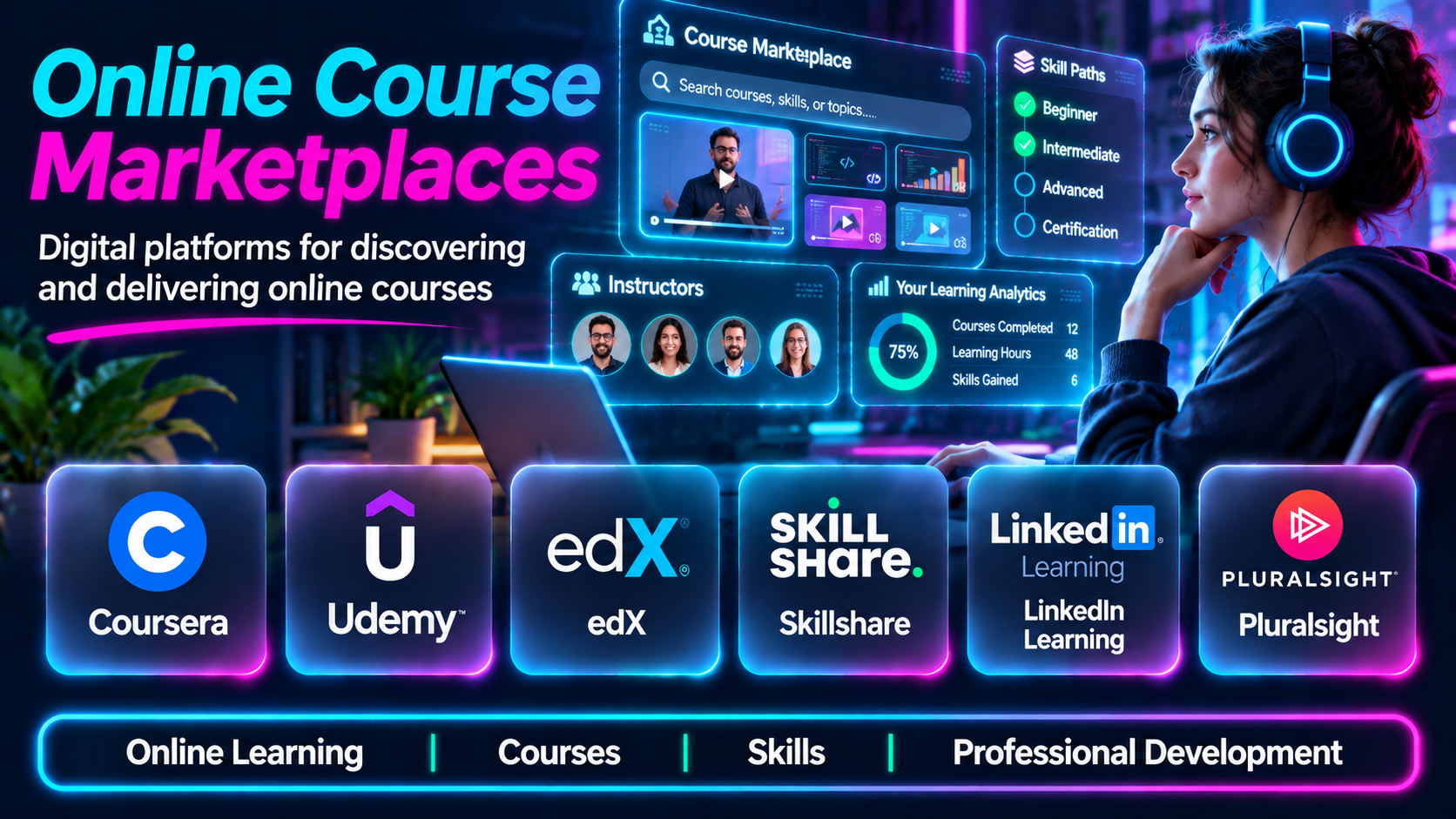
Online course marketplaces are digital platforms that help learners discover, purchase, subscribe to, or access educational courses.
They typically provide course catalogs, video lessons, learning resources, reviews, progress tracking, and payment systems.
Some platforms also provide quizzes, assignments, certificates, community discussions, or instructor feedback.
The marketplace model differs from a learning management system. A marketplace primarily helps learners discover educational offerings, while an LMS primarily manages learning delivery for a particular organization.
Some platforms combine both functions.
Top 10 Online Course Marketplaces
1. Udemy
Short Description
Udemy is a large online learning marketplace offering courses across professional, technical, and personal interest subjects.
Independent instructors create many of the courses available on the platform.
A professional may use Udemy to learn spreadsheet automation, programming fundamentals, or digital marketing.
Its broad catalog makes it useful for exploring practical topics at different skill levels.
However, course quality varies because content is created by many different instructors.
Learners should examine course outlines, instructor qualifications, recent updates, and reviews before purchasing.
Key Features
- Broad Course Catalog: Covers numerous professional and personal learning subjects.
- Individual Course Purchases: Supports access to selected courses under applicable purchase terms.
- Video Lessons: Provides structured instructional videos.
- Learner Reviews: Helps users evaluate course experiences.
- Course Previews: Allows inspection of selected lesson content.
- Progress Tracking: Records learning activity.
- Mobile Learning: Supports compatible mobile applications.
- Instructor Resources: Provides tools for course creators.
- Business Learning Offerings: Supports organizational training through separate services.
Benefits
Udemy offers flexible access to practical courses across many subjects.
Pros
- Large catalog.
- Broad skill coverage.
- Flexible learning.
- Frequent promotional pricing.
- Many practical topics.
Cons
- Variable course quality.
- Credentials may have limited formal recognition.
- Course freshness varies.
- Limited personalized instruction.
Use Cases
Professional upskilling, programming, business skills, and personal learning.
Best For: Learners seeking flexible individual courses.
2. Coursera
Short Description
Coursera provides online courses and educational programs developed with universities, companies, and other partners.
Its catalog includes individual courses, professional certificates, specializations, and selected degree programs.
A learner may use Coursera to develop data analysis skills through a structured certificate program.
Its institutional partnerships distinguish it from marketplaces dominated by independent instructors.
However, pricing, assessment requirements, credential recognition, and program availability differ across offerings.
Key Features
- University and industry courses.
- Professional certificates.
- Specializations.
- Selected degree programs.
- Video learning.
- Quizzes and assignments.
- Progress tracking.
- Structured learning pathways.
- Financial assistance options for eligible offerings.
Benefits
Coursera provides access to structured education from recognized institutional partners.
Pros
- Institutional partnerships.
- Professional certificates.
- Structured pathways.
- Academic subjects.
- Career-oriented programs.
Cons
- Pricing varies.
- Some programs require substantial time.
- Credentials are not universally recognized.
- Assessment requirements differ.
Use Cases
Career development, university-level learning, and professional certification preparation.
Best For: Learners seeking structured academic or career-oriented programs.
3. edX
Short Description
edX provides online courses and programs associated with universities and educational institutions.
Its offerings include academic subjects, professional development, and selected credential pathways.
A student may use edX to study computer science or mathematics through courses developed by institutional partners.
The platform is especially relevant to learners seeking academically oriented content.
However, not every course offers the same assessment experience, certificate terms, or enrollment conditions.
Key Features
- University-associated courses.
- Academic subjects.
- Professional learning programs.
- Video lessons.
- Assignments.
- Assessments.
- Certificates for eligible courses.
- Structured programs.
- Online learning access.
Benefits
edX expands access to academic and professional education.
Pros
- Academic content.
- Institutional partnerships.
- Structured programs.
- Broad subjects.
- Flexible online access.
Cons
- Program pricing varies.
- Credential conditions differ.
- Some courses require significant commitment.
- Limited direct instructor interaction in some offerings.
Use Cases
University-level learning, technical education, and professional development.
Best For: Learners seeking academically oriented online courses.
4. Skillshare
Short Description
Skillshare is an online learning platform emphasizing creative skills and project-based education.
Its catalog includes design, illustration, photography, video production, and related subjects.
A graphic designer may use Skillshare to learn a new illustration technique and apply it through a class project.
The platform’s creative focus makes it distinct from academic course marketplaces.
However, learners seeking formal credentials or advanced technical certifications may need another platform.
Key Features
- Creative course catalog.
- Video classes.
- Project-based learning.
- Instructor-led content.
- Creative community.
- Subscription access.
- Class discovery.
- Mobile learning.
- Personal skill development.
Benefits
Skillshare encourages practical creative learning through projects.
Pros
- Strong creative subjects.
- Project orientation.
- Accessible lessons.
- Broad creative community.
- Flexible exploration.
Cons
- Subscription model.
- Limited formal credentials.
- Variable course depth.
- Less suited to academic degrees.
Use Cases
Illustration, photography, design, and creative professional development.
Best For: Creative professionals and hobbyists.
5. LinkedIn Learning
Short Description
LinkedIn Learning provides professional development courses across business, technology, and creative disciplines.
Its catalog emphasizes workplace skills and career development.
An employee may use LinkedIn Learning to improve project management, communication, or spreadsheet skills.
Its integration with the LinkedIn ecosystem makes it relevant to professionals and organizational learning programs.
However, course completion certificates should not be confused with independent professional certifications.
Key Features
- Professional skills courses.
- Business learning.
- Technology training.
- Creative subjects.
- Learning paths.
- Progress tracking.
- Completion certificates.
- Organizational learning options.
- LinkedIn ecosystem integration.
Benefits
LinkedIn Learning provides structured workplace skill development.
Pros
- Career-oriented content.
- Broad professional topics.
- Learning paths.
- Business integration.
- Convenient access.
Cons
- Subscription costs.
- Limited formal accreditation.
- Course depth varies.
- Less focused on academic study.
Use Cases
Employee training, career development, and professional upskilling.
Best For: Working professionals and corporate learners.
6. Domestika
Short Description
Domestika is an online learning marketplace with a strong focus on creative disciplines.
Its courses often emphasize visual design, crafts, illustration, photography, and creative production.
A designer may use Domestika to learn a specialized artistic technique from an experienced practitioner.
Its curated creative presentation can make it attractive to learners seeking project-based instruction.
However, course language, subtitles, access terms, and subscription conditions should be reviewed carefully.
Key Features
- Creative course catalog.
- Video instruction.
- Project-based classes.
- Instructor-led lessons.
- Creative disciplines.
- Learning resources.
- Course discovery.
- Community features.
- Multilingual course options.
Benefits
Domestika provides specialized learning opportunities for creative skills.
Pros
- Strong creative focus.
- Specialized instructors.
- Project-based learning.
- Attractive instructional content.
- Diverse creative topics.
Cons
- Limited academic coverage.
- Course language differences.
- Access and pricing terms vary.
- Credentials have limited formal recognition.
Use Cases
Graphic design, illustration, crafts, and photography.
Best For: Learners developing specialized creative skills.
7. FutureLearn
Short Description
FutureLearn provides online courses and educational programs developed with universities and other organizations.
It emphasizes structured online learning across academic and professional subjects.
A learner may use FutureLearn to study healthcare, business, or social science topics.
Its institutional course partnerships make it relevant to learners seeking guided educational content.
However, course access periods, certificates, and subscription terms vary by offering.
Key Features
- Partner-created courses.
- Academic learning.
- Professional subjects.
- Structured course modules.
- Discussion activities.
- Assessments.
- Certificates for eligible offerings.
- Online learning pathways.
- Flexible study options.
Benefits
FutureLearn provides structured educational content from institutional partners.
Pros
- University partnerships.
- Academic subjects.
- Structured learning.
- Discussion-based activities.
- Professional programs.
Cons
- Access restrictions may apply.
- Pricing varies.
- Credential recognition differs.
- Program availability changes.
Use Cases
Academic enrichment, professional development, and continuing education.
Best For: Learners seeking structured institution-led courses.
8. Pluralsight
Short Description
Pluralsight is a technology skills learning platform emphasizing software development, IT operations, cloud computing, and related disciplines.
It is particularly relevant to technical professionals seeking structured skill development.
A software engineer may use Pluralsight to strengthen cloud architecture or programming knowledge.
Its technology focus distinguishes it from broad consumer course marketplaces.
However, it is a subscription-oriented skills platform rather than a conventional open instructor marketplace.
Key Features
- Technology course catalog.
- Software development training.
- Cloud computing topics.
- IT operations education.
- Skill assessments.
- Learning paths.
- Progress tracking.
- Organizational training.
- Technical learning resources.
Benefits
Pluralsight provides focused learning pathways for technology professionals.
Pros
- Technical specialization.
- Structured learning paths.
- Skills assessment.
- Professional relevance.
- Organizational options.
Cons
- Subscription costs.
- Narrower nontechnical coverage.
- Course freshness varies.
- Hands-on practice may require separate environments.
Use Cases
Software development, cloud engineering, cybersecurity, and IT training.
Best For: Technology professionals.
9. DataCamp
Short Description
DataCamp is an online learning platform specializing in data science, analytics, and related technical skills.
It combines instructional content with interactive coding exercises.
A business analyst may use DataCamp to learn Python, SQL, or data visualization.
Its interactive practice distinguishes it from platforms relying mainly on video lessons.
However, advanced real-world projects may require additional independent work beyond guided exercises.
Key Features
- Data science courses.
- Python education.
- SQL learning.
- Interactive exercises.
- Skill tracks.
- Career tracks.
- Progress tracking.
- Practice activities.
- Organizational learning options.
Benefits
DataCamp supports hands-on learning in data and analytics.
Pros
- Interactive coding.
- Data specialization.
- Structured pathways.
- Practical exercises.
- Beginner accessibility.
Cons
- Subscription costs.
- Limited non-data subjects.
- Guided exercises may simplify real work.
- Credentials vary in recognition.
Use Cases
Data analysis, SQL training, Python learning, and analytics development.
Best For: Data professionals and aspiring analysts.
10. Udacity
Short Description
Udacity provides technology-oriented learning programs emphasizing career-related technical skills.
Its offerings have included structured programs in programming, data science, artificial intelligence, and related fields.
A learner may use Udacity to complete a project-based technical training program.
Its focus on career-oriented projects makes it relevant to learners seeking practical portfolios.
However, program availability, mentoring arrangements, pricing, and ownership-related changes should be verified before enrollment.
Key Features
- Technology programs.
- Project-based learning.
- Career-oriented curricula.
- Programming education.
- Data and AI subjects.
- Structured learning paths.
- Project assessments.
- Learning resources.
- Selected learner support services.
Benefits
Udacity emphasizes practical technical projects and structured skill development.
Pros
- Career-oriented.
- Technical specialization.
- Project-based learning.
- Structured programs.
- Portfolio potential.
Cons
- Program costs.
- Offering availability varies.
- Time commitment.
- Support features differ by program.
Use Cases
Career transitions, technical upskilling, and portfolio development.
Best For: Learners pursuing structured technology training.
Online Course Marketplaces Comparison Table
| Platform | Main Focus | Best For | Main Consideration |
|---|---|---|---|
| Udemy | Broad independent courses | Flexible learners | Quality variation |
| Coursera | Institutional programs | Career credentials | Program pricing |
| edX | Academic courses | University-level learners | Credential conditions |
| Skillshare | Creative skills | Designers | Subscription |
| LinkedIn Learning | Workplace skills | Professionals | Limited formal accreditation |
| Domestika | Creative specialization | Artists | Language and access terms |
| FutureLearn | Partner courses | Academic learners | Access periods |
| Pluralsight | Technology skills | IT professionals | Technical focus |
| DataCamp | Data and analytics | Analysts | Narrow subject focus |
| Udacity | Project-based technology | Career changers | Program costs |
How to Choose the Right Online Course Marketplace
1. Define the Learning Goal
Decide whether you need a specific skill, career credential, academic knowledge, or personal enrichment.
2. Evaluate Instructor Expertise
Review relevant experience and teaching quality.
3. Inspect the Course Curriculum
A detailed outline helps determine whether the content meets your needs.
4. Check Course Freshness
Technical courses can become outdated as tools and practices change.
5. Review Practical Exercises
Projects and assessments help reinforce learning.
6. Understand Credential Value
Course completion certificates are not necessarily accredited qualifications.
7. Compare Pricing Models
Consider individual purchases, subscriptions, and program fees.
8. Review Access Terms
Some platforms limit access after a subscription ends.
9. Evaluate Learning Support
Look for discussion forums, instructor interaction, or feedback when needed.
10. Consider Long-Term Progression
Choose a platform that supports learning beyond one introductory course.
Best Online Course Marketplace by User Type
| User Type | Recommended Platform | Reason |
|---|---|---|
| General learner | Udemy | Broad catalog |
| Career certificate learner | Coursera | Structured programs |
| Academic learner | edX | University-associated courses |
| Creative hobbyist | Skillshare | Creative classes |
| Working professional | LinkedIn Learning | Workplace skills |
| Creative specialist | Domestika | Focused creative training |
| Continuing education learner | FutureLearn | Institutional courses |
| Software engineer | Pluralsight | Technical training |
| Data analyst | DataCamp | Interactive practice |
| Technology career changer | Udacity | Project-based programs |
Practical Example: Choosing an Online Python Course
Step 1: Define your goal, such as learning Python for data analysis.
Step 2: Identify your current programming experience.
Step 3: Compare beginner courses across suitable platforms.
Step 4: Review course outlines.
Step 5: Check instructor experience.
Step 6: Look for recent content updates.
Step 7: Inspect sample lessons.
Step 8: Confirm that exercises are included.
Step 9: Compare total costs and access terms.
Step 10: Select a course and establish a weekly schedule.
Step 11: Complete independent coding projects.
Step 12: Evaluate progress using practical tasks rather than certificates alone.
Frequently Asked Questions
1. What is an online course marketplace?
A platform where learners discover and access educational courses.
2. How does it differ from an LMS?
A marketplace focuses on course discovery, while an LMS manages learning delivery.
3. Are online courses effective?
They can be effective when learners engage actively and practice skills.
4. Are online course certificates accredited?
Some credentials have formal recognition, but many are completion certificates.
5. What is a professional certificate?
A structured learning credential designed around selected professional skills.
6. What is a specialization?
A sequence of related courses.
7. What is self-paced learning?
Studying according to an individual schedule.
8. Are free online courses available?
Yes, although access and certificate terms vary.
9. What is a subscription course platform?
A service that provides course access through recurring payment.
10. Can learners buy individual courses?
Some platforms support individual purchases.
11. What is a course preview?
A sample lesson available before enrollment.
12. Why do instructor qualifications matter?
They help establish subject expertise and credibility.
13. Are course reviews reliable?
They are useful signals but should not be the only selection factor.
14. Can online courses support career changes?
Yes, especially when combined with projects and practical experience.
15. What is project-based learning?
Learning through the completion of practical projects.
16. Do online courses include assignments?
Many do.
17. Can students learn programming online?
Yes.
18. Are creative skills suitable for online learning?
Many creative skills can be taught through demonstrations and practice.
19. What is a learning path?
An organized sequence of courses or activities.
20. Can companies use course marketplaces?
Many platforms offer organizational learning products.
21. What is a completion certificate?
A record that a learner has completed defined course requirements.
22. Does a certificate guarantee employment?
No.
23. How important is course freshness?
Very important for rapidly changing technical subjects.
24. Can courses be accessed on mobile devices?
Many platforms provide mobile applications.
25. What is an interactive coding exercise?
A programming task completed within a digital learning environment.
26. Are university-partnered courses always accredited?
No. Accreditation depends on the specific program.
27. How should course costs be compared?
Evaluate total fees, access periods, and included services.
28. Can learners receive instructor feedback?
Some programs provide feedback, but availability varies.
29. What should learners do after finishing a course?
Apply the knowledge through independent projects or practical work.
30. Which online course marketplace is best?
The best choice depends on subject, learning style, credential needs, and budget.
Final Thoughts
Online course marketplaces provide flexible ways to develop skills and explore new subjects.
Udemy offers broad course selection, while Coursera, edX, and FutureLearn emphasize institutional educational programs.
Skillshare and Domestika focus on creative learning. LinkedIn Learning supports professional development.
Pluralsight, DataCamp, and Udacity provide more specialized technology-oriented pathways.
Learners should prioritize course quality, practical application, and realistic learning outcomes over catalog size or marketing claims.
