Introduction
Voice communication remains essential for customer service, appointment scheduling, sales, and business operations. Traditional phone automation can handle structured requests, but callers often find rigid menus and repetitive prompts frustrating.
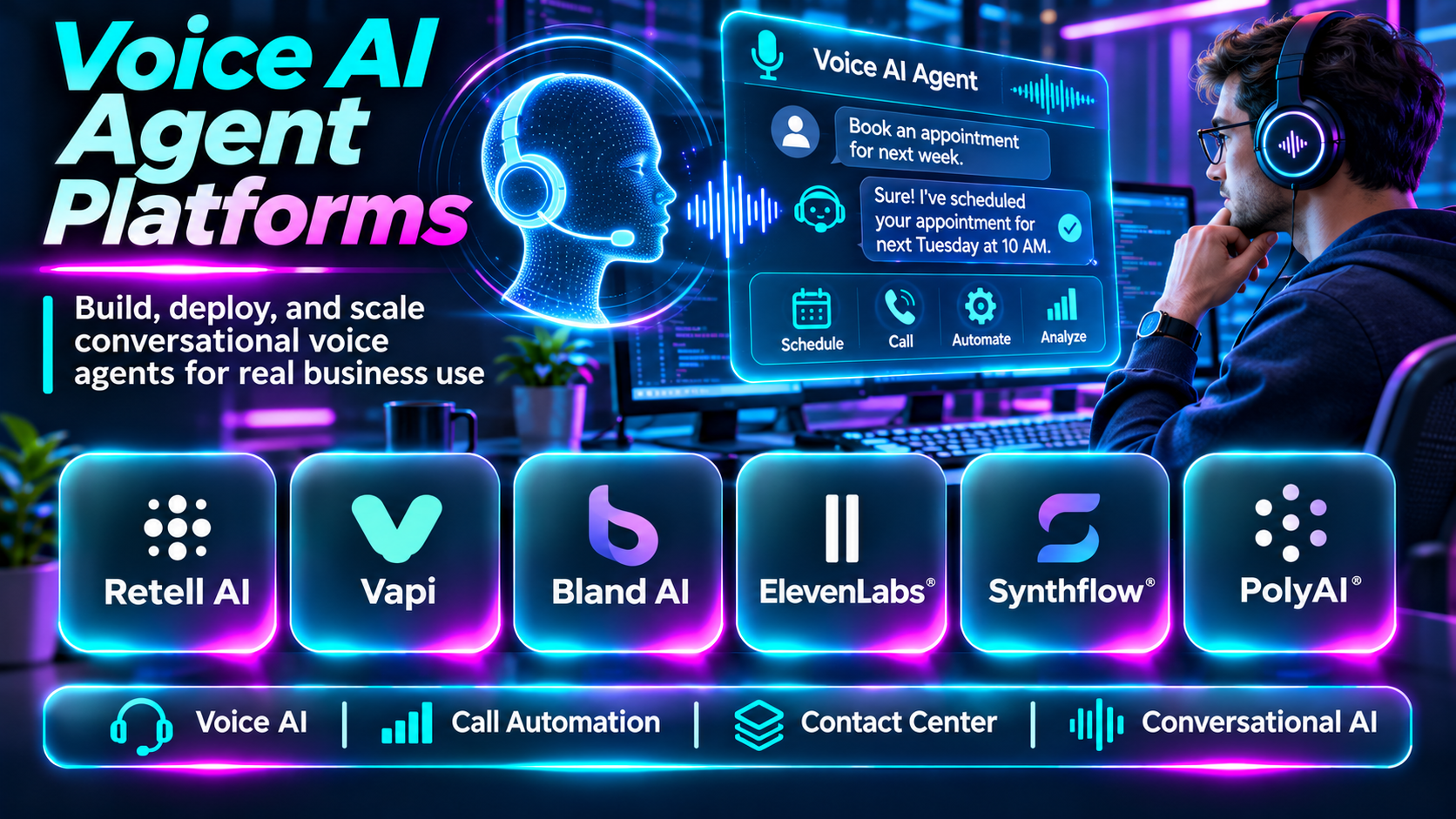
Voice AI agent platforms introduce more flexible conversational experiences. They combine speech recognition, language understanding, dialogue management, and speech generation to support spoken interactions.
Some platforms provide managed voice agents, while others supply APIs and infrastructure for developers building custom applications.
Selecting a platform requires careful evaluation of latency, speech accuracy, call quality, integration reliability, privacy, and human escalation.
This guide compares ten voice AI agent platforms and explains their practical strengths.
What Are Voice AI Agent Platforms?
Voice AI agent platforms enable software to conduct spoken conversations with people.
A typical system processes incoming audio, interprets the caller’s request, determines the next action, and produces a spoken response.
Some architectures use separate speech recognition, language models, and text-to-speech systems. Others use more integrated real-time audio models.
Voice AI agents may answer questions, gather information, schedule appointments, route calls, or execute authorized business workflows.
Unlike traditional IVR menus, conversational voice agents can often accept naturally phrased requests.
However, natural speech alone does not guarantee reliable service. Voice systems must handle interruptions, background noise, unclear information, and situations requiring human assistance.
Top 10 Voice AI Agent Platforms
1. Retell AI
Short Description
Retell AI is a platform for building conversational voice agents for phone-based and related voice interactions.
It provides tools for configuring voice agents and connecting them with telephony and business workflows.
Retell AI is particularly relevant to teams building automated inbound or outbound calling experiences where natural conversation and response speed matter.
Key Features
- Voice agent configuration: Defines agent behavior and conversation objectives.
- Telephony integration: Supports phone-based interactions.
- Conversational speech: Enables spoken exchanges.
- Interruption handling: Supports natural turn-taking.
- Workflow integration: Connects agents with external systems.
- Call monitoring: Provides visibility into interactions.
- Agent testing: Supports evaluation before deployment.
- Operational analytics: Helps teams assess call performance.
Benefits
Retell AI reduces the infrastructure required to build and operate voice agents.
Pros
- Voice-agent focus.
- Telephony capabilities.
- Developer integration options.
- Conversational workflows.
- Useful for phone automation.
Cons
- Usage-based costs require planning.
- Call quality depends on network and configuration.
- Complex workflows need engineering.
- Compliance requirements remain the operator’s responsibility.
Use Cases
Appointment booking, call routing, customer support, and lead qualification.
Best For: Teams developing phone-based AI agents.
2. Vapi
Short Description
Vapi provides developer-oriented infrastructure for building voice AI agents.
It helps developers coordinate speech, language models, telephony, and business integrations.
Vapi is particularly relevant when organizations want flexibility in how they configure conversational components.
Key Features
- Voice agent APIs.
- Telephony integration.
- Model and provider configuration.
- Speech processing.
- Function calling.
- Conversation orchestration.
- Call event handling.
- Developer tooling.
Benefits
Vapi provides a programmable foundation for custom voice applications.
Pros
- Developer flexibility.
- Integration-oriented architecture.
- Configurable voice stack.
- Suitable for custom applications.
- Supports workflow actions.
Cons
- Requires technical expertise.
- Multiple providers may affect cost.
- Performance depends on configuration.
- Operational testing is essential.
Use Cases
Custom AI receptionists, phone assistants, and conversational applications.
Best For: Developers building flexible voice systems.
3. Bland AI
Short Description
Bland AI focuses on AI-powered phone conversations and automated calling workflows.
It is relevant to organizations seeking programmable voice interactions connected to business processes.
Its suitability depends on the intended calling scenario, compliance requirements, and operational controls.
Key Features
- AI phone conversations.
- Outbound calling workflows.
- Inbound call handling.
- API integrations.
- Conversation configuration.
- Call data capture.
- Workflow actions.
- Call monitoring.
Benefits
Bland AI supports automation of structured phone-based business interactions.
Pros
- Phone automation focus.
- API connectivity.
- Configurable call flows.
- Useful for operational workflows.
- Supports automated conversations.
Cons
- Calling regulations must be respected.
- Usage costs can grow.
- Complex exceptions require humans.
- Careful testing is necessary.
Use Cases
Approved customer outreach, appointment confirmation, and inbound service calls.
Best For: Businesses implementing phone automation.
4. ElevenLabs Conversational AI
Short Description
ElevenLabs offers conversational AI capabilities alongside its speech technology.
Its voice agent functionality is relevant to applications where natural-sounding speech and voice presentation are important.
Organizations can use it to build spoken assistants connected to knowledge and application workflows.
Key Features
- Conversational voice agents.
- Speech synthesis.
- Voice selection.
- Multilingual speech capabilities.
- Knowledge integration.
- Tool connections.
- Agent configuration.
- Conversation monitoring.
Benefits
ElevenLabs supports expressive spoken interfaces for customer-facing applications.
Pros
- Strong speech technology focus.
- Voice customization.
- Conversational capabilities.
- Multilingual applications.
- Useful developer integrations.
Cons
- Voice quality alone does not guarantee task accuracy.
- Commercial usage costs.
- Telephony requirements must be reviewed.
- Voice identity and consent need governance.
Use Cases
Voice assistants, customer interactions, and interactive spoken applications.
Best For: Teams prioritizing voice quality.
5. Synthflow
Short Description
Synthflow is a voice AI platform oriented toward creating automated calling agents and business workflows.
Its approach is relevant to teams seeking to configure voice interactions without developing every component from scratch.
Synthflow is especially useful for operational use cases such as scheduling and customer inquiry handling.
Key Features
- Voice agent creation.
- Phone automation.
- Conversation configuration.
- Business integrations.
- Scheduling workflows.
- Call routing.
- Agent analytics.
- Workflow automation.
Benefits
Synthflow simplifies the setup of common business voice agent scenarios.
Pros
- Business workflow orientation.
- Voice automation.
- Configurable agents.
- Useful scheduling scenarios.
- Reduced custom development.
Cons
- Advanced customization may require additional work.
- Commercial pricing.
- Integration compatibility must be checked.
- Complex conversations need escalation.
Use Cases
Appointment booking, reception, and service inquiries.
Best For: Businesses seeking managed voice automation.
6. PolyAI
Short Description
PolyAI provides enterprise conversational voice assistants focused on customer service environments.
It is particularly relevant to organizations managing substantial inbound call volumes and complex service requirements.
PolyAI’s enterprise approach emphasizes conversational experiences integrated with contact center operations.
Key Features
- Conversational voice assistance.
- Contact center integration.
- Customer service automation.
- Natural-language interaction.
- Call routing.
- Workflow integration.
- Conversation analytics.
- Enterprise deployment support.
Benefits
PolyAI helps contact centers automate recurring spoken service interactions.
Pros
- Enterprise voice focus.
- Contact center relevance.
- Conversational service capabilities.
- Operational integration.
- Suitable for large deployments.
Cons
- Enterprise implementation effort.
- Commercial investment.
- Requires service process design.
- Performance must be validated across caller scenarios.
Use Cases
Enterprise contact centers and high-volume customer service.
Best For: Large service organizations.
7. Google Cloud Conversational Agents
Short Description
Google Cloud provides conversational agent technology for voice and digital customer interactions.
Its conversational infrastructure can be connected with contact center systems and enterprise workflows.
It is particularly relevant to organizations already using Google Cloud and requiring structured conversational experiences.
Key Features
- Conversational agent development.
- Speech and language integration.
- Dialogue management.
- Contact center connectivity.
- Webhook actions.
- Multilingual support.
- Cloud infrastructure integration.
- Testing and monitoring.
Benefits
Google Cloud supports scalable conversational applications within an established cloud ecosystem.
Pros
- Cloud integration.
- Structured conversation control.
- Enterprise architecture.
- Flexible development.
- Suitable for contact center use cases.
Cons
- Technical complexity.
- Usage-based costs.
- Requires conversation engineering.
- Integration maintenance.
Use Cases
Contact center virtual agents and enterprise voice workflows.
Best For: Google Cloud engineering teams.
8. Amazon Connect with Amazon Lex
Short Description
Amazon Connect is a cloud contact center service that can use Amazon Lex to provide conversational voice interactions.
Together, they support automated call handling, intent recognition, and integration with AWS-based business systems.
This combination is relevant to organizations seeking voice automation within an AWS contact center environment.
Key Features
- Cloud contact center infrastructure.
- Lex conversational interfaces.
- Speech interaction.
- Call routing.
- AWS Lambda integration.
- Contact flows.
- Operational analytics.
- AWS security integration.
Benefits
The combination connects conversational automation with contact center operations.
Pros
- AWS ecosystem integration.
- Contact center capabilities.
- Structured call workflows.
- Flexible backend integration.
- Cloud scalability.
Cons
- AWS expertise required.
- Multiple service costs.
- Configuration complexity.
- Requires ongoing contact flow maintenance.
Use Cases
Automated contact centers and customer service phone workflows.
Best For: AWS-centered organizations.
9. Twilio ConversationRelay
Short Description
Twilio ConversationRelay provides infrastructure for connecting telephone conversations with AI applications.
It is particularly relevant to developers who want to control their own conversational logic while using Twilio’s communication infrastructure.
Rather than functioning as a complete ready-made business agent, it serves as a component within a custom voice application architecture.
Key Features
- Telephony connectivity.
- Real-time conversation infrastructure.
- Speech interaction support.
- Application integration.
- Programmable call workflows.
- Developer APIs.
- Event handling.
- Custom conversational logic integration.
Benefits
ConversationRelay helps developers connect AI applications to live phone interactions.
Pros
- Programmable telephony.
- Developer control.
- Flexible architecture.
- Communication ecosystem integration.
- Useful for custom applications.
Cons
- Requires substantial development.
- Not a turnkey agent.
- Latency needs optimization.
- Operational costs depend on the full stack.
Use Cases
Custom phone agents and AI-powered contact center applications.
Best For: Voice AI engineering teams.
10. LiveKit Agents
Short Description
LiveKit Agents provides a framework for building real-time AI applications, including voice agents.
It is relevant to developers who want control over real-time audio processing, model integrations, and application behavior.
LiveKit is especially useful when voice interactions must be embedded into custom applications rather than delivered exclusively through traditional phone systems.
Key Features
- Real-time audio infrastructure.
- Agent development framework.
- Speech model integrations.
- Conversation orchestration.
- Tool calling.
- Application extensibility.
- Real-time session handling.
- Deployment options.
Benefits
LiveKit provides a flexible foundation for building interactive voice applications.
Pros
- Developer flexibility.
- Real-time communication focus.
- Model integration options.
- Suitable for custom applications.
- Extensible framework.
Cons
- Engineering expertise required.
- Production operations need planning.
- Telephony may require additional configuration.
- Performance depends on architecture.
Use Cases
Embedded voice assistants and real-time conversational applications.
Best For: Developers building custom real-time voice AI.
Voice AI Agent Platforms Comparison Table
| Platform | Primary Strength | Best For |
|---|---|---|
| Retell AI | Phone-based AI agents | Calling applications |
| Vapi | Programmable voice infrastructure | Developers |
| Bland AI | Phone automation | Business calling |
| ElevenLabs | Conversational speech | Voice-quality-focused apps |
| Synthflow | Managed voice workflows | Business operations |
| PolyAI | Enterprise voice service | Contact centers |
| Google Cloud | Cloud conversational agents | Google Cloud teams |
| Amazon Connect + Lex | AWS contact center automation | AWS enterprises |
| Twilio ConversationRelay | Programmable telephony | Custom voice applications |
| LiveKit Agents | Real-time voice framework | AI developers |
How to Choose the Right Voice AI Agent Platform
Evaluate the actual calling environment first. A telephone receptionist has different needs from an in-app voice assistant.
Measure end-to-end response latency, not only speech recognition or model response time. Test noisy calls, accents, interruptions, and silence.
Review telephony availability, number management, call transfers, CRM integration, scheduling systems, and business action permissions.
Assess recording and transcription policies, data retention, consent, and applicable calling regulations.
Compare total usage costs across telephony, speech recognition, language models, speech synthesis, and platform charges.
Finally, test human escalation and failure recovery. A reliable voice agent must know when to stop automating.
Best Voice AI Agent Software by User Type
| User Type | Recommended Platform |
|---|---|
| Phone agent developer | Retell AI |
| Flexible API engineering team | Vapi |
| Calling automation business | Bland AI |
| Voice experience designer | ElevenLabs |
| Business workflow team | Synthflow |
| Enterprise contact center | PolyAI |
| Google Cloud organization | Google Cloud Conversational Agents |
| AWS contact center | Amazon Connect + Lex |
| Programmable telephony developer | Twilio ConversationRelay |
| Real-time AI application developer | LiveKit Agents |
Practical Example: Building an AI Appointment Receptionist
A healthcare clinic wants to automate basic appointment inquiries while protecting patient information.
Step 1: Define permitted tasks such as office hours, appointment availability, and booking requests.
Step 2: Select a platform with reliable telephony and scheduling integrations.
Step 3: Design a concise conversational greeting.
Step 4: Configure speech recognition and voice output.
Step 5: Integrate an approved scheduling system.
Step 6: Require appropriate verification before accessing sensitive information.
Step 7: Prevent the agent from providing unsupported medical advice.
Step 8: Configure immediate human transfer for emergencies or complex cases.
Step 9: Test interruptions, accents, background noise, and misunderstood dates.
Step 10: Review applicable recording, privacy, and consent obligations.
Step 11: Pilot the system and measure booking accuracy and customer satisfaction.
Frequently Asked Questions
1. What is a voice AI agent?
Software that interacts with people through spoken conversation.
2. How does voice AI work?
It processes speech, determines a response, and generates spoken output.
3. What is speech recognition?
Technology that converts spoken language into text or another machine-readable representation.
4. What is text-to-speech?
Technology that generates speech from text.
5. What is voice latency?
The delay between a caller’s speech and the system’s response.
6. Why does latency matter?
Long delays make conversations unnatural and frustrating.
7. What is turn-taking?
Managing when each participant speaks.
8. Can voice agents handle interruptions?
Some support interruption detection and response adjustment.
9. Can voice AI make phone calls?
Yes, through supported telephony systems.
10. Can voice agents receive calls?
Yes, depending on platform configuration.
11. Are voice agents the same as IVR?
No. Voice agents generally support more flexible conversation.
12. Can voice agents schedule appointments?
Yes, with suitable scheduling integrations.
13. Can voice agents transfer callers?
Many support human transfer.
14. What is a voice agent webhook?
An integration mechanism for communicating with external systems.
15. Can voice AI support multiple languages?
Many platforms offer multilingual capabilities.
16. Are voice AI agents accurate?
Accuracy varies with speech quality, model behavior, and workflow design.
17. What happens when speech is misunderstood?
A well-designed agent asks for clarification or transfers the call.
18. What is voice cloning?
Technology that reproduces characteristics of a voice.
19. Does voice cloning require consent?
Consent and legal requirements should be carefully evaluated before use.
20. Can voice AI handle customer support?
Yes, particularly for structured and recurring requests.
21. Can voice agents access CRM systems?
Yes, through authorized integrations.
22. What is a real-time voice model?
A model designed to process and generate interactive audio with low latency.
23. What is a telephony provider?
A service that supplies calling infrastructure.
24. How are voice agents priced?
Often by minutes, usage, model processing, and related services.
25. Can voice agents record calls?
Some can, subject to configuration and applicable law.
26. Are voice agents secure?
Security depends on platform controls and implementation.
27. Can voice agents replace receptionists?
They may automate routine tasks, but human assistance remains important.
28. What is a voice agent fallback?
A safe action when the system cannot complete a request.
29. How should voice agents be evaluated?
Measure task success, latency, recognition accuracy, escalation, and caller satisfaction.
30. Which voice AI agent platform is best?
Choose based on calling requirements, technical resources, integrations, and reliability.
Final Thoughts
Voice AI agent platforms range from managed phone automation services to flexible developer frameworks.
Retell AI, Vapi, and Bland AI focus on programmable voice interactions. PolyAI addresses enterprise contact center scenarios, while Twilio and LiveKit support customized application architectures.
The best voice agent is not simply the one with the most natural voice. It is the system that completes authorized tasks accurately, responds promptly, protects caller information, and provides dependable human escalation.
