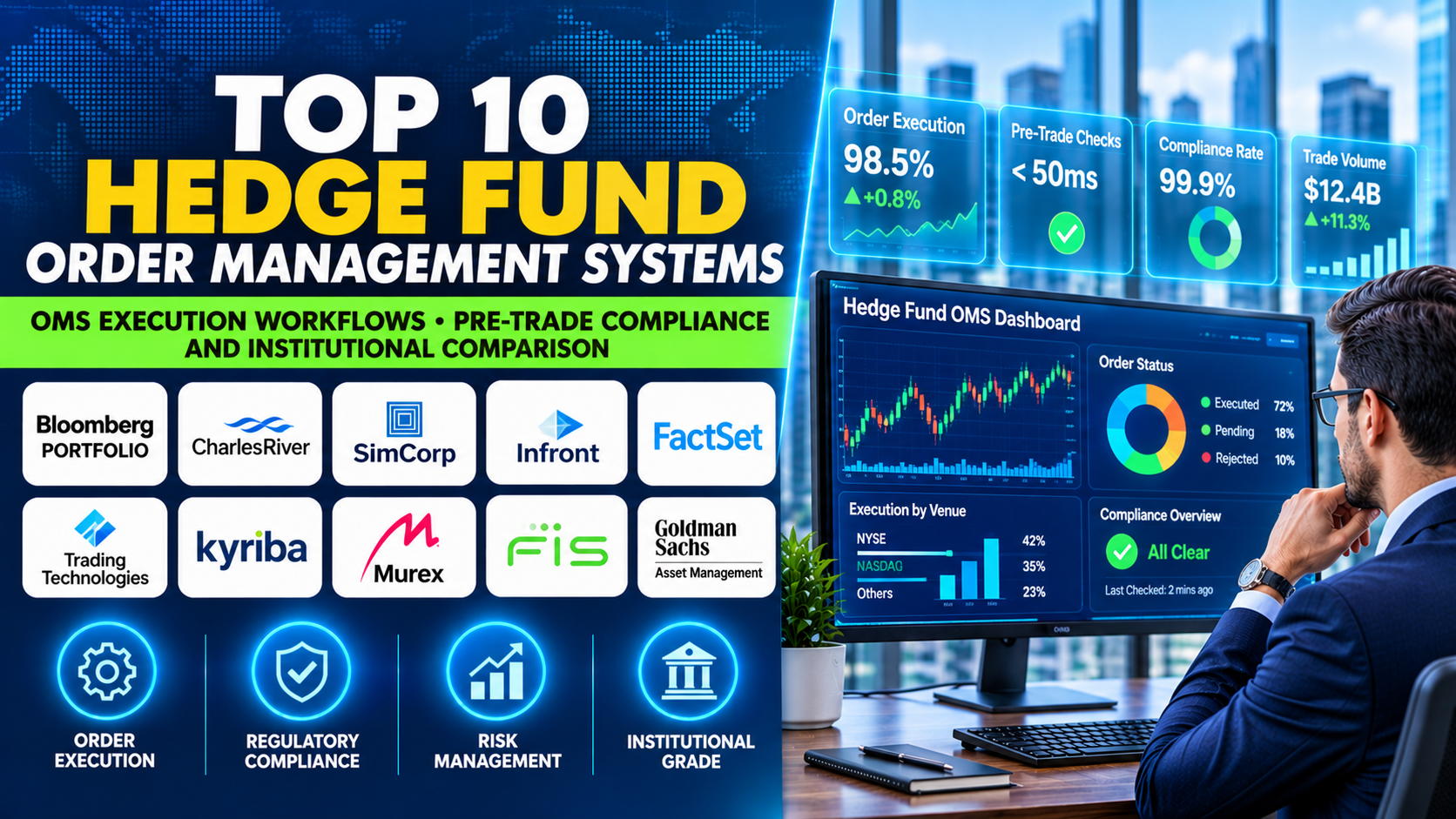
Introduction
In modern hedge fund operations, generating alpha on paper means nothing if execution friction, compliance breaches, or post-trade allocation errors erode returns before settlement. Unlike traditional long-only mutual funds that rebalance periodically across standard equities, hedge funds operate across complex multi-asset strategies—simultaneously executing long/short equity pairs, global futures, OTC derivatives, FX forwards, and private credit across multiple prime brokers and executing counterparties.
At the operational center of this trading desk sits the Hedge Fund Order Management System (OMS). Acting as the bridge between a portfolio manager’s investment intent and live market execution, the OMS manages the complete lifecycle of an order: capturing trade ideas, verifying pre-trade compliance against fund mandates, staging and routing orders via FIX protocols to brokers or Execution Management Systems (EMS), allocating block fills across master-feeder fund structures, and feeding real-time position updates back into the Investment Book of Record (IBOR).
Selecting the right OMS is one of the highest-consequence infrastructure decisions a hedge fund CTO, COO, or Head Trader makes. A rigid system built for traditional long-only asset managers will choke on short-locate workflows, multi-prime clearing rules, and intraday margin calculations. Conversely, an overly complex legacy installation can saddle an emerging manager with seven-figure consulting bills and months of integration delays. This guide evaluates ten leading Hedge Fund Order Management Systems across cloud-native front-to-back suites, institutional multi-asset heavyweights, and execution-centric OMS/EMS hybrids.
Why Legacy Order Workflows Fail Modern Hedge Funds
Attempting to manage institutional hedge fund trading through manual spreadsheets, disconnected broker portals, or basic retail execution tools exposes funds to severe operational and regulatory risks:
- Pre-Trade Compliance Blind Spots: Hedge funds operate under strict investor side-letters, prime broker margin agreements, short-sale locate rules, and regulatory concentration limits. Without automated pre-trade compliance checks intercepting orders before they hit the street, a single fat-finger trade can trigger a costly mandate breach or forced liquidation.
- Multi-Fund and Master-Feeder Allocation Errors: Hedge funds rarely trade for a single account. A single block order frequently must be split pro-rata or by custom risk-adjusted rules across onshore/offshore feeder funds, managed accounts, and multiple prime brokers. Manual spreadsheet allocations invite regulatory scrutiny and post-trade settlement breaks.
- Broken OMS-to-EMS Handshakes: When a fund’s Order Management System cannot communicate bidirectionally in real time with its Execution Management System (EMS), traders lose visibility into partial fills, working order slices, and real-time intraday P&L.
- Post-Trade T+1 Settlement Bottlenecks: With global markets operating on compressed T+1 settlement cycles, delayed trade affirmations, missing prime broker give-ups, and unallocated block trades result in failed settlements and steep counterparty penalty fees.
Modern Hedge Fund OMS platforms solve these vulnerabilities through automated FIX routing networks, real-time pre-trade rule engines, dynamic multi-prime allocation algorithms, and seamless straight-through processing (STP) to fund administrators and custodians.
Core Architectural Pillars of a Hedge Fund OMS
Evaluating a hedge fund OMS requires examining four foundational capabilities that govern order lifecycle speed, compliance control, and operational scalability:
1. Multi-Asset Order Staging and Blotter Flexibility
A hedge fund blotter must handle far more than simple market and limit equity orders. Traders need real-time views of working, staged, and filled orders across equities, listed options, futures, FX swaps, corporate bonds, and bank debt—complete with customizable grouping, pair-trading ratios, and instant bulk-order modifications.
2. Real-Time Pre-Trade and Intraday Compliance Engine
Before any order leaves the desk, the OMS must evaluate it against live positions, pending orders, restricted lists, short-locate inventory, and regulatory thresholds (such as SEC Rule 13F/13D/13G, UCITS, or AIFMD limits) in milliseconds. Crucially, the system must maintain an immutable audit trail of every compliance warning, override, and user approval.
3. Bi-Directional EMS Integration and FIX Connectivity
While the OMS manages order state, compliance, and allocations, high-touch and algorithmic traders rely on an Execution Management System (EMS) for smart order routing, broker algorithms, and Transaction Cost Analysis (TCA). Leading OMS platforms either embed native EMS capabilities or maintain low-latency, bi-directional FIX integrations with premier execution systems.
4. Automated Allocations and Prime Broker Straight-Through Processing (STP)
Once block orders execute, the OMS must automatically allocate fills across complex fund structures, assign executing vs. clearing prime brokers, match trades via electronic confirmation platforms (such as DTCC CTM or NYFIX), and transmit clean end-of-day drop copies to fund administrators.
Evaluating the Hedge Fund OMS Landscape
The market for hedge fund order management software divides into four distinct architectural models based on fund AUM, trading frequency, and operational infrastructure:
| Platform Category | Primary Strengths | Best Suited For | Key Limitation |
| Unified Cloud Front-to-Back Platforms | Integrated OMS, PMS, IBOR, and fund accounting on a single golden-source database. | Emerging to mid-sized hedge funds seeking rapid deployment and zero reconciliation overhead. | Standardized SaaS workflows offer less deep custom code modification than legacy suites. |
| Institutional Multi-Asset OMS Suites | Deep asset-class breadth, complex compliance rule libraries, and massive broker networks. | Large multi-strategy hedge funds with dedicated trading desks and complex compliance mandates. | Higher licensing costs, heavier UI footprints, and longer enterprise onboarding cycles. |
| Execution-Centric OMS/EMS Hybrids | Ultra-low-latency routing, custom execution algos, and real-time Transaction Cost Analysis (TCA). | Quantitative, statistical arbitrage, and high-turnover trading desks where execution is alpha. | Back-office fund accounting and complex partnership allocations typically require external systems. |
| Terminal-Integrated Institutional OMS | Direct integration with real-time market data, news, analytics, and global broker connectivity. | Funds whose portfolio managers and traders already live inside major data terminal ecosystems. | High per-seat total cost of ownership tied to underlying terminal subscriptions. |
Top 10 Hedge Fund Order Management Systems (OMS)
Below is a comprehensive evaluation of ten prominent Hedge Fund Order Management Systems, covering cloud-native all-in-one platforms, institutional OMS heavyweights, and execution-focused trading systems.
1. SS&C Eze (Eze OMS)
- Core Focus: Institutional multi-asset Order Management System engineered specifically for hedge fund trading complexity.
- Standout Capability: Highly configurable real-time trade blotters, integrated “what-if” modeling, commission/soft-dollar management, and connectivity to over 500 global execution venues.
- In-Depth Analysis: SS&C Eze OMS is one of the most widely adopted platforms across institutional hedge funds. It handles intricate multi-strategy workflows—from automated short-locate requests and multi-prime allocations to real-time pre-trade compliance across equities, fixed income, options, futures, and FX. Tight integration with Eze Eclipse (its cloud-native sister platform) and SS&C’s broader fund administration ecosystem makes it adaptable from boutique launches to multi-billion-dollar funds.
- Pros: Unmatched depth of hedge-fund-specific workflow rules and templates; seamless pairing with Eze EMS and SS&C accounting; extensive global broker FIX network.
- Cons: Traditional interface can feel dense compared to modern web-native SaaS entrants; complex bespoke configurations require professional services engagement.
- Best For: Established multi-strategy hedge funds, long/short equity desks, and credit funds requiring deep workflow configurability.
2. Enfusion (a Clearwater Analytics company)
- Core Focus: Cloud-native, unified front-to-back platform combining OMS, PMS, and Accounting Book of Record (ABOR).
- Standout Capability: Single golden-source architecture where order staging, compliance, execution, live P&L, and general ledger accounting operate on one shared real-time dataset.
- In-Depth Analysis: Enfusion eliminates the traditional operational divide between front-office trading and back-office accounting. When a portfolio manager stages an order in Enfusion’s cloud blotter and routes it via FIX to executing brokers, every partial fill instantaneously updates intraday exposure, risk metrics, and accounting ledgers without nightly batch reconciliations. Its managed services team further offloads daily prime broker break resolution.
- Pros: Fast cloud implementation without local servers or desktop installations; eliminates front-to-back reconciliation breaks; strong web and mobile accessibility for traveling PMs.
- Cons: Highly standardized multi-tenant architecture offers less custom code flexibility for funds with extreme bespoke execution workflows.
- Best For: Emerging to large hedge funds prioritizing cloud agility, lean operations teams, and unified front-to-back data integrity.
3. Bloomberg AIM (Asset and Investment Manager)
- Core Focus: Multi-asset OMS tightly embedded within the Bloomberg Terminal and enterprise data ecosystem.
- Standout Capability: Native integration with Bloomberg’s real-time market data, fixed-income pricing, analytics, and global broker execution network (EMSX).
- In-Depth Analysis: For hedge funds whose portfolio managers and traders already rely on Bloomberg Terminals for research, pricing, and Instant Bloomberg messaging, Bloomberg AIM provides a frictionless transition from idea generation to order execution. It excels particularly in global fixed income, credit, and multi-currency workflows where Bloomberg’s security master and evaluated pricing reduce reference data errors.
- Pros: Unrivaled integration with Bloomberg security master, news, and analytics; strong fixed-income and global multi-asset execution tools; 24/7 global support.
- Cons: High total cost of ownership tied to Bloomberg Terminal seat licenses; deep ecosystem lock-in.
- Best For: Global macro funds, fixed-income/credit hedge funds, and multi-asset desks heavily invested in the Bloomberg ecosystem.
4. Charles River IMS (State Street Alpha)
- Core Focus: Enterprise-grade OMS/EMS and automated compliance engine for large institutional funds and asset managers.
- Standout Capability: Institutional-scale pre-trade, intraday, and post-trade compliance rule engine capable of screening complex multi-fund mandates across global regulatory jurisdictions.
- In-Depth Analysis: Charles River OMS brings rigorous institutional governance to large hedge funds and hybrid alternative-traditional managers. It supports sophisticated portfolio rebalancing, multi-broker FIX routing, automated commission management, and tight middle-office integration with State Street’s custody and fund administration infrastructure.
- Pros: Industry-leading compliance rule libraries and audit trails; proven reliability under heavy institutional order volumes; strong multi-asset coverage.
- Cons: Longer implementation timelines and higher administrative complexity compared to nimble cloud-native hedge fund tools.
- Best For: Large institutional hedge funds, multi-manager platforms, and hybrid asset managers requiring strict compliance governance.
5. FlexTrade (FlexOMS & FlexTRADER)
- Core Focus: High-performance, customizable OMS/EMS hybrid engineered for active, multi-asset algorithmic and electronic execution.
- Standout Capability: Low-latency execution architecture featuring broker-neutral algorithmic trading, custom Execution Algo creation, and real-time Transaction Cost Analysis (TCA).
- In-Depth Analysis: FlexTrade built its reputation on the execution edge, uniting its institutional FlexTRADER EMS with FlexOMS to give quantitative and high-turnover hedge funds complete control over order routing. Traders can build custom execution logic, benchmark fills against real-time arrival prices, and connect via open APIs to proprietary alpha engines and external IBOR/accounting systems.
- Pros: Exceptional execution speed, customization, and algorithmic routing depth; true broker neutrality; open API architecture for quant desks.
- Cons: Requires experienced trading technology staff to maximize customization; back-office fund accounting must be paired with an external ledger.
- Best For: Quantitative hedge funds, statistical arbitrage desks, and high-turnover trading teams where execution quality directly drives alpha.
6. Broadridge Investment Management Solutions (NYFIX & Order Management)
- Core Focus: Integrated multi-asset portfolio, order, and risk management paired with the global NYFIX order-routing network.
- Standout Capability: Native access to Broadridge’s NYFIX marketplace—connecting thousands of buy-side firms, sell-side brokers, and execution venues for seamless order routing and post-trade matching.
- In-Depth Analysis: Broadridge delivers a comprehensive front-to-back suite spanning public equities, derivatives, fixed income, and private credit/CLOs. Its OMS integrates tightly with automated collateral management, securities lending, and post-trade confirmation workflows, helping hedge funds compress operational risk across multi-prime relationships.
- Pros: Built-in connectivity to the massive NYFIX routing and matching network; strong coverage across both liquid securities and private debt/structured credit; comprehensive post-trade operations.
- Cons: Enterprise module breadth can feel complex for lean, single-strategy emerging funds.
- Best For: Multi-asset hedge funds, private credit managers, and institutional funds seeking unified order routing and post-trade automation.
7. LSEG AlphaDesk
- Core Focus: Cloud-based OMS and Portfolio Management System designed for buy-side hedge funds and asset managers.
- Standout Capability: Agile SaaS deployment with multi-vendor market data neutrality, real-time portfolio exposure tracking, and broad FIX broker connectivity.
- In-Depth Analysis: Backed by the London Stock Exchange Group (LSEG), AlphaDesk offers an intuitive, browser-delivered OMS/PMS environment without heavy local hardware footprints. Portfolio managers and traders can monitor real-time P&L, stage orders, run pre-trade compliance checks, and route trades to electronic execution venues while connecting cleanly to external prime brokers and fund administrators.
- Pros: Fast cloud onboarding and clean web-based user experience; flexible multi-vendor market data integration; cost-effective SaaS licensing compared to monolithic terminals.
- Cons: Lacks built-in official fund accounting (ABOR), requiring downstream integration with a fund administrator or accounting ledger.
- Best For: Small-to-mid-sized hedge funds and long/short equity managers seeking a modern, cloud-native OMS/PMS layer.
8. Limina OMS / IMS
- Core Focus: Cloud-native, modular OMS and Front-to-NAV Investment Management System built on exception-based workflows.
- Standout Capability: Automated pre-trade compliance, real-time IBOR position updates, and no-code custodian/broker integration builders that eliminate custom middleware bottlenecks.
- In-Depth Analysis: Limina enables hedge funds and investment managers to start with a clean, fast OMS and scale seamlessly into full front-to-NAV operations without replacing systems. Its exception-based engine automates morning cash and position reconciliations, flagging only genuine discrepancies so traders and operations analysts focus on high-value decisions.
- Pros: Transparent, predictable pricing structure; rapid no-code integration with prime brokers and administrators; clean, modern cloud interface.
- Cons: Newer entrant compared to decades-old incumbents like Eze or Charles River; narrower native footprint in ultra-exotic OTC derivatives.
- Best For: Emerging and growing hedge funds seeking modern cloud SaaS agility, transparent pricing, and low IT overhead.
9. Orchestrade
- Core Focus: Cross-asset front-to-back trading, order management, and real-time risk platform for complex hedge funds and capital markets.
- Standout Capability: Unified, high-speed quantitative pricing and real-time risk engine embedded directly alongside order capture and lifecycle management across derivatives, fixed income, FX, and equities.
- In-Depth Analysis: Orchestrade was engineered from the ground up to solve cross-asset complexity without bolting together legacy acquisitions. Traders and risk managers share an identical real-time view of Greeks, sensitivities, P&L, and liquidity exposure as orders execute, making it exceptionally strong for multi-asset volatility, rates, and macro hedge funds.
- Pros: Exceptional native derivatives, rates, and cross-asset risk modeling; real-time front-to-back position and P&L consistency; modern unified codebase.
- Cons: Enterprise pricing and quantitative depth are geared toward sophisticated multi-asset funds rather than simple single-strategy equity shops.
- Best For: Global macro, relative value, fixed-income, and volatility hedge funds trading complex multi-asset portfolios.
10. HedgeGuard
- Core Focus: Integrated OMS, PMS, and real-time risk engine bridging traditional financial assets and digital/crypto markets.
- Standout Capability: Unified Investment Book of Record (IBOR) that manages order routing, pre-trade compliance, and portfolio exposure across both traditional prime brokers and institutional crypto exchanges/custodians.
- In-Depth Analysis: Hedge funds trading hybrid portfolios of listed securities alongside digital assets often struggle with fragmented execution and custody workflows. HedgeGuard consolidates traditional FIX broker routing and crypto venue APIs into a single blotter and real-time risk engine, pairing software with shadow NAV oversight against third-party fund administrators.
- Pros: Native support for both traditional securities and institutional digital assets; unified OMS/PMS/IBOR architecture; rapid deployment for emerging and mid-sized funds.
- Cons: Less entrenched in massive tier-1 multi-billion-dollar pension or sovereign mandates than BlackRock or State Street.
- Best For: Crypto hedge funds, hybrid digital-traditional asset managers, and emerging multi-asset funds.
Deep Comparison Matrix: Selecting the Right Hedge Fund OMS Architecture
To evaluate which Order Management System matches your fund’s trading velocity, asset mix, and operational staffing, review the structural comparison below:
| Platform | Architectural Model | Core Asset Strength | EMS / Execution Capability | Deployment & Hosting | Target Hedge Fund Profile |
| SS&C Eze OMS | Institutional Multi-Asset OMS | Equities, Options, Futures, FX, Credit | Native Eze EMS + 500+ Venues | Cloud / Hosted | Established Multi-Strategy & Long/Short Funds |
| Enfusion | Unified Cloud OMS/PMS/ABOR | Global Equities, Derivatives, Alternatives | Integrated FIX + External EMS Bridges | Multi-Tenant Cloud SaaS | Emerging to Large Lean-Ops Hedge Funds |
| Bloomberg AIM | Terminal-Integrated OMS | Fixed Income, Global Macro, Multi-Asset | Native Bloomberg EMSX | Managed Cloud / Terminal | Macro, Credit & Bloomberg-Centric Funds |
| Charles River IMS | Enterprise Institutional OMS | Global Multi-Asset & Separate Accounts | Integrated OMS/EMS & Compliance | Cloud / Hybrid Managed | Large Institutional & Multi-Manager Funds |
| FlexTrade | Execution-Centric OMS/EMS | Equities, FX, Futures, Options | Industry-Leading FlexTRADER EMS | Managed Cloud / Low-Latency | Quant, Stat-Arb & High-Turnover Funds |
| Broadridge | Front-to-Back + NYFIX Network | Public Assets, Private Debt, CLOs | Native NYFIX Order Routing | Managed Cloud | Multi-Asset & Private Credit Hedge Funds |
| LSEG AlphaDesk | Cloud SaaS OMS/PMS | Global Equities, FX, Listed Derivatives | Multi-Venue FIX & EMS Connectors | Cloud-Native SaaS | Small-to-Mid-Sized Long/Short & Multi-Asset Funds |
| Limina | Modular Front-to-NAV SaaS | Multi-Asset Liquid Portfolios | FIX Routing + No-Code Integrations | Cloud-Native SaaS | Growing Funds Scaling Off Spreadsheets |
| Orchestrade | Cross-Asset Trading & Risk Suite | OTC Derivatives, Rates, FX, Volatility | Integrated Order & Risk Lifecycle | Cloud / Enterprise Hosted | Global Macro, Volatility & Relative Value Funds |
| HedgeGuard | Hybrid Traditional + Crypto OMS/PMS | Listed Securities + Digital Assets | FIX Brokers + Crypto Venue APIs | Cloud SaaS | Crypto & Hybrid Multi-Asset Hedge Funds |
Implementation Pitfalls to Avoid
Implementing a Hedge Fund OMS touches every critical nerve of trading and operations. Avoid these four common deployment failures:
- Underestimating Prime Broker and FIX Certification Timelines: Even with a cloud-native OMS, certifying FIX drop-copy feeds, short-locate connections, and automated give-up rules across multiple prime brokers and executing brokers requires coordinated testing windows. Initiate broker onboarding in week one of implementation.
- Over-Engineering Pre-Trade Compliance Rules at Launch: Translating complex investor side-letters into rigid automated hard-stops without calibrating warning thresholds can inadvertently block legitimate trades during volatile market opens. Configure layered soft warnings and hard blocks carefully during paper-trading dry runs.
- Neglecting Middle-Office Exception Workflows: An OMS that captures trades cleanly but leaves post-trade affirmations, corporate actions, and prime broker reconciliations to manual email chains creates T+1 settlement bottlenecks. Verify end-to-end straight-through processing (STP) with your fund administrator before go-live.
- Buying Execution Complexity You Do Not Need: If your fund executes 30 low-turnover equity trades a week using standard broker algos, paying for an ultra-low-latency quantitative EMS/OMS hybrid adds unnecessary cost and maintenance overhead. Match execution tooling to your actual turnover and alpha source.
Choosing the Right Path Forward
Selecting the right Hedge Fund Order Management System requires aligning your trading desk’s velocity with your operations team’s headcount:
- What is your primary source of edge—fundamental stock picking where a unified cloud OMS/PMS/accounting platform (like Enfusion or AlphaDesk) minimizes operational overhead, or high-turnover quantitative execution where a customizable OMS/EMS hybrid (like FlexTrade or Eze) is essential?
- Which asset classes and prime brokers must be supported on day one—standard listed equities and options, complex OTC derivatives, or hybrid traditional-and-crypto venues?
- Do you want your OMS vendor to also serve as your official Accounting Book of Record (ABOR), or will an independent third-party fund administrator maintain the official books alongside your front-office IBOR?
During vendor demos, insist on walking through a live end-to-end trade lifecycle—from portfolio manager order staging and pre-trade compliance screening to multi-prime block allocation and end-of-day administrator reconciliation—using your fund’s actual strategy workflows.
Frequently Asked Questions
What is the difference between an OMS and an EMS in a hedge fund?
An Order Management System (OMS) manages the compliance, accounting, and allocation lifecycle of an order—tracking positions, enforcing pre-trade mandate rules, staging orders, and allocating executed block fills across funds. An Execution Management System (EMS) is a high-speed trading screen built for traders to slice orders, access direct market access (DMA), utilize broker execution algorithms, and measure real-time Transaction Cost Analysis (TCA).
Do emerging hedge funds need a separate OMS, PMS, and accounting system?
No. Emerging and mid-sized hedge funds typically benefit most from unified cloud platforms (such as Enfusion, Limina, or HedgeGuard) that combine the OMS, Portfolio Management System (PMS), and Investment Book of Record (IBOR) in one system while integrating seamlessly with an external third-party fund administrator for official accounting (ABOR).
How does an OMS handle multi-prime broker allocations?
A hedge fund OMS uses configurable allocation algorithms (such as pro-rata by NAV, target weight, or custom risk rules) to split a single executed block trade across multiple fund entities and assign specific prime brokers as clearing custodians, automatically transmitting electronic trade confirmations via FIX or DTCC CTM.
