Financial institutions, hedge funds, asset managers, and corporate treasury teams live and die by the speed, accuracy, and breadth of their market information. A single delayed tick during an interest rate announcement or a corrupted corporate actions record in a security master database can distort valuation models, trigger erroneous algorithmic trades, or cause compliance breaches.
For decades, market data consumption was dominated by monolithic desktop terminals built for human traders staring at multi-monitor setups. Today, financial workflows are bifurcated. While discretionary portfolio managers and investment bankers still rely on rich front-end workstations for fundamental research and peer screening, quantitative analysts, risk engines, and fintech developers require low-latency APIs, normalized cloud data lakes, and direct exchange feeds that flow straight into automated pipelines. Choosing the wrong delivery model—or paying for overlapping enterprise data licenses—is one of the fastest ways to bloat operational expenditure without improving alpha or operational resilience.
Introduction
Modern market data platforms serve as the central nervous system of capital markets and corporate finance. They aggregate, normalize, enrich, and distribute real-time price ticks, historical time-series, reference data, company fundamentals, consensus estimates, and macroeconomic indicators across global asset classes.
Because financial organizations vary dramatically in their technical maturity and workflow demands, the market data ecosystem has fractured into distinct architectural tiers. An investment banking analyst building discounted cash flow (DCF) models in Excel has fundamentally different requirements than a quantitative developer backtesting tick-level equity strategies in Python, or a middle-office operations team reconciling end-of-day evaluated pricing for fixed income portfolios. This guide examines ten prominent market data platforms across institutional terminals, enterprise reference feeds, and developer-first APIs—detailing their architectural strengths, licensing trade-offs, operational limitations, and optimal use cases.
Why Fragmented Market Data Infrastructure Fails Modern Finance
Relying on ad-hoc data feeds, manual CSV downloads, or disconnected vendor terminals creates severe operational and financial friction as trading volumes and reporting mandates scale:
- The Normalization Bottleneck: Every global exchange formats ticker symbols, timestamps, order book depths, and corporate action notices differently. Ingesting raw exchange feeds without a robust normalization layer forces internal engineering teams to spend months building and maintaining fragile parsers instead of focusing on proprietary analytics.
- Data Silos Between Front, Middle, and Back Offices: When front-office traders execute based on one pricing source while middle-office risk systems and back-office accounting ledgers ingest delayed end-of-day files from another, valuation discrepancies and trade breaks inevitably follow.
- Runaway Exchange and Redistribution Fees: Market data licensing is notoriously complex. Exchanges charge strict per-user display fees, non-display algorithmic usage fees, and enterprise redistribution penalties. Without clear entitlement controls and usage telemetry, organizations routinely face unexpected audit fines from data vendors and exchanges.
- Latency vs. Depth Trade-Offs: Many platforms excel at deep historical fundamentals and scrubbed financial statements but struggle to deliver sub-second streaming ticks. Conversely, low-latency streaming APIs often lack the rich metadata, ownership structures, and consensus analyst estimates required for fundamental due diligence.
Modern market data platforms address these structural challenges by offering standardized identifiers (such as FIGI, ISIN, and CUSIP), cloud-native bulk delivery, low-latency WebSockets, and tight spreadsheet or programmatic integrations.
Core Architectural Pillars of a Modern Market Data Stack
Evaluating market data platforms requires looking beyond surface-level user interfaces to inspect how data is sourced, cleansed, governed, and delivered into downstream workflows.
1. Asset Class Breadth and Evaluated Pricing
Equities and major currency pairs enjoy transparent, centralized exchange pricing. Over-the-counter (OTC) derivatives, municipal bonds, structured credit, and private market instruments do not. Top-tier enterprise platforms differentiate themselves through proprietary evaluated pricing services—combining dealer quotes, market curves, and quantitative models to establish defensible daily valuations for illiquid assets.
2. Delivery Mechanisms: Terminals vs. Feeds vs. Cloud Lakes
- Interactive Desktop Workstations: Designed for human analysts, featuring integrated charting, news wires, chat networks, and proprietary Excel add-ins.
- Low-Latency Streaming Feeds and APIs: REST and WebSocket endpoints engineered for programmatic consumption by order management systems (OMS), algorithmic execution engines, and custom fintech applications.
- Cloud Data Shares and Bulk Files: Direct ingestion into Snowflake, AWS S3, or Databricks, allowing quantitative researchers and risk teams to run massive historical backtests without managing local file-transfer infrastructure.
3. Security Master and Reference Data Hygiene
Raw price ticks are useless without accurate reference data. A mature market data platform maintains a clean security master—tracking mergers, stock splits, dividend adjustments, credit rating changes, and entity hierarchies so historical backtests remain free of survivorship bias and corporate action distortions.
4. Entitlement Management and Redistribution Governance
Enterprise platforms must enforce granular access controls that map directly to exchange compliance rules. Automated entitlement tracking ensures that only licensed users or authorized downstream applications access restricted real-time feeds, protecting the firm during vendor compliance audits.
Evaluating the Market Data Platform Landscape
The financial data ecosystem spans several specialized categories, each built around distinct user personas and technical delivery models:
| Platform Category | Primary Strengths | Best Suited For | Key Limitation |
| All-in-One Institutional Terminals | Deep multi-asset real-time data, integrated news, messaging networks, and advanced fixed-income/derivatives analytics. | Buy-side portfolio managers, sell-side traders, and institutional fixed-income desks. | High per-seat licensing costs and strict terminal-locked access controls. |
| Fundamental & Modeling Suites | Scrubbed company financials, M&A transaction databases, ownership records, and click-through Excel auditing. | Investment banking analysts, private equity associates, and equity research teams. | Less suited for ultra-low-latency intraday trading or real-time order book execution. |
| Enterprise Reference & Evaluated Feeds | Bulk security master enrichment, corporate actions, and evaluated OTC pricing delivered directly to enterprise databases. | Middle-office operations, fund accounting, risk engines, and custodian banks. | Requires internal data engineering pipelines; lacks a consumer-friendly front-end UI. |
| Developer-First Cloud & API Platforms | Clean REST/WebSocket APIs, normalized tick/bar schemas, Python SDKs, and transparent usage-based pricing. | Quantitative researchers, algorithmic traders, and fintech startups building client-facing apps. | Narrower coverage of niche global fixed income, private credit, and proprietary analyst research. |
Top 10 Market Data Platforms
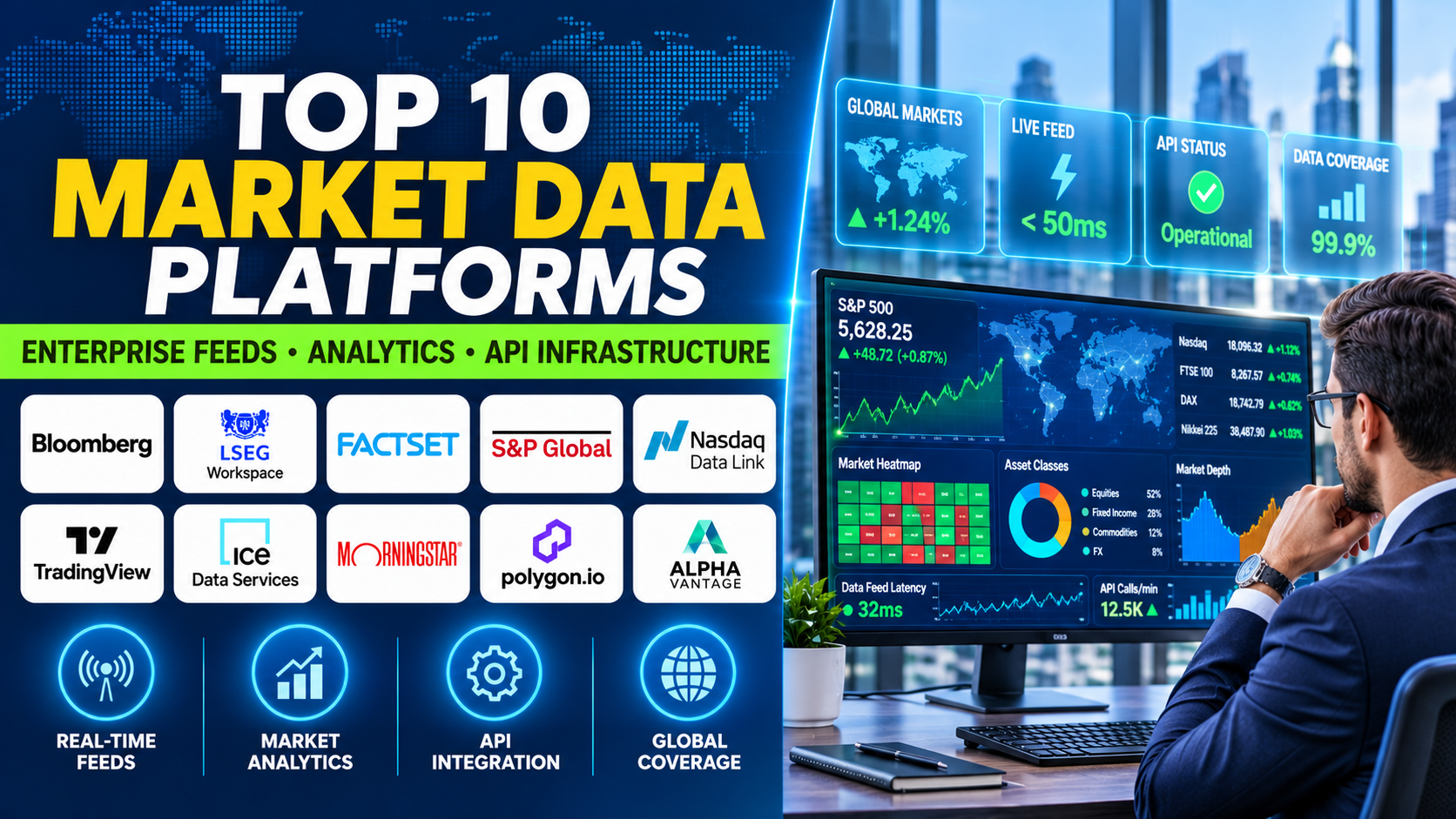
Below is a detailed evaluation of ten leading market data platforms, covering institutional workstations, fundamental research engines, enterprise data feeds, and modern developer APIs.
1. Bloomberg Terminal (and Bloomberg Data License)
- Core Focus: Comprehensive cross-asset market intelligence, real-time pricing, news, analytics, and institutional messaging.
- Standout Capability: Unrivaled depth across fixed income, OTC derivatives, and global macro markets, paired with the ubiquitous Instant Bloomberg (IB) chat network that functions as the primary communication rail for institutional liquidity.
- In-Depth Analysis: Bloomberg remains the benchmark against which all institutional market data platforms are measured. Beyond its iconic multi-screen desktop terminal, Bloomberg Enterprise Data (Data License and B-PIPE) delivers normalized real-time streaming feeds and bulk reference datasets directly into internal risk systems and cloud warehouses. Its standardized Financial Instrument Global Identifier (FIGI) is widely adopted across capital markets to link disparate asset classes.
- Pros: Unmatched breadth across fixed income, commodities, FX, and equities; industry-standard messaging network; gold-standard corporate actions and security master accuracy.
- Cons: High annual per-seat subscription costs; steep command-line learning curve; strict data redistribution and export limits under standard terminal licenses.
- Best For: Buy-side asset managers, institutional sales and trading desks, fixed-income traders, and global macro hedge funds.
2. LSEG Workspace (formerly Refinitiv Eikon)
- Core Focus: Multi-asset market data, real-time Reuters news, macroeconomic datasets, and customizable desktop/API workflows.
- Standout Capability: Combines deep global FX, commodities, and cross-asset pricing with Datastream—one of the world’s most comprehensive historical macroeconomic time-series databases—and exclusive Reuters news integration.
- In-Depth Analysis: Backed by the London Stock Exchange Group, LSEG Workspace is the most direct institutional competitor to the Bloomberg Terminal. It offers a modernized, web-and-desktop modular interface alongside open Python scripting environments (CodeBook) that let analysts query tick data and macroeconomic series directly inside the platform. For enterprise pipelines, LSEG Elektron (Real-Time) provides ultra-low-latency global feed distribution.
- Pros: Exceptional FX, commodities, and European market coverage; flexible tiered packaging compared to rigid all-or-nothing terminals; strong open-API and Python integration.
- Cons: Historical product transitions between legacy Reuters, Refinitiv, and LSEG brands can occasionally create overlapping menus or documentation fragmentation.
- Best For: Global FX desks, corporate treasury teams, macroeconomic researchers, and multi-asset institutional analysts.
3. FactSet
- Core Focus: Integrated portfolio analytics, equity research, fundamental modeling, and multi-asset data aggregation.
- Standout Capability: Seamless, auditable Excel integration paired with institutional-grade portfolio attribution, risk modeling, and open data delivery via Snowflake and REST APIs.
- In-Depth Analysis: FactSet excels at uniting proprietary client portfolio holdings with scrubbed fundamental data, consensus estimates, and ownership records. Its open-ecosystem philosophy allows asset managers to blend third-party specialist datasets alongside FactSet’s core content inside a single unified Concordance schema. Its Excel plug-in is widely favored by analysts for transparent formula auditing that clicks straight back to underlying regulatory filings.
- Pros: Superior portfolio attribution and multi-asset risk tools; highly intuitive spreadsheet modeling; strong open-data cloud sharing integrations.
- Cons: Real-time breaking news coverage and inter-dealer fixed-income chat networks are less dominant than Bloomberg’s.
- Best For: Equity research teams, institutional asset managers, wealth management platforms, and investment bankers.
4. S&P Capital IQ Pro
- Core Focus: Corporate fundamentals, credit ratings, M&A transaction intelligence, and sector-specific datasets.
- Standout Capability: Unparalleled depth in standardized company financial statements, private company intelligence, S&P Global credit risk indicators, and specialized sector data (via legacy SNL Financial coverage in banking, insurance, real estate, and energy).
- In-Depth Analysis: S&P Capital IQ Pro is built from the ground up for corporate finance, credit underwriting, and deal origination. Unlike hardware-bound terminals, its web-first architecture allows analysts to log in from any browser while maintaining deep bi-directional Excel modeling templates. Its integration of S&P Global Ratings, Market Intelligence, and Panjiva supply chain data makes it indispensable for fundamental valuation and credit risk screening.
- Pros: Gold-standard standardized financials and M&A comps; unmatched private market and sector-specific depth; browser-accessible from anywhere.
- Cons: Not engineered for high-frequency real-time trading execution or sub-second market-making workflows.
- Best For: Investment banks, private equity firms, corporate development teams, and commercial credit analysts.
5. ICE Data Services
- Core Focus: Enterprise fixed-income evaluated pricing, reference data, low-latency exchange feeds, and indices.
- Standout Capability: Authoritative end-of-day and intraday evaluated pricing across millions of global fixed-income securities, backed by Intercontinental Exchange’s global clearing and exchange infrastructure.
- In-Depth Analysis: Operating largely behind the scenes rather than as a single desktop terminal, ICE Data Services powers the middle and back offices of the world’s largest asset managers, custodians, and mutual funds. Its Consolidated Feed aggregates low-latency tick data from hundreds of global trading venues, while its Continuous Evaluated Pricing (CEP) provides real-time transparency into corporate bonds, sovereign debt, and municipal securities for net asset value (NAV) calculations and collateral management.
- Pros: Industry-leading evaluated fixed-income pricing; ultra-reliable security master and corporate actions feeds; robust low-latency consolidated feed.
- Cons: Primarily structured as enterprise data pipes and APIs rather than an all-in-one visual workstation for junior analysts.
- Best For: Fund administrators, custodian banks, fixed-income portfolio accounting systems, and middle-office risk teams.
6. Morningstar Direct
- Core Focus: Mutual fund, ETF, and managed investment research, manager due diligence, and portfolio construction.
- Standout Capability: Comprehensive fund holdings transparency, proprietary Morningstar Ratings and Medalist research, and institutional-grade performance attribution for multi-asset wealth portfolios.
- In-Depth Analysis: Morningstar Direct is the definitive platform for wealth advisors, fund-of-funds managers, and retirement plan consultants. It normalizes global open-end fund, ETF, hedge fund, and separate account data into clean, comparable peer groups. With tight integration into PitchBook (a Morningstar company), users can evaluate public fund strategies alongside private equity and venture capital allocations in a single reporting workflow.
- Pros: Unrivaled global fund and ETF coverage; clean client-ready presentation and reporting builders; strong private-market crossover via PitchBook.
- Cons: Limited utility for active intraday equity traders, derivatives desks, or corporate M&A bankers.
- Best For: Wealth management firms, institutional asset allocators, fund selectors, and financial advisors.
7. Databento
- Core Focus: Cloud-native, usage-based historical and real-time market data APIs for quantitative finance.
- Standout Capability: Direct, normalized access to raw market-by-order (MBO) and Level 3 order book data across major futures, equities, and options exchanges with transparent pay-as-you-go pricing.
- In-Depth Analysis: Databento modernizes institutional market data procurement by eliminating opaque multi-year enterprise contracts and slow SFTP batch deliveries. Built by quantitative infrastructure engineers, it streams nanosecond-timestamped tick data using a compact binary encoding format (DBN) with native Python, C++, and Rust client libraries. Researchers can inspect exact historical order book reconstructions in seconds without provisioning massive on-premise storage clusters.
- Pros: Transparent, self-serve usage pricing; exceptionally fast API and Python SDK performance; deep Level 3 tick granularity.
- Cons: Focused strictly on quantitative market microstructure data rather than company fundamentals, news, or analyst estimates.
- Best For: Quantitative hedge funds, high-frequency trading researchers, academic labs, and algorithmic trading developers.
8. Polygon.io
- Core Focus: Developer-friendly REST and WebSocket APIs for real-time and historical US equities, options, indices, forex, and crypto.
- Standout Capability: Sub-millisecond WebSocket streaming, clean JSON/CSV schemas, and generous flat-rate developer tiers designed for rapid application prototyping and production fintech backends.
- In-Depth Analysis: Polygon.io bridges the gap between institutional exchange feeds and modern web application development. By connecting directly to major US market data consolidators (SIPs) and dark pools, it provides unified aggregates, tick-level trades, quotes, and snapshot endpoints with consistent documentation. Engineering teams can integrate live market tickers or historical backtesting pipelines into web and mobile apps in hours rather than navigating months-long legacy vendor onboarding.
- Pros: Exceptionally clean developer documentation and modern APIs; predictable, transparent flat-rate pricing tiers; rapid onboarding.
- Cons: Coverage is primarily centered on US markets and major global currencies/crypto rather than comprehensive global fixed income or international equities.
- Best For: Retail brokerages, consumer fintech startups, algorithmic traders, and backend software engineers.
9. Nasdaq Data Link (formerly Quandl)
- Core Focus: Cloud-based marketplace for core financial, macroeconomic, and alternative datasets delivered via unified APIs.
- Standout Capability: Single-API access to hundreds of curated core and alternative data feeds—ranging from global futures and fundamentals to satellite retail traffic, supply chain shipping logs, and institutional sentiment.
- In-Depth Analysis: Nasdaq Data Link acts as an aggregation hub that standardizes disparate third-party data vendors into consistent time-series and tabular schemas. Quantitative analysts use its Python, R, and Excel connectors to ingest both traditional end-of-day pricing and non-traditional alpha signals directly into Jupyter notebooks and cloud warehouses without negotiating separate technical integrations with dozens of boutique data providers.
- Pros: Unified API schema across hundreds of core and alternative datasets; strong Python/R/Excel native integration; backed by Nasdaq’s institutional governance.
- Cons: Individual premium datasets carry separate subscription fees; not built for ultra-low-latency tick-by-tick execution streaming.
- Best For: Quantitative investment teams, data scientists, macro economists, and alternative-data researchers.
10. Koyfin
- Core Focus: Modern web-based financial analytics, charting, and fundamental screening workstation for wealth managers and independent investors.
- Standout Capability: Institutional-grade multi-asset charting, macroeconomic dashboards, and customizable financial templates delivered through a fast, browser-native interface at a fraction of legacy terminal pricing.
- In-Depth Analysis: Koyfin addresses the massive middle market underserved by $25,000-per-year institutional terminals. Drawing on institutional fundamental and consensus data feeds, it offers rich scatter-plot factor analysis, yield curve visualizations, earnings transcripts, and portfolio watchlists without requiring proprietary hardware or complex command codes.
- Pros: Fast, modern browser UI with minimal learning curve; accessible tiered pricing for independent advisors and small funds; strong multi-asset visualization.
- Cons: Lacks institutional inter-dealer messaging, deep OTC derivatives pricing, and raw enterprise bulk feed exports.
- Best For: Registered investment advisors (RIAs), family offices, boutique hedge funds, and fundamental equity analysts.
Deep Comparison Matrix: Selecting the Right Market Data Architecture
To identify which platform fits your operational workflow, technical stack, and budget profile, compare their core structural parameters below:
| Platform | Primary Delivery Model | Core Asset Strength | Programmatic / API Support | Pricing & Licensing Structure | Target User Persona |
| Bloomberg Terminal | Dedicated Workstation + Enterprise Feeds | Fixed Income, FX, Derivatives, Equities, News | B-PIPE, Data License, Python/Excel APIs | High fixed annual per-seat quote | Institutional Traders, PMs, Fixed-Income Desks |
| LSEG Workspace | Desktop/Web Terminal + Real-Time Feeds | FX, Commodities, Global Macro, Equities | Elektron Feeds, CodeBook (Python), REST APIs | Tiered enterprise annual seat quotes | FX Traders, Macro Strategists, Corporate Treasury |
| FactSet | Desktop/Web Workstation + Cloud Share | Global Equities, Fundamentals, Portfolio Attribution | Snowflake Share, REST APIs, Excel Plug-in | Modular annual seat and dataset quotes | Asset Managers, Equity Research, Investment Bankers |
| S&P Capital IQ Pro | Web Browser + Excel Plug-in | Corporate Financials, M&A, Credit, Private Markets | Xpressfeed Bulk Delivery, APIs, Excel | Modular enterprise seat quotes | Investment Bankers, PE/VC, Credit Underwriters |
| ICE Data Services | Enterprise Feeds & Cloud Pipelines | Evaluated Fixed Income, Reference Data, Indices | Consolidated Feed, REST/SFTP, Cloud Ingestion | Enterprise volume and dataset contracts | Middle-Office Ops, Custodians, Risk Engines |
| Morningstar Direct | Desktop/Web Research Platform | Mutual Funds, ETFs, Manager Research, PitchBook | Data Feeds, Excel Add-in, Reporting Exports | Annual institutional seat licenses | Wealth Managers, Fund Selectors, Consultants |
| Databento | Cloud API & Binary Streaming | Futures, Equities, Options (Tick / Level 3 MBO) | Python, C++, Rust SDKs, Raw TCP/WebSocket | Transparent usage-based pay-as-you-go | Quant Researchers, HFT Engineers, Algo Traders |
| Polygon.io | Developer REST & WebSocket APIs | US Equities, Options, Indices, FX, Crypto | REST, WebSockets, Python/JS/Go SDKs | Flat-rate tiered monthly/annual plans | Fintech Developers, Retail Brokerages, Algo Devs |
| Nasdaq Data Link | Cloud Data Marketplace & APIs | Macroeconomic, Core Futures, Alternative Data | Unified REST API, Python/R/Excel SDKs | Per-dataset subscriptions + enterprise tiers | Quant Analysts, Data Scientists, Macro Teams |
| Koyfin | Browser-Based Web Workstation | Global Equities, Macro Charts, Consensus Estimates | CSV/Excel Exports (UI-first architecture) | Accessible self-serve SaaS tiers | RIAs, Family Offices, Independent Analysts |
Implementation Pitfalls to Avoid
Acquiring a premier market data subscription does not guarantee clean downstream analytics. Financial organizations routinely encounter costly bottlenecks during integration and rollout:
- Overlooking Exchange Redistribution Compliance: A standard desktop terminal license permits a human analyst to view data on screen, not to scrape prices into an internal database that feeds fifty downstream risk users or a client-facing web portal. Violating display versus non-display licensing terms triggers severe retroactive exchange audit penalties.
- Neglecting Symbology Mapping Across Vendors: Ingesting equity prices from one API, fixed-income evaluated prices from another, and fundamental financials from a third without a unified security master creates entity-matching failures. Establish a single canonical identifier standard (such as FIGI or ISIN) before connecting multiple feeds.
- Overbuying Monolithic Seats for Read-Only Consumers: Equipping every junior analyst, compliance officer, or portfolio accountant with a full-featured institutional trading terminal inflates annual software spend unnecessarily. Segment users by actual workflow need—combining core workstations for active traders with lighter web terminals or centralized database feeds for downstream consumers.
Choosing the Right Path Forward
Selecting the right market data architecture begins with separating human research workflows from automated programmatic consumption. Before signing multi-year vendor agreements, clarify three operational boundaries:
- Who is the primary consumer of the data—a human analyst making discretionary decisions in Excel and web dashboards, or an automated risk engine, OMS, or trading algorithm ingesting programmatic feeds?
- Which asset classes and geographies require true real-time tick streaming versus delayed intraday snapshots or end-of-day evaluated pricing?
- Do our licensing agreements explicitly cover downstream redistribution into internal cloud data warehouses, BI dashboards, and client-facing applications?
By aligning your licensing structure and technical delivery pipes with actual operational consumption, you eliminate redundant terminal spend while ensuring every trading desk, risk model, and client report operates from a single, verifiable source of market truth.
Frequently Asked Questions
What is the difference between a market data terminal and an enterprise market data feed?
A market data terminal (such as Bloomberg Terminal, LSEG Workspace, or FactSet) is an interactive front-end workstation built for human analysts, combining visual charting, news, messaging, and spreadsheet plug-ins under per-user display licenses. An enterprise market data feed (such as Bloomberg B-PIPE, ICE Consolidated Feed, or Databento) delivers raw or normalized programmatic data streams directly into servers, databases, and trading algorithms without a graphical user interface.
Why are exchange fees separate from market data platform subscriptions?
Market data platforms act as aggregators and software providers, while stock and derivatives exchanges (such as NYSE, Nasdaq, CME, and LSE) own the underlying intellectual property of their live price ticks. Exchanges require platforms to collect and remit separate monthly exchange fees based on whether the end user is classified as a non-professional retail user, a professional institutional user, or a non-display automated system.
Can fintech startups and small funds access institutional-grade market data without paying $25,000 per seat?
Yes. Modern API-first providers such as Databento and Polygon.io offer direct, normalized tick and bar data on transparent usage-based or flat monthly developer tiers. Similarly, browser-based platforms like Koyfin provide institutional fundamental data, consensus estimates, and macroeconomic charting for independent advisors and boutique funds without legacy terminal hardware or multi-year enterprise contracts.
