Introduction
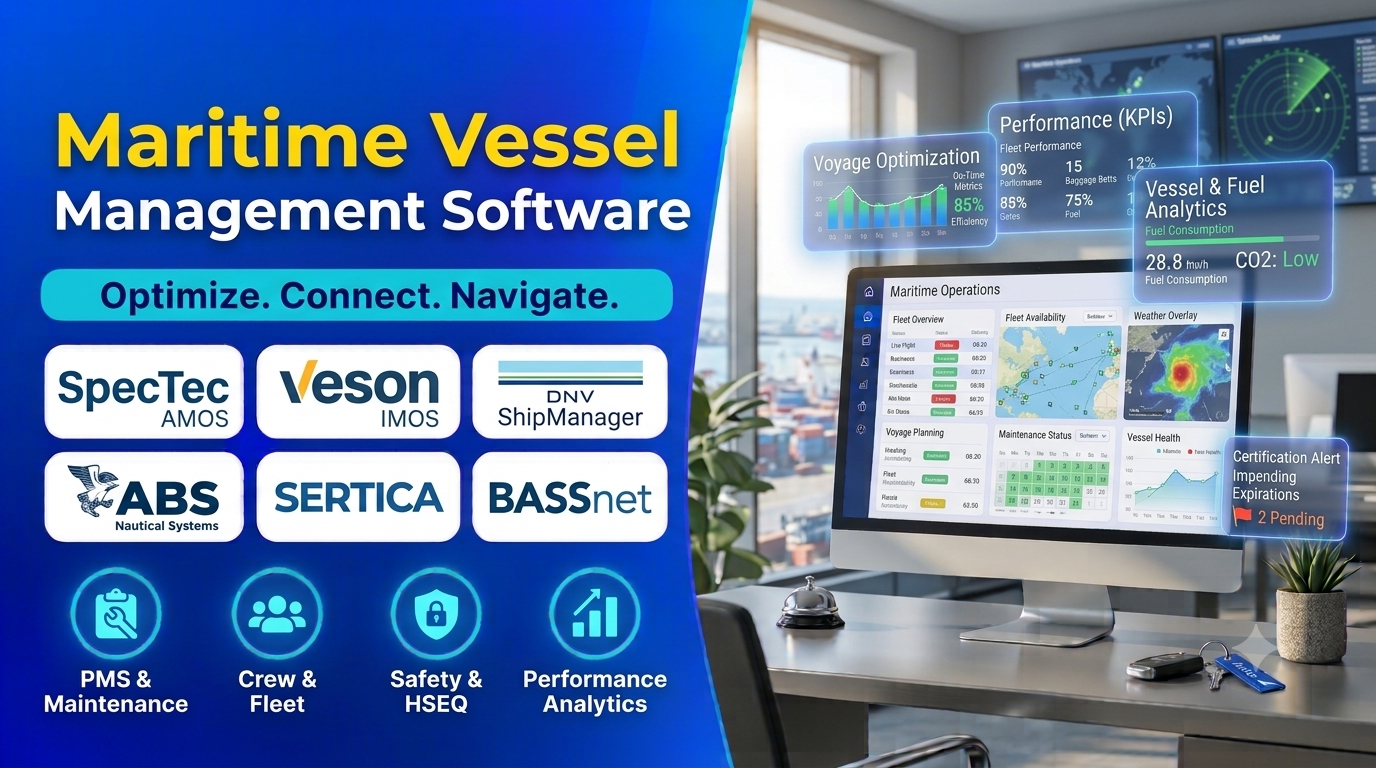
Maritime Vessel Management Software plays an important role across major industries in 2026 and what these tools help professionals achieve. Modern shipping companies, commercial tanker fleets, dry bulk operators, offshore support vessel providers, and ship management enterprises rely heavily on these digital platforms to manage technical maintenance, ensure regulatory compliance, coordinate crew rotations, and optimize voyage operations. Organizations across maritime logistics, fleet engineering, marine safety, and commercial chartering depend on these solutions to maintain seamless, safe, and cost-effective daily fleet operations.
The limitations and costs of traditional or manual methods compared to using Maritime Vessel Management Software platforms are substantial. Paper noon reports, uncoordinated maintenance spreadsheets, and delayed certificate tracking often result in port state control detentions, unexpected machinery breakdowns, missed survey windows, and fuel-inefficient voyages. These legacy approaches create administrative bottlenecks and leave technical superintendents reacting to emergency repairs rather than preventing them proactively.
Modern capabilities offered by Maritime Vessel Management Software solutions extend far beyond basic planned maintenance systems (PMS). Contemporary platforms feature real-time IoT vessel telemetry, automated EU ETS and FuelEU maritime compliance tracking, mobile-first offline crew inspection apps, and dynamic voyage profit-and-loss analytics. These capabilities enable maritime operators to transition from fragmented paper logs to fully synchronized, data-driven vessel management.
Why choosing the right tool matters for both beginners and experienced professionals cannot be overstated. Selecting a platform that aligns with internal technical proficiency ensures high user adoption and minimizes deployment delays. An intuitive system empowers chief engineers to log maintenance work orders quickly while giving fleet directors deep analytical visibility.
Key selection factors include fleet size and vessel type, budget constraints, technical skill level, and commercial chartering versus technical management needs. A small commercial coastal fleet requires a lightweight, mobile-first inspection app, whereas a multinational tanker conglomerate needs multi-vessel voyage P&L accounting, class-society digital twins, and enterprise ERP integrations. Evaluating these parameters carefully prevents costly software migrations and ensures long-term operational success.
This guide provides a comprehensive overview of everything covered in this resource, including detailed tool breakdowns, a comparative evaluation table, and practical selection frameworks. Readers will also find a step-by-step operational workflow demonstration, extensive frequently asked questions, and closing recommendations. Every section is designed to give technical and managerial professionals actionable insights into modern maritime vessel technology.
What Is Maritime Vessel Management Software?
Maritime Vessel Management Software is a centralized digital platform that organizes, optimizes, and monitors technical maintenance, safety compliance, crew certifications, procurement, and commercial voyage operations across a shipping fleet. It functions by compiling machinery running hours, noon reports, ISM/ISPS safety audits, dry-docking milestones, and financial ledgers into a single accessible cloud and onboard interface. This digital framework replaces paper logs with structured, auditable digital fleet records.
How it works conceptually involves synchronizing data between shipboard servers and shore-based offices via satellite communications, where crew members log daily noon reports and maintenance checks offline, and the system automatically synchronizes the data when connectivity is restored. Technical superintendents monitor component running hours, trigger spare parts procurement, and track regulatory certificate expiry dates from central shore dashboards. This end-to-end synchronization operates continuously across oceans.
A concrete step-by-step example of a professional using Maritime Vessel Management Software involves a chief engineer on a bulk carrier logging a completed monthly overhauling of an auxiliary diesel generator into the onboard mobile app. The work order automatically updates component running hours, deducts required replacement filters from the inventory module, and alerts the shore-based purchasing department to replenish spare stock. The technical superintendent verifies the completed job on the shore dashboard, keeping class surveyors informed in real time.
How this improves efficiency is by eliminating unexpected machinery failures, ensuring 100% audit readiness for port state control inspections, and optimizing voyage fuel consumption. Maritime operators gain instant visibility into vessel-level profitability, equipment reliability trends, and environmental emissions through real-time analytics dashboards. This data-driven approach reduces operational expenses and maximizes fleet uptime.
Common applications of Maritime Vessel Management Software include:
- Commercial Tanker & Dry Bulk Fleets: Managing complex global voyages, cargo loading calculations, bunkering, and demurrage claims.
- Technical Ship Management: Overseeing planned maintenance systems (PMS), dry-docking projects, and machinery spare parts procurement.
- Marine Safety & HSEQ Compliance: Managing ISM, ISPS, MLC, EU ETS, and FuelEU maritime environmental reporting and audit trails.
- Crew Personnel Administration: Tracking seafarer certifications, crew rotation schedules, rest-hour compliance, and payroll.
- Offshore Support Vessels (OSV): Coordinating specialized marine logistics, dynamic positioning equipment maintenance, and charterer reporting.
- Container & Liner Shipping: Managing container slot allocations, schedule reliability, and port turnaround logistics.
Top 10 Maritime Vessel Management Software Solutions in 2026
1. SpecTec AMOS
SpecTec AMOS is developed by SpecTec and operates as the long-standing industry incumbent and gold standard in maritime asset management and technical maintenance software. Its core purpose is to provide shipowners and technical managers with a comprehensive, battle-tested system to manage planned maintenance, machinery spares inventory, procurement, and regulatory compliance. The software sets the benchmark for technical depth in the shipping industry.
Target users include technical superintendents, chief engineers, fleet managers, and procurement officers. Primary workflows involve scheduling planned maintenance routines, managing global spare parts inventories, and processing purchasing requisitions. Teams use its robust platform to govern technical fleet operations.
Its standout technical advantage is its mature, industrial-strength data model accumulated over decades of deployment across thousands of vessels, featuring structured asset hierarchies, comprehensive spare parts catalogue logic, and trusted class-society audit acceptance.
Collaboration, ecosystem, and scalability strengths make SpecTec AMOS ideal for large mature operators, tanker fleets, bulker companies, and offshore enterprises. The platform offers open application programming interfaces, tiered deployment architectures (AMOS Gateway, Horizon, Enterprise), and mobile inspection workflows. SpecTec provides global engineering support and structured implementation programs.
– Maritime Asset Management: Organizes complex machinery item hierarchies, running hours, and calendar schedules.
– Planned Maintenance System (PMS): Schedules preventive maintenance work orders to replace reactive repairs.
– Spare Parts Inventory Control: Monitors stock levels across vessels and shore warehouses, tracking critical spares and reorder thresholds.
- Procurement and Purchasing Cycle: Streamlines vessel requisitions, quotation requests (RFQs), purchase orders, and supplier invoice management.
- Multi-Tier Deployment Scaling: Offers flexible architecture scaling from single-vessel gateways to global enterprise governance.
- Mobile-First Maintenance Execution: Permits crew members to execute maintenance tasks, scan equipment QR codes, and capture photo proof onboard.
- Compliance and Safety Records: Maintains centralized documentation for ISM, SOLAS, MARPOL, and ISPS audits.
- ERP and IoT Integration: Connects maintenance data smoothly with enterprise resource planning systems and condition monitoring sensors.
– Governs technical fleet maintenance and procurement reliably with a mature, battle-tested enterprise architecture.
– Prevents unexpected equipment failures by shifting fleets from reactive repairs to structured planned maintenance.
– Optimizes spare parts inventory levels across vessels and warehouses to avoid critical shortages.
- Simplifies port logistics and purchasing workflows from initial requisition to supplier invoicing.
- Facilitates smooth port state control and class society audits with trusted compliance documentation.
- Scales effectively from growing fleets to massive global shipping conglomerates.
- Backed by decades of maritime domain expertise and global support infrastructure.
– Industry-leading technical maintenance and procurement data model depth.
– Trusted class-society audit acceptance and compliance documentation.
- Flexible multi-tier deployment scaling (Gateway, Horizon, Enterprise).
- Robust spare parts catalogue and inventory logic.
- Mobile-first equipment scanning and photo documentation.
- Extensive ERP and condition monitoring integration capabilities.
– Legacy desktop and Citrix-style deployments still present in older installations can be heavy to maintain.
– Steep learning curve for newer superintendents expecting modern consumer-grade UI patterns.
– Pricing is opaque and almost always requires multi-year enterprise implementation negotiations.
- Custom integrations often require specialized professional services.
- Overkill for small coastal operators managing fewer than five vessels.
- Large Tanker and Bulker Fleet: Managing technical maintenance, spare parts, and class audits across a fleet of thirty vessels.
- Offshore Drilling Enterprise: Coordinating complex machinery maintenance and critical spares inventory in remote waters.
- Established Ship Management Company: Standardizing technical operations and procurement workflows across managed vessels.
- Global Container Line: Managing heavy machinery running hours and dry-docking preparation schedules.
- Multi-Vessel Offshore Support Fleet: Tracking equipment reliability and compliance documentation for charterers.
- Engineering-Heavy Shipping Enterprise: Enforcing strict planned maintenance hierarchies across global shipboard teams.
- Technical Superintendents
- Chief Engineers and Ship Masters
- Fleet Procurement Managers
- Chief Operating Officers
- Marine Compliance Officers
- Fleet Engineering Directors
2. Helm CONNECT
Helm CONNECT is developed by Helm Operations and operates as a modern, user-friendly maritime operations, maintenance, and compliance platform. Its core purpose is to provide marine operators with an intuitive, modular software suite that simplifies day-to-day vessel maintenance, safety management, and crew logistics. The software is renowned for its delightful user experience and practical workflow design.
Target users include tug and barge operators, workboat companies, offshore support vessel managers, and commercial marine fleet superintendents. Primary workflows involve executing planned maintenance tasks, managing safety drills, dispatching crew schedules, and tracking compliance audits. Teams use its platform to drive high day-to-day operational adoption.
Its standout technical advantage is its practical, workflow-first modular design (Helm CONNECT Maintenance, Compliance, Personnel, and Logistics) that allows operators to adopt core maintenance workflows instantly and expand into HSEQ and crew management smoothly without system friction.
Collaboration, ecosystem, and scalability strengths make Helm CONNECT ideal for workboat companies, tug and barge fleets, and commercial marine operators seeking fast deployment and high crew adoption. The platform offers open application programming interfaces, offline-capable mobile apps, and transparent modular pricing. Helm Operations provides top-rated customer support and structured training.
– Practical Maintenance Management: Handles tasks, equipment inventories, requisitions, predictive maintenance, and logbook integration in a single workflow.
– Comprehensive Compliance Tooling: Coordinates drills, safety meetings, forms, audits, and corrective actions for audit readiness.
– Personnel and Crew Logistics: Manages dispatching, billing, crew scheduling, certifications, and payroll across the fleet.
- Offline-Capable Mobile Workflows: Permits crew members to complete forms and maintenance tasks offline with automatic synchronization.
- Event-Driven Automation: Triggers automated tasks based on operational status changes and equipment running hours.
- Transparent Modular Pricing: Publishes accessible module-based pricing starting from modular vessel tiers.
- Open API Surface: Supports operational data exchange and system-to-system synchronization with external ERPs.
- Intuitive User Experience: Delivers modern UI patterns that require minimal crew training time.
– Accelerates crew adoption significantly with an intuitive, modern user experience designed for day-to-day marine work.
– Simplifies safety audit preparation with comprehensive compliance tooling covering drills, meetings, and corrective actions.
– Unifies vessel maintenance, personnel scheduling, and logistics in a single scalable platform.
- Lowers administrative friction with offline-capable mobile workflows for shipboard personnel.
- Provides transparent modular pricing models starting from accessible per-vessel tiers.
- Backed by top-rated customer support and rapid deployment timelines.
– Delightful, modern user experience and intuitive workflow design.
– Flexible modular architecture enabling gradual adoption.
– Transparent modular pricing transparency.
- Robust offline mobile synchronization for crew use.
- Comprehensive compliance and personnel logistics tooling.
- Open API integration framework.
– Focused primarily on workboats, tugs, barges, and coastal marine fleets, making it less optimized for complex multi-vessel global tanker chartering than Veson IMOS.
– Advanced deep-sea maritime voyage P&L accounting is lighter than enterprise shipping ERPs.
- Heavy reliance on mobile app deployment for optimal crew task execution.
- Custom enterprise modifications require engineering coordination.
- Internet connectivity dependency required for cloud dashboard synchronization.
- Tug and Barge Operating Company: Managing day-to-day vessel maintenance, safety drills, and crew dispatching.
- Inland Marine Transport Fleet: Coordinating workboat logistics, personnel certifications, and compliance audits.
- Offshore Support Vessel (OSV) Provider: Tracking specialized marine equipment maintenance and crew hours.
- Coastal Dredging Enterprise: Managing maintenance task execution and safety meetings across active vessels.
- Marine Construction Fleet: Coordinating equipment requisitions, compliance forms, and payroll.
- Commercial Harbor Towage Service: Streamlining vessel logbook integration and defect tracking.
- Workboat Fleet Managers
- Marine Operations Superintendents
- Safety and Compliance Officers
- Crew Dispatchers and Personnel Leads
- Tugboat Captains and Chief Engineers
- Marine Company Executives
3. Veson IMOS Platform
The Veson IMOS Platform is developed by Veson Nautical and operates as the dominant global market leader in maritime commercial marine operations, chartering, voyage management, and financial risk control. Its core purpose is to provide commercial shipping enterprises with an integrated system to manage cargo contracts, voyage planning, bunkering, demurrage claims, and maritime accounting. The software sets the global standard for commercial shipping intelligence.
Target users include commercial operators, chartering managers, voyage operations superintendents, and maritime accountants. Primary workflows involve negotiating freight contracts, optimizing voyage P&L, managing bunker procurement, and settling demurrage claims. Teams use its enterprise platform to govern commercial shipping profitability.
Its standout technical advantage is its comprehensive integration of commercial maritime operations with financial accounting and dynamic voyage P&L analytics, allowing shipping companies to simulate voyage scenarios, track freight market exposure, and control charter party risks in real time.
Collaboration, ecosystem, and scalability strengths make Veson IMOS ideal for large shipping companies, tanker operators, dry bulk enterprises, and LNG carriers managing complex global voyages. The platform offers open application programming interfaces, market data integrations, and enterprise security. Veson Nautical provides professional implementation consulting and global support.
– End-to-End Maritime Commercial Operations: Integrates voyage planning, chartering, bunkering, and demurrage into a unified platform.
– Dynamic Voyage Profit & Loss (P&L): Calculates real-time financial performance and freight returns across active voyages.
– Advanced Demurrage Claim Management: Tracks laytime calculations and automates dispute resolution workflows.
- Bunker Procurement and Management: Optimizes fuel purchasing, hedging strategies, and consumption monitoring.
- Contract and Charter Party Management: Governs complex time charter and voyage charter agreements securely.
- Maritime Financial Accounting: Connects voyage revenues and operating costs directly with enterprise general ledgers.
- Global Market Intelligence: Ingests trade flows, freight rates, and port intelligence feeds.
- Enterprise Security Architecture: Protects sensitive commercial contracts and financial data with high-security encryption.
– Maximizes commercial shipping profitability with real-time dynamic voyage P&L analytics and freight optimization.
– Streamlines complex chartering, bunkering, and demurrage claim settlements in a single system.
– Protects profit margins with rigorous contract management and freight market exposure tracking.
- Unifies commercial operations and maritime financial accounting smoothly.
- Backed by Veson Nautical’s dominant global market leadership and trusted industry reputation.
- Scales effectively across massive global fleets running tanker, dry bulk, container, and LNG operations.
– Dominant market leadership in commercial chartering and voyage operations.
– Real-time dynamic voyage P&L analytics.
– Comprehensive demurrage and bunkering management tools.
- Robust maritime financial accounting integration.
- Massive global shipping enterprise scalability.
- Extensive market data and trade flow intelligence integrations.
– Steep learning curve and high upfront enterprise implementation costs.
– Desktop-heavy interface footprint compared to lightweight mobile inspection apps.
– Pricing reflects enterprise commercial tiers ($50K–$500K+/year).
- Focused primarily on commercial chartering and voyage execution rather than technical machinery maintenance.
- Implementation timelines involve comprehensive commercial workflow consulting.
- Global Tanker Shipping Enterprise: Managing complex spot and time charter voyages across international waters.
- Large Dry Bulk Operator: Handling multi-vessel cargo contracts, bunkering, and demurrage calculations.
- International LNG Carrier Corporation: Governing specialized energy transport contracts and voyage P&L.
- Commercial Ship Broking House: Analyzing freight market intelligence and tracking voyage execution.
- Integrated Shipping Conglomerate: Synchronizing commercial chartering desks with technical vessel management.
- Global Commodity Trading Firm: Managing owned and chartered vessel logistics alongside commodity movements.
- Commercial Chartering Managers
- Voyage Operations Superintendents
- Maritime Financial Controllers
- Shipping Company Executives
- Demurrage Claim Specialists
- Bunker Procurement Directors
4. DNV ShipManager
DNV ShipManager is developed by DNV and operates as a modular, class-society-backed technical management and compliance software suite. Its core purpose is to provide shipping operators with advanced technical maintenance, procurement, crewing, and health, safety, and environmental (HSE) compliance tools certified by world-leading classification expertise. The software brings DNV marine engineering rigor to fleet management.
Target users include technical directors, DNV-classed vessel superintendents, HSE managers, and crew superintendents. Primary workflows involve managing technical dry-docking projects, executing risk-based inspections, and tracking regulatory compliance. Teams use its platform to maintain uncompromised vessel integrity.
Its standout technical advantage is its direct backing by DNV classification society expertise, featuring Risk-Based Inspection (RBI) integration and digital twin technology that enables proactive vessel integrity management aligned perfectly with upcoming IMO and class society mandates.
Collaboration, ecosystem, and scalability strengths make DNV ShipManager ideal for large shipping operators with DNV-classed vessels, technical ship managers, and compliance-focused fleet enterprises. The platform offers open application programming interfaces, modular deployment, and robust audit management tools. DNV provides premier global maritime consultancy and technical support.
– Class-Society-Backed Technical Management: Leverages DNV classification expertise for uncompromised vessel integrity.
– Risk-Based Inspection (RBI) Integration: Prioritizes maintenance tasks based on machinery risk profiling and class rules.
– Comprehensive HSE and Compliance: Manages ISM, ISPS, MLC, and environmental regulatory reporting seamlessly.
- Digital Twin Technology: Simulates vessel structural and machinery health for proactive maintenance.
- Integrated Procurement and Dry-Docking: Manages spare parts purchasing and complex shipyard dry-docking projects.
- Crew Management and Certifications: Tracks seafarer qualifications, rest-hour rules, and crew rotation schedules.
- Modular Software Architecture: Licenses technical, compliance, and crewing modules incrementally based on needs.
- Global Audit Readiness: Pre-aligns fleet records with international maritime statutory requirements.
– Elevates vessel integrity and safety standards with class-society-backed risk-based inspection workflows.
– Streamlines complex shipyard dry-docking projects and technical procurement in a unified suite.
– Ensures 100% regulatory compliance and audit readiness for IMO, ISM, and class surveyors.
- Harnesses digital twin technology to transition from calendar-based maintenance to predictive asset health.
- Offers exceptional modularity, allowing shipping companies to adopt technical and compliance modules incrementally.
- Backed by DNV’s world-class maritime classification authority and global technical support.
– Direct DNV class-society backing and digital twin technology.
– Risk-Based Inspection (RBI) integration for advanced asset integrity.
– Comprehensive HSE and regulatory compliance management.
- Modular deployment architecture.
- Robust dry-docking and procurement tooling.
- Backed by DNV maritime engineering leadership.
– Steep learning curve and complex customization configuration.
– Enterprise pricing reflects top-tier class-society software standards.
- Privileges DNV-classed vessel workflows, which requires careful mapping for mixed-class fleets.
- Heavy reliance on technical data accuracy for digital twin simulations.
- Custom enterprise modifications require engineering coordination.
- DNV-Classed Fleet Operator: Managing integrated technical maintenance, dry-docking, and class compliance.
- Technical Ship Management Company: Standardizing safety management systems across diverse managed vessels.
- Offshore Engineering Enterprise: Coordinating complex asset integrity and risk-based inspections.
- Large Bulk Carrier Corporation: Managing scheduled machinery overhauls and statutory surveys.
- Tanker Fleet Technical Director: Ensuring strict compliance with environmental and class safety rules.
- Marine Compliance Specialist: Auditing ISM and HSE documentation across global fleet operations.
- Technical Directors
- DNV-Class Superintendents
- HSE and Compliance Managers
- Dry-Docking Project Engineers
- Chief Engineers
- Fleet Engineering VPs
5. ABS Wavesight (NS5)
ABS Wavesight (featuring the industry-trusted NS5 suite) is developed by ABS Wavesight (an affiliate of the American Bureau of Shipping) and operates as a premier maritime software platform focused on decarbonization, regulatory compliance, and fleet enterprise management. Its core purpose is to help shipowners navigate environmental regulations, validate carbon emissions, and streamline technical operations with the regulatory backing of the American Bureau of Shipping. The software brings class-aligned sustainability intelligence to shipping.
Target users include sustainability directors, fleet managers, compliance officers, and technical superintendents. Primary workflows involve validating greenhouse gas emissions, managing digital logbooks, and executing technical maintenance. Teams use its platform to govern fleet decarbonization.
Its standout technical advantage is its specialized focus on sustainability, maritime decarbonization analytics, and automated regulatory reporting (such as EU ETS, FuelEU Maritime, CII, and IMO DCS), backed by the regulatory authority of the ABS classification brand.
Collaboration, ecosystem, and scalability strengths make ABS Wavesight ideal for ABS-classed fleets, US-flag operators, and sustainability-focused shipping companies seeking decarbonization leadership. The platform offers open application programming interfaces, digital logbook integrations, and secure cloud infrastructure. ABS Wavesight provides expert maritime consulting and customer support.
– Advanced Decarbonization and Emissions Tracking: Validates greenhouse gas emissions, CII ratings, and IMO DCS compliance.
– Automated EU ETS and FuelEU Reporting: Streamlines mandatory European environmental compliance and carbon accounting.
– Class-Aligned Digital Logbooks: Replaces paper deck and engine logbooks with verified digital logbook records.
- NS5 Technical Maintenance Suite: Manages planned maintenance, machinery spares, and technical work orders.
- Comprehensive HSE and Certificate Control: Tracks statutory vessel certificates, surveys, and safety audits.
- Real-Time Fleet Carbon Analytics: Displays vessel carbon intensity and fuel efficiency metrics on executive dashboards.
- ABS Class-Society Alignment: Smooths conversations with underwriters and auditors through trusted classification backing.
- Open API Surface: Connects maritime data smoothly with enterprise ERP systems and data lakes.
– Accelerates fleet decarbonization compliance with automated carbon accounting for EU ETS, FuelEU, and CII.
– Replaces prone-to-error paper logs with secure, class-verified digital deck and engine logbooks.
– Streamlines audits and underwriter reviews with trusted American Bureau of Shipping classification branding.
- Unifies technical maintenance (NS5) with advanced environmental emissions tracking in a single platform.
- Uncovers actionable fuel efficiency insights with real-time carbon analytics dashboards.
- Backed by ABS maritime engineering expertise and global compliance support.
– Specialized leadership in maritime decarbonization and emissions validation.
– Trusted American Bureau of Shipping (ABS) class-society brand alignment.
- Secure, class-verified digital logbook capabilities.
- Robust NS5 technical maintenance and HSE management heritage.
- Comprehensive statutory certificate tracking.
- Open API integration framework for enterprise data lakes.
– Heritage UI feels functional rather than consumer-delightful.
– Data model can be rigid for operators seeking aggressive workflow customization.
– Connecting NS5/Wavesight to third-party BI environments requires structured technical planning.
- Privileges ABS-class workflows, which requires adaptation for mixed-class fleets.
- Enterprise pricing is customized for commercial maritime budgets.
- US-Flag Ship Operator: Managing strict regulatory compliance, digital logbooks, and ABS class alignment.
- Decarbonization-Focused Fleet: Tracking EU ETS carbon allowances and FuelEU compliance metrics.
- ABS-Classed Tanker Company: Unifying technical maintenance (NS5) with environmental emissions reporting.
- Marine Sustainability Director: Reporting greenhouse gas footprints and CII ratings to stakeholders.
- Commercial Shipping Enterprise: Upgrading paper logbooks to secure digital equivalents.
- Fleet Compliance Manager: Coordinating statutory surveys and underwriter audits smoothly.
- Fleet Sustainability Directors
- US-Flag Marine Operations Managers
- ABS-Class Superintendents
- Environmental Compliance Officers
- Chief Engineers and Masters
- Maritime Corporate Executives
6. Sertica (by Logimatic)
Sertica is developed by Logimatic out of Denmark and operates as a pragmatic, highly respected maritime fleet management software suite designed for Northern European and global ship operators. Its core purpose is to provide shipping companies with a coherent, low-drama platform covering planned maintenance, procurement, HSQE compliance, and crewing. The software is celebrated for its loyal customer base and disciplined implementation teams.
Target users include technical superintendents, fleet managers, purchasing officers, and marine quality managers. Primary workflows involve managing planned maintenance tasks, executing procurement workflows, and tracking safety quality audits. Teams use its platform to run reliable technical operations.
Its standout technical advantage is its highly coherent, all-in-one data model where PMS, procurement, HSQE, and crewing sit natively on a single platform with sensible, out-of-the-box integrations to common maritime ERP and accounting systems.
Collaboration, ecosystem, and scalability strengths make Sertica ideal for Nordic operators, mixed cargo fleets, offshore support vessels, and buyers seeking an honest, low-drama implementation partner. The platform offers open application programming interfaces, mobile inventory scanners, and robust reporting. Logimatic provides dedicated customer success and disciplined deployment consulting.
– Coherent All-in-One Architecture: Unifies planned maintenance, procurement, HSQE compliance, and crewing natively.
– Pragmatic Maintenance Management: Schedules component servicing, tracks running hours, and manages condition-based tasks.
– Streamlined Procurement Workflows: Structures vessel purchasing from requisitions through approvals to order confirmations.
- HSQE and Safety Auditing: Coordinates safety meetings, near-miss reports, audits, and corrective action workflows.
- Crew Certification and Planning: Manages seafarer rotation schedules, certificate tracking, and contract administration.
- Maritime ERP Integration: Connects operational data smoothly with standard maritime accounting and ERP financial systems.
- Mobile Maintenance App: Permits crew members to execute maintenance checks and scan spare parts offline.
- Disciplined Implementation Methodology: Backed by low-drama, highly structured customer onboarding teams.
– Delivers a coherent, low-drama implementation experience backed by disciplined Nordic engineering teams.
– Unifies technical maintenance, procurement, safety compliance, and crewing on a single cohesive platform.
– Streamlines vessel purchasing workflows with structured approval hierarchies and ERP financial connectors.
- Enhances crew administration with robust seafarer certificate tracking and rotation planning.
- Lowers administrative friction with intuitive mobile maintenance and inventory scanning tools.
- Backed by high customer loyalty and honest, transparent vendor partnerships.
– Coherent all-in-one platform covering PMS, procurement, HSQE, and crewing.
– Disciplined, low-drama implementation methodology and loyal customer base.
- Sensible integration with standard maritime ERP and accounting systems.
- Pragmatic, user-friendly maintenance and purchasing workflows.
- Robust crew certification and safety auditing tooling.
- Responsive customer support.
– Global service footprint outside Europe and Northern waters is thinner compared to global giants like SpecTec AMOS.
– User interface, though improved, still trails the absolute cleanest cloud SaaS competitors.
– Pricing remains a per-vessel negotiated model rather than published transparent list tiers.
- Artificial intelligence and predictive analytics are present as catalogue features rather than core operating logic.
- Custom enterprise modifications require engineering coordination.
- Northern European Ship Operator: Managing integrated technical PMS, procurement, and HSQE compliance.
- Mixed Cargo and Offshore Support Fleet: Streamlining maintenance and crewing across diverse vessel types.
- Maritime Buyer Seeking Low-Drama Partner: Implementing fleet software with disciplined, predictable onboarding.
- Regional Shipping Enterprise: Unifying spare parts purchasing with accounting ERP systems.
- Quality-Focused Fleet Manager: Tracking safety audits, near-miss reports, and corrective actions.
- Vessel Technical Superintendent: Coordinating planned maintenance and dry-docking preparation.
- Technical Superintendents
- Fleet Purchasing Managers
- HSQE and Quality Directors
- Crewing Superintendents
- Chief Engineers
- Maritime Company Owners
7. ShipNet Fleet Manager
ShipNet Fleet Manager is developed by ShipNet and operates as an enterprise maritime software platform uniquely spanning both the commercial and technical sides of shipping operations. Its core purpose is to connect commercial chartering and voyage accounting directly with technical planned maintenance, procurement, and crewing in a single unified data model. The software is a rare bridge between commercial and technical marine management.
Target users include integrated ship managers, commercial owner-operators, technical superintendents, and voyage accountants. Primary workflows involve managing commercial voyage P&L alongside technical maintenance schedules, spare parts procurement, and seafarer crewing. Teams use its platform to unify shore-side management.
Its standout technical advantage is its rare breadth across the commercial and technical domains, allowing integrated ship managers to eliminate data silos between the commercial chartering desk and the technical engineering department within a single database.
Collaboration, ecosystem, and scalability strengths make ShipNet ideal for integrated ship managers, owner-operators, and commercial shipping enterprises running both commercial and technical operations. The platform offers open application programming interfaces, financial accounting suites, and enterprise reporting. ShipNet provides professional implementation consulting and global support.
– Fully Integrated Commercial and Technical Suite: Connects chartering, voyage accounting, technical PMS, and crewing in one data model.
– Voyage P&L and Laytime Calculation: Manages freight contracts, voyage costs, laytime, and demurrage settlement.
– Planned Maintenance System (PMS): Schedules technical maintenance routines and tracks machinery component histories.
- Procurement and Spare Parts Inventory: Streamlines vessel requisitions, purchasing orders, and warehouse inventory control.
- Crew Management and Payroll: Tracks seafarer certifications, wage scales, contract administration, and crew rotations.
- Comprehensive Maritime Accounting: Connects operational data directly with financial general ledger accounting workflows.
- Enterprise Reporting Dashboards: Delivers holistic executive visibility into vessel profitability and technical expenditure.
- Open API Framework: Connects maritime data smoothly with external enterprise systems and data lakes.
– Unifies commercial chartering and technical ship management seamlessly within a single data model.
– Eliminates data silos between commercial voyage accountants and technical engineering superintendents.
– Streamlines vessel procurement and inventory control with integrated purchasing workflows.
- Protects commercial profitability with integrated laytime, demurrage, and voyage P&L tools.
- Backed by comprehensive multi-departmental reporting suites for holistic executive oversight.
- Scales effectively across integrated ship managers and commercial owner-operators.
– Rare breadth combining commercial chartering, voyage accounting, and technical PMS in one platform.
– Seamless data continuity between shore-side commercial and technical teams.
- Comprehensive crewing and procurement modules.
- Robust maritime financial accounting integration.
- Enterprise-grade scalability for integrated ship managers.
- Open API integration framework.
– Substantial enterprise footprint means implementation projects require multi-quarter commitments.
– Operators running strictly technical management (without commercial chartering) may feel they are paying for unneeded breadth.
– Modernisation upgrades are in progress, but the system is not the lightest cloud option on the market.
- Heavy reliance on structured multi-departmental change management during onboarding.
- Custom enterprise workflow modifications require engineering coordination.
- Fully Integrated Ship Manager: Running commercial chartering, voyage accounting, technical PMS, and crewing in one platform.
- Commercial Owner-Operator: Unifying freight contract execution with vessel maintenance and spare parts purchasing.
- Enterprise Shipping Conglomerate: Managing commercial fleet P&L alongside technical engineering compliance.
- Voyage Accounting Department: Settling demurrage, laytime, and bunker costs alongside technical requisitions.
- Technical Superintendent at Integrated Firm: Coordinating maintenance tasks while viewing commercial charter schedules.
- Maritime Executive Managing Combined Desks: Overseeing commercial and technical operations from a single management console.
- Integrated Ship Managers
- Commercial Owner-Operators
- Voyage Accounting Directors
- Technical Superintendents
- Maritime Chief Financial Officers
- Shipping Company Executives
8. Marine Inspection
Marine Inspection is developed by Marine Inspection and operates as a mobile-first, inspection-led maritime software platform designed for commercial fleets prioritizing crew adoption, transparent commercial terms, and rapid fiscal-quarter deployment. Its core purpose is to modernize vessel inspections, defect tracking, and regulatory pre-alignment with a lightweight, mobile-first crew application. The software brings modern SaaS agility to marine compliance.
Target users include fleet safety managers, technical superintendents, ship masters, and chief officers. Primary workflows involve conducting mobile vessel inspections (VIR), auto-generating defect work orders, tracking equipment registries, and managing statutory certificates. Teams use its platform to drive rapid crew adoption and audit readiness.
Its standout technical advantage is its true offline-capable mobile crew application featuring sub-60-second defect capture and automatic defect-to-work-order generation, combined with transparent month-to-month pricing and a fully functional free trial.
Collaboration, ecosystem, and scalability strengths make Marine Inspection ideal for commercial fleets seeking high crew adoption, fast deployment, and transparent commercial terms. The platform offers open application programming interfaces, 2026 regulatory pre-alignment (IMO MSC.428(98), IACS UR E26/E27, EU ETS, FuelEU, Hong Kong Convention), and rapid 6-12 week deployment. Marine Inspection provides transparent self-service onboarding.
– Mobile-First Inspection-Led Architecture: Built around vessel inspection workflows as the primary user product.
– True Offline Crew App: Permits crew members to capture inspections and defects offline with sub-60-second capture speeds.
– Defect-to-Work-Order Auto-Generation: Converts inspection defects automatically into structured maintenance work orders.
- 2026 Regulatory Pre-Alignment: Pre-aligned with IMO MSC.428(98), IACS UR E26/E27, EU ETS, FuelEU, and Hong Kong Convention.
- Certificate and Insurance Tracking: Monitors statutory vessel certificate expiry dates and insurance documentation centrally.
- Transparent Commercial Terms: Publishes transparent pricing models with month-to-month flexibility and free trials.
- Rapid 6-12 Week Deployment: Implements across commercial fleets within a single fiscal quarter.
- Centralized Fleet Alerts: Broadcasts safety and compliance alerts instantly across shore and vessel teams.
– Drives exceptional crew adoption with a true offline mobile app featuring sub-60-second defect capture.
– Eliminates administrative inspection lag by converting vessel defects automatically into structured work orders.
– Future-proofs compliance with out-of-the-box pre-alignment for 2026 maritime regulations (EU ETS, FuelEU, cyber rules).
- Lowers commercial risk with transparent month-to-month pricing and fully functional free trials.
- Accelerates time-to-value with rapid 6-12 week fleet deployment timelines.
- Backed by modern SaaS architecture and user-friendly interface design.
– Mobile-first crew app with true offline support and sub-60-second defect capture.
– Transparent pricing and fully functional free trial.
– 2026 regulatory pre-alignment (IMO, IACS, EU ETS, FuelEU).
- Rapid 6-12 week deployment timeline.
- Month-to-month commercial flexibility.
- Intuitive inspection workflows.
– Narrower commercial chartering coverage than Veson IMOS for complex tanker voyage operations (best paired with a voyage platform for those use cases).
– Focused primarily on inspection-led compliance and defect management rather than massive heavy financial ERP accounting.
- Heavy reliance on mobile tablet usage for optimal crew inspection workflows.
- Custom enterprise modification requests require scoping.
- Internet connectivity required only for initial/final data synchronization.
- Commercial Fleet Prioritizing Crew Adoption: Deploying mobile-first inspection workflows with rapid crew training.
- Safety-Focused Ship Manager: Tracking vessel inspection reports (VIR) and auto-generating defect work orders.
- Fleet Seeking Transparent Commercials: Avoiding opaque enterprise negotiations with month-to-month SaaS flexibility.
- Operator Re-Aligning with 2026 Regulations: Complying instantly with EU ETS, FuelEU, and cyber resilience rules.
- Growing Shipping Company: Executing rapid fleet software deployment within a single fiscal quarter.
- Marine Compliance Department: Monitoring statutory certificates and centralized fleet safety alerts.
- Fleet Safety Managers
- Technical Superintendents
- Ship Masters and Chief Officers
- Marine Compliance Officers
- Shipping Company Founders
- Fleet Operations Leads
9. NOZZLE
NOZZLE is developed by Nozzle and operates as an integrated ship management software environment designed to connect vessel operations, technical maintenance, HSEQ, crew administration, and financial management into a single cohesive platform. Its core purpose is to give fleet managers and shipboard teams a seamless, cloud-based operating system that eliminates data silos between ship and shore. The software brings integrated operational clarity to maritime management.
Target users include fleet managers, technical superintendents, HSEQ officers, crew managers, and maritime accountants. Primary workflows involve managing noon reports, scheduled maintenance, safety audits, crew certifications, and vessel-level financial accounting. Teams use its platform to maintain total operational visibility.
Its standout technical advantage is its truly integrated data model where a single noon report entry point automatically populates fuel consumption, route performance, and operational status records while linking directly with the planned maintenance system and financial general ledgers.
Collaboration, ecosystem, and scalability strengths make NOZZLE ideal for commercial fleet operators, technical managers, and shipowners seeking an integrated ship management environment. The platform offers open application programming interfaces, offline-capable mobile apps, and robust financial management modules. NOZZLE provides structured cloud deployment and customer success support.
– Integrated Ship Management Environment: Combines technical PMS, HSEQ, crew, procurement, and finance in one system.
– Automated Noon Report Processing: Turns daily position and voyage data into centralized records for fuel consumption and performance.
– ISM and ISPS Document Control: Controls document version control automatically, restricting outdated access and providing complete audit trails.
– Vessel Certificate Expiry Monitoring: Automates expiry alerts across the fleet to prevent port state control detentions.
– Seafarer Certification and Crew Admin: Consolidates crew scheduling, certification tracking, and flag state requirements in a single view.
- Structured Procurement Workflows: Enforces purchasing approval hierarchies from vessel requisition to order confirmation.
- Maritime Financial Management: Connects operational data (voyage costs, maintenance spend) directly with accounting workflows.
- Offline-Capable Mobile App: Permits captains, officers, and shore staff to access approvals and inspections offline with auto-sync.
– Unifies technical maintenance, HSEQ compliance, crew administration, procurement, and finance in a cohesive platform.
– Eliminates duplicate data entry by using the noon report as a single operational entry point for performance tracking.
– Prevents costly port state control detentions and charter party breaches with automated certificate expiry alerts.
- Protects safety standards with rigorous ISM/ISPS document version control and audit trail execution.
- Connects vessel-level operational expenditures directly with accounting workflows for accurate profit visibility.
- Backed by robust mobile app synchronization overcoming at-sea connectivity constraints.
– Coherent, integrated ship management environment across technical, HSEQ, crew, and finance.
– Automated noon report data population reducing manual corrections.
– Strict ISM/ISPS document version control and audit trail execution.
- Automated certificate expiry monitoring preventing port detentions.
- Maritime-specific financial management connecting operations to accounting.
- Robust offline mobile application support.
– Newer market presence compared to vintage legacy incumbents like SpecTec AMOS.
– Implementation requires structured onboarding across shipboard and shore teams.
- Ongoing subscription pricing is tailored for commercial fleet operators.
- Heavy reliance on accurate noon report data entries for performance tracking.
- Custom enterprise ERP modifications require API coordination.
- Commercial Fleet Operator: Managing integrated technical PMS, HSEQ, crewing, and financial accounting.
- Safety and Compliance Manager: Controlling ISM document versions and tracking corrective actions to closure.
- Technical Superintendent: Monitoring planned maintenance work orders and critical spare parts inventory.
- Crewing Superintendent: Tracking seafarer certifications and simplifying crew change administration.
- Maritime Financial Controller: Analyzing vessel-level profitability and operational cost control.
- Ship Master at Sea: Accessing approvals, inspections, and reports via offline-capable mobile apps.
- Fleet Managers
- Technical Superintendents
- HSEQ and Compliance Officers
- Crewing Superintendents
- Maritime Financial Controllers
- Ship Masters and Chief Officers
10. AXSMarine
AXSMarine is developed by AXSMarine and operates as a specialized online maritime commercial market intelligence, chartering, and trade flow platform. Its core purpose is to provide maritime commercial professionals, shipbrokers, charterers, and analysts with instant access to vessel tracking, freight market data, trade flows, and analytical tools. The software brings web-based market intelligence to commercial shipping desks.
Target users include commercial charterers, shipbrokers, maritime market analysts, and freight traders. Primary workflows involve analyzing global trade flows, evaluating freight market rates, tracking global vessel positions, and calculating voyage estimates. Teams use its platform to execute profitable commercial chartering decisions.
Its standout technical advantage is its cloud-native, SaaS-delivered maritime market intelligence database combining global automatic identification system (AIS) vessel tracking with comprehensive dry bulk, tanker, and container trade flow analytics in a lightning-fast web browser interface.
Collaboration, ecosystem, and scalability strengths make AXSMarine ideal for commercial chartering desks, shipbroking houses, maritime trading firms, and market analysts. The platform offers open application programming interfaces, custom trade data exports, and multi-user team collaboration tools. AXSMarine provides responsive customer support and transparent subscription tiers.
– Global Maritime Market Intelligence: Provides instant access to vessel tracking, freight rates, and trade flow statistics.
– AIS Vessel Tracking Integration: Monitors live global ship positions, speeds, and destination ports on interactive maps.
- Dry Bulk, Tanker, and Container Modules: Offers specialized commercial market modules tailored for diverse shipping sectors.
- Fast Voyage Estimator Tools: Calculates theoretical voyage economics and port disbursements rapidly.
- Custom Trade Flow Reports: Analyzes historical and real-time cargo movements and port congestion metrics.
- Cloud-Based Web Architecture: Operates entirely in web browsers with zero desktop installation friction.
- Open API Data Access: Connects maritime market data smoothly with internal corporate databases and BI tools.
- Multi-User Team Collaboration: Shares chartering notes, vessel lists, and market insights securely across brokerage teams.
– Accelerates commercial chartering and market analysis with lightning-fast cloud web access.
– Enhances trade negotiation positioning with comprehensive global vessel tracking and trade flow analytics.
– Eliminates desktop software installation friction with 100% cloud-native browser delivery.
- Uncovers actionable market opportunities by monitoring real-time port congestion and cargo movements.
- Backed by decades of maritime commercial intelligence expertise and reliable data feeds.
- Scales effectively across boutique shipbroking houses and global multinational trading desks.
– Cloud-native web delivery requiring zero desktop installation.
– Comprehensive global maritime market intelligence and AIS vessel tracking.
– Specialized commercial modules for dry bulk, tankers, and containers.
- Fast voyage estimator and trade flow reporting tools.
- Open API data access for custom business intelligence integration.
- Responsive customer support.
– Focused strictly on commercial chartering, market intelligence, and voyage analytics, making it distinct from technical maintenance PMS software like SpecTec AMOS.
– Ongoing subscription pricing scales based on user seat licenses and module bundles.
- Heavy reliance on internet connectivity for live AIS tracking and market data feeds.
- Custom enterprise data lake integrations require API configuration.
- Not designed for shipboard crew administration or machinery spare parts procurement.
- Commercial Shipbroking House: Analyzing freight market rates and matching cargo requirements with open vessels.
- Chartering Desk at Shipping Enterprise: Evaluating spot market opportunities and calculating voyage estimates.
- Maritime Market Analyst: Tracking global trade flows, commodity movements, and port congestion trends.
- Freight Trading Firm: Monitoring vessel positions and trade flow economics in real time.
- Maritime Financial Institution: Assessing shipping market dynamics and asset utilization values.
- Bunker Supplier: Analyzing global vessel movements and refueling port demand patterns.
- Commercial Shipbrokers
- Chartering Managers
- Maritime Market Analysts
- Freight Traders
- Shipping Company Executives
- Corporate Strategy Analysts
Comparison Table: Top 10 Maritime Vessel Management Software Solutions
| Tool Name | Best For | Platform(s) | Standout Feature | Pricing |
|---|---|---|---|---|
| SpecTec AMOS | Large mature operators needing deep technical PMS and procurement | Cloud / On-Premises | Industry-standard asset hierarchies, spare parts catalogue logic, and class audit trust | Custom enterprise quote |
| Helm CONNECT | Workboat, tug, and barge fleets prioritizing user experience and crew adoption | Cloud / Mobile | Practical workflow-first modular design with offline mobile task execution | Tiered per vessel/month |
| Veson IMOS Platform | Large shipping companies managing complex global tanker and dry bulk voyages | Cloud / Enterprise | Dominant commercial chartering suite with real-time dynamic voyage P&L analytics | Enterprise tier ($50K-$500K+/yr) |
| DNV ShipManager | Operators of DNV-classed vessels needing class-backed technical maintenance | Cloud / Enterprise | Class-society backing with Risk-Based Inspection (RBI) and digital twin technology | Custom enterprise quote |
| ABS Wavesight (NS5) | ABS-classed and US-flag operators prioritizing decarbonization and digital logs | Cloud / Enterprise | Specialized decarbonization analytics and automated EU ETS/FuelEU emissions tracking | Custom enterprise quote |
| Sertica | Northern European fleets wanting an honest, low-drama implementation partner | Cloud / On-Premises | Coherent all-in-one data model combining PMS, procurement, HSQE, and crewing | Custom enterprise quote |
| ShipNet Fleet Manager | Integrated ship managers connecting commercial voyage P&L with technical PMS | Cloud / Enterprise | Rare breadth bridging commercial chartering and technical ship management in one data model | Custom enterprise quote |
| Marine Inspection | Commercial fleets wanting mobile-first inspection workflows and transparent pricing | Cloud / Mobile | True offline crew app with sub-60-second defect capture and month-to-month flexibility | Transparent subscription |
| NOZZLE | Fleet operators seeking an integrated environment with automated noon reports | Cloud / Mobile | Unified noon report entry point populating performance, maintenance, and finance workflows | Custom enterprise quote |
| AXSMarine | Commercial shipbrokers and charterers needing online market intelligence | Cloud / SaaS | Cloud-native maritime market intelligence combining AIS tracking and trade flow analytics | User-seat subscription |
Note: Pricing, licensing, supported platforms, and available features can change. Check the official vendor websites for current plans, educational access, and regional availability.
Which Maritime Vessel Management Software Is Right for You?
Selecting the ideal maritime vessel management software depends heavily on your fleet size, vessel type, commercial chartering versus technical management focus, and budget structure. A large tanker enterprise managing complex global voyages has vastly different software needs than a workboat tug fleet prioritizing crew adoption, a DNV-classed operator wanting class-society digital twins, an integrated ship manager connecting commercial voyage P&L with technical PMS, or a commercial fleet wanting mobile-first inspection workflows. Evaluating these core operational parameters ensures that your software investment drives immediate safety compliance and profitability gains.
Matching software capabilities to chief engineer proficiency and satellite bandwidth constraints prevents common implementation pitfalls and guarantees high operational adoption across your fleet team. Enterprise PMS suites offer deep machinery maintenance hierarchies and procurement workflows, whereas cloud-native SaaS platforms provide mobile inspection speed and transparent pricing. Assessing your team’s readiness for digital twins or dynamic voyage P&L accounting will further refine your selection process.
For Large Mature Operators and Technical PMS Depth: SpecTec AMOS
Large tanker, bulker, and offshore fleets managing complex machinery maintenance hierarchies, spare parts inventory control, and procurement workflows with trusted class-society audit acceptance choose SpecTec AMOS.
Its technical depth is industry-standard. Choose SpecTec AMOS if your primary objective is a battle-tested enterprise PMS for a large mature fleet. Choose Marine Inspection instead if you manage commercial fleets prioritizing mobile-first inspection workflows and transparent pricing.
For Workboats, Tugs, and Barges: Helm CONNECT
Tug and barge operators, workboat companies, and commercial marine fleets seeking an intuitive, modular software suite with delightful user experience and practical offline mobile task execution choose Helm CONNECT.
Its crew adoption is exceptional. Choose Helm CONNECT if your priority is intuitive day-to-day marine operations and safety compliance. Choose SpecTec AMOS instead if you manage heavy deep-sea commercial vessels requiring complex industrial maintenance hierarchies.
For Global Tanker and Dry Bulk Commercial Voyages: Veson IMOS Platform
Large shipping companies, tanker operators, and dry bulk enterprises managing complex global voyages, cargo contracts, bunkering, demurrage claims, and real-time dynamic voyage P&L analytics choose the Veson IMOS Platform.
Its commercial leadership is dominant. Choose Veson IMOS if your primary focus is commercial chartering and voyage financial risk control. Choose ShipNet Fleet Manager instead if you need a rare bridge connecting commercial chartering directly with technical ship management.
For DNV-Classed Vessels and Digital Twins: DNV ShipManager
Operators of DNV-classed vessels, technical ship managers, and compliance-focused fleet enterprises wanting advanced technical maintenance, risk-based inspections (RBI), and digital twin technology backed by DNV class expertise choose DNV ShipManager.
Its class-society backing is rigorous. Choose DNV ShipManager if your fleet is DNV-classed and requires proactive asset integrity management. Choose Sertica instead if you seek a Northern European implementation partner with a loyal customer base.
For Decarbonization and Digital Logbooks: ABS Wavesight (NS5)
ABS-classed fleets, US-flag operators, and sustainability-focused shipping companies wanting automated greenhouse gas emissions tracking (EU ETS, FuelEU, CII) combined with secure digital logbooks and NS5 maintenance choose ABS Wavesight.
Its sustainability intelligence is specialized. Choose ABS Wavesight if your primary operational driver is fleet decarbonization and ABS class alignment. Choose DNV ShipManager instead if you need broad DNV-classed technical management.
For Northern European Operators and Low-Drama Implementation: Sertica
Northern European fleets, mixed cargo operators, and maritime buyers seeking an honest, coherent all-in-one platform (PMS, procurement, HSQE, crewing) backed by disciplined Nordic implementation teams choose Sertica.
Its partnership is low-drama. Choose Sertica if you value an honest implementation partner and out-of-the-box ERP integrations. Choose SpecTec AMOS instead if you operate a massive global tanker fleet requiring industrial-strength catalogue logic.
For Integrated Commercial and Technical Management: ShipNet Fleet Manager
Integrated ship managers, commercial owner-operators, and enterprises needing a single data model that genuinely connects commercial chartering and voyage accounting with technical PMS and crewing choose ShipNet Fleet Manager.
Its departmental breadth is unique. Choose ShipNet Fleet Manager if your firm runs both commercial and technical desks and needs them unified in one database. Choose Veson IMOS if your primary focus is commercial chartering without heavy technical PMS requirements.
For Mobile-First Inspections and Transparent Commercials: Marine Inspection
Commercial fleets prioritizing crew adoption, mobile-first inspection workflows (VIR), true offline sub-60-second defect capture, and transparent month-to-month pricing with free trials choose Marine Inspection.
Its SaaS agility is modern. Choose Marine Inspection if your fleet needs fast deployment, high crew adoption, and transparent commercial terms. Choose SpecTec AMOS instead if you require heavy industrial enterprise spare parts procurement hierarchies.
For Integrated Noon Reports and Operational Clarity: NOZZLE
Fleet managers and technical superintendents seeking an integrated ship management environment where a single noon report entry point populates performance, maintenance, safety, and accounting workflows choose NOZZLE.
Its operational clarity is cohesive. Choose NOZZLE if you want automated noon report data processing and strict ISM document control. Choose Marine Inspection instead if your priority is mobile-first inspection execution and transparent SaaS pricing.
For Commercial Shipbrokers and Market Intelligence: AXSMarine
Commercial shipbrokers, charterers, maritime market analysts, and freight traders wanting lightning-fast cloud web access to global vessel tracking (AIS), freight rates, and trade flow statistics choose AXSMarine.
Its market intelligence is specialized. Choose AXSMarine if you operate a commercial chartering desk or brokerage requiring trade flow analytics. Choose Veson IMOS instead if you need full-scale voyage P&L execution and contract management.
| User Type | Recommended Software | Why? |
|---|---|---|
| Large Mature Tanker / Bulker Operator | SpecTec AMOS | Industry-standard asset hierarchies, spare parts catalogue logic, and class audit trust. |
| Workboat / Tug & Barge Fleet Manager | Helm CONNECT | Practical workflow-first modular design with offline mobile task execution. |
| Commercial Chartering / Voyage Manager | Veson IMOS Platform | Dominant commercial chartering suite with real-time dynamic voyage P&L analytics. |
| DNV-Classed Vessel Technical Manager | DNV ShipManager | Class-society backing with Risk-Based Inspection (RBI) and digital twin technology. |
| Decarbonization / US-Flag Operator | ABS Wavesight (NS5) | Specialized decarbonization analytics and automated EU ETS/FuelEU emissions tracking. |
| Northern European Fleet Operator | Sertica | Coherent all-in-one data model combining PMS, procurement, HSQE, and crewing. |
| Integrated Commercial & Technical Manager | ShipNet Fleet Manager | Rare breadth bridging commercial chartering and technical ship management in one data model. |
| Fleet Seeking High Crew Adoption & SaaS Speed | Marine Inspection | True offline crew app with sub-60-second defect capture and month-to-month flexibility. |
| Operations Manager Wanting Noon Report Unity | NOZZLE | Unified noon report entry point populating performance, maintenance, and finance workflows. |
| Commercial Shipbroker / Market Analyst | AXSMarine | Cloud-native maritime market intelligence combining AIS tracking and trade flow analytics. |
Practical Example: Implementing a Maritime Vessel Management Program Using Marine Inspection
Implementing a structured maritime vessel management program is essential for transforming paper noon reports, missed maintenance schedules, and port state control detention risks into an efficient, audit-ready, and data-driven fleet operation. Shipping companies often struggle with poor crew adoption of legacy desktop software, delayed defect reporting, and administrative burnout during safety audits. Utilizing a modern platform like Marine Inspection or Helm CONNECT allows fleet safety managers to deploy mobile-first crew apps, automate defect-to-work-order generation, and streamline certificate tracking.
This practical workflow demonstrates how an operations team establishes a modern maritime vessel management system for a commercial dry bulk shipping fleet. By following a systematic seven-step process, fleet safety managers can configure asset registers, provision offline crew tablets, and empower shipboard officers. This standardized process ensures maximized vessel uptime and flawless port state control compliance.
Step 1: Fleet Asset Register Audit and Equipment Hierarchy Setup
The fleet safety manager begins by conducting a comprehensive audit of all vessel machinery items (such as main engines, auxiliary generators, steering gear, and safety equipment), establishing structured asset hierarchies and equipment QR codes within the Marine Inspection master database.
Step 2: Shore Team Provisioning and Role-Based Access
The technical superintendent establishes user accounts for shore-based superintendents, fleet managers, and purchasing officers, assigning granular role-based access permissions that govern defect approvals and certificate review workflows.
Step 3: Deploying Offline Crew Tablets and Mobile App Training
Shipboard officers download the Marine Inspection offline-capable mobile app onto ruggedized tablets, receiving brief orientation on conducting mobile vessel inspection reports (VIR) with sub-60-second defect capture speeds.
Step 4: Executing Mobile Inspections and Auto-Generating Work Orders
During routine weekly safety rounds aboard a bulk carrier, the chief officer records a corroded ventilation damper via the mobile tablet, capturing a photo and submitting the report, which the system automatically converts into a structured maintenance work order.
Step 5: Reviewing Defects and Triggering Spare Parts Procurement
The shore-based technical superintendent reviews the auto-generated defect work order on the central dashboard, approves the repair, and triggers an automated requisition request for replacement damper components to the procurement department.
Step 6: Monitoring Statutory Certificates and Fleet Compliance
The marine compliance officer utilizes the centralized certificate tracking module to monitor statutory vessel survey expiry dates and insurance documentation, ensuring zero risk of port state control detentions across the fleet.
Step 7: Analyzing Fleet Performance and Audit Readiness
At the conclusion of each quarterly accounting and safety cycle, fleet leadership accesses real-time analytics dashboards to evaluate defect resolution turnaround times, equipment reliability trends, and overall audit readiness.
This structured seven-step workflow transforms an abstract maritime management concept into a repeatable, auditable operational process that drives fleet safety compliance and operational resilience.
Frequently Asked Questions (FAQs)
- What is Maritime Vessel Management Software?
- Which vessel management software option is best for commercial fleets prioritizing crew adoption and mobile workflows?
- Are there free or open-source maritime ship management software solutions available?
- What is the core difference between maritime technical maintenance software (PMS) and commercial voyage chartering software (IMOS)?
- What is the best platform for large mature tanker and dry bulk fleets needing industrial asset hierarchies?
- Which tool is best suited for workboat, tug, and barge operators wanting intuitive day-to-day marine workflows?
- How well do modern maritime vessel management platforms handle poor at-sea satellite connectivity?
- What is the difference between class-society technical management and standalone commercial software?
- What is the #1 core methodology in maritime vessel management software?
- How do cloud-native maritime SaaS platforms differ from legacy desktop Citrix installations?
- What is the best option for shipping companies needing automated EU ETS and FuelEU maritime decarbonization tracking?
- Are these software platforms applicable across different tanker, bulker, container, offshore, and tug verticals?
- What are the typical ERP and noon report integrations required for maritime fleet deployment?
- What is the step-by-step criteria for choosing the right maritime vessel management software?
- What is the difference between automated defect-to-work-order generation and manual maintenance logging?
- Which software is best for integrated ship managers connecting commercial voyage P&L with technical PMS?
Final Thoughts
Maritime Vessel Management Software remains an essential pillar of technical engineering safety, commercial voyage profitability, and regulatory compliance across modern shipping environments in 2026. These digital platforms empower maritime enterprises to transition from paper noon reports and unexpected machinery breakdowns to automated planned maintenance, mobile-first inspection execution, and real-time voyage analytics, protecting bottom lines and ensuring absolute audit readiness.
SpecTec AMOS provides the industry-standard asset hierarchies and class audit trust for large mature operators. Helm CONNECT offers practical workflow-first modular design with offline mobile task execution for workboat and tug fleets. Veson IMOS Platform delivers dominant commercial chartering and voyage P&L analytics for global tanker and dry bulk shipping. DNV ShipManager provides class-backed technical management with Risk-Based Inspection (RBI) and digital twin technology. ABS Wavesight (NS5) leads in maritime decarbonization and automated EU ETS/FuelEU emissions tracking. Sertica offers a coherent all-in-one data model backed by disciplined Northern European implementation teams. ShipNet Fleet Manager connects commercial chartering and voyage accounting directly with technical PMS. Marine Inspection provides a mobile-first, inspection-led platform with true offline sub-60-second defect capture and transparent pricing. NOZZLE unifies noon report performance tracking with maintenance and finance workflows. AXSMarine delivers cloud-native maritime market intelligence combining AIS tracking and trade flow analytics.
Evaluating your fleet size, vessel type, commercial chartering versus technical management focus, and budget structure is essential before committing. Taking advantage of trial editions and software demonstrations allows your team to validate operational performance firsthand. Selecting the right maritime vessel management platform today ensures long-term fleet resilience and commercial shipping excellence for years to come.
