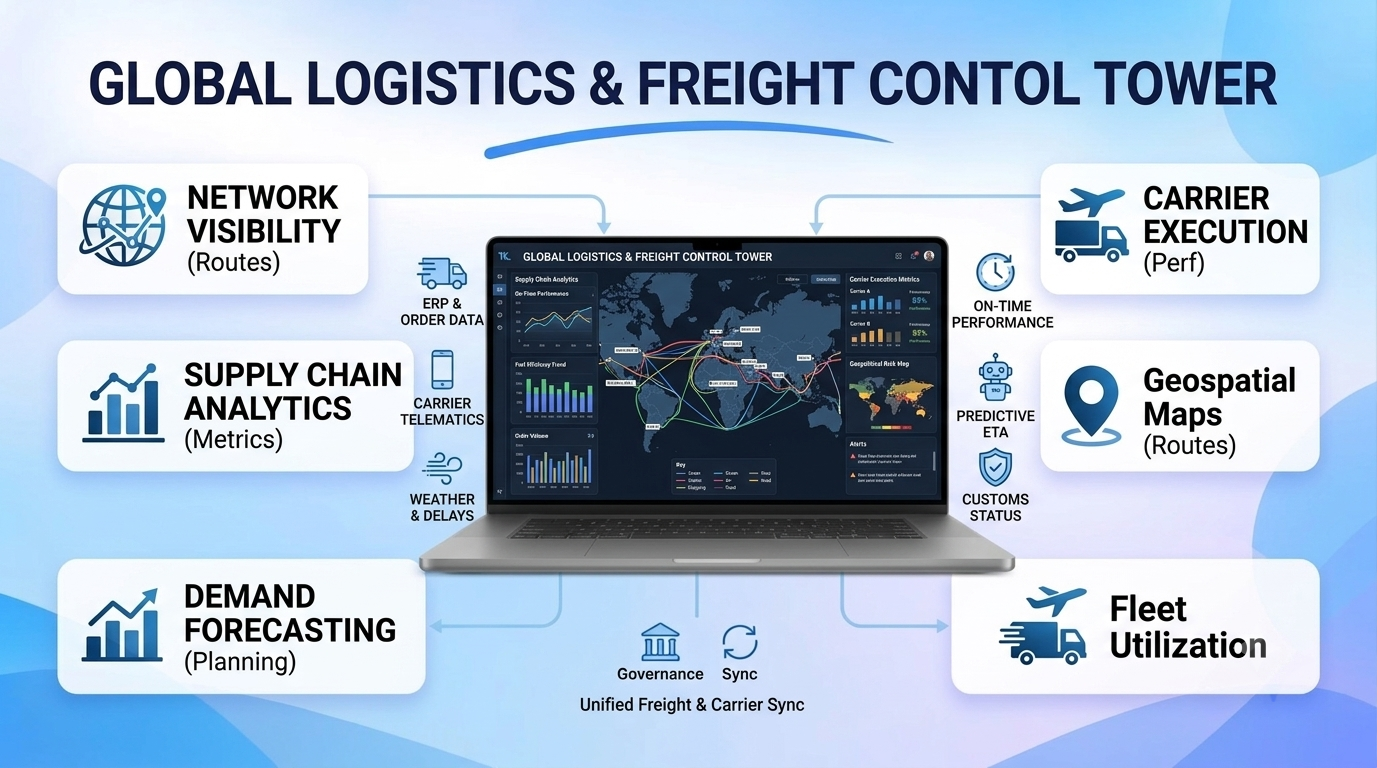
When a company ships pallets, full truckloads, intermodal containers, or international ocean freight across dozens of carriers using emailed rate sheets, manual load boards, and disconnected ERP order screens, freight spend quietly balloons by 10 to 20 percent. Duplicate carrier invoices go uncaught, less-than-truckload (LTL) shipments travel separately instead of consolidating into multi-stop truckloads, and customer service teams learn a shipment is delayed only after the customer calls to complain.
A Transportation Management System (TMS) governs the commercial and physical execution of freight movement—spanning order consolidation, multi-mode carrier rating, automated tendering, real-time shipment visibility, and freight audit and payment. Evaluating TMS platforms requires distinguishing between Tier-1 global enterprise supply-chain suites, 3PL-native multi-client TMS platforms, cloud-native mid-market shipper TMS tools, and parcel-focused shipping engines.
Five Core Capabilities That Separate True TMS From Basic Shipping Software
Basic parcel shipping apps print carrier labels; an enterprise or mid-market TMS optimizes freight economics across complex multi-leg networks:
- Multi-Mode Rating, Consolidation, and Load Optimization: Comparing contract tariffs and spot market rates simultaneously across LTL, Full Truckload (FTL), intermodal, air, ocean, and parcel—while automatically pooling compatible orders into consolidated multi-stop truckloads and calculating 3D trailer/container cube utilization.
- Automated Carrier Tendering and Spot-Market Waterfall: Executing routing-guide waterfalls automatically—tendering loads to primary contracted carriers via EDI (204/990) or API, cascading to backup carriers upon rejection or timeout, and broadcasting uncovered freight to digital freight brokers or spot boards.
- Real-Time Multi-Modal Visibility and Exception Management: Ingesting live GPS/ELD pings, ocean AIS vessel telemetry, and carrier EDI 214 status milestones (paired with visibility networks like Project44 or FourKites) to calculate dynamic predictive ETAs and flag detention, dwell-time, or temperature excursions early.
- Automated Freight Audit, Rating Verification, and Settlement: Matching carrier invoices (EDI 210) against tendered rates, fuel surcharge tables, accessorial rules (liftgate, detention, lumper fees), and signed Proof of Delivery (POD) records—flagging overcharges automatically before ERP general-ledger payment.
- Cross-Border Trade Compliance and Dock Appointment Scheduling: Generating commercial invoices, customs declarations, and hazardous-materials manifests for international lanes while coordinating warehouse dock door appointments to eliminate carrier detention charges.
Leading Transportation Management Systems (TMS)
Oracle Transportation Management (OTM)
Oracle Transportation Management (OTM) is widely regarded as the most comprehensive global multi-modal TMS for Fortune 500 shippers and multinational logistics providers. Engineered to orchestrate complex domestic and international movements across ocean, air, rail, FTL, LTL, and parcel in a single data model, OTM excels at multi-leg network optimization, global trade compliance integration, predictive machine-learning lead times, and automated freight settlement.
Global enterprises shipping across continents with intricate customs, multi-leg consolidation, and strict financial audit requirements standardize on OTM. Its primary trade-offs are high licensing costs, long implementation cycles, and the need for dedicated OTM administrative expertise.
SAP Transportation Management (SAP TM)
Embedded natively within SAP S/4HANA Digital Supply Chain, SAP Transportation Management provides tight financial and operational continuity for enterprises already running SAP ERP and SAP Extended Warehouse Management (EWM). Supporting strategic freight procurement, ocean container optimization, carrier collaboration portals, and natural-language exception handling via SAP Joule, it maintains strict financial audit trails directly inside the core ERP ledger.
Manhattan Active Transportation Management and Blue Yonder TMS
- Manhattan Active Transportation Management delivers a cloud-native, versionless microservices TMS designed to unify warehouse and transportation execution—simultaneously optimizing inbound supplier freight and outbound customer deliveries to maximize backhaul utilization and reduce empty miles.
- Blue Yonder Transportation Management pairs carrier execution and exception management with digital-twin network scenario modeling—allowing supply chain planners to simulate weather disruptions, fuel spikes, or port strikes before committing carrier capacity.
MercuryGate TMS and Descartes Systems Group (3PL & Global Trade Specialists)
- MercuryGate TMS is built specifically around Third-Party Logistics (3PL) and freight broker workflows—natively handling multi-client SLA rules, customer-specific rating markups, multi-tenant reporting, and faster mid-to-enterprise deployment than Tier-1 ERP suites.
- Descartes Systems Group combines a broad multi-modal TMS with the Global Logistics Network, excelling in customs compliance, denied-party screening, ocean/air forwarding, and pre-built carrier EDI connectivity.
Trimble TMS (TMW.Suite / Innovative) and McLeod Software (Asset-Based Carrier TMS)
While shipper TMS platforms focus on tendering freight out to carriers, asset-based trucking companies and private fleets require a Carrier TMS. Trimble Transportation and McLeod LoadMaster govern dispatch boards, driver settlement/payroll, fuel tax (IFTA) reporting, tractor-trailer pairing, and customer EDI billing for asset-based carriers and freight brokerages.
Kuebix (by Trimble), FreightPOP, and Rose Rocket (Cloud Mid-Market Shipper & Broker TMS)
Mid-market shippers and growing freight brokers priced out of seven-figure Tier-1 suites gravitate toward rapid-deployment cloud TMS platforms:
- Kuebix and FreightPOP provide fast SaaS onboarding, instant LTL/FTL API rate shopping across pre-connected carrier networks, automated BOL generation, and freight audit dashboards without multi-month IT projects.
- Rose Rocket delivers a modern, collaborative cloud TMS tailored for small-to-mid-sized trucking companies and freight brokerages seeking intuitive order-to-cash dispatch and customer portals.
Transportation Management Systems (TMS) Comparison
| TMS Platform | Primary Market Role | Modal & Global Scope | Key Architectural Strength | Deployment & Complexity | Best Fit |
|---|---|---|---|---|---|
| Oracle OTM | Tier-1 Global Shipper & 3PL TMS | Full multi-modal (ocean, air, rail, FTL, LTL, parcel) | Unmatched multi-leg global optimization & freight settlement | Cloud / Hybrid (enterprise implementation) | Multinational enterprises with complex cross-border freight |
| SAP TM | ERP-Native Enterprise TMS | Global multi-modal & parcel | Seamless S/4HANA financial & SAP EWM warehouse unity | S/4HANA Cloud & On-Premises | Enterprises standardized on SAP S/4HANA |
| Manhattan Active / Blue Yonder | Unified Supply Chain Execution TMS | Domestic & global multi-modal | Inbound/outbound backhaul AI (Manhattan) / network twins (Blue Yonder) | Versionless Cloud SaaS (Manhattan) / Cloud | Large retail & CPG networks unifying WMS and TMS |
| MercuryGate / Descartes | 3PL-Native & Global Trade TMS | Multi-modal + deep customs/forwarding (Descartes) | Multi-client 3PL billing/SLAs (MercuryGate) & customs (Descartes) | Cloud SaaS | 3PL providers, freight forwarders & compliance-heavy shippers |
| Trimble / McLeod | Asset-Based Carrier & Broker TMS | Over-the-road FTL, LTL & dedicated fleets | Driver settlement, IFTA, dispatch & asset utilization | Cloud & On-Premises | Asset-based trucking fleets & freight brokerages |
| FreightPOP / Kuebix / Rose Rocket | Mid-Market Cloud Shipper & Broker TMS | Primarily domestic LTL, FTL, parcel & ocean/air APIs | Fast SaaS onboarding, instant API rating & low IT overhead | Multi-tenant Cloud SaaS | Mid-market manufacturers, distributors & growing brokers |
Common TMS Implementation Pitfalls to Avoid
- Buying a Shipper TMS When You Operate an Asset-Based Fleet (or Vice Versa): Shipper TMS tools optimize carrier selection and freight audit, whereas Carrier TMS tools manage driver payroll, tractor maintenance intervals, and backhaul revenue per mile. Verify your primary operating model before shortlisting vendors.
- Underestimating Carrier EDI and API Onboarding Time: A TMS cannot rate or tender loads electronically until your contracted carriers are connected. Audit how many of your core LTL/FTL carriers already exist in the vendor’s pre-built API/EDI network versus requiring custom EDI mapping.
- Ignoring Accessorial Rules in Automated Freight Audit: Base line-haul rates are rarely where carriers overcharge; margin leaks through disputed detention fees, incorrect freight classes (NMFC codes), and unverified residential/liftgate accessorials. Configure strict accessorial approval tolerances before turning on auto-pay.
Selecting the Right Transportation Management System
Match your TMS investment to your annual freight spend, modal complexity, and ERP landscape:
- For Mid-Market Shippers Spending $2M–$25M Annually on Domestic Freight: Start with FreightPOP or Kuebix for rapid LTL/FTL rate shopping, BOL automation, and invoice auditing without heavy IT overhead.
- For Third-Party Logistics (3PL) Providers and Freight Forwarders: Evaluate MercuryGate TMS for multi-client SLA and margin management, or Descartes when customs compliance and global carrier networks dominate.
- For Global Enterprises With Complex Multi-Modal Supply Chains: Standardize on Oracle OTM, SAP TM (for S/4HANA shops), or Manhattan Active TMS (when unifying WMS and TMS execution).
