Spreadsheets work until a business crosses 500 SKUs, adds a second warehouse or 3PL partner, or starts selling across both wholesale B2B accounts and online marketplaces simultaneously. At that point, stockouts on top-selling items happen alongside mounting piles of dead capital sitting in slow-moving overstock—and year-end financial write-offs surprise leadership because landed costs and shrinkage were never tracked continuously.
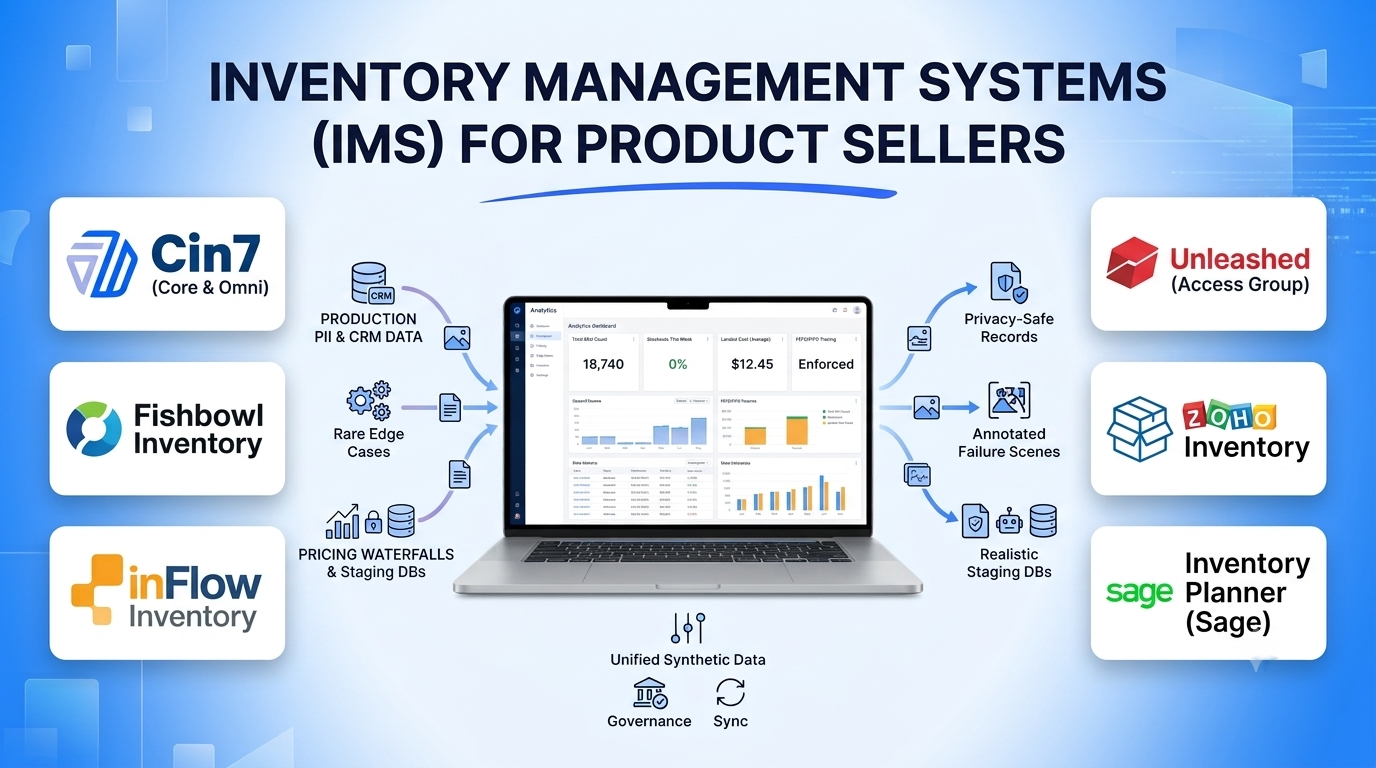
Inventory management systems (IMS) serve as the operational ledger of physical stock—tracking exact quantities across locations, calculating reorder points and demand forecasts, managing purchase orders, and syncing stock levels across sales channels and accounting software. Evaluating IMS platforms requires distinguishing between e-commerce multi-channel inventory hubs, B2B wholesale and distribution inventory platforms, cloud ERP inventory suites, and AI-driven demand forecasting and replenishment tools.
Five Core Capabilities of Modern Inventory Management Software
When evaluating inventory management software, look beyond simple SKU counting to inspect five essential financial and operational controls:
- Real-Time Multi-Location Stock Ledger (On-Hand, Committed, Available, In-Transit): Separating physical stock on the shelf from units already reserved for open sales orders, quarantined for quality hold, or currently in transit on open purchase orders—preventing double-selling across channels.
- Lot, Serial, and Expiration (FEFO/FIFO) Traceability: Essential for food, cosmetics, supplements, pharmaceuticals, and electronics—tracking vendor batch numbers, serial numbers, and expiration dates from receiving dock through customer shipment, and enforcing First-Expired, First-Out (FEFO) picking.
- Dynamic Reorder Points, Lead-Time Tracking, and Demand Forecasting: Moving beyond static “reorder when stock hits 20” rules by incorporating vendor lead-time variability, seasonal demand trends, safety-stock formulas, and automated Purchase Order (PO) generation.
- Landed Cost Allocation and Inventory Valuation Accuracy: Rolling international ocean/air freight, customs duties, tariffs, and insurance directly into unit SKU valuation using FIFO, Weighted Average Cost (WAC), or Specific Identification—keeping balance-sheet asset values and gross margins accurate in QuickBooks, Xero, or NetSuite.
- Kitting, Bundling, and Light Assembly Support: Dynamically calculating available bundle stock from underlying component quantities (e.g., a 3-piece skincare gift set) without locking physical inventory prematurely into pre-assembled kits.
Leading Inventory Management Systems
Cin7 (Cin7 Core and Cin7 Omni)
Cin7 is one of the most comprehensive cloud inventory management platforms for product sellers operating across e-commerce, wholesale B2B, retail POS, and light manufacturing. Combining multi-warehouse stock control, batch/serial tracking, landed cost allocation, built-in B2B wholesale ordering portals, EDI compliance for big-box retailers, and native sync with Shopify, Amazon, QuickBooks Online, and Xero, Cin7 bridges operational inventory and multi-channel commerce cleanly.
Scaling product brands and wholesale distributors managing 1,000 to 50,000 SKUs across multiple warehouses and sales channels favor Cin7’s breadth. Its rich feature set requires structured onboarding and disciplined SKU setup.
Unleashed (by Access Group)
Unleashed focuses squarely on B2B wholesale distributors, food/beverage producers, and light manufacturers that prioritize rigorous margin control, batch/expiration traceability, and real-time perpetual inventory valuation. Known for deep landed-cost calculations, multi-currency supplier purchasing, mobile barcode scanning, and tight integration with Xero, QuickBooks, and Shopify, Unleashed avoids bloated ERP complexity while maintaining strict accounting discipline.
Wholesale and batch-tracked product businesses needing clean perpetual inventory accounting and supplier cost visibility rely heavily on Unleashed.
Zoho Inventory
Zoho Inventory delivers an accessible, cost-effective cloud inventory solution for small-to-mid-sized businesses—especially organizations already running Zoho Books, Zoho CRM, or Shopify. Supporting multi-warehouse tracking, composite items/bundles, serial and batch tracking, barcode scanning, and automated reorder alerts, Zoho Inventory provides strong core functionality at entry-level SMB pricing, though very high-volume multi-warehouse enterprises eventually outgrow its throughput and reporting depth.
Fishbowl Inventory
Fishbowl remains a staple for small and mid-sized warehouses and light manufacturers committed to QuickBooks Desktop or QuickBooks Online. Adding multi-location bin tracking, barcode-driven receiving/picking, cycle counting, and auto-reordering on top of QuickBooks without requiring a full accounting system replacement, Fishbowl excels in physically structured warehouses.
inFlow Inventory and Sortly (Agile SMB & Internal Asset/Stock Trackers)
- inFlow Inventory targets small wholesale, e-commerce, and B2B businesses wanting fast setup, built-in B2B showroom portals, barcode label printing, and straightforward purchasing/invoicing workflows.
- Sortly specializes in ultra-simple, visual QR/barcode inventory tracking for tools, IT equipment, medical supplies, and field service vans rather than complex multi-channel retail accounting.
Inventory Planner (by Sage) and Netstock (Dedicated Demand Forecasting & Replenishment)
When a company’s core inventory ledger already lives inside Shopify, NetSuite, or Dynamics—but poor purchasing decisions cause chronic stockouts or dead stock—specialized replenishment engines like Inventory Planner and Netstock plug directly into existing ERPs/IMS tools to model seasonal velocity, supplier lead times, and open-to-buy budgets.
Inventory Management Systems Comparison
| Platform | Primary Focus | Traceability & Valuation | Channel & Accounting Ecosystem | Target Business Size | Best Fit |
| Cin7 (Core / Omni) | Omnichannel wholesale, D2C & EDI inventory | Batch/serial, FEFO, landed cost & light BOMs | Shopify, Amazon, EDI, QuickBooks, Xero | Scaling SMB & mid-market (10–250 staff) | Brands & distributors selling across D2C, wholesale & retail EDI |
| Unleashed | B2B wholesale, food/beverage & light Mfg inventory | Deep perpetual valuation, landed cost & batch tracking | Xero, QuickBooks, Shopify, Salesforce | SMB & mid-market B2B distributors | Margin-focused wholesalers & batch-tracked producers |
| Zoho Inventory | Affordable multi-warehouse & e-commerce stock control | Serial/batch tracking & composite bundles | Zoho Books/CRM, Shopify, Amazon, eBay | Small businesses & early-stage SMBs | Cost-conscious SMBs & existing Zoho suite users |
| Fishbowl Inventory | Warehouse bin & barcode control for QuickBooks | Lot/serial tracking, cycle counts & work orders | Deepest QuickBooks Online & Desktop sync | SMBs & mid-market warehouses | QuickBooks-centric companies needing structured warehouse bins |
| inFlow Inventory | Fast-setup wholesale & SMB stock management | Lot/serial tracking, barcode generation & B2B portal | QuickBooks, Xero, Shopify, WooCommerce | Small B2B & wholesale teams | Small teams wanting rapid setup without consultant overhead |
| Inventory Planner / Netstock | AI demand forecasting & replenishment optimization | Statistical safety stock, seasonality & OTB budgets | Plugs into Shopify, NetSuite, Cin7, Dynamics | Mid-market retailers & distributors | Operations teams fixing overstock & stockout purchasing errors |
Common Inventory Management Pitfalls to Avoid
- Turning On Automated Channel Sync Before Reconciling Physical Counts: Connecting an IMS to push stock numbers to Shopify and Amazon while warehouse shelves are still inaccurate immediately pushes wrong quantities across every storefront. Freeze stock movements for a physical count before enabling live channel pushes.
- Using Average Costing When Freight and Tariffs Fluctuate Wildly: Ignoring landed costs (freight, customs, duties) understates true COGS by 10–25% on imported goods—tricking leadership into thinking low-margin SKUs are profitable. Enforce landed-cost allocation on every international Purchase Order receipt.
- Replacing Annual Shutdown Counts With Zero Cycle Counting: Waiting until December to count inventory guarantees massive year-end write-offs. Implement daily or weekly ABC cycle counting—counting high-value/high-velocity “A” SKUs monthly and “C” SKUs quarterly.
Selecting the Right Inventory Management System
Match your IMS choice to your sales channels, traceability requirements, and accounting system:
- For Small Businesses Needing Clean Multi-Location & Barcode Control: Start with Zoho Inventory or inFlow Inventory.
- For QuickBooks-Committed Warehouses: Choose Fishbowl Inventory to add bin-level barcode control without migrating accounting.
- For B2B Wholesalers and Batch-Tracked Producers: Evaluate Unleashed for rigorous landed-cost accounting and batch/expiration control.
- For Multi-Channel Brands Scaling Across E-Commerce, Wholesale, and Retail EDI: Standardize on Cin7—and add Inventory Planner or Netstock once purchasing complexity demands statistical demand forecasting.
