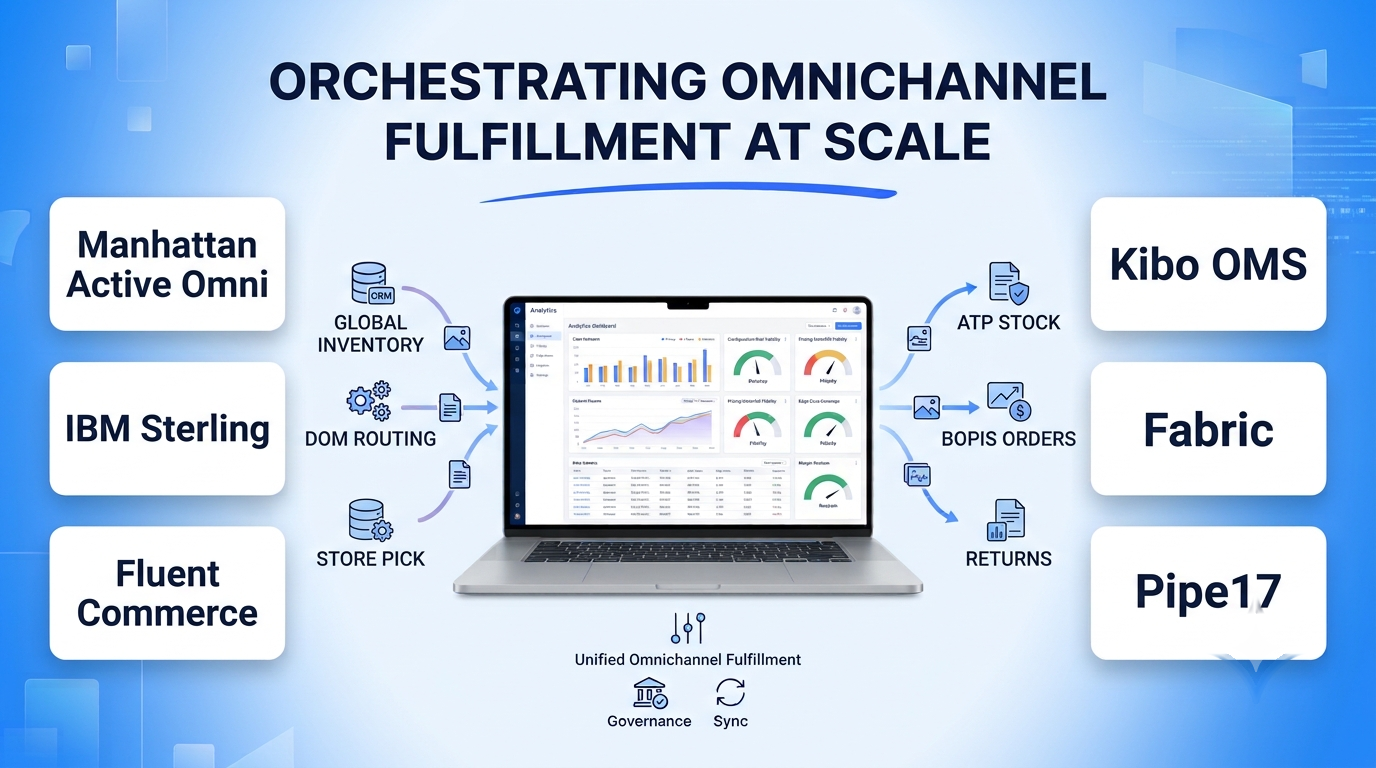
Capturing an order on a website, mobile app, marketplace, or EDI portal is only the starting gun. Modern commerce breaks down between the “Buy” button and the doorstep: a customer orders three items online, one sits in a regional distribution center, another is only available as the last unit in a retail store three states away, and the customer calls support twenty minutes later asking to change the shipping address or return one item to a physical store.
An Order Management System (OMS) acts as the central nervous system of omnichannel fulfillment—maintaining a single real-time view of inventory across warehouses, retail stores, and drop-ship vendors, executing intelligent Distributed Order Management (DOM) routing rules, orchestrating split shipments, and managing returns and exchanges. Evaluating OMS platforms requires distinguishing between enterprise composable DOM suites, mid-market commerce-native OMS platforms, and e-commerce operations/shipping hubs.
Five Core Capabilities of a Modern Order Management System
When evaluating OMS software for retail, direct-to-consumer (D2C) brands, or B2B wholesale distribution, inspect five operational engines:
- Real-Time Global Inventory Visibility and Safety Stock Buffers: Aggregating Available-to-Promise (ATP) stock across warehouses, 3PLs, physical stores, and in-transit purchase orders in real time—applying channel-specific safety stock buffers so high-velocity marketplaces never oversell the final unit in a retail store.
- Distributed Order Management (DOM) Sourcing Optimization: Automatically routing each order line to the optimal fulfillment node using configurable cost, distance, SLA, and margin rules—minimizing split shipments, reducing shipping zones, balancing store pick workloads, and preventing markdowns by routing orders to overstocked stores.
- In-Flight Order Modification and Exception Handling: Allowing customer service agents (and self-service customer portals) to cancel unpicked items, update addresses, swap sizes, or resolve payment/fraud holds cleanly before the warehouse prints a packing slip.
- Store Fulfillment (BOPIS, Curbside, and Ship-from-Store): Equipping retail store associates with intuitive mobile pick-and-pack apps that enforce SLA timers, barcode scan verification, and carrier label printing without disrupting walk-in shoppers.
- Omnichannel Returns, Exchanges, and Reverse Logistics: Orchestrating Buy-Online-Return-in-Store (BORIS), instant exchange reservations, carrier drop-off labels, and automated ERP financial refunds/credits once returned goods pass inspection.
Leading Order Management Systems (OMS)
Manhattan Active Omni
Manhattan Active Omni is the benchmark enterprise cloud OMS for global tier-one omnichannel retailers. Built on a versionless, microservices-native architecture, it unifies Distributed Order Management, enterprise inventory availability, Store Inventory & Fulfillment, and omnichannel Customer Engagement (call-center order servicing)—scaling effortlessly through peak Black Friday concurrency while optimizing fulfillment cost-to-serve across thousands of stores and distribution centers.
Large multi-banner retailers and global consumer brands operating complex store-and-DC networks standardize on Manhattan Active Omni, accepting enterprise licensing and structured system-integrator implementations.
IBM Sterling Order Management
IBM Sterling Order Management remains a cornerstone enterprise DOM platform for massive B2C retailers, telecommunications providers, and complex B2B/industrial distributors. Renowned for deep supply-chain orchestration—including multi-enterprise drop-ship networks, complex service/installation scheduling alongside physical product delivery, and AI-assisted fulfillment optimization—Sterling handles intricate order topologies across cloud and hybrid deployments.
Fluent Commerce (Fluent Order Management)
Fluent Commerce pioneered the composable, API-first cloud OMS category—designed specifically for mid-market and enterprise brands adopting MACH (Microservices, API-first, Cloud-native, Headless) commerce architectures. Featuring a flexible low-code workflow engine, virtual inventory catalogs (allowing segmented stock allocation per region or channel), and rapid integration with Shopify Plus, commercetools, Salesforce Commerce Cloud, and Adyen, Fluent lets engineering teams tailor fulfillment logic without monolithic rigidity.
Kibo Order Management and Fabric OMS
- Kibo Order Management delivers a modular, cloud-native DOM suite particularly strong in Ship-from-Store, BOPIS, and curbside fulfillment, offering pre-built store associate mobile interfaces and fast deployment for mid-market omnichannel retailers.
- Fabric OMS provides a modern, API-first order and inventory orchestration platform tailored for digital-native brands and mid-market retailers scaling across D2C webstores, wholesale EDI, and 3PL networks.
Linnworks, Cin7, and Pipe17 (Mid-Market E-Commerce & Multi-Channel Ops)
For high-growth e-commerce brands and distributors whose primary challenge is synchronizing orders, inventory, and shipping across Shopify, Amazon, Walmart, TikTok Shop, 3PLs, and accounting systems:
- Linnworks centralizes multi-marketplace listing, inventory sync, order routing, and carrier label generation in one operations hub.
- Cin7 (Core & Omni) blends multi-channel order management with light manufacturing, wholesale B2B portals, and warehouse inventory tracking.
- Pipe17 acts as a modern AI-powered order operations connectivity hub—sitting between selling channels (Shopify, Amazon, EDI) and fulfillment endpoints (3PLs, WMS, NetSuite) to automate order routing, split-shipment reconciliation, and exception resolution in days without brittle custom middleware.
Order Management Systems (OMS) Comparison
| OMS Platform | Architectural Tier | Core Strength | Store Fulfillment & DOM Depth | Ecosystem & Integration Fit | Best Fit |
| Manhattan Active Omni | Enterprise versionless cloud microservices | Unmatched retail scale, DOM optimization & store fulfillment | Very High (BOPIS, Ship-from-Store, POS & call center) | Deep retail ERP, WMS & POS ecosystem | Global Tier-1 omnichannel retailers & department stores |
| IBM Sterling OMS | Enterprise cloud / hybrid DOM platform | Complex B2C/B2B order topologies, drop-ship & service bundling | Very High (multi-enterprise sourcing & ATP) | SAP, Oracle, enterprise EDI & legacy ERP integration | Large enterprises with complex B2B/B2C supply chains |
| Fluent Commerce | Composable MACH cloud-native OMS | Flexible low-code workflows & virtual inventory segmentation | High (configurable DOM routing & store pick) | Shopify Plus, commercetools, SFCC, Stripe/Adyen | Mid-market & enterprise brands building composable commerce |
| Kibo / Fabric OMS | Modular cloud omnichannel OMS | Rapid store-fulfillment rollout (Kibo) / API-first agility (Fabric) | High (strong BOPIS, curbside & 3PL routing) | Modern headless commerce, 3PLs & ERPs | Mid-market retailers scaling store & 3PL fulfillment |
| Linnworks / Cin7 / Pipe17 | Mid-market e-commerce & connectivity hubs | Multi-marketplace sync, 3PL routing & fast deployment | Moderate (warehouse/3PL routing; lighter store POS) | Shopify, Amazon, Walmart, NetSuite, QuickBooks, 3PLs | Fast-growing D2C & marketplace brands managing multiple 3PLs |
Common OMS Implementation Pitfalls to Avoid
- Turning On Ship-from-Store Without Store-Level Safety Stock Buffers: A retail store’s ERP inventory count is notoriously noisy due to unrecorded theft, damaged display items, or items sitting in a shopper’s fitting room. Always enforce a store-level safety buffer (e.g., hiding the last 2 units from online ATP) to avoid painful order cancellations.
- Over-Optimizing for Shipping Cost While Ignoring Split-Shipment Penalties: Splitting a three-item order across three warehouses to save $1.20 on ground zones triples box costs, annoys customers with staggered deliveries, and increases return rates. Configure DOM scoring weights to penalize split shipments appropriately.
- Confusing ERP Order Entry With Distributed Order Management: Basic ERP sales-order modules record orders, but they rarely recalculate real-time sourcing across 40 stores and 6 3PLs dynamically or expose modern self-service customer modification APIs.
Selecting the Right Order Management System
Match your OMS architecture to your fulfillment footprint and commerce stack:
- For Digital-Native Brands Selling Across Marketplaces and 3PLs: Choose Pipe17, Linnworks, or Cin7 to synchronize channels, 3PLs, and accounting without heavy enterprise overhead.
- For Composable Mid-Market & Enterprise Retail: Evaluate Fluent Commerce or Kibo OMS for API-first Distributed Order Management and store fulfillment.
- For Global Multi-Banner Retail or Complex B2B Supply Chains: Standardize on Manhattan Active Omni or IBM Sterling OMS for proven peak-season scale and deep multi-node optimization.
