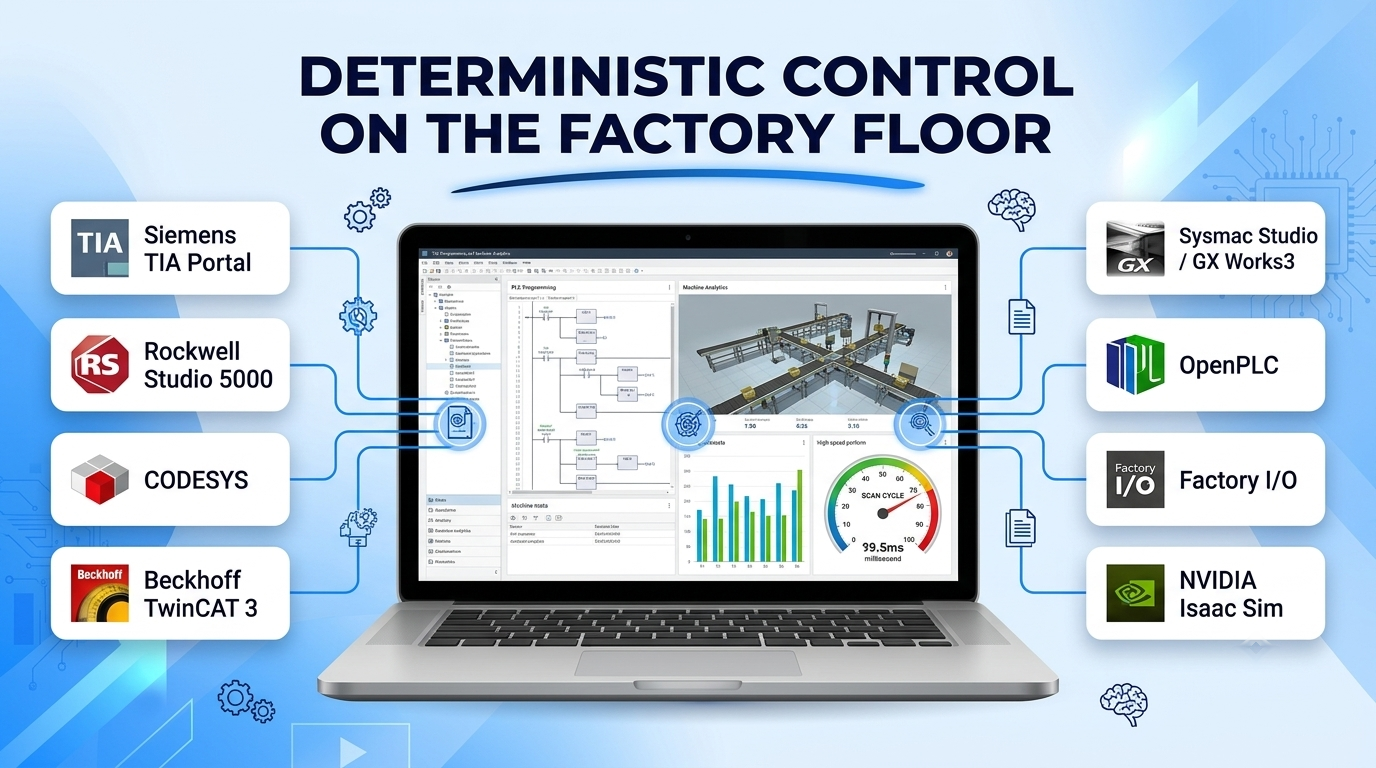
Unlike enterprise software where a garbage-collection pause or network retry goes unnoticed, a Programmable Logic Controller (PLC) executes deterministic scan cycles every few milliseconds—reading physical proximity sensors, calculating PID loops, and energizing high-speed servo valves where a missed deadline ruins product or damages machinery.
Because PLC programming environments are tightly bound to industrial hardware ecosystems, evaluating PLC programming tools requires distinguishing between OEM-locked flagship engineering suites, hardware-agnostic IEC 61131-3 runtimes, PC-based real-time EtherCAT controllers, and open-source training and edge automation tools.
Five Core Capabilities of Modern PLC Engineering Environments
When evaluating PLC development software for machine builders (OEMs), system integrators, or plant maintenance teams, inspect five practical capabilities:
- Full IEC 61131-3 Language Support: Support for graphical Ladder Diagram (LD) and Function Block Diagram (FBD) (prized by plant electricians for live visual troubleshooting) alongside Structured Text (ST) (essential for complex math, array parsing, and state machines) and Sequential Function Chart (SFC).
- Bumpless Online Editing and Live Diagnostics: The ability to modify logic, force I/O tags, and inspect live execution state on a running production line without stopping the PLC scan cycle—critical in continuous 24/7 manufacturing.
- Built-In Hardware Simulation and Virtual Commissioning: Emulating PLC CPU execution locally on an engineering laptop—and connecting to 3D physics plant simulators like Factory I/O or NVIDIA Isaac Sim—to debug interlocks weeks before physical control panels arrive.
- Integrated Motion Control, Safety (FSoE / PROFIsafe), and Fieldbus Configuration: Configuring multi-axis servo kinematics, functional safety logic (SIL 3 / PLe), and deterministic fieldbuses (PROFINET, EtherNet/IP, EtherCAT) inside one unified hardware tree rather than juggling separate configurator utilities.
- Version Control and CI/CD Diffing: Historically, proprietary binary PLC project files broke Git diffing and team collaboration. Modern suites increasingly provide XML/text export APIs, library version management, and automated build/test pipelines.
Leading PLC Programming Tools and Engineering Suites
Siemens TIA Portal (Totally Integrated Automation)
Siemens TIA Portal (STEP 7) is the dominant industrial automation engineering environment across Europe, Asia, and global OEM machinery. Uniting PLC programming (for SIMATIC S7-1200, S7-1500, and ET 200SP controllers), functional safety (STEP 7 Safety), WinCC HMI configuration, and SINAMICS drive commissioning inside a single database, TIA Portal features symbolic tag addressing, integrated PLCSIM virtual controllers, and a comprehensive library architecture for modular machine builders.
Engineering teams working with Siemens hardware gain deep cross-discipline integration across PLCs, drives, safety, and HMIs. Its primary trade-offs are heavy workstation resource demands (requiring high RAM and fast NVMe storage) and strict version compatibility between TIA Portal releases and controller firmware.
Rockwell Automation Studio 5000 Logix Designer
Studio 5000 Logix Designer is the industry standard across North American automotive, food and beverage, pharmaceutical, and heavy manufacturing plants running Allen-Bradley ControlLogix and CompactLogix controllers. Built around a tag-based memory architecture, Add-On Instructions (AOIs) for reusable encapsulated logic, seamless online editing, and tight CIP Safety / EtherNet/IP integration, Studio 5000 pairs with FactoryTalk Logix Echo for high-fidelity controller emulation.
Plants and integrators operating in North America rely heavily on Studio 5000 for its strong maintenance-floor familiarity and broad talent pool. Licensing is tiered by supported languages (Ladder-only vs. Full multi-language editions) and represents a significant upfront capital investment.
CODESYS Development System
CODESYS is the leading hardware-independent IEC 61131-3 engineering suite, powering hundreds of PLC brands worldwide—including WAGO, Schneider Electric (EcoStruxure Machine Expert), Festo, Turck, Eaton, and Bosch Rexroth—as well as soft-PLC runtimes on industrial Linux PCs and Raspberry Pi hardware. The desktop IDE is free to download and includes a built-in soft-PLC simulator, native Git integration, object-oriented extensions to Structured Text, and integrated visualization.
Machine builders and engineers wanting portable IEC 61131-3 code that avoids single-hardware vendor lock-in—or students learning industrial automation without purchasing expensive hardware—rely extensively on CODESYS.
Beckhoff TwinCAT 3
Beckhoff TwinCAT 3 turns standard industrial Windows PCs into deterministic, multi-core real-time PLC, CNC, and motion controllers running over ultra-fast EtherCAT fieldbuses. Uniquely embedded directly inside Microsoft Visual Studio, TwinCAT 3 lets automation engineers combine standard IEC 61131-3 languages with C/C++, MATLAB/Simulink models, and native Git source control—assigning different tasks to dedicated CPU cores with sub-millisecond cycle times.
High-speed packaging, semiconductor, robotics, and test-stand builders needing extreme EtherCAT determinism and tight integration between PLC logic and PC-based vision or C++ algorithms favor TwinCAT 3.
Mitsubishi GX Works3 and Omron Sysmac Studio
For Asian manufacturing ecosystems and high-speed discrete machinery, Mitsubishi Electric GX Works3 (for MELSEC iQ-R/iQ-F PLCs) and Omron Sysmac Studio (uniting NJ/NX machine controllers, EtherCAT motion, vision sensors, and safety in one IDE) remain core production standards.
OpenPLC and Factory I/O (Open-Source & Virtual Training Ecosystem)
For education, prototyping, and open-source edge control, OpenPLC provides a completely free, open-source IEC 61131-3 editor and runtime supporting all five standard languages across Linux, Raspberry Pi, and industrial microcontrollers. Pairing OpenPLC, CODESYS, TIA Portal, or Studio 5000 with Factory I/O (a 3D real-time industrial plant simulator featuring conveyors, sorting stations, and palletizers) gives engineers and trainees realistic physical feedback without risking real machinery.
PLC Programming Tools Comparison
| Tool / IDE | Hardware Ecosystem | Supported Languages | Built-In Simulation & Emulation | Licensing & OS | Best Fit |
| Siemens TIA Portal | Siemens SIMATIC S7-1200 / S7-1500 / Safety | LD, FBD, ST, SCL, SFC, GRAPH | PLCSIM & PLCSIM Advanced | Commercial tiered licenses (Windows) | European/global OEMs & plants standardized on Siemens |
| Rockwell Studio 5000 | Allen-Bradley ControlLogix / CompactLogix | LD, FBD, ST, SFC (tier-dependent) | FactoryTalk Logix Echo / Emulate | Commercial tiered licenses (Windows) | North American manufacturing & process plants |
| CODESYS | Multi-vendor (WAGO, Schneider, Festo, Linux/RPi) | All 5 IEC 61131-3 + OOP extensions | Built-in soft-PLC simulator | Free IDE; per-device runtime license (Windows IDE) | Hardware-agnostic OEMs & engineers avoiding vendor lock-in |
| Beckhoff TwinCAT 3 | Beckhoff Industrial PCs & EtherCAT I/O | All 5 IEC 61131-3 + C/C++ + Simulink | Local real-time core simulation | Free engineering IDE; runtime licenses by CPU class | High-speed EtherCAT motion, CNC & PC-based control |
| Sysmac Studio / GX Works3 | Omron NJ/NX (Sysmac) / Mitsubishi iQ-R/F | Full IEC 61131-3 + integrated motion/vision | Built-in controller & 3D motion simulation | Commercial OEM licenses (Windows) | High-speed discrete automation & Asian supply chains |
| OpenPLC | Raspberry Pi, Arduino, Linux & industrial IPCs | All 5 IEC 61131-3 languages | Built-in basic simulation + Factory I/O bridge | 100% Free & Open-Source (Linux, Windows, macOS) | Learning, academic labs & open-source edge prototypes |
Common PLC Engineering Pitfalls to Avoid
- Writing Clever Structured Text Where Plant Electricians Need Ladder Logic: Even if an engineer prefers Structured Text for everything, basic machine fault interlocks and E-stop diagnostics are far faster for third-shift maintenance technicians to troubleshoot visually in Ladder Logic. Reserve Structured Text for math, data parsing, and complex recipes while keeping machine interlocks readable in Ladder or FBD.
- Skipping Virtual Commissioning Before Site Acceptance Testing (SAT): Debugging sensor timing and conveyor handoffs on a live factory floor costs thousands of dollars per hour in downtime. Simulate core sequences against PLCSIM, Logix Echo, or Factory I/O before shipping panels.
- Neglecting Program Upload/Compare Governance: When multiple engineers make live online edits during commissioning without checking changes back into a central repository (such as Siemens TIA Project Server, Rockwell AssetCentre, or Git), offline backups fall out of sync with the running PLC—turning a hardware replacement into an emergency rewrite.
Selecting the Right PLC Programming Tool
In most industrial projects, hardware selection dictates the IDE—but when you have architectural choice:
- For Standardized Plant-Floor Maintenance: Align with your facility’s installed base—Studio 5000 in Allen-Bradley facilities or TIA Portal in Siemens environments.
- For Multi-Brand OEM Equipment Portability: Build on CODESYS so your core IEC 61131-3 application libraries compile across multiple PLC hardware suppliers.
- For Sub-Millisecond Motion, Robotics, and PC-Based Control: Adopt Beckhoff TwinCAT 3 over EtherCAT.
- For Learning and Low-Cost Prototyping: Start with CODESYS or OpenPLC paired with Factory I/O to master IEC 61131-3 fundamentals with zero upfront license cost.
