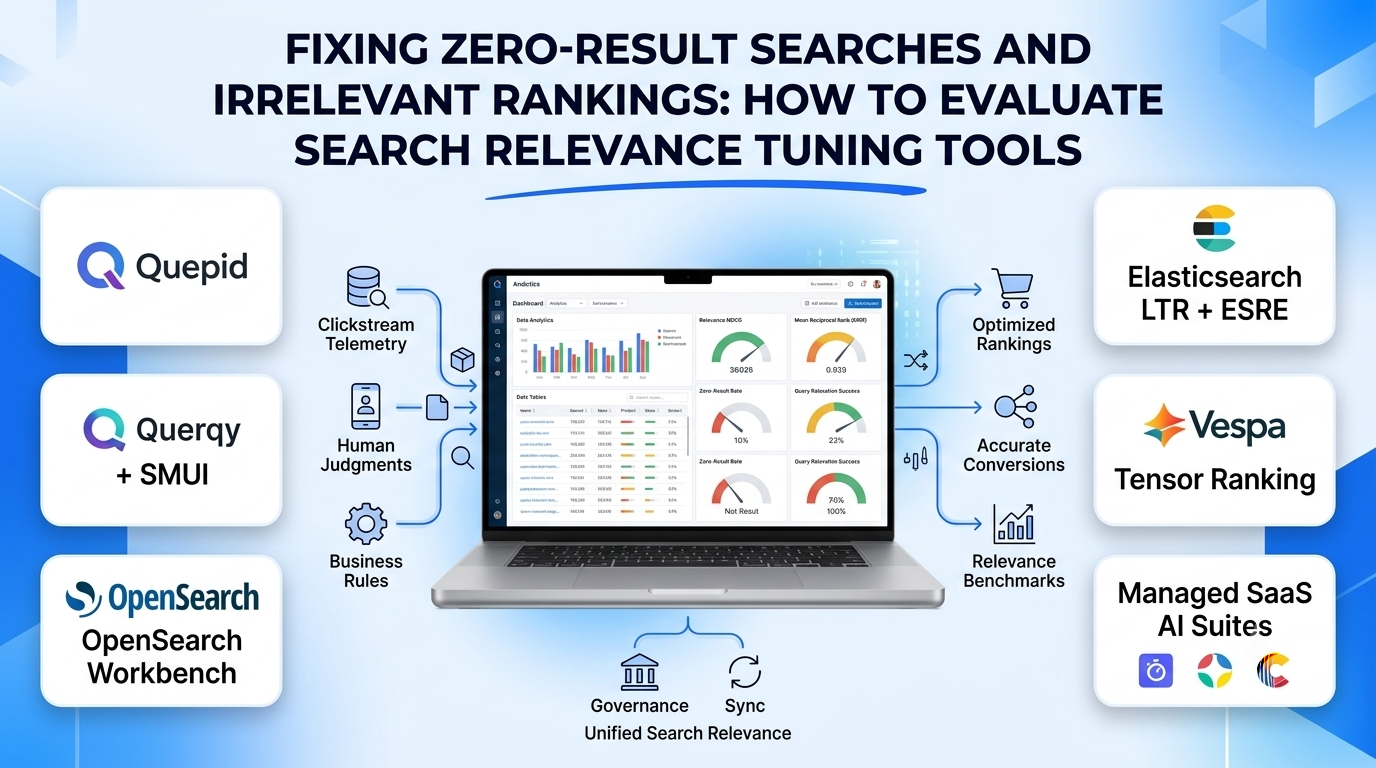
Deploying a search engine or hybrid vector index is only the starting line. Within weeks of launch, real users type misspelled brand names, ambiguous acronyms, multi-attribute filters (“waterproof trail shoes under 100”), and long conversational queries—exposing zero-result dead ends, buried bestsellers, and keyword-stuffing artifacts that quietly erode conversion and user trust.
Search relevance tuning tools give search engineers, merchandisers, and product teams the instrumentation to measure ranking quality scientifically, apply business rules without redeploying backend code, train Learning-to-Rank (LTR) models, and run side-by-side relevance experiments before shipping query changes to live traffic.
Five Core Capabilities of Modern Search Relevance Tooling
Effective relevance engineering requires uniting offline human judgment datasets with online clickstream telemetry and controllable query-rewriting layers:
- Offline Relevance Workbenches and Judgment Rating (NDCG / MRR): Teams cannot improve what they do not score. Relevance workbenches let domain raters grade query-document pairs (0–3 relevance scales) and automatically compute Normalized Discounted Cumulative Gain (NDCG@k), Mean Reciprocal Rank (MRR), and Precision@k across golden query sets whenever analyzer settings, BM25 weights, or embedding models change.
- Side-by-Side Query and Pipeline Comparison: Running two search configurations (such as pure BM25 vs. hybrid dense+sparse with cross-encoder reranking) side by side over the same query set to inspect exact rank shifts before running live A/B tests.
- Active Query Rewriting and Merchandising Rules: Empowering search analysts and merchandisers to manage multi-word synonyms, typo corrections, query relaxation, category boosts, and pinned results through a governed UI—without waiting on engineering sprints.
- User Behavior Insights (UBI) and Click-Model Training: Capturing standardized impression, click, add-to-cart, and dwell-time events tied to unique
query_idtokens to detect high-traffic zero-result queries, abandonments, and implicit training signals for Learning-to-Rank. - Learning-to-Rank (LTR) and Neural Reranking Integration: Training gradient-boosted decision trees (XGBoost, LightGBM) or deploying neural cross-encoders (ColBERT, BGE, Cohere Rerank) to combine dozens of signals—lexical score, semantic similarity, popularity, freshness, margin, and personalization—into a single calibrated rank score.
Leading Search Relevance Tuning Tools
Quepid
Built by OpenSource Connections, Quepid is the standard open-source relevance workbench for search engineers working with Elasticsearch, OpenSearch, and Apache Solr. Teams organize representative search queries into test cases, rate returned results collaboratively, track NDCG and Precision metrics across iterative query experiments, snapshot historical tuning runs, and export human judgment lists directly into Learning-to-Rank training pipelines.
Search engineering teams iterating on complex Elasticsearch, OpenSearch, or Solr query DSLs—who need reproducible offline NDCG benchmarks before deploying changes—rely heavily on Quepid.
Querqy and SMUI (Search Management User Interface)
Also from the open-source search community, Querqy is a dedicated query pre-processor plugin for Solr, Elasticsearch, and OpenSearch, paired with SMUI (Search Management User Interface). Instead of hacking brittle boost clauses inside application code, Querqy/SMUI gives e-commerce merchandisers and search analysts an intuitive web UI to configure directional synonyms, common spelling corrections, query-word deletions, and category boosts—with staging previews and Git/deployment workflows.
E-commerce and marketplace teams where category managers need safe, self-service control over daily search rules without breaking core engine performance benefit directly from Querqy and SMUI.
OpenSearch Search Relevance Workbench and UBI
OpenSearch integrates native relevance tooling directly into its open-source distribution via the Search Relevance Workbench and User Behavior Insights (UBI) plugins. Engineers can compare two query pipelines side by side in OpenSearch Dashboards, collect standardized client-side click/conversion telemetry linked to query IDs, configure LLM-assisted or human relevance judgments, and plug pre-trained cross-encoder reranking models directly into search pipelines.
Organizations running OpenSearch gain native side-by-side comparison, behavior tracking, and neural reranking without deploying separate external workbench servers.
Elasticsearch Learning to Rank (LTR) and Elastic Search Relevance Engine (ESRE)
Elastic combines native hybrid search (BM25 + ELSER sparse neural retrieval + dense vector kNN with Reciprocal Rank Fusion) with the Elasticsearch Learning to Rank plugin (allowing teams to upload trained XGBoost or RankLib models for second-stage rescoring) and Elastic’s Search AI query-rule and synonym management APIs.
Vespa (Native Multi-Phase Ranking & Tensor Scoring)
For organizations operating high-scale search and recommendation workloads where relevance depends on complex custom ranking expressions, Vespa treats multi-phase ranking as a first-class architectural primitive. Engineers define declarative ranking profiles combining lexical BM25, dense HNSW vectors, learned sparse representations (ColBERT/SPLADE), ONNX cross-encoder models, and real-time tensor features inside a single low-latency distributed engine.
Commercial AI Search Suites With Built-In Relevance Studios (Algolia, Coveo, Constructor)
Teams that prefer a managed SaaS search platform over operating open-source clusters often adopt Algolia, Coveo, or Constructor—all of which bundle visual merchandising rule builders, automated synonym mining, dynamic re-ranking from clickstream analytics, and built-in multi-armed bandit A/B testing inside a managed control plane.
Search Relevance Tuning Tools Comparison
| Tool / Platform | Primary Role | Supported Search Engines | Human & Behavior Signals | Ranking & Rule Capabilities | Best Fit |
| Quepid | Offline relevance workbench & NDCG grader | Elasticsearch, OpenSearch, Apache Solr | Collaborative manual ratings + judgment export | Query DSL iteration, metric snapshots & LTR dataset prep | Search engineers tuning open-source query templates systematically |
| Querqy + SMUI | Active query rewriting & merchandising UI | Apache Solr, Elasticsearch, OpenSearch | Merchandiser-curated rules & analytics hooks | Multi-word synonyms, typo rules, category boosts & filters | E-commerce & marketplace teams empowering non-engineers safely |
| OpenSearch Relevance Workbench + UBI | Built-in comparison, telemetry & reranking | OpenSearch native | Standardized UBI click/event capture + LLM/human ratings | Side-by-side query diffs, query rewriting & cross-encoders | Teams standardized on OpenSearch wanting integrated tooling |
| Elasticsearch LTR + ESRE | Hybrid retrieval & ML rescoring | Elasticsearch native | Clickstream-derived LTR feature logs | BM25 + ELSER + dense vectors + XGBoost/RankLib LTR | Engineering teams deploying custom ML ranking inside Elastic |
| Vespa | High-scale serving & multi-phase tensor ranking | Vespa standalone engine | Real-time tensor features & online feedback loops | Multi-phase BM25 + HNSW + ColBERT + ONNX neural reranking | High-throughput search & RAG teams needing custom ML rankers |
| Algolia / Coveo / Constructor | Managed SaaS search & merchandising studios | Managed proprietary SaaS | Automated clickstream & conversion optimization | Visual pinning, dynamic reranking & built-in A/B testing | Product & e-commerce teams wanting turnkey managed search |
Common Search Relevance Tuning Traps
- Optimizing Only for Head Queries While Ignoring the Long Tail: Fixing the top 50 highest-volume queries via manual synonym rules improves headline metrics while leaving 60% of multi-word long-tail queries broken. Pair rule-based tuning (Querqy) with semantic/hybrid retrieval and Learning-to-Rank to generalize across unseen phrasing.
- Training Learning-to-Rank on Uncorrected Position Bias: Users click result #1 far more often than result #5 simply because it sits at the top of the screen—not because it is more relevant. Always apply inverse propensity weighting (IPW) or randomized interleaving when converting raw click logs into LTR training labels.
- Adding Heavy Cross-Encoder Rerankers Without Latency Budgets: Rescoring the top 200 documents with a large transformer cross-encoder can add 300ms+ to p99 latency. Limit second-stage neural reranking to the top 20–50 candidates returned by fast first-stage lexical/vector retrieval.
Selecting the Right Search Relevance Tuning Tool
Build your relevance toolkit incrementally based on your search maturity:
- Stage 1 (Establish Measurement First): Deploy Quepid (or OpenSearch Search Relevance Workbench) and build a golden set of 100–200 representative queries—including zero-result and long-tail queries—so every tuning change is measured against NDCG.
- Stage 2 (Empower Merchandising & Domain Experts): Add Querqy and SMUI so analysts can resolve synonyms, misspellings, and category boosts safely without engineering bottlenecks.
- Stage 3 (Scale ML & Neural Ranking): Instrument clickstream behavior tracking (UBI) and introduce Learning-to-Rank or multi-phase neural reranking in Elasticsearch, OpenSearch, or Vespa once you have clean behavioral signals.
