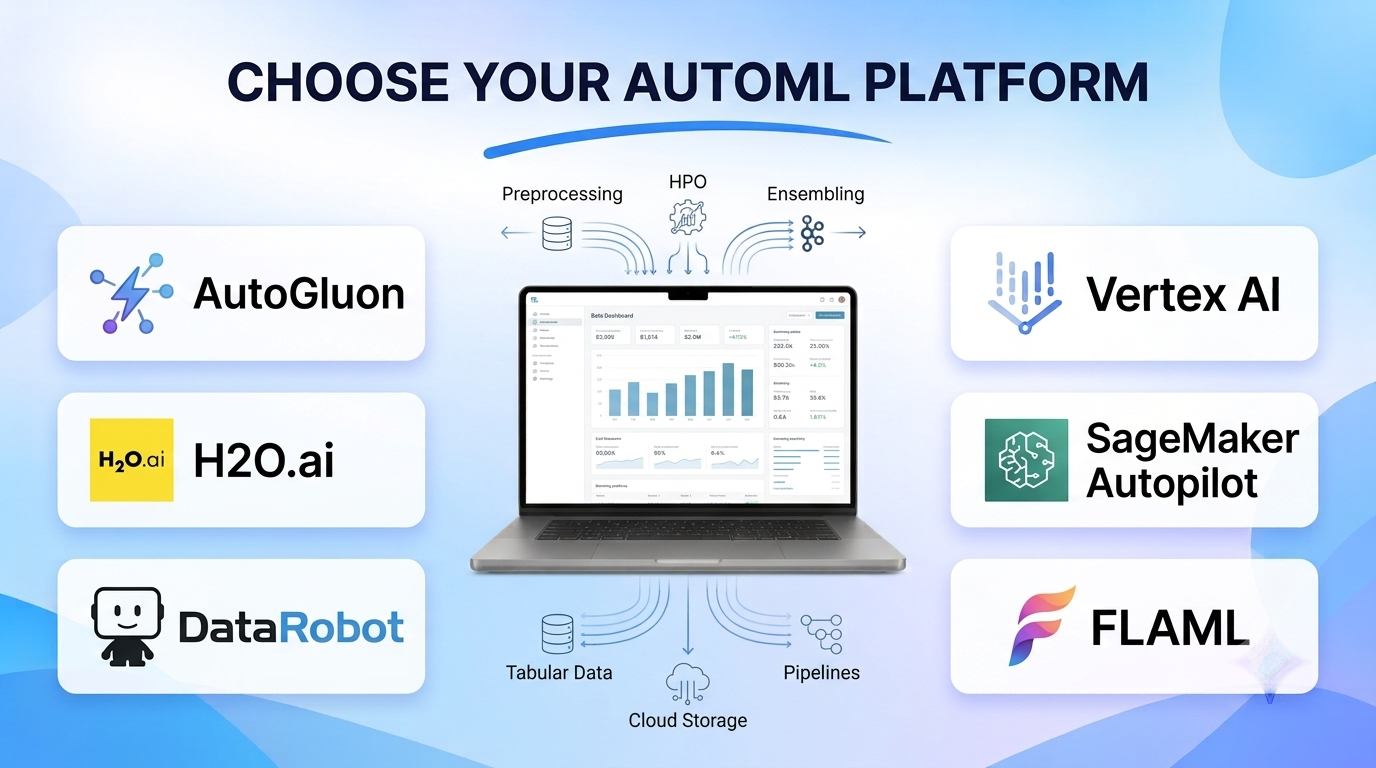
Automated Machine Learning (AutoML) platforms promise to compress weeks of repetitive feature engineering, algorithm selection, and hyperparameter tuning into an automated pipeline. For teams drowned in business requests—such as churn propensity scoring, demand forecasting, credit risk modeling, and predictive maintenance—AutoML eliminates boilerplate experimentation and establishes strong statistical baselines in hours rather than months.
The real risk of AutoML is not that it produces weak models, but that it produces opaque models that fail silently in production or violate domain constraints. Evaluating an AutoML platform requires looking past leaderboard accuracy scores to examine how each system handles temporal data leakage, feature engineering transparency, explainability documentation, and clean code export for production deployment.
What AutoML Actually Automates—and Where Human Judgment Remains Mandatory
Modern AutoML spans a wide technical spectrum. Understanding where automation excels versus where domain expertise remains essential prevents costly deployment failures:
- Automated Preprocessing and Feature Generation: Handling missing values, encoding high-cardinality categorical columns, extracting datetime components, and testing interaction terms or rolling window aggregations across relational tables.
- Algorithm Search and Ensembling: Evaluating gradient-boosted decision trees (XGBoost, LightGBM, CatBoost), linear models, neural networks, and stacked ensembles systematically across cross-validation folds.
- Hyperparameter Optimization (HPO): Applying Bayesian optimization, successive halving, or evolutionary search to tune learning rates, tree depths, and regularization parameters efficiently.
- Where Humans Must Intervene: Defining the prediction target cleanly, preventing target leakage (accidentally feeding future information into historical training rows), selecting business-aligned evaluation metrics (such as precision at top-k or asymmetric financial loss rather than generic accuracy), and enforcing fairness or regulatory constraints.
Architectural Categories of AutoML Software
Rather than treating every AutoML tool as identical, divide the market into three distinct architectural approaches:
- Open-Source Python AutoML Libraries: Code-first packages imported directly into Python scripts or notebooks. They execute locally or on existing cloud compute clusters, export standard Python artifacts, and impose zero per-seat vendor licensing.
- Cloud Hyperscaler AutoML Services: Managed services embedded inside AWS, Google Cloud, and Azure that provision distributed compute automatically, integrate tightly with cloud object storage and identity policies, and deploy directly to managed prediction endpoints.
- Enterprise Visual and Governance AutoML Suites: End-to-end commercial platforms providing point-and-click modeling studios, automated compliance documentation, bias auditing, and centralized model risk governance for cross-functional teams.
Leading AutoML Platforms and Libraries Compared in Depth
AutoGluon
Developed and open-sourced by Amazon Web Services, AutoGluon has repeatedly set the benchmark in independent tabular AutoML evaluations by prioritizing multi-layer stack ensembling and bagging over brittle hyperparameter tuning alone. Supporting tabular data, time-series forecasting, and multimodal datasets (combining text, images, and tabular fields in a single dataframe), AutoGluon trains diverse model families—including LightGBM, CatBoost, XGBoost, neural networks, and foundation models—and combines them via multi-layer stacking with out-of-fold validation to prevent overfitting.
Data scientists and ML engineers seeking maximum predictive accuracy on structured tabular or multimodal datasets with minimal lines of Python code consistently favor AutoGluon. Its primary trade-off is inference latency and artifact footprint: multi-layer stacked ensembles consume more memory and compute during real-time scoring than a single tuned LightGBM model, requiring AutoGluon’s distillation features when strict millisecond inference SLAs apply.
H2O.ai (H2O AutoML and H2O Driverless AI)
H2O.ai spans two distinct offerings tailored to different organizational needs. H2O-3 AutoML is a mature, open-source distributed machine learning framework supporting Python and R APIs alongside a browser-based Flow UI, automatically training and ensembling generalized linear models, random forests, gradient boosting machines, and deep neural networks across in-memory clusters. H2O Driverless AI is its commercial enterprise platform, adding automated genetic-algorithm feature engineering, automatic visualizations, Shapley explainability reports, and low-latency MOJO (Model Object, Optimized) Java/C++ scoring pipelines.
Regulated enterprises—particularly banks, insurers, and healthcare organizations—value H2O Driverless AI for its automated model documentation, reason codes, and standalone scoring artifacts that run without heavy Python runtime dependencies. Open-source H2O-3 delivers strong distributed tabular modeling at zero license cost, though its UI and workflow feel more traditional than modern cloud-native notebooks.
DataRobot
DataRobot is an enterprise AI platform built around governed, end-to-end automated machine learning. Users upload datasets or connect cloud data warehouses, and DataRobot automatically profiles columns for target leakage, generates domain-aware features (including time-series lag windows and geospatial aggregations), runs parallel model tournaments across dozens of open-source and proprietary algorithms, and generates automated compliance documentation for model risk committees.
Organizations with lean data science teams—or enterprises where business analysts collaborate with data scientists under strict audit and governance controls—derive major operational leverage from DataRobot. For research-focused engineering teams building custom deep learning architectures, DataRobot’s opinionated workflow and enterprise licensing cost can feel restrictive compared to code-first libraries.
Google Cloud Vertex AI AutoML
Vertex AI AutoML provides Google Cloud’s fully managed, no-code/low-code automated modeling service across tabular, image, video, and text datasets. Integrated directly with BigQuery and Google Cloud Storage, Vertex AI handles automated feature transformations, neural architecture search, distributed training, and one-click deployment to autoscaling REST endpoints with built-in feature attribution explanations.
Teams already storing analytical data in BigQuery and operating within Google Cloud gain frictionless deployment and IAM-governed security without managing GPU or CPU clusters. Its trade-offs include cloud vendor lock-in—since proprietary managed AutoML models cannot always be exported as arbitrary editable source code—and compute charges that can escalate quickly during long search budgets on wide tabular datasets.
Amazon SageMaker Autopilot
Amazon SageMaker Autopilot differentiates itself from “black-box” cloud AutoML services by generating transparent, editable Python notebooks alongside every automated experiment. When pointed at tabular data in Amazon S3, Autopilot inspects data types, generates multiple candidate feature-engineering and algorithm pipelines (supporting XGBoost, LightGBM, CatBoost, linear learners, and deep learning), tunes hyperparameters, and outputs full data-exploration and candidate-definition notebooks that data scientists can inspect, modify, and version in Git.
AWS-centric engineering teams that want automated baseline generation without sacrificing code transparency or auditability benefit strongly from Autopilot’s white-box notebook generation. Like other hyperscaler services, it remains tightly coupled to AWS S3, IAM, and SageMaker infrastructure.
FLAML (Fast and Lightweight AutoML)
Created by Microsoft Research, FLAML is an open-source Python library engineered specifically for low-cost, sample-efficient hyperparameter optimization and model selection. Unlike brute-force search tools that spend hours evaluating expensive configurations early, FLAML’s cost-frugal optimization algorithm prioritizes fast, inexpensive learner configurations first and gradually explores costlier models only when they improve validation metrics, supporting scikit-learn estimators, LightGBM, XGBoost, CatBoost, and time-series forecasting.
Python developers and resource-constrained engineering teams running automated retraining pipelines inside CI/CD jobs or modest CPU containers value FLAML’s speed, tiny dependency footprint, and scikit-learn-compatible API (fit/predict). It focuses primarily on tabular modeling and hyperparameter search rather than turnkey visual governance dashboards.
TPOT and Auto-sklearn
TPOT (Tree-based Pipeline Optimization Tool) uses genetic programming to evolve complete scikit-learn pipelines—discovering sequences of feature preprocessors, dimensionality reducers, and estimators—and exports the winning pipeline directly as clean, standalone Python code. Auto-sklearn applies Bayesian optimization and meta-learning (warm-starting search based on prior dataset characteristics) to construct automated scikit-learn ensembles.
Academic researchers, educators, and Python practitioners wanting transparent scikit-learn pipeline generation on moderate tabular datasets appreciate both libraries’ open-source transparency. On very large multi-million-row datasets or complex multimodal inputs, AutoGluon and FLAML generally scale more efficiently.
Dataiku (Visual AutoML)
Dataiku integrates AutoML directly inside its collaborative visual-and-code data science studio. Analysts prepare data using visual recipes or SQL/Python, launch automated modeling sessions with built-in k-fold cross-validation, inspect subpopulation fairness and partial dependence plots, and deploy models into scheduled batch or real-time API scoring pipelines governed by centralized IT permissions.
Cross-functional enterprise analytics teams bridging domain analysts and technical data scientists benefit from having data preparation, AutoML training, and production scheduling unified in one workspace.
AutoML Platform Comparison
| Platform | Deployment & Licensing | Primary Data Modalities | Transparency & Export | Best Fit | Key Trade-Off |
| AutoGluon | Open-source Python library (Apache 2.0) | Tabular, time-series, multimodal (text + image) | Full Python access; multi-layer ensemble artifacts | Maximum tabular accuracy with minimal code | Stacked ensembles increase inference latency/RAM |
| H2O.ai (Driverless AI / H2O-3) | Open-source (H2O-3) + Commercial Enterprise | Tabular, time-series, NLP | Standalone low-latency MOJO Java/C++ artifacts + reports | Regulated industries needing fast scoring and audit docs | Commercial Driverless AI carries enterprise licensing |
| DataRobot | Commercial Cloud SaaS or on-premises | Tabular, time-series, text, geospatial | Automated compliance docs, Shapley values, API endpoints | Enterprise governance and cross-functional modeling | High commercial cost; less flexible for custom research |
| Vertex AI AutoML | Managed Google Cloud service | Tabular, image, video, text | Managed endpoints + feature attributions (limited export) | BigQuery and GCP teams wanting zero-ops deployment | Cloud lock-in and high search compute costs on wide tables |
| SageMaker Autopilot | Managed AWS service | Tabular, time-series | Generates full editable Python notebooks + S3 artifacts | AWS teams wanting “white-box” transparent AutoML | Coupled to AWS SageMaker and S3 infrastructure |
| FLAML | Open-source Python library (MIT) | Tabular, time-series | Standard scikit-learn compatible Python estimators | Fast, compute-efficient automated retraining in Python | No built-in visual UI or enterprise model registry |
| TPOT | Open-source Python library (LGPL) | Tabular | Exports readable, standalone scikit-learn Python code | Generating clean baseline Python scripts for small/medium data | Genetic search can be slow on large, high-dimensional data |
Critical Evaluation Criteria Before Adopting AutoML
- Temporal Leakage Protection: For time-series forecasting, churn prediction, or credit scoring, random k-fold cross-validation leaks future patterns into training folds and produces artificially inflated accuracy. Verify that the platform supports strict time-based splitting and out-of-time validation windows.
- Inference Latency vs. Ensemble Complexity: An AutoML leaderboard winner built from 25 stacked gradient-boosted trees and neural networks may take 300 milliseconds per row to score—violating a 20-millisecond real-time API budget. Check whether the platform supports model distillation or latency-constrained search budgets.
- Explainability and Audit Artifacts: In financial, healthcare, and insurance workflows, regulators require clear global feature importance and per-prediction reason codes (such as SHAP values). Ensure explainability reports are generated automatically rather than bolted on manually.
- Reproducibility and Version Control: Confirm that every automated run logs random seeds, dataset snapshots, package versions, and preprocessing steps so results can be reproduced months later during an audit.
Practical Guidance for Choosing an AutoML Stack
If your team works in Python and wants the strongest out-of-the-box predictive performance on structured or multimodal data without vendor lock-in, start with AutoGluon—or FLAML when compute budgets and training speed are tight. Organizations standardized on AWS or Google Cloud that want managed training and one-click endpoint hosting gain the smoothest path through SageMaker Autopilot (especially if engineers value editable Python notebook output) or Vertex AI AutoML. Finally, for regulated enterprises where compliance documentation, bias auditing, and cross-functional governance matter as much as model accuracy, DataRobot or H2O Driverless AI justifies its commercial investment.
