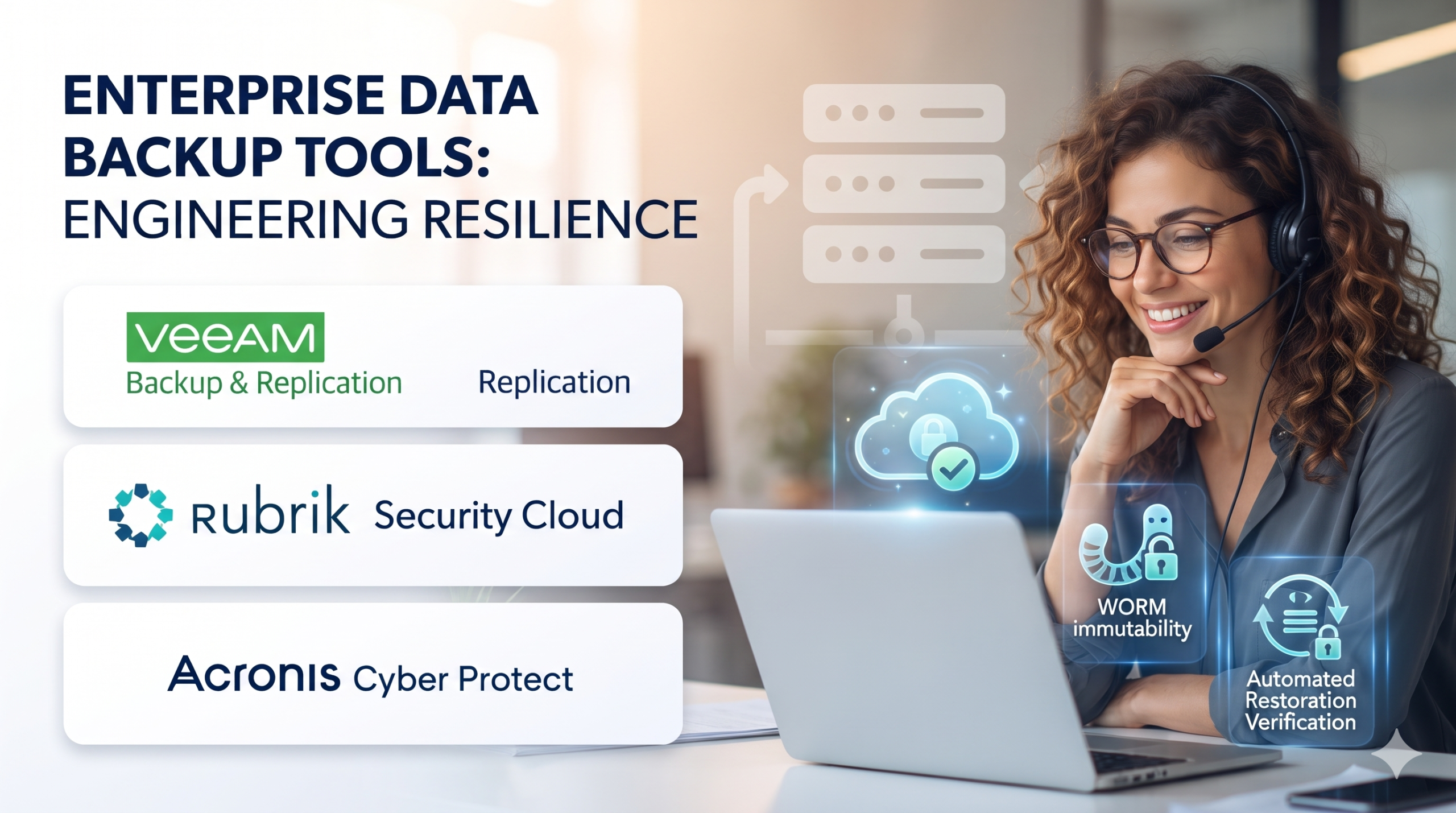
Every IT professional eventually confronts a definitive moment of truth: the hard drive array fails, a ransomware payload locks the primary database, or a human error wipes a critical production volume. In that precise instant, an organization’s operational survival depends entirely on the reliability, speed, and integrity of its data backup infrastructure.
Yet, managing data backup has grown vastly more complex than scheduling a nightly script to copy files to an external drive. Modern enterprise environments span local virtualized hypervisors, distributed multi-cloud architectures, and remote employee endpoints. Selecting the right data backup tools requires looking past marketing claims to examine recovery time objectives, storage deduplication efficiency, and immutable security boundaries.
The Paradigm Shift in Modern Data Protection
A decade ago, backup strategies followed a rigid, linear pattern: full backups on weekends, incremental backups on weeknights, and tapes rotated off-site. Today, that traditional model breaks down under the weight of petabyte-scale cloud workloads, containerized applications, and aggressive cyber threats.
Modern data backup tools must solve three critical engineering challenges:
- Ransomware Immunity and Air-Gapping: Attackers routinely target backup catalogs first to eliminate recovery options before launching primary encryption payloads. Modern tools must enforce write-once-read-many (WORM) immutability and logical air-gapping to protect backup points from tampering.
- Instant Recovery Demands: Waiting hours or days to rebuild a failed database or hypervisor host results in catastrophic business downtime. Enterprise tools now prioritize instant virtual machine mounting and continuous data protection (CDP) to restore operational status in seconds.
- Hybrid Cloud Interoperability: Data no longer resides exclusively on local server racks. Protecting workloads distributed across SaaS applications, public cloud object storage, and private infrastructure requires versatile, policy-driven backup orchestration.
Core Evaluation Pillars for Backup Software
When evaluating data backup tools for production environments, infrastructure architects should assess platforms across four foundational capabilities:
- Granular vs. Bare-Metal Restore Options: A robust tool must support both complete bare-metal system restoration for catastrophic hardware failures and granular file- or object-level recovery for accidental deletions.
- Storage Efficiency and Deduplication: Retaining weeks of historical backups consumes massive storage capacity. Advanced block-level deduplication and compression drastically reduce storage footprint and lower long-term retention costs.
- Automated Restoration Testing: Unverified backups are essentially unproven theories. Leading platforms feature automated sandbox testing environments that boot backed-up workloads in isolation to verify data integrity without manual intervention.
- Bandwidth and Network Optimization: Pushing large incremental backups across distributed networks can saturate corporate WAN links. Look for solutions supporting block-level incremental-forever logic and customizable bandwidth throttling.
Leading Data Backup Platforms Compared
The software market encompasses hypervisor-native enterprise suites, lightweight cloud-first agents, and comprehensive data protection platforms.
| Product | Primary Focus | Deployment Model | Supported Platforms | Standout Advantage | Notable Limitation |
| Veeam Backup & Replication | Comprehensive Virtual & Hybrid Enterprise Backup | Software-Defined | VMware, Hyper-V, Windows, Linux, AWS, Azure | Industry-standard reliability, instant VM recovery, and robust immutability options. | Requires careful planning and resource provisioning to manage large enterprise deployments. |
| Rubrik Security Cloud | Zero-Trust Data Security & Automated Recovery | Cloud-Managed SaaS | Enterprise VMs, Cloud Workloads, Databases | Automated ransomware detection, anomaly scoring, and rapid cloud orchestration. | Premium enterprise pricing model can be cost-prohibitive for smaller organizations. |
| Acronis Cyber Protect | Combined Backup and Endpoint Security | Software / Cloud Hybrid | Windows, macOS, Linux, Mobile | Integrates active ransomware protection and endpoint security directly into the backup client. | Managing multiple security modules can introduce administrative complexity. |
| BorgBackup | Open-Source Deduplicating Archival Tool | Self-Hosted / CLI | Linux, macOS | Highly efficient space-saving deduplication and authenticated encryption. | Lacks a native enterprise graphical management console out of the box. |
Deep-Dive Platform Analysis
Veeam Backup & Replication: The Enterprise Standard
Veeam has established itself as a cornerstone of virtualized infrastructure protection. It integrates deeply with VMware vSphere and Microsoft Hyper-V, capturing application-consistent backups without heavy agent overhead. Its Scale-out Backup Repository architecture allows administrators to tier older backups seamlessly from high-performance local storage to cost-effective object storage while enforcing strict immutability locks.
- Best Suited For: Mid-sized to large enterprises seeking flexible, hardware-agnostic backup infrastructure with unmatched hypervisor integration.
- Operational Trade-Off: Managing complex, distributed enterprise deployments requires experienced administrative oversight and disciplined resource planning.
Rubrik Security Cloud: Zero-Trust Resilience
Rubrik approaches backup and recovery through an uncompromising security lens. Recognizing that backup repositories are primary targets during cyber attacks, Rubrik enforces zero-trust architecture natively. Its platform continuously scans backup data for malware signatures and file entropy changes, alerting security teams to anomalous behavior before restoration occurs.
- Best Suited For: Large enterprises and regulated industries prioritizing automated threat detection and rapid, cloud-orchestrated recovery.
- Operational Trade-Off: The SaaS-managed architecture and enterprise licensing model represent a significant financial investment.
Acronis Cyber Protect: Unified Protection and Security
Acronis bridges the traditional gap between data backup and endpoint cybersecurity. By combining robust disk-image backups with active anti-malware and vulnerability assessment tools, it protects systems against both data loss and active malware infections within a single management agent.
- Best Suited For: Small to mid-sized businesses and Managed Service Providers looking to consolidate backup and endpoint security tools.
- Operational Trade-Off: The breadth of integrated features can sometimes create a cluttered administrative interface for teams seeking pure, dedicated backup workflows.
Implementation Pitfalls and Operational Best Practices
Deploying a data backup strategy fails quickly if technical deployment outpaces operational governance:
- Adhere to the 3-2-1-1-0 Rule: Maintain at least 3 copies of your data, across 2 different media types, with 1 copy stored off-site, 1 copy stored on immutable or offline storage, and with 0 errors verified during automated recovery testing.
- Enforce Multi-Factor Authentication Everywhere: Backup consoles provide ultimate access to enterprise data. Secure all administrative accounts with hardware-token MFA and enforce multi-person authorization for deletion policies.
- Run Regular Recovery Drills: Never assume a backup works until you successfully restore a critical database in an isolated recovery environment and verify application integrity.
Strategic Decision Framework
Selecting the right data backup tool depends heavily on your infrastructure scale, security risk profile, and internal operational capacity:
- If you manage a traditional or hybrid virtualized data center requiring granular control and proven reliability, Veeam offers the most versatile software-defined architecture.
- If your primary concern is advanced ransomware detection, automated threat analysis, and zero-trust security, Rubrik provides industry-leading cloud intelligence.
- If you require a streamlined solution combining endpoint security and backup for smaller environments, Acronis Cyber Protect delivers robust dual-purpose utility.
Audit your current recovery time objectives, verify your immutable storage boundaries, and conduct a live restoration test before finalizing your data protection architecture.
