When a primary data center suffers a catastrophic hardware failure, a sophisticated ransomware attack, or a regional power grid collapse, minutes of downtime can translate into millions of dollars in lost revenue and broken service-level agreements. In this critical window, an organization’s survival depends entirely on its Disaster Recovery (DR) tooling.
Yet, owning a backup copy of your data is no longer sufficient. Modern disaster recovery requires active replication, automated failover orchestration, and rigorous testing capabilities to ensure that complex multi-tier applications can spin up seamlessly in an alternative cloud or secondary hosting site without manual scripting errors.
The Paradigm Shift from Backup to Continuous Failover
Early disaster recovery strategies relied heavily on periodic backups shipped off-site, requiring system administrators to manually rebuild servers, reconfigure IP routing, and restore databases piece by piece during an outage. In high-availability enterprise environments, this manual approach results in recovery times that stretch into days—unacceptable for modern digital services.
Modern disaster recovery focuses on Recovery Point Objectives (RPO) and Recovery Time Objectives (RTO) measured in seconds or minutes.
- RPO (Recovery Point Objective): Determines how much data loss an organization can tolerate, dictating how frequently data must be replicated to the secondary site.
- RTO (Recovery Time Objective): Determines how quickly systems must be restored and operational after a disruption occurs.
Achieving near-zero RPO and RTO requires continuous data replication, automated dependency mapping, and orchestration engines that execute failover sequences in the correct hierarchical order (e.g., ensuring domain controllers and databases start before application front-ends).
Core Architecture and Evaluation Pillars
When technical architects evaluate disaster recovery platforms, success depends on analyzing four foundational engineering capabilities:
- Replication Mechanics (Synchronous vs. Asynchronous): Synchronous replication writes data to primary and secondary sites simultaneously, guaranteeing zero data loss (RPO = 0) but introducing latency penalties. Asynchronous replication batches writes at intervals, balancing network overhead with acceptable data loss thresholds.
- Automated Failover Orchestration: Manual failover scripts fail under pressure. DR tools must execute complex, multi-step runbooks automatically, managing DNS re-routing, IP translation, and service dependencies with a single click.
- Non-Disruptive Disaster Recovery Testing: A disaster recovery plan that has never been tested in production is merely a hypothesis. Leading tools allow isolated testing environments to spin up and execute simulated failovers without interrupting live user traffic.
- Cloud and Multi-Cloud Interoperability: Modern disaster recovery has largely shifted away from maintaining redundant secondary physical data centers. Utilizing cloud hyperscalers (AWS, Azure, Google Cloud) as an elastic recovery target reduces capital expenditure while maintaining geographic separation.
Leading Disaster Recovery Platforms Compared
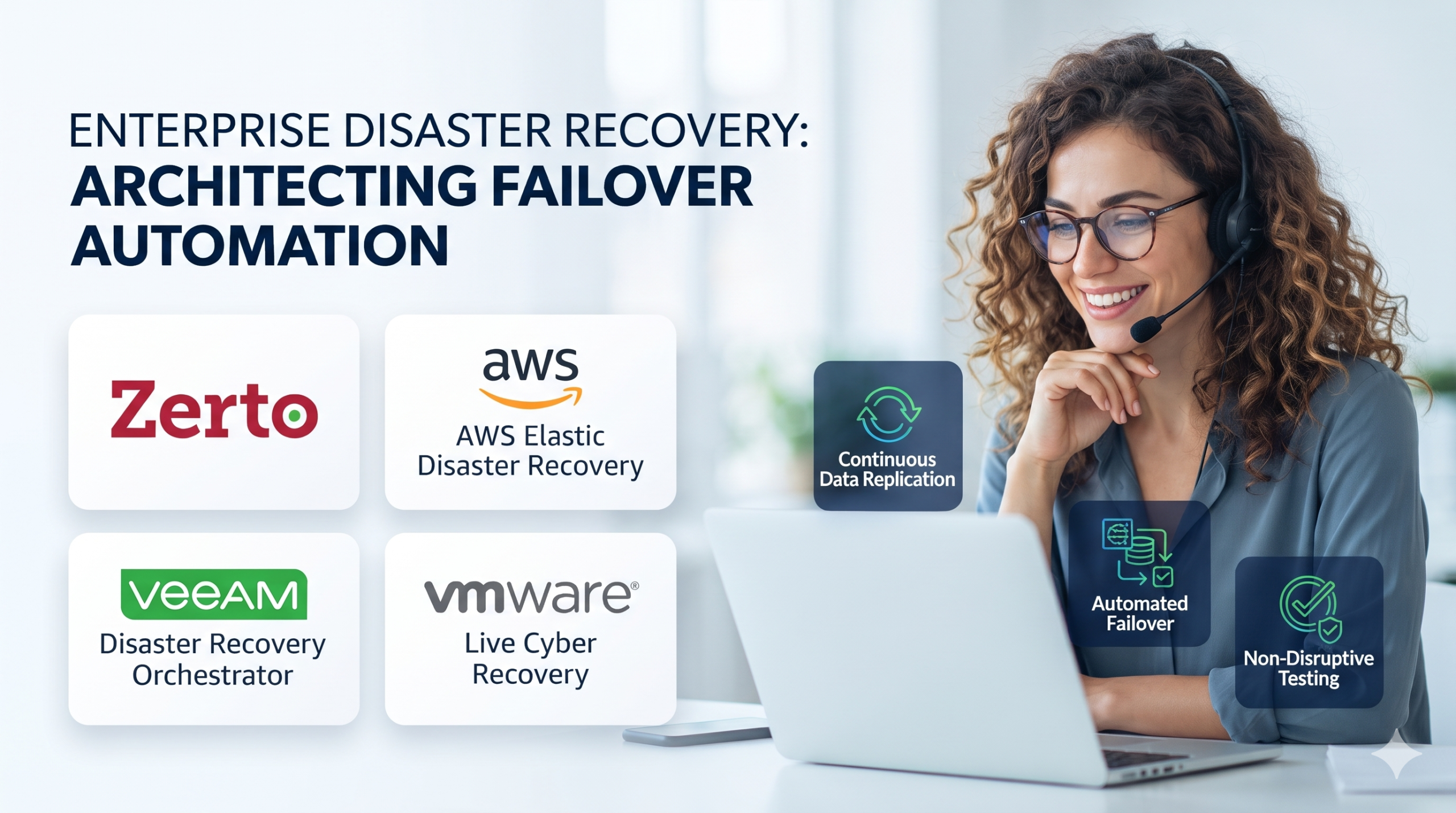
The disaster recovery software market spans hypervisor-native replication engines, cloud-native migration tools, and comprehensive enterprise orchestration suites.
| Product | Primary Focus | Deployment Model | Supported Platforms | Standout Advantage | Notable Limitation |
| Zerto | Continuous Data Protection & Hypervisor Replication | Software-Defined Virtual Appliance | VMware vSphere, Microsoft Hyper-V, AWS, Azure | Industry-leading sub-second RPO with journaling for granular point-in-time recovery. | Requires dedicated storage and network bandwidth planning to sustain continuous replication. |
| AWS Elastic Disaster Recovery (TRS) | Cloud-Native Failover to AWS Infrastructure | Cloud-Managed SaaS | On-Premises Physical & Virtual Servers, AWS | Cost-effective cloud staging architecture keeping workloads dormant until failover occurs. | Tailored primarily for organizations migrating to or operating within the AWS ecosystem. |
| Veeam Disaster Recovery Orchestrator | Automated DR Testing, Documentation & Failover | Software Platform | VMware vSphere, Veeam Backup Repositories | Automates compliance reporting and scheduled, zero-impact DR drill execution. | Deeply tied to the Veeam backup ecosystem for optimal orchestration performance. |
| VMware Live Cyber Recovery (formerly SRM) | Enterprise Failover & Site Migration Automation | Software / Cloud Hybrid | VMware vSphere cloud environments | Deep integration with VMware infrastructure providing seamless automated runbook execution. | Highly specialized for VMware-centric data centers; less adaptable to heterogeneous hypervisors. |
Deep-Dive Platform Analysis
Zerto: Continuous Data Protection (CDP)
Zerto approaches disaster recovery through continuous journal-based replication at the hypervisor level. Instead of taking periodic snapshots, it captures every block write in real time. This allows administrators to roll back production environments to a specific point in time just seconds before a ransomware infection or database corruption occurred, virtually eliminating data loss.
- Best Suited For: Enterprise environments running mission-critical virtualized workloads demanding sub-second RPO and flexible multi-cloud target options.
- Operational Trade-Off: Continuous replication demands robust network bandwidth between primary and secondary sites to prevent replication lag.
AWS Elastic Disaster Recovery: Cloud-First Agility
Maintaining an idle secondary physical data center just in case of an emergency is financially inefficient. AWS Elastic Disaster Recovery (AWS DRS) minimizes idle infrastructure costs by replicating on-premises workloads into lightweight staging areas in the cloud. When a disaster strikes, the platform automatically launches full compute instances, reducing recovery costs significantly.
- Best Suited For: Organizations seeking to replace physical secondary data centers with a scalable, cloud-native recovery target on AWS.
- Operational Trade-Off: While it supports multi-cloud environments, its deepest automation and cost efficiencies are optimized for AWS infrastructure.
Veeam Disaster Recovery Orchestrator: Compliance and Testing
Many organizations build disaster recovery plans that fail during an actual crisis because dependencies were overlooked or runbooks were out of date. Veeam focuses heavily on automated testing and compliance documentation. It schedules recurring, non-disruptive DR drills, verifies application responsiveness, and automatically generates compliance audit reports for regulatory bodies.
- Best Suited For: Regulated industries and IT teams that must prove compliance and routinely test disaster recovery readiness without human intervention.
- Operational Trade-Off: It functions primarily as an orchestration and testing layer that relies on underlying backup and replication mechanisms to move data.
Implementation Pitfalls and Operational Best Practices
Deploying a disaster recovery solution fails quickly if technical deployment outpaces operational governance:
- Define Realistic RPO and RTO Goals: Not every application requires sub-second failover. Tier your workloads (Tier 1: Mission-critical databases; Tier 2: Internal collaboration tools; Tier 3: Historical archives) to match DR investment with actual business impact.
- Automate Failback Testing: Many teams successfully test failing over to a secondary site, but fail to test how to cleanly fail back to primary infrastructure once normal operations resume without losing intervening transactions.
- Secure Failover Credentials: During an emergency, administrative credentials must be accessible. Ensure your DR orchestration platform integrates with enterprise identity management while maintaining emergency break-glass procedures.
Strategic Decision Framework
Selecting the optimal disaster recovery platform depends heavily on your existing infrastructure footprint, budget constraints, and regulatory requirements:
- If your workloads demand absolute zero data loss (sub-second RPO) and you operate a heavily virtualized private or hybrid cloud, Zerto provides unmatched continuous data protection.
- If your organization wants to eliminate secondary physical data center costs by leveraging cloud infrastructure, AWS Elastic Disaster Recovery offers an efficient cloud-native staging model.
- If your primary challenge is proving compliance and automating routine DR testing drills, Veeam Disaster Recovery Orchestrator delivers robust governance tooling.
Audit your application dependencies, establish clear recovery objectives, and conduct a fully executed failover drill before your organization faces an unexpected crisis.
