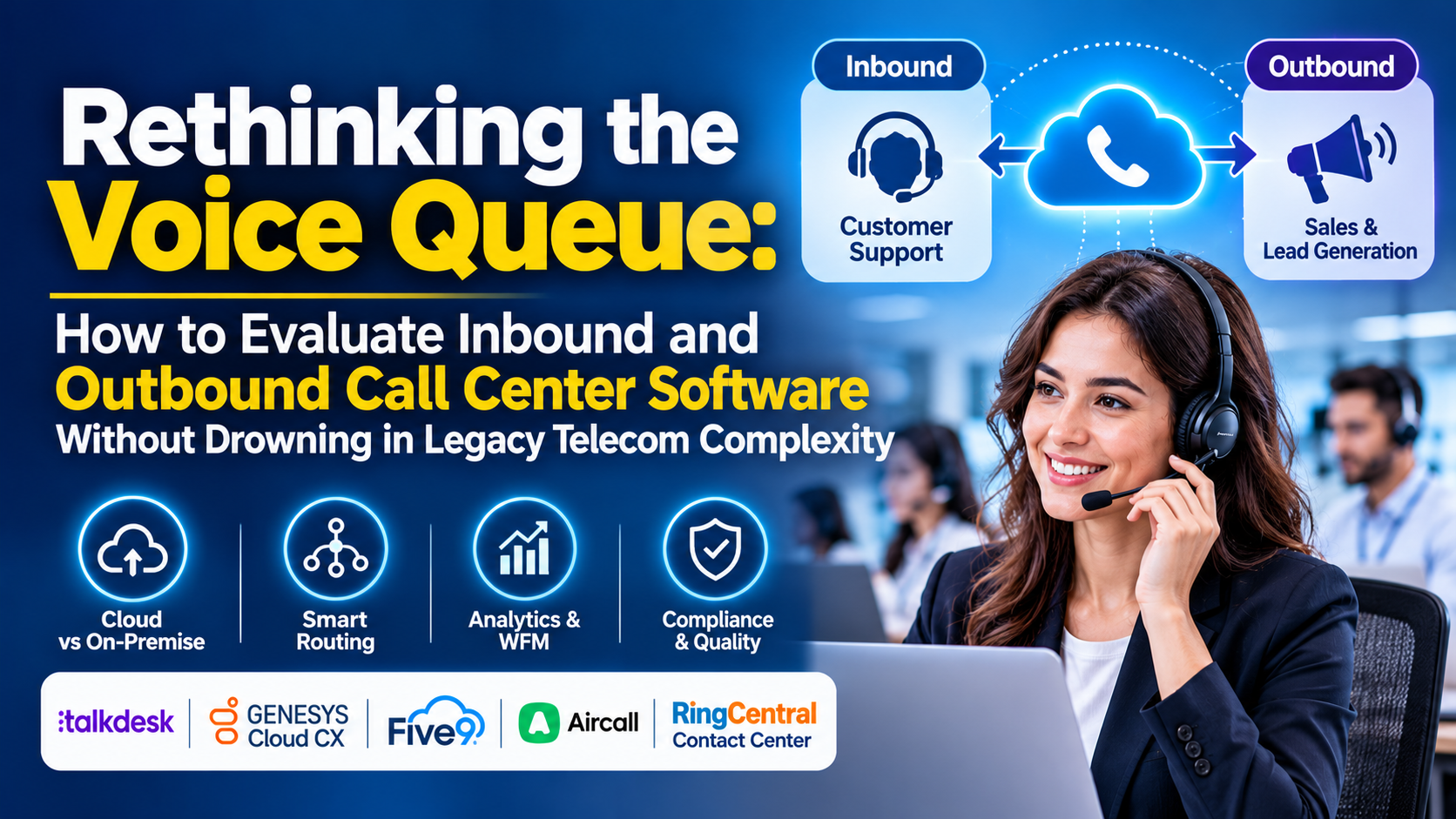
For decades, the physical or virtual call center operated on a familiar premise: rows of agents wearing headsets, staring at flashing green lights on a PBX switchboard, waiting for the next inbound ring. Telephony was a specialized silo managed by telecom engineers, completely disconnected from the rest of the company’s customer data.
Today, that operational isolation is gone. Modern call center software has evolved far beyond traditional voice routing into sophisticated software suites that manage inbound service queues, outbound sales campaigns, interactive voice response (IVR) automation, and multi-channel customer interactions from a single web browser.
Yet, shopping for call center software remains a daunting enterprise. Vendors frequently mask aging infrastructure behind flashy user interfaces and automated artificial intelligence claims.
Choosing the right platform requires cutting through the marketing hype to examine core routing logic, carrier infrastructure, agent usability, and total cost of ownership.
The Architectural Divide: Inbound Service Versus Outbound Sales
When organizations start evaluating call center software, they frequently make the mistake of assuming all voice platforms serve the same operational master. In reality, the market splits cleanly into two distinct workflows that demand very different software architectures:
1. Inbound Customer Service and Support Platforms
These systems are engineered for high-volume incoming inquiries. Their primary goal is first-call resolution and minimizing customer wait times.
- Key Architectural Needs: Intelligent skill-based routing, robust interactive voice response (IVR) trees, customer queue callbacks (so users don’t have to stay on hold), and deep CRM integrations that surface a customer’s history the moment their call connects.
- Primary Metric: Average Handling Time (AHT) and Customer Satisfaction (CSAT).
2. Outbound Sales and Lead Generation Platforms
These platforms are built for proactive outreach, cold calling, and high-velocity sales development teams.
- Key Architectural Needs: Predictive dialers (which automatically dial numbers and filter out voicemails or busy signals before connecting a live agent), local caller ID presence (displaying local area codes to increase pickup rates), and automated script guidance.
- Primary Metric: Connect rates, meetings booked, and conversion volume.
Attempting to force an inbound customer service platform to handle an aggressive outbound sales dialing campaign—or vice versa—results in severe operational friction.
The Evolution of Voice Infrastructure: Cloud Versus On-Premise
The most consequential technical decision an organization faces when adopting call center software is deployment architecture.
- Cloud-Based (CCaaS): The modern standard. Software runs entirely in the cloud, allowing remote or hybrid agents to log in from anywhere with an internet connection. Scaling up agent seats takes minutes rather than weeks, and software updates are managed automatically by the vendor.
- On-Premise and Hybrid PBX: Relies on physical servers installed in corporate offices or data centers. While rapidly declining in market share, some heavily regulated enterprises in finance, healthcare, or government still maintain on-premise systems to retain absolute physical control over their voice data and carrier routing.
For the vast majority of growing businesses, cloud-based architecture offers superior agility, disaster recovery, and integration capabilities.
5 Leading Call Center Software Platforms Compared
| Platform | Primary Specialization | Standout Operational Advantage | Core Limitation |
| Talkdesk | Cloud contact center & industry-specific workflows | Rapid deployment, intuitive agent workspace, and pre-built integrations for retail, healthcare, and finance | Advanced custom reporting and bespoke routing rules require higher enterprise tiers |
| Genesys Cloud CX | Complex enterprise routing & global scalability | Highly extensible API architecture, robust workforce engagement management, and massive concurrency capacity | Steep configuration curve and administrative complexity for smaller or fast-moving teams |
| Five9 | Outbound sales dialing & workforce optimization | Industry-leading predictive dialing algorithms, compliance management, and robust outbound campaign tools | User interface can feel utilitarian and cluttered compared to modern native-cloud startups |
| Aircall | Agile SMB telephony & fast CRM integrations | Extremely fast setup, clean user interface, and straightforward integrations for growing digital-first businesses | Less suited for massive, multi-tier enterprise call centers with thousands of concurrent agents |
| RingCentral Contact Center | Unified business voice and multichannel routing | Seamlessly blends enterprise business phone systems (VoIP) with advanced contact center queuing | Complex administrative overhead when managing legacy telephony bridges |
Critical Evaluation Factors Beyond the Agent Dashboard
When sitting through vendor demonstrations, buyers are often captivated by real-time wallboards, AI speech sentiment dials, and colorful reporting graphs. Experienced operations directors look deeper into structural mechanics:
- SIP Trunking and Carrier Flexibility: Does the platform force you to use their bundled telecom carrier, or can you bring your own carrier (BYOC) to negotiate better international calling rates and SIP termination fees?
- Compliance and Telemarketing Regulations: If you operate outbound calling campaigns, compliance with regulations like the Telephone Consumer Protection Act (TCPA) is mandatory. Ensure the platform includes built-in Do-Not-Call (DNC) list scrubbing, consent management, and time-zone calling restrictions to avoid crippling legal penalties.
- Workforce Engagement Management (WEM): As your team scales, managing agent schedules, adherence, quality assurance (QA) call scoring, and coaching manually becomes impossible. Verify whether WEM tools are native or require expensive third-party add-ons.
- Network Resilience and Call Quality Monitoring: Voice traffic requires absolute real-time packet delivery. Look for platforms that provide granular administrative monitoring for jitter, packet loss, and latency across agent connections.
Common Implementation Mistakes to Avoid
Rolling out call center software without an operational strategy leads to agent frustration and poor customer experiences. Watch out for these common missteps:
- Over-Engineering the IVR Tree: Designing a phone tree with twelve different branching options and endless menu choices infuriates callers, driving up abandonment rates. Keep interactive voice response menus concise and offer an easy escape hatch to a human operator.
- Neglecting Agent Desktop Ergonomics: If an agent has to toggle between four different browser windows and disconnected applications just to resolve a single customer call, handle times will spike and burnout will accelerate. Prioritize unified desktop interfaces.
- Ignoring Network Bandwidth Requirements: Deploying cloud-based voice software across an office or remote workforce without verifying local router configurations, Quality of Service (QoS) rules, and internet bandwidth limits guarantees robotic audio and dropped calls.
Making the Final Decision
Choosing call center software requires balancing your organization’s immediate operational scale with its long-term growth trajectory.
If your company operates an aggressive outbound sales operation requiring advanced predictive dialing and strict campaign compliance, a specialized powerhouse like Five9 provides unmatched dialing infrastructure. If your organization is a growing mid-market business needing rapid deployment, clean CRM integrations, and an intuitive agent workspace, a platform like Talkdesk or Aircall offers immediate operational velocity. For global enterprises managing complex multi-channel routing and massive concurrency, Genesys Cloud CX delivers enterprise-grade depth.
Begin by auditing your current operational bottlenecks—whether that is long hold times, high agent turnover due to clunky software, or low outbound connection rates—and select the platform built to clear those specific hurdles.
