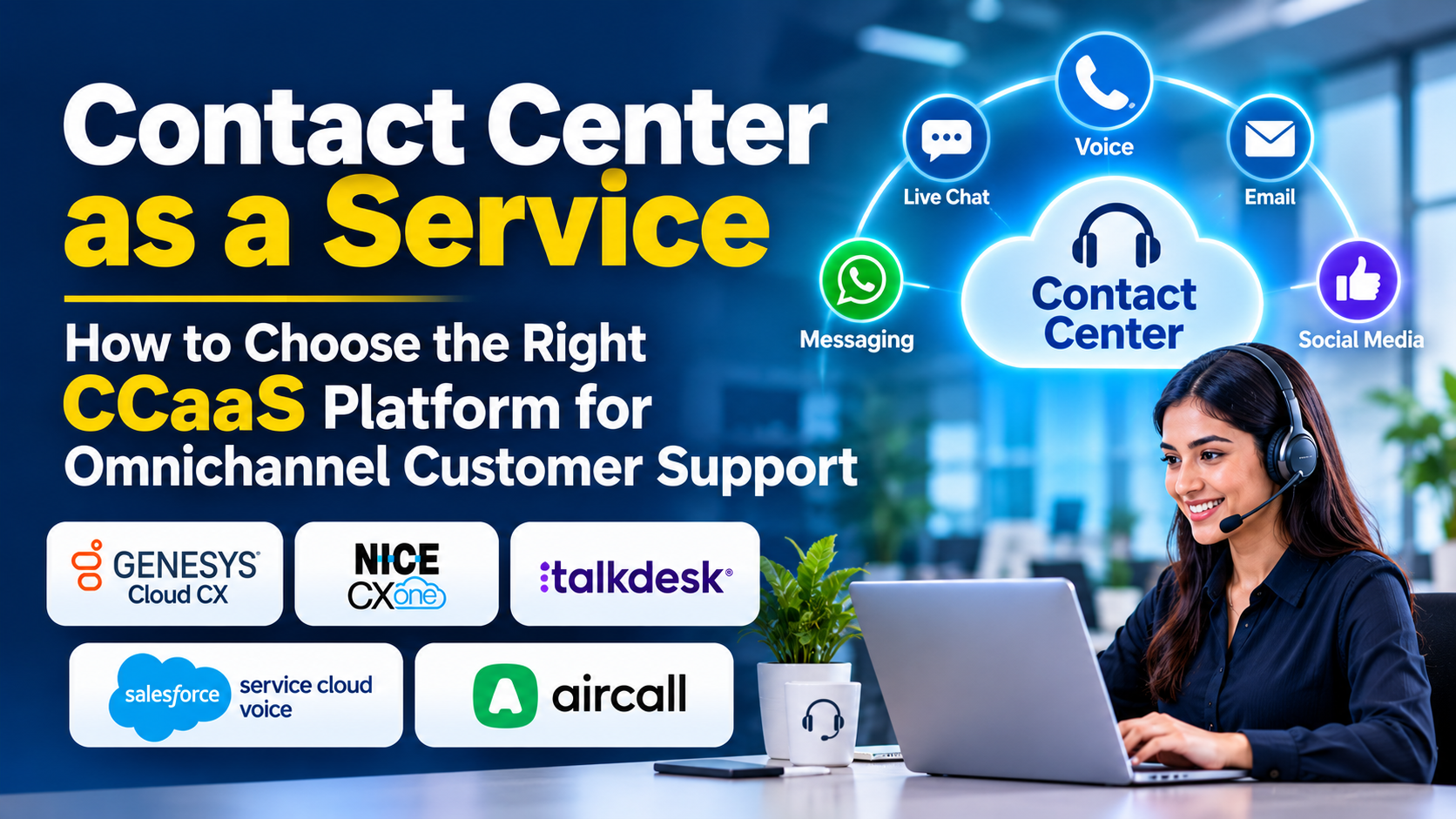
There is a distinct operational breaking point for growing companies when customer support stops being a shared email inbox and starts demanding a serious command center.
A customer might start an inquiry via an interactive web chat on their mobile phone, abandon the session halfway through, follow up via direct message on social media the next day, and finally call the support hotline because their issue remains unresolved. If your support infrastructure treats each of those touchpoints as isolated events, your agents are forced to ask the customer to repeat their entire story from scratch.
That friction is the hallmark of legacy support architecture. When organizations outgrow basic help desks or single-channel live chat tools, they turn to cloud-based Contact Center as a Service (CCaaS) platforms.
Yet, shopping for a contact center platform is notoriously complex. Vendors bundle automated interactive voice response (IVR) trees, omnichannel routing engines, workforce management tools, and generative AI transcription into sprawling enterprise suites. Cutting past the marketing buzzwords requires examining how data flows across communication channels, how routing logic handles peak queue volumes, and what operational trade-offs accompany cloud migration.
The Core Shift: From Siloed Voice Queues to Unified Omnichannel Journeys
Historically, “call centers” were voice-first operations. Customers called a 1-800 number, navigated an automated phone tree, and waited on hold until an agent became available.
Modern contact centers are fundamentally omnichannel. Voice is still vital, but it shares equal billing with asynchronous messaging, SMS, live web chat, email, and social media channels. More importantly, true omnichannel platforms do not just offer multiple channels—they preserve context across them. If a customer transitions from an AI chatbot to a human agent on WhatsApp, the entire conversation history and sentiment score follow the ticket instantly.
This shift has elevated the contact center from a traditional cost center into a primary driver of customer retention and revenue intelligence.
The Architectural Divide in Contact Center Software
When evaluating contact center platforms, IT leaders and customer service directors typically encounter two major architectural models:
1. Native Cloud CCaaS Platforms
Built entirely in the cloud from day one, these platforms offer rapid deployment, elastic scalability, global redundancy, and continuous feature updates delivered via web interfaces and cloud APIs.
- The Trade-Off: While incredibly agile, migrating massive legacy telephony infrastructures and custom integrations to a native cloud environment requires meticulous planning and network preparation.
- Representative Examples: Genesys Cloud CX, Talkdesk, NICE CXone.
2. CRM-Embedded Contact Center Suites
For organizations heavily invested in a specific customer relationship management ecosystem, these contact center tools are native extensions built directly into the CRM interface.
- The Trade-Off: Unmatched workflow continuity for agents who already live inside the CRM, but can sometimes lack the deep carrier-grade telecom routing flexibility of dedicated CCaaS giants.
- Representative Examples: Salesforce Service Cloud Voice, Zendesk Talk.
5 Leading Contact Center Platforms Compared
| Platform | Primary Specialization | Standout Operational Advantage | Core Limitation |
| Genesys Cloud CX | Enterprise-grade omnichannel routing & customizability | Highly extensible API architecture, robust workforce engagement management, and massive global enterprise scalability | Steep configuration curve and administrative complexity for smaller or fast-moving teams |
| NICE CXone | Comprehensive enterprise analytics & AI automation | Industry leader in customer interaction analytics, AI-driven automation, and deep omnichannel workforce optimization | High total cost of ownership and extensive implementation timelines for full deployment |
| Talkdesk | Rapid cloud deployment & industry-specific workflows | Modern, intuitive agent workspace with out-of-the-box pre-built integrations for retail, healthcare, and finance | Advanced custom reporting and bespoke routing logic require higher-tier enterprise packages |
| Salesforce Service Cloud Voice | CRM-native telephony & unified agent workflows | Deep native integration with Salesforce data, lightning-fast screen pops, and unified case management | Primarily optimized for organizations anchored firmly in the Salesforce software ecosystem |
| Aircall | Agile SMB telephony & fast CRM integrations | Extremely fast setup, clean user interface, and straightforward integrations for growing digital-first businesses | Less suited for complex, multi-tier enterprise call centers with thousands of concurrent agents |
Critical Evaluation Factors Beyond the Agent Dashboard
When sitting through vendor demonstrations, buyers are often captivated by futuristic AI sentiment dials and colorful real-time wallboards. Experienced contact center directors look deeper into structural mechanics:
- SIP Trunking and Telecom Carrier Flexibility: Can you bring your own carrier (BYOC) to negotiate better international calling rates, or are you locked into the vendor’s bundled telephony pricing?
- Workforce Management (WFM) and Quality Management (QM): As call volumes scale, managing agent scheduling, adherence, and performance reviews manually becomes impossible. Verify whether robust WFM and automated QA scoring are native or require expensive add-on modules.
- AI Hand-Off Reliability: AI chatbots and voice bots are increasingly common, but evaluate how smoothly the platform hands a frustrated customer over to a human agent. If the bot fails to pass along context, automation becomes an obstacle rather than a helper.
- Compliance and Security (HIPAA, PCI-DSS): For contact centers handling credit card payments or sensitive medical records, ensure the platform supports automated pause-and-resume recording features and secure payment collection tools that comply with strict regulatory frameworks.
Common Implementation Mistakes to Avoid
Rolling out a modern contact center platform without an operational strategy leads to agent frustration and degraded customer experiences. Watch out for these common missteps:
- Over-Engineering IVR Trees: Creating an automated phone tree with twelve different branching options and twenty menu choices ensures that callers will immediately start pressing zero to reach an operator. Keep routing trees concise and customer-centric.
- Neglecting Agent Ergonomics and UI Fatigue: If an agent has to toggle between five different browser tabs and disparate software windows just to resolve a single customer inquiry, average handle times will skyrocket. Prioritize unified agent desktops.
- Treating AI as a Total Replacement for Human Staff: While generative AI can summarize call transcripts and automate routine responses, viewing it as a way to slash support headcount without monitoring quality often results in plummeting customer satisfaction scores.
Making the Final Decision
Choosing a contact center platform requires balancing your organization’s current operational scale with its long-term growth trajectory.
If your organization is a massive global enterprise requiring deep telecom customization, complex multi-region routing, and advanced workforce optimization, an established industry powerhouse like Genesys Cloud CX or NICE CXone provides the necessary infrastructure. If your team operates within a modern digital-first business and values rapid deployment, intuitive workflows, and clean CRM integrations, a platform like Talkdesk or Aircall offers immediate operational velocity.
Begin by auditing your current support bottlenecks—whether that is fragmented customer history across channels, long hold times, or inadequate supervisor analytics—and select the platform built to clear those specific operational hurdles.
