In subscription business models, acquiring a new customer is only the opening transaction. The real work—and the long-term profitability—begins the moment the contract is signed.
Yet, many software-as-a-service (SaaS) companies and recurring-revenue businesses run blind during the customer lifecycle. Customer success managers (CSMs) spend their days reacting to inbound support tickets, scrambling to prepare for quarterly business reviews, or discovering that a major account is canceling only when an automated cancellation email arrives on the first of the month. By then, the churn is irreversible.
When customer data is trapped across billing systems, support ticketing queues, and product usage logs, account health becomes a guessing game. To shift from reactive firefighting to predictable revenue retention, organizations turn to Customer Success Platforms (CSPs).
Evaluating this software category requires looking past flashy health-score dashboards and understanding how data ingestion, automated playbooks, and early-warning telemetry actually protect recurring revenue.
The Data Fragmentation Problem in Account Retention
Before evaluating platforms, it helps to examine why customer success operations struggle as a company scales.
A healthy account is rarely defined by a single metric. It is a composite picture built from multiple data streams:
- Product Telemetry: How often are users logging in? Are they adopting core features or ignoring advanced modules?
- Support Interactions: How many high-priority tickets has the account submitted recently? Are their technical blockers being resolved quickly?
- Commercial Signals: When is their contract renewal date? Are they expanding their user seats, or have they requested invoice adjustments?
When these signals live in separate silos—product data in a data warehouse, support notes in Zendesk, and billing details in Stripe—no single team has a complete view of account health. Customer success managers are forced to manually stitch together data points across spreadsheets, missing quiet warning signs until it is too late.
Customer Success Platforms solve this by aggregating these disparate data streams into a unified customer data graph, calculating automated health scores, and triggering proactive workflows before clients slip away.
The Architectural Divide in Customer Success Software
The CSP market generally splits into three distinct operational philosophies:
1. Enterprise Customer Success and Health Analytics
These platforms are engineered for complex B2B environments with high-value enterprise accounts. They focus heavily on deep data integrations, custom health-scoring algorithms, revenue forecasting, and executive reporting dashboards.
- The Trade-Off: Requires rigorous data hygiene and technical implementation; often over-engineered for smaller businesses with straightforward product-led growth (PLG) models.
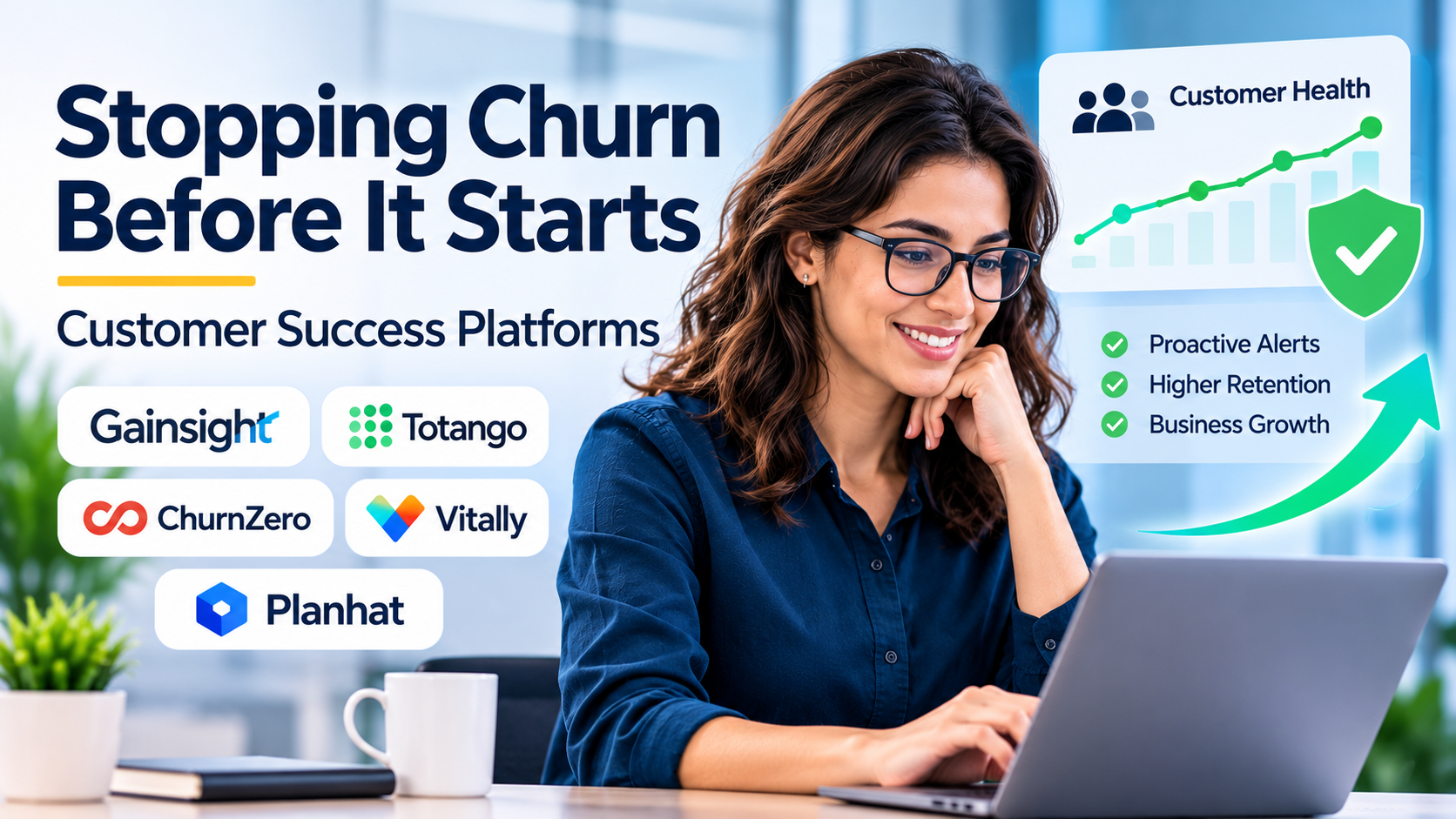
- Representative Examples: Gainsight, Totango, ChurnZero.
2. Product-Led Growth (PLG) and High-Volume Success Platforms
Built for companies with self-serve or high-volume user bases where CSMs cannot touch every account manually. These tools prioritize automated in-app messaging, behavioral triggers, and scalable email nurture sequences.
- The Trade-Off: Excellent at automating touchpoints for thousands of small accounts, but lacks the deep relationship-mapping and custom enterprise account planning tools required for six-figure contracts.
- Representative Examples: Catalyst, Vitally, Planhat.
3. CRM-Native and Lightweight Success Extensions
For organizations that want to keep customer success workflows entirely inside their existing CRM environment without introducing a standalone database.
- The Trade-Off: Seamless CRM alignment, but often lacks specialized customer success metrics, advanced health-scoring flexibility, and robust telemetry dashboards.
- Representative Examples: Salesforce Customer Success extensions and HubSpot service hubs.
5 Leading Customer Success Platforms Compared
| Platform | Primary Specialization | Standout Operational Advantage | Core Limitation |
| Gainsight CS | Enterprise customer success & advanced analytics | Industry pioneer with unmatched data integration depth, robust health scoring, and enterprise revenue forecasting | High total cost of ownership, complex configuration, and steep learning curve |
| Totango | Modular customer success & rapid deployment | Flexible, modular architecture that allows teams to launch specific success programs quickly | Custom reporting and advanced data modeling can feel rigid compared to enterprise competitors |
| ChurnZero | Real-time alerts & automated playbook execution | Excellent real-time alerting system that triggers immediate CSM playbooks based on user behavior shifts | Interface can feel cluttered when managing complex multi-tier enterprise hierarchies |
| Vitally | Modern product-data integration & collaboration | Clean, intuitive user interface with powerful integration for product telemetry and customer collaboration | Less suited for massive, highly bureaucratic enterprise corporate structures |
| Planhat | Flexible data modeling & embedded analytics | Highly customizable data architecture with built-in billing, usage analytics, and client portal tools | Requires technical familiarity to configure custom data models and metric calculations |
Critical Evaluation Factors Beyond the Health Score
When sitting through vendor demonstrations, buyers are often mesmerized by color-coded health scores and predictive churn graphs. Experienced customer success leaders look deeper into structural mechanics:
- Data Ingestion and Sync Reliability: A CSP is only as good as its data pipeline. Verify how smoothly the platform ingests high-volume product telemetry, billing history, and support tickets without latency or data sync failures.
- Playbook Automation Versus Manual Oversight: Can the platform automatically trigger internal tasks (e.g., assigning a CSM to reach out when product logins drop by 30%) without flooding your team with false-positive alerts?
- Customer Success Collaboration Portals: Do clients have visibility into their own success plans, shared objectives, and milestone tracking through a secure, branded customer portal?
- Expansion and Net Revenue Retention (NRR) Tracking: Beyond preventing churn, does the platform help identify upsell and cross-sell opportunities by highlighting accounts that are hitting usage limits?
Common Implementation Mistakes to Avoid
Rolling out a customer success platform without a clear operational strategy leads to expensive software abandonment. Watch out for these common missteps:
- Over-Complicating Health Scores on Day One: Building a health score that combines twenty different variables—logins, ticket counts, NPS scores, email opens, and contract size—before you know what actually drives retention in your business creates noisy, unreliable data. Start simple.
- Treating the CSP as a Replacement for CSM Relationships: Software automates alerts and data tracking, but it cannot build human trust. Relying entirely on automated emails while neglecting direct customer conversations will still result in churn.
- Failing to Secure Cross-Departmental Buy-In: Customer success depends on product, sales, and support data. If product or support teams refuse to keep their data clean in the source systems, your CSP dashboards will display inaccurate health metrics.
Making the Final Decision
Choosing a customer success platform is an exercise in aligning your software architecture with your customer acquisition model.
If your organization manages complex, high-value enterprise accounts where deep data integration, custom health modeling, and executive revenue forecasting are mandatory, an established enterprise powerhouse like Gainsight CS provides unmatched capability. If your business operates in a modern, fast-moving SaaS environment where intuitive product data integration and clean collaboration are paramount, a platform like Vitally or ChurnZero offers an agile alternative.
Begin by auditing your retention blind spots: determine whether your team struggles with late churn warnings, fragmented account data, or disorganized renewal tracking, and select the platform built to bring complete visibility to your customer lifecycle.
