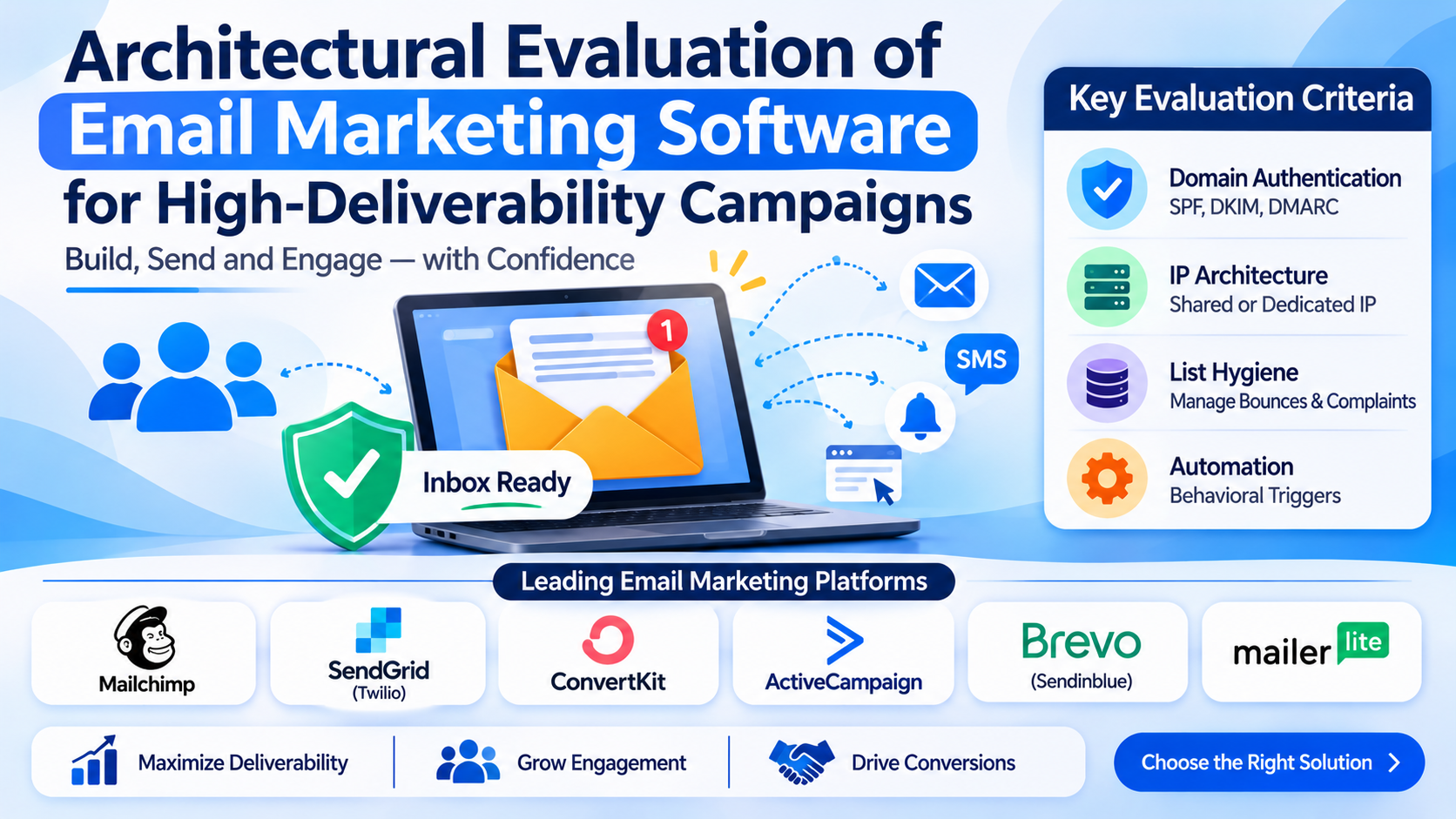
Sending bulk electronic mail requires looking past simple drag-and-drop template builders and examining underlying sender reputation infrastructure, domain authentication standards, and database hygiene controls. Sending high-volume campaigns without proper technical configuration often results in messages landing directly in spam folders, bypassing recipient inboxes entirely.
Choosing email marketing software involves balancing ease of use against deliverability controls, automation flexibility, contact-based pricing models, and compliance with anti-spam legislation. This guide examines leading email marketing platforms, analyzing their technical architecture, delivery mechanisms, and enterprise trade-offs.
Core Evaluation Criteria for Email Infrastructure
Selecting an email marketing platform requires examining how technical and administrative mechanisms protect sender reputation and ensure inbox placement.
- Domain Authentication Support: Native implementation and configuration assistance for SPF (Sender Policy Framework), DKIM (DomainKeys Identified Mail), and DMARC (Domain-based Message Authentication, Reporting, and Conformance) to prevent spoofing and verify sender identity.
- IP Architecture and Dedicated IPs: Availability of dedicated sending IP addresses for high-volume senders, allowing organizations to isolate their sender reputation from shared server pools.
- Bounce Handling and List Hygiene: Automated suppression of hard bounces, invalid email addresses, and spam complaints to protect sender score integrity.
- Automation and Behavioral Triggers: The ability to orchestrate complex, multi-step subscriber journeys based on link clicks, open rates, and custom event data.
Leading Email Marketing Platforms Compared
Different business models, technical capabilities, and subscriber volumes require distinct email delivery architectures. Below is an examination of six prominent email marketing platforms.
Mailchimp
- Primary Focus: All-in-one marketing platform combining email campaigns, landing pages, and basic automation for growing businesses.
- Deployment Model: Cloud SaaS.
- Technical Strengths: Exceptionally user-friendly template editor, extensive third-party integration catalog, and straightforward audience segmentation tools.
- Considerations: Pricing scales steeply as contact lists grow, and advanced automated workflows require upgrading to higher-tier pricing plans.
SendGrid (Twilio)
- Primary Focus: Developer-first email infrastructure, high-volume transactional mail, and API-driven delivery.
- Deployment Model: Cloud SaaS with robust SMTP and Webhook APIs.
- Technical Strengths: Industry standard for reliable transactional email delivery (password resets, receipts), advanced IP warmup tooling, and robust sub-user management.
- Considerations: Focused heavily on developer APIs and transactional messaging; marketing newsletter design tools are less intuitive compared to dedicated creator platforms.
ConvertKit (Kit)
- Primary Focus: Creator-focused email marketing, newsletters, and digital product sales for bloggers and independent creators.
- Deployment Model: Cloud SaaS.
- Technical Strengths: Tag-based subscriber architecture that simplifies complex list management without nested folders, excellent plain-text deliverability, and native digital product commerce features.
- Considerations: Less optimized for complex multi-channel e-commerce merchandising catalogs or heavy enterprise B2B sales pipelines.
ActiveCampaign
- Primary Focus: Advanced marketing automation, behavioral tracking, and CRM integration.
- Deployment Model: Cloud SaaS.
- Technical Strengths: Highly flexible visual automation builder, predictive sending algorithms, and robust transactional and marketing email synergy.
- Considerations: Complex branching automation structures require careful auditing to prevent logic loops and sending errors.
Brevo (formerly Sendinblue)
- Primary Focus: Volume-based email and multi-channel messaging for small-to-medium businesses.
- Deployment Model: Cloud SaaS.
- Technical Strengths: Unique pricing structure based on message send volume rather than contact database size, making it highly cost-effective for organizations with large, dormant lists.
- Considerations: Advanced behavioral tracking and enterprise analytics are less comprehensive compared to dedicated enterprise heavyweights.
MailerLite
- Primary Focus: Streamlined, modern email marketing with clean design tools and straightforward pricing.
- Deployment Model: Cloud SaaS.
- Technical Strengths: Clean user interface, robust free tier for small lists, reliable customer support, and intuitive drag-and-drop newsletter creation.
- Considerations: Advanced developer APIs and complex data integrations are more limited compared to enterprise-grade platforms like SendGrid or ActiveCampaign.
Comparative Technical Overview
| Platform | Primary Use Case | Delivery Architecture | Pricing Model | Best Suited For |
| Mailchimp | General SMB marketing & newsletters | Shared / Dedicated IP pools | Contact list volume | Small businesses and general marketers |
| SendGrid | Transactional & API-driven mail | Enterprise SMTP & APIs | Email send volume | Developers and high-volume applications |
| ConvertKit | Creator newsletters & digital sales | Tag-based subscriber routing | Contact list volume | Bloggers, podcasters, and solo creators |
| ActiveCampaign | Behavioral automation & CRM | Shared / Dedicated IP options | Contact database tier | Marketers needing complex workflow automation |
| Brevo | High-volume message sending | Scalable delivery servers | Message volume limit | Organizations with large lists and lower send frequencies |
| MailerLite | Simple, cost-effective campaigns | Standard cloud delivery | Contact list volume | Beginners and budget-conscious publishers |
Implementation and Deliverability Best Practices
Deploying email marketing software requires strict adherence to technical standards to ensure messages reach the inbox.
- Mandatory DNS Records: Always configure SPF, DKIM, and DMARC records for your custom sending domain. Sending mail from a generic free webmail domain or unauthenticated server will trigger spam filters.
- Warmup New IPs: When transitioning to a dedicated IP address, gradually increase send volumes over several weeks starting with highly engaged subscribers to build a positive sender reputation with major mailbox providers (Google, Microsoft, Yahoo).
- Permission-Based Lists: Never purchase or scrape email lists. Ingesting unverified contacts leads to high hard bounce rates and spam trap hits, which can permanently black-list your sending domain.
Summary and Selection Framework
Choosing the right email marketing software depends heavily on your technical requirements, send volume, and primary use case.
- Choose SendGrid when building applications that require reliable programmatic transactional email delivery via APIs and SMTP.
- Choose ConvertKit when operating as an independent creator, writer, or educator focused on newsletter monetization.
- Choose ActiveCampaign when your primary requirement is complex, behavioral-triggered marketing automation.
- Choose Brevo when you maintain a large subscriber database but send emails infrequently, benefiting from volume-based pricing.
- Choose Mailchimp or MailerLite when seeking user-friendly, drag-and-drop newsletter builders for general business updates.
Evaluate your sending volume, technical resources, and automation needs before committing to an email service provider.
