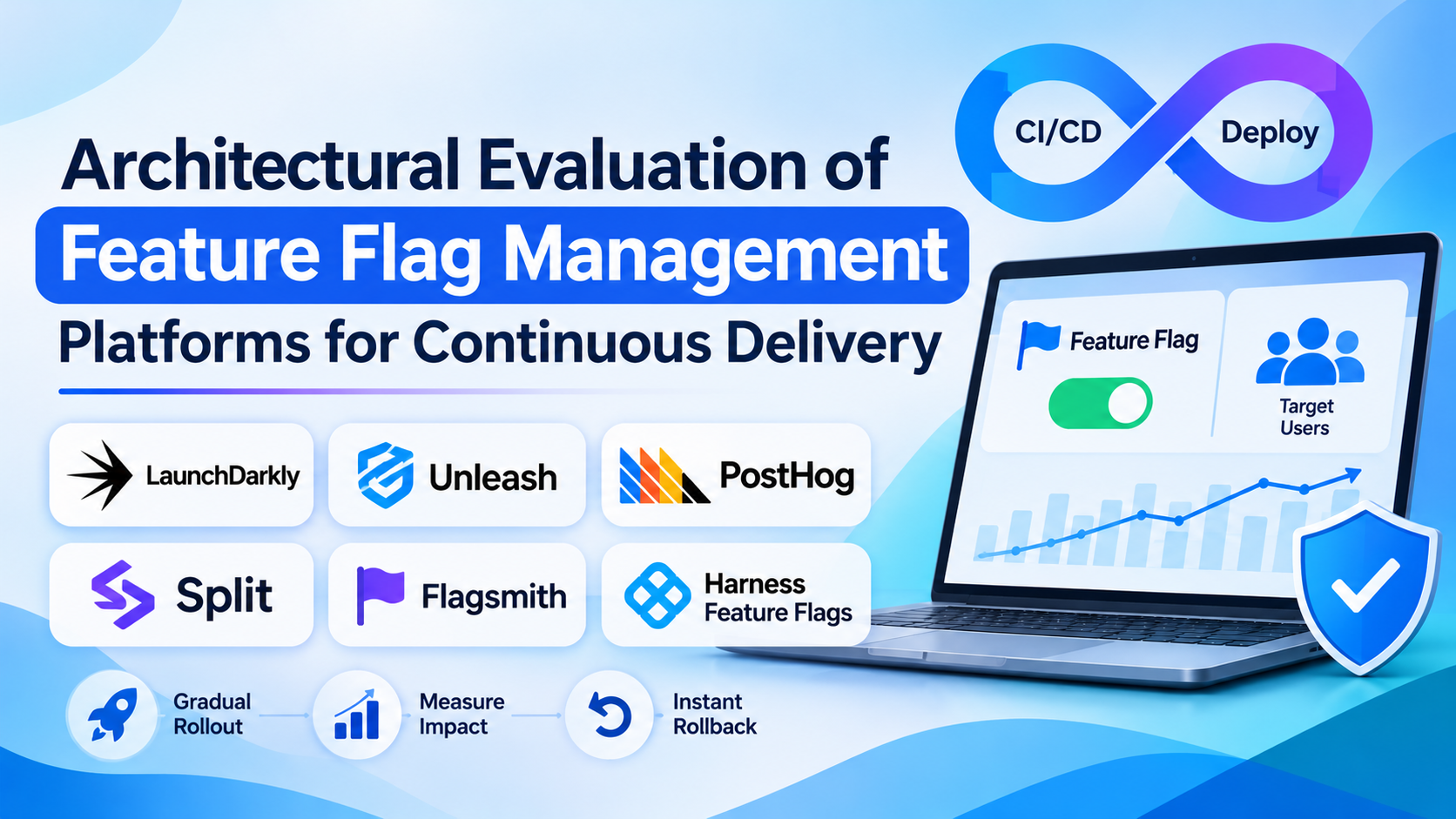
Releasing software updates in modern development cycles requires decoupling code deployment from feature release. Relying on long-lived branching strategies or static configuration files often leads to merge conflicts, difficult rollback procedures, and high-risk monolithic releases. Feature flags (or toggles) allow engineering teams to wrap new functionality in conditional checks, enabling safe progressive delivery, canary releases, and instant kill switches in production.
Implementing a feature flag management tool requires evaluating SDK evaluation latency, local caching mechanisms, multi-environment governance, and technical debt management around stale flag cleanup. This guide examines leading feature flag management platforms, analyzing their architectural models, targeting capabilities, and enterprise integration trade-offs.
Core Evaluation Criteria for Feature Flag Architecture
Selecting a feature flag platform involves balancing developer ergonomics against infrastructure reliability and security governance.
- SDK Evaluation Latency and Resilience: Whether flags are evaluated locally in-memory via downloaded rules payload (ensuring zero network latency during request handling) or require remote network calls per evaluation.
- Targeting Rules and Contextual Evaluation: The flexibility of the targeting engine to evaluate complex user attributes, device types, geographic locations, and custom contextual payloads without performance degradation.
- Technical Debt and Flag Lifecycle Management: Automated tracking of flag age, dead code indicators, and workflow reminders to prevent orphaned flags from accumulating in production codebases.
- Audit Logs and Role-Based Access Control (RBAC): Granular permission controls ensuring only authorized engineers or product owners can modify production flags, backed by immutable audit trails.
Leading Feature Flag Management Platforms Compared
Different team sizes, compliance requirements, and CI/CD pipeline maturities demand distinct architectural approaches. Below is an examination of six prominent feature flag platforms.
LaunchDarkly
- Primary Focus: Enterprise-grade feature management, release orchestration, and dynamic targeting.
- Deployment Model: Cloud SaaS with robust server-side and client-side SDKs.
- Technical Strengths: Industry pioneer with sub-millisecond local evaluation via streaming SDK connections, fine-grained multi-environment governance, rigorous audit logging, and extensive enterprise integrations.
- Considerations: Premium enterprise pricing tiers make it a significant investment for early-stage startups or smaller engineering teams.
Unleash
- Primary Focus: Open-source, privacy-first feature flag management with flexible self-hosting options.
- Deployment Model: Self-hosted (Docker/Kubernetes) or Fully Managed Cloud SaaS.
- Technical Strengths: Transparent open-source architecture that allows enterprises to keep all evaluation data entirely within their own infrastructure, satisfying strict data residency and compliance mandates.
- Considerations: Managing self-hosted instances requires internal DevOps resources to oversee database backups, cluster scaling, and server upgrades.
PostHog
- Primary Focus: Developer-centric product operating system combining feature flags, analytics, and session replays.
- Deployment Model: Cloud SaaS or self-hosted containerized deployment.
- Technical Strengths: Seamless integration between feature flag rollouts and behavioral analytics, allowing teams to instantly measure how a new feature impacts user retention and conversion funnels.
- Considerations: Primarily optimized as an all-in-one product analytics and experimentation suite; standalone feature flag management workflows are simpler compared to dedicated release orchestration platforms.
Split
- Primary Focus: Feature delivery platform driven by automated data-backed experimentation and impact metrics.
- Deployment Model: Cloud SaaS.
- Technical Strengths: Automatically correlates feature flag rollouts with application performance metrics and error rates, alerting teams if a new flag negatively impacts core system stability.
- Considerations: Steeper learning curve for teams looking purely for basic boolean toggle management rather than metric-driven feature releases.
Flagsmith
- Primary Focus: Simple, lightweight feature flagging and remote configuration across multiple platforms.
- Deployment Model: Open-source self-hosted or Cloud SaaS.
- Technical Strengths: Highly intuitive user interface, straightforward API design, support for edge-based flag evaluation via Cloudflare Workers, and clear separation between environments.
- Considerations: Lacks some of the advanced enterprise compliance workflows and complex multi-variate targeting rules found in heavier platforms.
Harness Feature Flags
- Primary Focus: CI/CD pipeline integration and automated software delivery governance.
- Deployment Model: Cloud SaaS or self-hosted hybrid.
- Technical Strengths: Native integration within the broader Harness software delivery platform, enabling automated progressive rollouts tied directly to deployment pipelines and verification gates.
- Considerations: Most valuable when adopted as part of the broader Harness DevOps ecosystem rather than as an isolated standalone point solution.
Comparative Technical Overview
| Platform | Primary Architecture | Evaluation Model | Deployment Option | Best Suited For |
| LaunchDarkly | SaaS streaming architecture | Local in-memory SDK caching | Cloud SaaS | Large enterprises requiring robust governance and compliance |
| Unleash | Open-source proxy / server | Local client SDK evaluation | Self-hosted or Cloud | Organizations requiring strict data residency and self-hosting |
| PostHog | Unified product OS | SDK evaluation / API | Cloud or Self-hosted | Product-led engineering teams combining flags with analytics |
| Split | Data-driven experimentation | Local SDK + Metric telemetry | Cloud SaaS | Teams prioritizing automated impact and error tracking |
| Flagsmith | Lightweight API & edge engine | Edge / Local evaluation | Self-hosted or Cloud | Developers seeking simple, fast, and transparent tooling |
| Harness FF | DevOps pipeline integrated | Pipeline-driven evaluation | Cloud or Hybrid | Enterprises automating CI/CD release verification |
Implementation and Technical Debt Management
Deploying feature flags without governance quickly leads to “technical debt graveyard” scenarios where expired flags clutter the codebase.
- Flag Lifetime Policies: Establish team agreements requiring every feature flag to have an assigned owner and an expiration date. Set up automated code review reminders or static analysis checks to flag old conditionals.
- SDK Initialization and Fallbacks: Ensure application code handles SDK downtime gracefully by defining clear default fallback values (e.g., failing safely to the baseline state if the flag service is unreachable).
- Environment Separation: Maintain strict parity between development, staging, and production environments, ensuring test flags do not accidentally bleed into production user sessions.
Summary and Selection Framework
Choosing the right feature flag management tool depends on infrastructure requirements, security mandates, and team workflows.
- Choose LaunchDarkly when enterprise compliance, advanced role-based access control, and robust audit logging are top priorities.
- Choose Unleash or Flagsmith when organizational policy mandates self-hosted, open-source infrastructure with complete data ownership.
- Choose PostHog when looking to unify feature flag rollouts directly with product analytics and session recordings.
- Choose Split when automated monitoring of business metrics and error rates during flag rollouts is required.
Evaluate your security posture, engineering stack, and release frequency before committing to a feature flag platform.
