Introduction
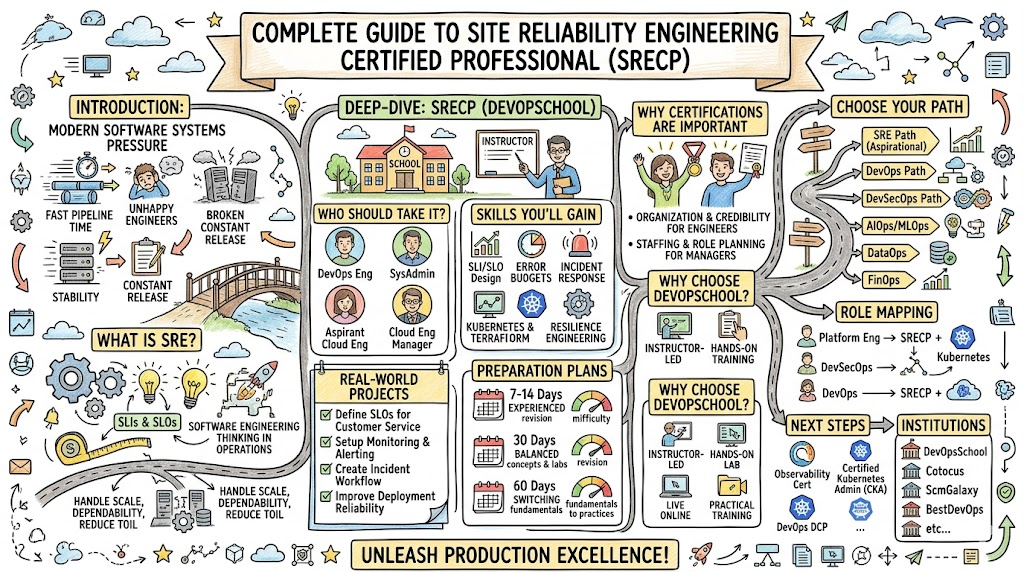
Modern software teams are under constant pressure to release faster, recover quicker, and keep services stable at all times. That is exactly where Site Reliability Engineering becomes important. SRE is not just about keeping servers up. It is about building reliability into the way software is designed, deployed, monitored, and improved. In practical terms, it brings software engineering thinking into operations so teams can handle scale, reduce manual work, and make production systems more dependable.
The Site Reliability Engineering Certified Professional (SRECP) program from DevOpsSchool is built for professionals who want structured, practical learning in this area. The official certification page describes SRECP as a professional training and certification program focused on SRE principles, operational excellence, automation-first practices, SLIs, SLOs, error budgets, incident response, observability, resilience engineering, and hands-on exposure to tools used in modern reliability work.
For working engineers and managers, this matters because reliability is now a business issue, not only a technical issue. A failed deployment, a noisy alerting system, weak observability, or missing service objectives can directly affect revenue, reputation, and customer trust. That is why a focused SRE certification can help professionals move from reactive firefighting to disciplined reliability engineering.
What is Site Reliability Engineering Certified Professional (SRECP)?
Site Reliability Engineering Certified Professional, or SRECP, is a professional certification program offered by DevOpsSchool for people who want to learn and apply modern SRE practices in real environments. According to the official page, the program is designed to validate and advance expertise in SRE vocabulary, principles, and engineering methods that improve reliability, scalability, and efficiency across the software delivery lifecycle.
The program goes beyond theory. It explicitly covers practical reliability disciplines such as defining SLOs, using SLIs to measure service behavior, and applying error budgets to balance feature speed with system stability. It also includes hands-on exposure to tools and platforms such as Prometheus, Grafana, OpenTelemetry, Kubernetes, Terraform, Istio, and PagerDuty.
In plain words, SRECP is for professionals who do not want to stop at “I understand reliability.” It is for people who want to say, “I can design, measure, automate, improve, and govern reliability in production.”
Why it Matters in Today’s Software, Cloud, and Automation Ecosystem
Today’s systems are distributed, containerized, API-driven, and always changing. Teams deploy more often, run more services, and depend on cloud platforms, automation pipelines, and observability stacks to keep everything working. In such an environment, traditional operations alone is not enough. The official DevOpsSchool description of SRE highlights scalability, reliability, and software-engineering-led operations as core goals of the discipline.
This is why SRE matters now more than ever. When systems become more complex, teams need measurable reliability targets, better incident handling, stronger monitoring, better deployment safety, and clear trade-offs between innovation and stability. SRE provides that operating model. The SRECP curriculum reflects this reality by covering SLIs, SLOs, error budgets, observability, chaos testing, incident response, Kubernetes, Terraform, and GitOps-related tooling.
For software engineers, SRE improves how production systems are built and maintained. For managers, it gives a language for discussing risk, customer experience, operational efficiency, and service quality. That is why SRE has become a bridge between engineering execution and business outcomes. This is partly why SRECP appears in GurukulGalaxy’s broader list of software and IT certifications alongside cloud, DevOps, Kubernetes, observability, and automation credentials.
Why Certifications are Important for Engineers and Managers
A good certification does not replace real work, but it can give structure, direction, and credibility. For engineers, certifications help organize learning, close knowledge gaps, and signal seriousness to employers. For managers, they provide a clear framework to evaluate capabilities, plan team growth, and align technical development with organizational needs.
In the case of SRE, the value is even more practical. Reliability work often spans monitoring, automation, architecture, incident response, and culture. Many professionals learn pieces of this on the job, but not always in a connected way. A focused certification helps connect those pieces into one working model. The official SRECP page emphasizes practical implementation, real-world use cases, and live production relevance rather than theory alone.
For managers, certifications also support better staffing and role planning. If you are building SRE capability in a team, you need engineers who understand not just tooling, but reliability objectives, operational trade-offs, and scalable practices. A certification like SRECP can help create that shared baseline.
Why Choose DevOpsSchool?
DevOpsSchool positions SRECP as a hands-on, instructor-led, practical training and certification program. The official page highlights live and interactive learning options, hands-on labs, real case studies, and coverage of modern tooling and implementation practices used in reliability engineering. It also lists multiple delivery modes including self-learning, live online batches, one-to-one online sessions, and corporate training options.
A strong point is breadth plus practicality. The curriculum is not limited to SRE theory. It touches DevOps foundations, cloud reliability, SLO design, SLIs, error budgets, Kubernetes, Helm, Terraform, CI/CD, observability, and service operations. That makes it suitable for professionals who need an applied learning path rather than a narrow conceptual overview.
Another practical advantage is role relevance. The official page specifically speaks to experienced DevOps engineers moving toward SRE and operations leaders who want to implement reliability practices across teams. That makes the program useful both for hands-on engineers and for technical managers shaping service reliability programs.
Certification Deep-Dive: Site Reliability Engineering Certified Professional (SRECP)
What is this certification?
SRECP is a professional SRE certification from DevOpsSchool designed to build and validate modern reliability engineering capability. It covers core SRE ideas, service reliability measurement, operational excellence, and implementation practices for real production systems. The official page describes it as a training and certification program focused on reliability, scalability, and efficiency across the software delivery lifecycle.
Who should take this certification?
This certification is a strong fit for:
- DevOps engineers moving into reliability-focused roles
- System administrators growing into cloud-native operations
- SRE aspirants who want structured learning
- Platform engineers managing production systems
- Cloud engineers responsible for uptime and performance
- Engineering managers leading service reliability initiatives
This recommendation is grounded in how DevOpsSchool positions the program for experienced DevOps engineers and operations leaders implementing reliability practices.
Certification Overview Table
| Certification Name | Track | Level | Who it’s for | Prerequisites | Skills Covered | Recommended Order |
|---|---|---|---|---|---|---|
| Site Reliability Engineering Certified Professional (SRECP) | SRE | Professional | DevOps engineers, SRE aspirants, platform/cloud engineers, technical managers | Basic exposure to Linux, cloud, CI/CD, monitoring, and operations is helpful | SLI, SLO, error budgets, incident response, observability, resilience, Kubernetes, Terraform, reliability practices | 1 |
Site Reliability Engineering Certified Professional (SRECP)
What it is
SRECP is a professional certification that teaches how to apply engineering discipline to operations and production reliability. It is built around measurable reliability practices, operational excellence, automation, and modern tooling used in real-world software environments.
Who should take it
- Working DevOps engineers
- SRE aspirants
- Platform and cloud engineers
- Operations professionals moving toward automation-first roles
- Engineering managers responsible for uptime, incidents, and service performance
Skills you’ll gain
- Understanding of SRE principles and vocabulary
- Designing and using SLIs and SLOs
- Applying error budgets in release and operations decisions
- Improving incident response and operational readiness
- Building observability foundations
- Working with tools like Prometheus, Grafana, OpenTelemetry, Kubernetes, Terraform, Istio, and PagerDuty
- Thinking about resilience, scalability, and maintainability in production systems
Real-world projects you should be able to do after it
- Define SLOs for a customer-facing service
- Build SLIs for latency, availability, and error rate
- Set up monitoring and alerting with observability tools
- Create an incident-response workflow for production services
- Improve deployment reliability using automation and infrastructure as code
- Support Kubernetes-based services with reliability-focused operations
- Reduce operational overload by moving repetitive tasks into automation
Preparation plan
7–14 days
Use this if you already work in DevOps, cloud, or operations. Focus on SRE basics, SLIs, SLOs, error budgets, incident response, monitoring, and the certification curriculum summary. Review the official outline and map each topic to your current job.
30 days
Best for most working professionals. Spend the first phase on concepts, the next phase on tooling and hands-on labs, and the final phase on service-based case studies. Practice translating business expectations into reliability objectives.
60 days
Best for beginners or role-switchers. Start with Linux, cloud basics, CI/CD, monitoring, and containers. Then move into SRE concepts, observability, Kubernetes, Terraform, and reliability practices. End with mini-projects and revision. The official curriculum breadth supports this longer path.
Common mistakes
- Treating SRE as only monitoring
- Memorizing tools without understanding service objectives
- Ignoring error budgets and business trade-offs
- Studying concepts without hands-on practice
- Focusing only on incidents and not on prevention
- Learning Kubernetes or Terraform separately without relating them to reliability outcomes
Best next certification after this
A logical next step after SRECP depends on your direction. If you want to stay in the same track, observability or advanced cloud-native certifications make sense. If you want broader delivery responsibility, DevOps certifications are a strong progression. GurukulGalaxy’s certification list places SRECP near Kubernetes, observability, DevOps, and cloud certifications, which supports those next-step combinations.
Choose your path
DevOps path
Start with delivery, automation, CI/CD, infrastructure as code, and release engineering. SRECP adds strong production reliability thinking for DevOps professionals who want to mature beyond pipeline ownership.
DevSecOps path
If your goal is secure delivery, begin with DevSecOps foundations, then add SRECP to strengthen resilience, availability, and secure operational response in production.
SRE path
This is the most direct path for professionals focused on uptime, incident response, observability, and service health. SRECP is the anchor certification here.
AIOps/MLOps path
Choose this if you want automation and intelligence in operations or ML system reliability. SRECP gives the operational reliability layer that complements AI-driven and ML-driven workflows.
DataOps path
For data platform teams, reliability matters in pipelines, orchestration, and platform operations. SRECP helps bring service thinking into data systems.
FinOps path
If your role involves cloud efficiency and operational cost control, SRECP helps because good reliability engineering reduces waste, incident-driven cost, and unplanned rework. This is a practical cross-functional path for engineering leaders. This is an inference based on SRE’s focus on efficiency and operational excellence.
Role → Recommended certifications
| Role | Recommended certification direction |
|---|---|
| DevOps Engineer | SRECP, DevOps Certified Professional, Kubernetes-related certifications |
| SRE | SRECP first, then observability or advanced cloud-native reliability certifications |
| Platform Engineer | SRECP plus Kubernetes and Terraform-oriented learning |
| Cloud Engineer | SRECP plus cloud architecture / cloud DevOps certifications |
| Security Engineer | DevSecOps certifications first, then SRECP for secure reliability practices |
| Data Engineer | DataOps-oriented learning plus SRECP for platform reliability |
| FinOps Practitioner | FinOps learning plus SRECP for reliability-cost balance |
| Engineering Manager | SRECP, leadership-oriented DevOps/SRE learning, and cross-functional reliability programs |
This mapping is a practical synthesis of the SRECP role positioning on DevOpsSchool and the surrounding certification ecosystem listed by GurukulGalaxy.
Next certifications to take
Same track
Observability Certified Professional or an observability-focused certification
A natural next move because SRECP already introduces reliability measurement, monitoring, and observability thinking. GurukulGalaxy also lists observability credentials in the broader ecosystem.
Cross-track
Certified Kubernetes Administrator (CKA)
A strong cross-track option because modern SRE work often operates in containerized environments, and the SRECP curriculum itself includes Kubernetes exposure. GurukulGalaxy also lists CKA in the surrounding software engineering certification stack.
Leadership
DevOps Certified Professional (DCP) or a manager-focused DevOps/SRE program
This is useful for professionals who want to move from implementation into cross-team platform, process, and reliability leadership. GurukulGalaxy includes DCP among the broader certification options relevant to software engineers.
Institutions that help with training and certifications for SRECP
DevOpsSchool
DevOpsSchool is the direct provider of the SRECP certification, which makes it the most aligned option for learners who want official training support for this program. It is suitable for working engineers and managers looking for structured and practical reliability learning.
Cotocus
Cotocus can be useful for professionals seeking implementation-oriented technical support and training. It may help learners who want practical exposure related to cloud, automation, and modern engineering workflows.
Scmgalaxy
Scmgalaxy is known for learning in DevOps, automation, and engineering tools. It can be helpful for learners who want to strengthen technical foundations before going deeper into specialized reliability topics.
BestDevOps
BestDevOps is often recognized in the wider DevOps and cloud training ecosystem. It can support professionals exploring structured learning in automation, infrastructure, and engineering practices that connect well with reliability careers.
devsecopsschool.com
This platform is useful for professionals who want to combine reliability thinking with secure delivery practices. It supports engineers working in environments where security and resilience must both be strong.
sreschool.com
SRESchool is naturally relevant for learners who want deeper focus on reliability engineering. It can support stronger understanding of service health, observability, incident response, and operational maturity.
aiopsschool.com
AIOpsSchool can be useful for professionals interested in intelligent automation and analytics-driven operations. It is a good complementary option for learners exploring the future of operational engineering.
dataopsschool.com
DataOpsSchool is helpful for professionals working on data platforms, pipelines, and analytics operations. It supports learners who want stronger operational consistency and stability in data-heavy environments.
finopsschool.com
FinOpsSchool is relevant for professionals focused on cloud efficiency, governance, and financial control. Since system stability often supports better cost outcomes, it can be a valuable complementary learning area.
FAQs on certifications and career value
1. Is SRECP difficult?
It is a professional-level certification, so it is not beginner-easy. It becomes manageable if you already understand Linux, cloud basics, CI/CD, and monitoring. The official curriculum breadth suggests it rewards both concept clarity and practical exposure.
2. How much time should I give for preparation?
Most working professionals can plan for 30 days. Beginners may need closer to 60 days, while experienced DevOps engineers may prepare faster. This is a practical study estimate based on the curriculum size and topic spread.
3. Are there prerequisites?
There is no strict prerequisite stated on the lines reviewed, but basic familiarity with Linux, cloud, automation, monitoring, and software delivery will help significantly.
4. Who benefits most from this certification?
DevOps engineers, SRE aspirants, platform engineers, cloud engineers, and engineering managers can all benefit because the program covers both implementation and operational decision-making.
5. Is it only for operations people?
No. SRE is about applying software engineering to operations problems. That makes it relevant to software engineers and platform teams too.
6. Does it include observability?
Yes. The official material explicitly mentions observability and related tooling exposure.
7. Does it cover SLOs and SLIs?
Yes. These are central parts of the official description.
8. Is Kubernetes part of the learning path?
Yes. The curriculum includes Kubernetes and Helm concepts.
9. What comes after SRECP?
Good next steps include observability-focused certifications, Kubernetes administration, or broader DevOps certifications depending on your role direction.
10. Will this help in job transitions?
Yes, especially for people moving from DevOps, support, or operations into reliability-focused roles. That is consistent with how DevOpsSchool positions the program.
11. Is this useful for managers?
Yes. Managers benefit because SRE gives a language for service quality, risk, uptime, and operational maturity.
12. Is certification enough without projects?
No. Certification helps most when paired with real practice such as defining SLOs, improving observability, or supporting incident workflows. This is an inference strongly supported by the program’s hands-on emphasis.
FAQs on Site Reliability Engineering Certified Professional (SRECP)
1. What is SRECP in simple words?
It is a professional certification that teaches you how to build and run reliable software systems using SRE practices.
2. Is SRECP good for software engineers?
Yes. SRE itself is defined as applying software engineering to operations and infrastructure problems.
3. Is SRECP good for managers?
Yes. It helps managers understand reliability targets, operational maturity, and engineering trade-offs.
4. Does SRECP include real tools?
Yes. The official page mentions tools such as Prometheus, Grafana, OpenTelemetry, Kubernetes, Terraform, Istio, and PagerDuty.
5. What is the biggest value of this certification?
It connects reliability concepts to real implementation work instead of leaving them as theory.
6. Can beginners take it?
Yes, but a longer study plan is wiser if you are new to cloud, Linux, or operations.
7. Is it only about monitoring and alerts?
No. It also covers SLOs, SLIs, error budgets, resilience, incident response, automation, and service reliability design.
8. Where should I start before enrolling?
Start with Linux basics, cloud fundamentals, CI/CD concepts, monitoring, and production support exposure. That will make the SRE topics easier to absorb. This is a practical preparation recommendation based on the curriculum scope.
Conclusion
If you want to grow from simply managing systems to engineering reliability in a measurable, scalable, and modern way, SRECP is a very practical certification path. It aligns well with real production work because it focuses on SLOs, SLIs, error budgets, observability, resilience, automation, and cloud-native tooling instead of staying at a surface level. For engineers, it sharpens operational depth. For managers, it improves decision quality around uptime, risk, and service maturity. If your career is moving toward platform engineering, reliability leadership, or modern cloud operations, SRECP is a strong step in the right direction.