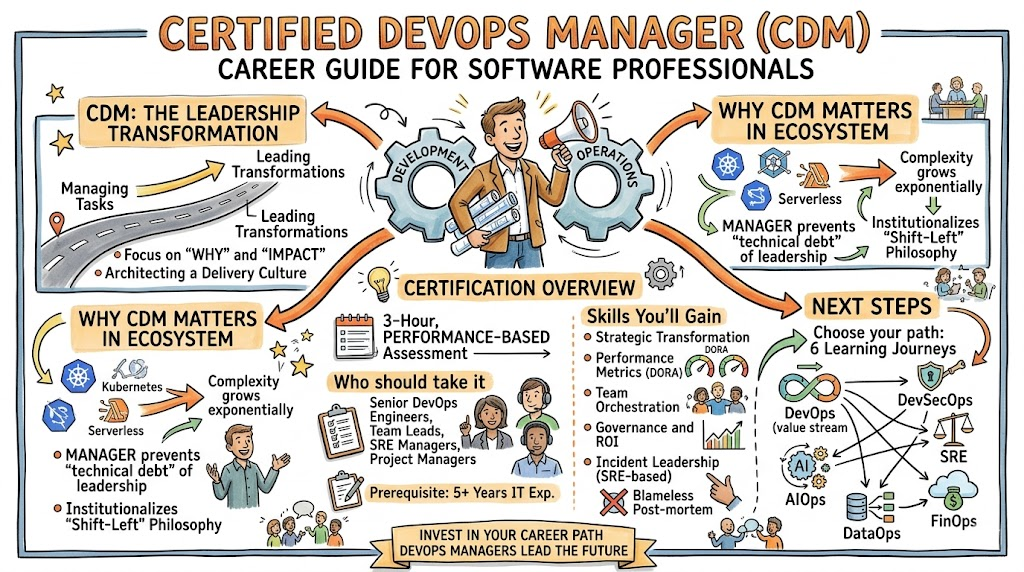
This guide is designed to introduce you to the Certified DevOps Manager (CDM) program, a roadmap for those ready to move from managing tasks to leading transformations.
The transition to DevOps is not just a change in tools; it is a fundamental shift in how organizations deliver value. While engineers focus on the “how” of automation, a DevOps Manager must focus on the “why” and the “impact.” We are now in an era where speed and stability must coexist, and the CDM is the credential that prepares you to navigate this high-stakes environment. Whether you are an engineer looking to step into leadership or a manager looking to modernize your toolkit, this guide provides the tactical blueprint you need.
What is Certified DevOps Manager (CDM)?
The Certified DevOps Manager (CDM) is an elite, advanced-level professional credential designed for the next generation of engineering leaders. It is not a test of your ability to write a script or configure a server; rather, it is an assessment of your ability to architect a delivery culture. The CDM validates your competence in strategic planning, organizational governance, risk mitigation, and the financial management of technical ecosystems.
Unlike entry-level certifications, the CDM focuses on the performance-based application of DevOps principles at scale. It requires candidates to demonstrate how they would resolve team silos, optimize DORA metrics, and align technical roadmaps with business objectives. It acts as a bridge, turning high-performing senior engineers into strategic assets for their companies.
Why it Matters in Today’s Software, Cloud, and Automation Ecosystem
In today’s ecosystem, software is the business. Companies no longer have the luxury of slow release cycles or frequent outages. However, as we adopt technologies like Kubernetes, Serverless, and AI-driven operations, the complexity grows exponentially. Without a dedicated DevOps Manager to oversee these moving parts, automation can actually become a liability, propagating errors at the speed of light.
The CDM is vital because it institutionalizes the “Shift-Left” philosophy across the entire organization. It ensures that security, reliability, and cost-efficiency are not afterthoughts but are built into the very foundation of the delivery pipeline. In a world where a single configuration error can lead to a multi-million dollar data breach or a cloud bill that wipes out a quarter’s profit, the CDM provides the governance framework to prevent catastrophe while maintaining velocity.
Why Certifications are Important for Engineers and Managers
For engineers, a certification like the CDM is a career accelerator. It provides a formal validation of your expertise that years of experience alone sometimes cannot. In a global market—especially for professionals in India looking at international roles—it serves as a universal language of competence. It proves that you don’t just “know” DevOps, but you have mastered the management of it.
For managers, certifications are a primary tool for risk management. When you hire or promote a Certified DevOps Manager, you are ensuring a standardized level of excellence across your leadership tier. It reduces the “technical debt” of leadership, ensuring that your managers are using industry-best practices to lead their teams. It also builds immense confidence among stakeholders and clients, knowing that the infrastructure powering their business is managed by recognized, world-class experts.
Why Choose DevOpsSchool?
Choosing where to train is as important as the certification itself. DevOpsSchool offers a unique, mentor-led environment that is built on decades of real-world experience. Their curriculum isn’t just a collection of slides; it is a living document that evolves as the industry does. They prioritize a “practical-first” approach, ensuring that every student spends significant time in interactive labs that mimic real enterprise challenges.
The support system at DevOpsSchool is what truly sets them apart. You aren’t just a student; you become part of a global community of practitioners. Their mentors stay with you through the difficult parts of the learning curve, providing the technical and strategic guidance needed to not just pass an exam, but to excel in your role. When you choose DevOpsSchool, you are investing in a career path supported by the most respected veterans in the DevOps space.
Certification Deep-Dive: Certified DevOps Manager (CDM)
What it is
The Certified DevOps Manager (CDM) is a 3-hour, performance-based assessment. It tests your ability to design roadmaps, manage cross-functional teams, and oversee the entire software delivery lifecycle from a strategic perspective.
Who should take it
This is specifically designed for Senior DevOps Engineers, Team Leads, SRE Managers, IT Project Managers, and aspiring Engineering Managers who have at least 5 years of experience in the IT industry.
Certification Overview Table
| Track | Level | Who it’s for | Prerequisites | Skills Covered | Recommended Order |
|---|---|---|---|---|---|
| DevOps | Master | Operations Managers | 5+ Years IT Exp | Strategy, ROI, DORA | 1st |
| DevSecOps | Advanced | Security Leads | CDM Basics | Governance, Compliance | 2nd |
| SRE | Expert | Reliability Leads | Admin Skills | SLOs, Error Budgets | 2nd |
| AIOps/MLOps | Specialist | AI Architects | CDM/SRE | AI-driven Automation | 3rd |
| DataOps | Specialist | Data Managers | Pipeline Exp | Data Governance | 3rd |
| FinOps | Specialist | Finance/Eng Mgr | Cloud Basics | Cloud Cost Opt. | 2nd |
Skills you’ll gain
- Strategic Transformation: The ability to move an entire legacy organization toward a high-velocity DevOps model.
- Performance Metrics: Mastering the use of DORA metrics (Lead Time, MTTR, etc.) to drive team performance.
- Team Orchestration: Leading distributed and hybrid teams while maintaining a high-performance culture.
- Governance and ROI: Understanding the financial impact of technical decisions and proving the value of automation.
- Incident Leadership: Managing major system failures with an SRE-based, blameless post-mortem approach.
Real-world projects you should be able to do after it
- Enterprise DevOps Roadmap: Design a 12-month plan for migrating an enterprise to a cloud-native delivery model.
- Automated Compliance Framework: Build a system that enforces security policies automatically within the CI/CD pipeline.
- Cloud Budget Optimization: Perform a deep-dive audit of cloud resources and implement a FinOps strategy that saves 20% on spend.
- DORA Dashboard Implementation: Create a real-time visualization of the team’s delivery performance for executive stakeholders.
Preparation Plan
7–14 Days (The Expert Sprint)
This is for those who are already in leadership roles. Spend these two weeks focusing on the official exam domains. Take daily mock exams and focus heavily on scenario-based questions where you must choose the “best” strategic response.
30 Days (The Practitioner Path)
The ideal path for most senior engineers. Spend the first two weeks reviewing the technical tracks (CI/CD, SRE, FinOps). Use the final two weeks to study management theory and organizational change management frameworks.
60 Days (The Career Transition)
For those moving from traditional management. Spend the first month getting hands-on with the tools (Kubernetes, Terraform, Jenkins). Spend the second month focusing on how to lead the teams that use these tools.
Common Mistakes
- Over-Technical Focus: Trying to solve every problem with code rather than looking at the process or the people.
- Neglecting Metrics: Failing to understand how to quantify success for the business.
- Ignoring Culture: Underestimating the difficulty of breaking down silos between different departments.
- Poor Time Management: Getting stuck on one scenario in the exam and running out of time for the rest.
Best next certification after this
The Master in DevOps Engineering (MDE) is the most logical next step, as it provides the deep technical mastery that complements your managerial expertise.
Choose your path: 6 Learning Journeys
1. The DevOps Path
This is the foundational path for optimizing the value stream. As a manager, you focus on removing bottlenecks between development and operations, ensuring that the software delivery “highway” is fast, smooth, and predictable.
2. The DevSecOps Path
The path for the security-conscious leader. You learn how to bake security into the culture of the team, ensuring that vulnerability scanning and compliance are continuous processes rather than late-stage roadblocks.
3. The SRE Path
The path of reliability. You focus on the health of production systems. As a manager, you use software engineering principles to solve operational problems, balancing the need for speed with the requirement for 99.9% uptime.
4. The AIOps/MLOps Path
The future of operations. You lead teams that use machine learning to manage infrastructure. This path is for those who want to oversee self-healing systems that can predict and fix failures before they impact the user.
5. The DataOps Path
Focused on the integrity and speed of data. You learn to manage the pipelines that power AI and analytics, ensuring that data is treated with the same rigor and automation as application code.
6. The FinOps Path
The path of financial accountability in the cloud. You bridge the gap between engineering and the CFO, ensuring that cloud spend is optimized and every dollar spent contributes to the bottom line.
Role → Recommended Certifications Mapping
| Current Role | Recommended Certification Journey |
|---|---|
| DevOps Engineer | CKA → Certified DevOps Professional → CDM |
| SRE | CKA → SRE Certified Professional → CDM |
| Platform Engineer | CKA → Certified GitOps Associate → CDM |
| Cloud Engineer | AWS/Azure/GCP Architect → CDM |
| Security Engineer | CKS → DevSecOps Certified Professional → CDM |
| Data Engineer | DataOps Certified Professional → CDM |
| FinOps Practitioner | FinOps Certified Practitioner → CDM |
| Engineering Manager | CDM → Master in DevOps Engineering (MDE) |
Next Certifications to Take
Following the guidance for industry veterans, these are the top three directions you should consider after earning your CDM:
- Same Track (Leadership Depth): Master in DevOps Engineering (MDE). This is the ultimate credential for those who want to be recognized as global leaders in the field.
- Cross-Track (Technical Insight): Master in Observability Engineering. This allows a manager to gain deep technical “sight” into the systems their teams are building.
- Leadership (Future-Proofing): Master in AIOps. As organizations scale, AI-driven management is becoming the standard for senior vice presidents and directors.
Training & Certification Support Institutions
If you are looking for support in achieving the Certified DevOps Manager (CDM) designation, the following institutions provide expert-led programs:
DevOpsSchool
The primary provider for CDM training. They are known for their massive library of technical resources and their focus on real-world projects. They provide a high-touch learning environment with direct access to industry veterans who have managed global infrastructure.
Cotocus
A specialized consulting and training firm that focuses on digital transformation. They help senior leaders bridge the gap between legacy IT and modern DevOps practices, making them an excellent choice for managers in traditional enterprises.
Scmgalaxy
A leading community platform for software configuration and DevOps professionals. They offer a wealth of technical tutorials and community-driven support, which is invaluable for staying updated on the latest toolsets.
BestDevOps
Known for their high-impact, focused bootcamps. They provide intensive training sessions designed to get professionals certified and ready for leadership roles in a very short timeframe.
devsecopsschool.com
The world’s leading specialized portal for security integration. They provide the deep-dive security knowledge that is now a mandatory part of the CDM curriculum.
sreschool.com
Dedicated entirely to the science of reliability. If your goal is to master uptime and system performance, this is the place to gain your SRE-specific managerial skills.
aiopsschool.com
Leading the charge in AI-driven operations. They teach you how to build “self-healing” systems using machine learning, preparing you for the next decade of infrastructure management.
dataopsschool.com:
Specializes in the automation of data lifecycles, ensuring data quality and speed for modern enterprises. Essential for managers overseeing data-heavy environments.
finopsschool.com:
Focuses on the business side of the cloud, helping leaders master cost governance and cloud financial management.
FAQs (General Career & Value)
- Is the CDM certification recognized globally?
Yes, it is highly regarded in major tech hubs across India, the USA, Europe, and the Middle East. - How long does the certification last?
The CDM certification from DevOpsSchool is valid for a lifetime with no renewal fees. - What is the passing score for the CDM exam?
You need a minimum score of 70% to pass the performance-based assessment. - Can a Software Engineer take this exam?
Absolutely. It is the perfect credential for developers looking to move into management or architecture. - Is the training provided in person or online?
DevOpsSchool provides both live online instructor-led sessions and self-paced recorded options. - Does the CDM cover multi-cloud strategies?
Yes, the curriculum includes managing infrastructure across AWS, Azure, and Google Cloud. - Is there a free retake for the exam?
Most training packages at DevOpsSchool include one free retake if you don’t pass on the first attempt. - How much experience do I really need?
While 5 years is recommended, those with high technical aptitude and 3 years of experience can succeed with proper training. - What is the format of the exam?
It is a performance-based exam where you must resolve specific management and technical scenarios. - Does it help with salary negotiations?
Yes. Certified managers typically command salaries 30-50% higher than their non-certified peers. - Are there any group discounts for companies?
Yes, all the mentioned institutions offer corporate training programs for engineering teams. - What is the best way to start?
The best way to start is to review the syllabus on the DevOpsSchool website and sign up for a foundational session.
FAQs (Specific to Certified DevOps Manager – CDM)
- What is the main focus of the CDM Domain 1?
Domain 1 focuses on DevOps Strategy and ROI, ensuring technical goals align with business profit. - Does the CDM cover cultural change?
Yes, a significant portion of the exam is dedicated to breaking down silos and fostering collaboration. - Are DORA metrics part of the exam?
Yes, you must know how to measure and improve Deployment Frequency and Lead Time. - How is FinOps addressed in CDM?
You are tested on your ability to implement cloud cost-tagging and optimization policies. - Is SRE a requirement for CDM?
You don’t need an SRE cert, but you must understand SLOs and Error Budgets as a manager. - Does CDM include DevSecOps?
Yes, the management of automated security “Guardrails” is a core part of the syllabus. - What role does AI play in the CDM?
The exam introduces the concepts of AIOps and how a manager can leverage AI for system monitoring. - Is there a lifetime access to materials?
Yes, DevOpsSchool provides lifetime access to their LMS and updated course materials.
Conclusion
The evolution from engineer to manager is perhaps the most significant milestone in a technical career. The Certified DevOps Manager (CDM) certification is more than just a credential; it is a declaration that you have mastered the complexity of modern delivery. As we look toward a future defined by AI and autonomous systems, the need for human leaders who can navigate the ethical, financial, and technical challenges of DevOps has never been greater. By following this roadmap and committing to continuous learning, you aren’t just securing a certification—you are securing the future of your career.