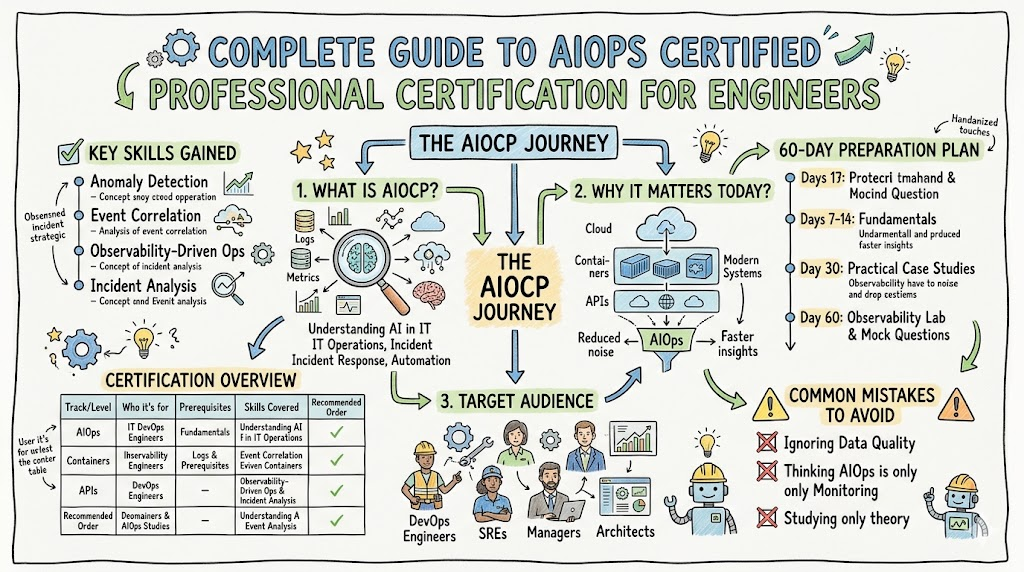
Introduction
The AiOps Certified Professional (AIOCP) certification gives engineers and managers a practical way to understand how artificial intelligence can improve IT operations. Modern software systems are no longer simple. They run across cloud platforms, containers, microservices, APIs, monitoring tools, and automation pipelines. Because of this, operations teams deal with huge volumes of logs, metrics, alerts, incidents, and performance data every day. Manual work alone is no longer enough. Teams now need intelligent systems that can reduce noise, detect patterns, support root cause analysis, and improve response speed.
This is where AIOps becomes valuable. It helps organizations move from reactive operations to more predictive and automated operations. For working engineers, AIOCP builds a strong foundation in how AI supports monitoring, observability, incident response, and operational decision-making. For managers, it offers a clear framework for understanding how intelligent operations can improve reliability, efficiency, and scale. This guide explains the certification in a practical, career-focused way so professionals can decide how it fits into their growth path.
What is AiOps Certified Professional (AIOCP)?
AiOps Certified Professional (AIOCP) is a role-focused certification designed for professionals who want to understand and apply artificial intelligence in IT operations. It covers the practical side of using AI and machine learning to improve monitoring, event correlation, anomaly detection, incident response, automation, and service reliability. Instead of treating operations as only a manual support function, AIOCP teaches how modern teams can use data and intelligent systems to manage large and complex environments more effectively.
The certification is useful because modern infrastructure produces far more operational data than humans can manually process. AIOps helps convert that data into insight. It supports faster issue detection, smarter alert handling, better root cause understanding, and more reliable automation. In simple terms, AIOCP helps professionals understand how to build and manage intelligent operations practices in real environments.
Why it Matters in Today’s Software, Cloud, and Automation Ecosystem
Today’s engineering teams work in environments that are highly distributed and always changing. Applications are deployed many times a day. Cloud services scale up and down constantly. Containers and Kubernetes create dynamic workloads. APIs connect systems across different platforms. At the same time, business expectations for uptime and speed continue to rise. This creates a serious challenge for operations teams.
Traditional monitoring can tell you that something is wrong, but it often cannot tell you why it happened, how serious it is, or what should be done first. AIOps adds intelligence to this process. It helps teams group related alerts, detect unusual patterns, reduce false alarms, and support faster recovery. This matters because engineering productivity depends on fewer distractions and faster incident response. It also matters because business leaders need reliable systems without growing operations teams at the same pace as system complexity. In modern software, cloud, and automation ecosystems, AIOps is becoming a practical advantage rather than just an experimental idea.
Why Certifications are Important for Engineers and Managers
Certifications are important when they help people build structured knowledge that can be applied in real work. In fast-moving technical fields, many professionals learn in fragments. They know one tool well, another tool partly, and some concepts only at a surface level. A certification can organize that learning into a clear path. It helps engineers understand not just isolated tools, but how different concepts work together in production.
For engineers, certifications improve confidence and show commitment to growth. They also help during interviews, role changes, and internal promotions because they provide a recognized proof of learning. For managers, certifications are equally useful. They make it easier to understand technical discussions, evaluate team skill gaps, and guide transformation efforts. A certification like AIOCP is valuable because it brings together AI, operations, observability, and automation in one practical framework. It helps both individual contributors and leaders speak the same language about modern operations and make better decisions in a rapidly changing environment.
Why Choose DevOpsSchool
DevOpsSchool is a strong option for professionals who want practical learning rather than only theory. Its certification approach is useful for working engineers and managers because it connects technical ideas with real-world operations, automation, and enterprise needs. Instead of treating AIOps as only a buzzword, the learning path is aligned with actual concerns such as monitoring, observability, automation workflows, incident handling, and operational improvement.
Another reason many professionals prefer DevOpsSchool is its wider ecosystem. AIOps does not exist alone. It is connected with DevOps, SRE, MLOps, DataOps, DevSecOps, and FinOps. A learning provider that understands these relationships can help professionals build a longer career path instead of preparing only for one exam. This is especially helpful for engineers who want to grow from operations into architecture, reliability, platform engineering, or leadership roles. For managers, this broader view also makes it easier to align certification choices with long-term team needs and digital transformation goals.
Certification Deep-Dive: AiOps Certified Professional (AIOCP)
What is this certification?
AiOps Certified Professional (AIOCP) is a professional certification that validates a learner’s understanding of how AI can be used to strengthen IT operations. It focuses on practical knowledge that helps professionals improve monitoring, incident analysis, event handling, automation, and operational intelligence. The purpose is not to turn every engineer into a data scientist. Instead, it helps technical professionals understand how intelligent systems can support the work they already do in operations, reliability, cloud, and support environments.
This certification is important because modern operations teams work with too much telemetry to handle manually. Logs, traces, metrics, alerts, and event streams all create operational noise. AIOCP helps professionals learn how to reduce that noise and turn it into useful action. It gives a framework for understanding where AI fits into operational workflows, how it improves system visibility, and how it can support faster decisions in complex environments.
Who should take this certification?
This certification is suitable for a wide range of professionals. It is highly useful for DevOps engineers, SREs, cloud engineers, platform engineers, operations engineers, support specialists, and software engineers who work close to production systems. It is also helpful for managers, team leads, architects, and technical decision-makers who want to understand the future direction of operations and automation.
If you work in environments where alerts are too noisy, incidents take too long to diagnose, or systems are becoming difficult to manage at scale, this certification is a good fit. It is also useful for professionals who want to move into reliability, intelligent automation, or AI-driven operations roles. For managers, it provides enough practical understanding to guide teams and investments more effectively. For engineers, it builds a bridge between traditional operations knowledge and modern intelligent systems. In both India and global markets, that combination is becoming increasingly valuable.
Certification Overview Table
| Track | Level | Who it’s for | Prerequisites | Skills covered | Recommended order |
|---|---|---|---|---|---|
| AIOps | Professional | DevOps engineers, SREs, cloud engineers, operations teams, managers, software engineers | Basic understanding of IT operations, cloud, monitoring, and automation | AIOps concepts, anomaly detection, event correlation, observability, incident support, automation, operational intelligence | After fundamentals in DevOps, cloud, monitoring, or operations |
Detailed Guide: AiOps Certified Professional (AIOCP)
What it is
This certification validates a professional’s understanding of how artificial intelligence supports modern IT operations. It focuses on intelligent monitoring, operational analysis, automation support, and better incident handling in complex environments.
Who should take it
- DevOps engineers working on production systems and automation
- SRE professionals managing reliability, alert quality, and response
- Cloud engineers operating large-scale distributed platforms
- Platform engineers building internal engineering systems
- Software engineers moving closer to operations and observability
- Managers who lead teams responsible for uptime, performance, and operational maturity
Skills you’ll gain
- Understanding of AIOps principles and use cases
- Ability to connect logs, metrics, traces, and alerts into useful operational insight
- Better knowledge of anomaly detection and event correlation
- Improved understanding of observability-driven operations
- Stronger incident analysis and response thinking
- Practical awareness of automation in operations workflows
- Better understanding of how AIOps aligns with DevOps, SRE, MLOps, and cloud operations
- More confidence in discussing intelligent operations with technical teams and leadership
Real-world projects you should be able to do after it
- Design an AIOps adoption roadmap for an operations team
- Create an incident analysis flow using telemetry and alert correlation
- Build a monitoring strategy that reduces duplicate and noisy alerts
- Define automation steps for common operational events
- Compare tool options for observability and intelligent operations
- Support root cause analysis using patterns from logs and metrics
- Improve service health visibility for distributed systems
- Map AIOps use cases to business reliability goals
Preparation plan
- 7–14 days
- Study core AIOps definitions and concepts
- Understand the difference between traditional monitoring and AIOps
- Review observability basics such as logs, metrics, traces, and alerts
- Learn common AIOps use cases in incident response and automation
- 30 days
- Read practical case studies on anomaly detection and incident handling
- Explore monitoring and dashboarding tools
- Study how AIOps connects with DevOps, SRE, cloud, and automation
- Build notes on workflows, operational data, and use-case patterns
- 60 days
- Create a simple observability lab with sample logs and alerts
- Simulate common operational issues and think through response patterns
- Design a sample AIOps maturity plan for a team or company
- Revise all concepts through practical examples and mock questions
Common mistakes
- Thinking AIOps is only advanced monitoring
- Ignoring data quality and alert quality
- Focusing on tools before understanding the problem
- Treating automation as a replacement for engineering judgment
- Confusing AIOps with deep AI research work
- Studying only theory without mapping it to operations
- Forgetting the connection between AIOps and business outcomes
- Not learning the basics of observability before going deeper
Best next certification after this
- Same-track option: Advanced AIOps or MLOps-focused certification
- Cross-track option: SRE or DevSecOps certification
- Leadership option: Technical leadership or operations strategy certification
Choose Your Learning Path
DevOps Path
- Focus on CI/CD, automation, infrastructure as code, deployment pipelines, and release velocity
- Add AIOps to improve operational insight after deployment
- Useful for engineers who want smarter feedback loops between development and production
DevSecOps Path
- Focus on secure delivery, compliance automation, secrets handling, and vulnerability visibility
- Add AIOps to improve security-related alert intelligence and operational response
- Useful for engineers building secure and resilient systems
SRE Path
- Focus on reliability, uptime, SLOs, SLIs, error budgets, and incident management
- Add AIOps to improve alert quality, anomaly detection, and faster operational recovery
- Useful for engineers managing critical production services
AIOps / MLOps Path
- Focus on intelligent operations, automation, model-aware systems, and operational decision support
- Add MLOps ideas if you work with data science teams and production models
- Useful for professionals building AI-enabled platforms and automation systems
DataOps Path
- Focus on data movement, pipeline quality, governance, lineage, and reproducibility
- Add AIOps to improve the operational side of data-driven systems
- Useful for engineers who want stronger control over telemetry and operational data quality
FinOps Path
- Focus on cloud spending, resource efficiency, usage visibility, and cost accountability
- Add AIOps to detect cost anomalies and improve performance-to-cost decisions
- Useful for teams running large cloud environments where efficiency matters
Role → Recommended Certifications
| Role | Recommended certifications |
|---|---|
| DevOps Engineer | AIOCP, DevOps certification, cloud automation certification |
| SRE | AIOCP, SRE certification, observability certification |
| Platform Engineer | AIOCP, Kubernetes or platform engineering certification, SRE certification |
| Cloud Engineer | AIOCP, cloud operations certification, DevOps certification |
| Security Engineer | AIOCP, DevSecOps certification, cloud security certification |
| Data Engineer | AIOCP, DataOps certification, data engineering certification |
| FinOps Practitioner | AIOCP, FinOps certification, cloud cost management certification |
| Engineering Manager | AIOCP, leadership certification, DevOps or SRE manager-focused certification |
Next Certifications to Take After AIOCP
Same Track Progression
- Move toward a deeper AIOps or MLOps certification
- Build stronger expertise in intelligent automation and operational analytics
- Best for professionals who want to specialize in AI-driven operations
Cross-Track Expansion
- Take an SRE certification to improve reliability thinking
- Take a DevSecOps certification to strengthen security automation
- Best for professionals who want broader engineering value across teams
Leadership and Management Track
- Choose a certification focused on technical leadership or platform strategy
- Learn how to guide teams, tool choices, and operational transformation
- Best for senior engineers moving into management responsibilities
Training and Certification Support Providers
- DevOpsSchool
DevOpsSchool provides practical learning for modern engineering domains such as DevOps, SRE, cloud, automation, and AIOps. Its strength is the way it connects technical theory with real operational use cases. This makes it a good choice for professionals who want job-relevant learning and a broader long-term roadmap. - Cotocus
Cotocus supports professionals and organizations with training across cloud-native and modern IT practices. It is useful for learners who want focused upskilling in areas that directly affect engineering productivity and operational maturity. Its broader technology coverage can help professionals build related skills around AIOps. - Scmgalaxy
Scmgalaxy is known for technical training, practical guidance, and learning support in automation and software operations domains. It is useful for professionals who want structured learning with industry-focused topics. It can also support learners who prefer practical understanding over abstract theory. - BestDevOps
BestDevOps is useful for professionals who want straightforward learning across DevOps, automation, and modern operations areas. Its value comes from helping learners focus on practical skills that matter in real work. For AIOps learners, that practical approach can support smoother certification preparation. - devsecopsschool.com
DevSecOpsSchool is relevant for professionals who want to combine intelligent operations with secure delivery and compliance awareness. It is a strong next-step resource for those who want to understand security automation in modern engineering environments. This is especially valuable in regulated and risk-sensitive industries. - sreschool.com
SRESchool is useful for reliability-focused professionals who want stronger skills in uptime, observability, incident management, and service quality. Since AIOps and SRE overlap in many operational areas, this provider can help learners deepen their production reliability knowledge. It is a strong fit for engineers managing critical services. - aiopsschool.com
AIOpsSchool is directly aligned with intelligent operations, automation, and AI-driven engineering learning. It is useful for professionals who want focused education in AIOps and related fields. Learners who want to go deeper after AIOCP can benefit from a provider centered on this domain. - dataopsschool.com
DataOpsSchool is useful because operational intelligence depends on clean, reliable, and well-managed data flows. Professionals working with AIOps benefit when they also understand data quality, pipeline reliability, and governance. This makes it relevant for engineers working close to operational telemetry and analytics. - finopsschool.com
FinOpsSchool is valuable for professionals who want to understand the business side of engineering operations. AIOps becomes even more useful when it also supports cost efficiency and cloud optimization. This provider is helpful for engineers and managers who must balance performance, scale, and spending.
Frequently Asked Questions
1. How difficult is the AiOps Certified Professional certification?
It is generally moderate in difficulty for professionals who already understand basic IT operations, cloud, monitoring, or automation concepts.
2. How much time is usually needed to prepare?
Most working professionals can prepare well in a few weeks to two months, depending on experience and study consistency.
3. Are there any strict prerequisites?
There may not be strict formal prerequisites, but a basic understanding of operations, cloud, and monitoring is very helpful.
4. Is this certification only for operations engineers?
No. It is useful for DevOps engineers, SREs, software engineers, cloud engineers, and technical managers as well.
5. Should I study DevOps before AIOCP?
If you are completely new to automation and operations, a DevOps or cloud foundation can help. If you already work around production systems, AIOCP can still be a strong next step.
6. Is AIOCP useful for managers?
Yes. Managers benefit because it helps them understand how AI supports operations, incident handling, automation, and team productivity.
7. Does the certification focus more on tools or concepts?
A strong certification usually balances both. AIOCP is most useful when you understand the concepts first and then connect them to practical tools and workflows.
8. Will AIOCP help in interviews?
Yes. It can strengthen your profile if you can explain real use cases, operational challenges, and practical outcomes clearly.
9. Can this certification help me move into an SRE or platform role?
Yes. It builds knowledge that is relevant to reliability, observability, automation, and intelligent operations, which all support those roles.
10. Is AIOCP valuable only in India?
No. The skills behind AIOps are relevant in global software, cloud, platform, and enterprise operations teams.
11. What is the biggest mistake people make while preparing?
The biggest mistake is learning only terms without understanding how they solve real operations problems.
12. What is the real career value of this certification?
Its value comes from helping professionals understand a growing area where AI, operations, and automation meet. That makes it useful for future-facing engineering roles.
FAQs on AiOps Certified Professional (AIOCP)
1. What is AIOCP mainly about?
AIOCP is mainly about understanding how artificial intelligence supports IT operations through monitoring, analysis, automation, and better incident handling.
2. Who should ideally take AIOCP first?
Professionals already working in DevOps, cloud, SRE, support, platform, or software operations environments are a strong fit.
3. Is AIOCP more theoretical or practical?
It is more valuable when treated as a practical certification that helps you apply concepts to modern operational environments.
4. Does AIOCP help with observability?
Yes. It supports understanding of how logs, metrics, traces, and alerts can be used more intelligently.
5. Is AIOCP useful for cloud-native environments?
Yes. It is especially relevant for cloud-native systems where telemetry volume and operational complexity are very high.
6. Can software engineers benefit from AIOCP?
Yes. Software engineers who work close to production systems can gain strong insight into operational reliability and intelligent monitoring.
7. What should I do after AIOCP?
You can go deeper into AIOps or expand into SRE, DevSecOps, DataOps, or FinOps depending on your role and interest.
8. Is AIOCP a good long-term career choice?
Yes. As intelligent operations becomes more important in modern engineering, the knowledge behind AIOCP is likely to stay highly relevant.
Conclusion
AiOps Certified Professional (AIOCP) is a practical and forward-looking certification for professionals who want to understand the future of IT operations. It connects artificial intelligence with real engineering challenges such as alert overload, incident diagnosis, observability, automation, and operational scale. For engineers, it builds a stronger understanding of how modern systems can be managed with more intelligence and less manual effort. For managers, it provides a useful framework for guiding teams and improving operational maturity. The true value of AIOCP is not only in the certificate itself, but in the mindset it builds. It helps professionals move from reactive support work to more intelligent, data-informed operations. If your work touches production systems, cloud, automation, reliability, or service health, AIOCP can be a meaningful step in your long-term growth.

I gained clarity on AI-driven operations, predictive monitoring, and automation, and I will apply this knowledge to improve enterprise reliability and intelligent system management.
Advancing Technical Expertise Through Specialized Infrastructure Intelligence Programs Enhances My Career Path While Building Essential Systems Management Skills For Future Professional Success And Industry Growth Successfully
This blog offers valuable insights into AIOps certification, helping professionals understand modern IT operations, automation, and career growth opportunities.
Excellent article! It clearly explains AIOps certification benefits and helps engineers understand AI-driven operations, automation, and modern IT challenges effectively.