Introduction
In the modern software landscape, the line between “building” and “running” software has all but vanished. As an industry veteran who has witnessed the transformation from manual data center migrations to the era of ephemeral, self-healing cloud clusters, I can tell you one thing for certain: the “siloed” engineer is becoming a relic of the past.
Today, the industry demands a “Master”—someone who doesn’t just write code or manage servers, but who builds the automated highways that allow software to flow from a developer’s laptop to a global production environment in minutes. This is the essence of the Master in DevOps Engineering (MDE).
What is Master in DevOps Engineering (MDE)?
The Master in DevOps Engineering (MDE) is a comprehensive professional certification and training program designed to transform software engineers and systems administrators into elite “Platform Architects.” It is not a single-tool course. Instead, it is a multi-disciplinary curriculum that integrates cultural philosophies, technical automation, and architectural best practices.
MDE focuses on the entire Software Development Life Cycle (SDLC), teaching you how to apply the principles of CALMS (Culture, Automation, Lean, Measurement, and Sharing). By the end of this program, you aren’t just a Jenkins user or a Docker enthusiast; you are a professional capable of designing an entire engineering ecosystem that is resilient, secure, and cost-effective.
Why it Matters in Today’s Software, Cloud, and Automation Ecosystem
The shift from “Cloud First” to “Cloud Native” has fundamentally redefined the competitive landscape, transforming digital velocity into the primary marker of business survival. In an era where a six-hour release cycle can obsolete a six-month roadmap, the margin for architectural inefficiency has vanished. We are now managing complexity at a scale where microservices—often numbering in the hundreds—render manual oversight a relic of the past. This has elevated Kubernetes to the status of a modern cloud “operating system,” making orchestration expertise a non-negotiable requirement for the modern engineer.
Furthermore, the standard for reliability has shifted toward absolute zero-downtime; users no longer tolerate maintenance windows, necessitating systems that evolve while in full flight. This technical evolution is matched by a strategic pivot in fiscal responsibility. As the industry moves from “growth at all costs” to “profitable growth,” FinOps has matured into a core engineering discipline, ensuring that rapid innovation remains economically sustainable.
Why Certifications are Important for Engineers and Managers
In a crowded global market, certifications serve as a vital, verified signal of competence that bridges the gap between raw talent and industry-proven expertise. For engineers, these credentials replace the fragmented “YouTube-first” learning approach with a structured, validated curriculum that builds genuine confidence and dismantles imposter syndrome by grounding their skills in recognized standards. Simultaneously, for leadership, certifications establish a crucial common language across the organization; when a team is “MDE Certified,” there is a shared, high-level understanding of critical nuances—like the distinction between a deployment and a release—ensuring that stability and speed are prioritized in tandem. Ultimately, investing in these benchmarks acts as a powerful lever for both recruitment branding and long-term talent retention, signaling a commitment to professional excellence.
Why Choose DevOpsSchool?
Through my years in the field, I’ve seen many training providers come and go. DevOpsSchool stands out because they prioritize the “Engineers’ Reality.” Their pedagogy isn’t based on slide decks; it’s based on Labs and Real-World Scenarios. They provide a 24/7 cloud lab environment, ensuring that students in India, the US, or Europe can practice on production-grade infrastructure. Their mentors are active practitioners who understand that in the real world, things break in ways that aren’t in the manual. DevOpsSchool focuses on the “troubleshooting” mindset, which is the most valuable asset any DevOps engineer can have.
Certification Deep-Dive: Master in DevOps Engineering (MDE)
What is this certification?
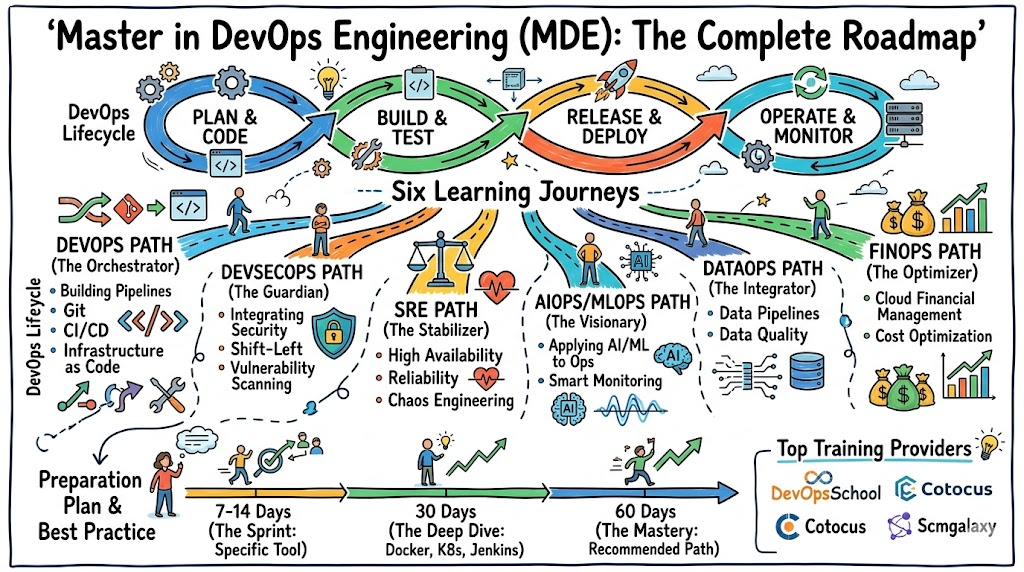
The MDE is a professional-grade credential that validates your ability to manage the “Infinite Loop” of DevOps. It covers everything from Source Code Management (SCM) and Continuous Integration (CI) to Continuous Deployment (CD), Infrastructure as Code (IaC), and Observability.
Who should take this certification?
- Software Engineers: Who want to understand where their code goes and how it runs.
- Systems Administrators: Who want to trade their manual scripts for automated pipelines.
- QA Engineers: Who want to master “Shift-Left” testing and automated quality gates.
- Release Managers: Who need to oversee complex, multi-cloud delivery schedules.
- Freshers/Graduates: With a strong logical foundation who want to enter the highest-paying niche in IT today.
Certification Overview Table
| Track | Level | Who it’s for | Prerequisites | Skills Covered | Recommended Order |
| Foundation | Associate | Aspiring DevOps Engineers | Basic Linux / Networking | Git, Maven, Shell Scripting | 1 |
| Core MDE | Professional | Working Engineers | Foundation Skills | Docker, Jenkins, Ansible, Terraform | 2 |
| Advanced Orchestration | Expert | Senior Engineers / SREs | Core MDE | Kubernetes, Helm, Service Mesh (Istio) | 3 |
| Strategy & Leadership | Master | Managers / Architects | Expert Track | Culture, ROI, AIOps, Governance | 4 |
About Certification Name: Master in DevOps Engineering (MDE)
What it is
The MDE is an intensive, project-driven certification that covers the entire “DevOps Periodic Table.” It is designed to take an individual from a siloed role to a holistic “DevOps Lead” capable of architecting delivery pipelines for Fortune 500 companies or high-growth startups.
Who should take it
This program is perfect for those who are “stuck” in a traditional IT role and want to pivot to a role that offers more creative freedom, higher pay, and the ability to work remotely for global firms.
Skills you’ll gain
- Automation: Building pipelines that run without human intervention.
- Containerization: Decoupling software from the underlying hardware.
- Orchestration: Managing thousands of containers across a cluster.
- Configuration Management: Ensuring 1,000 servers are configured identically.
- Security: Integrating vulnerability scanning into the build process.
- Observability: Using logs, metrics, and traces to find the “needle in the haystack” during an outage.
Real-world projects you should be able to do after it
- Build a “Single Click” Environment: Provision a VPC, Database, and App Cluster on AWS using Terraform.
- Implement a Zero-Downtime Pipeline: Use Jenkins and Kubernetes to perform a Canary release.
- Setup Self-Healing Infrastructure: Configure Kubernetes Liveness and Readiness probes to automatically restart failing services.
- Construct a DevSecOps Pipeline: Integrate SonarQube and Snyk to automatically block code with high-severity vulnerabilities.
Preparation plan
- 7–14 Days (The Sprint): Focus on one tool only (e.g., Docker). Ideal for those who need to fill a specific gap for a project.
- 30 Days (The Deep Dive): Master the “Big Three”: Docker, Kubernetes, and Jenkins. Requires 2–3 hours of daily lab work.
- 60 Days (The Mastery): The full MDE journey. Month 1 covers Linux, Git, and CI/CD. Month 2 covers IaC, Kubernetes, and Observability. This is the recommended path for true mastery.
Common mistakes
- Skipping Linux: Trying to learn DevOps without knowing how to navigate a Linux terminal is like trying to be a pilot without knowing how to read an altimeter.
- Tool Hopping: Learning five different CI tools superficially instead of mastering one (like Jenkins) deeply.
- Ignoring the “Dev” in DevOps: Not learning how to read or write basic scripts (Python/Bash) to automate manual tasks.
- Theory over Practice: Spending 10 hours watching videos and 0 hours in the terminal.
Best next certification after this
Once you have the MDE, I recommend moving toward Certified DevSecOps Professional to add the security layer, or SRE Foundation to focus on site reliability.
Choose Your Path: 6 Learning Journeys
The beauty of DevOps is that it’s a broad church. Depending on your personality and interests, you can specialize in one of these six paths:
DevOps Path
The “Orchestrator.” You love building the perfect pipeline and ensuring that code flows smoothly from “Dev” to “Prod.”
DevSecOps Path
The “Guardian.” You are passionate about security and want to prove that “fast” software can also be “secure” software.
SRE Path
The “Stabilizer.” You enjoy the challenge of high availability. You treat operations as a software engineering problem.
AIOps/MLOps Path
The “Visionary.” You want to apply DevOps rigors to the world of Artificial Intelligence and Machine Learning.
DataOps Path
The “Integrator.” You focus on the data supply chain, ensuring that data scientists have high-quality, fresh data at their fingertips.
FinOps Path
The “Optimizer.” You are the bridge between engineering and finance, ensuring the cloud bill doesn’t eat the company’s profits.
Role → Recommended Certifications Mapping
| If your role is… | You should take… |
| DevOps Engineer | MDE + Kubernetes (CKA) + Terraform Associate |
| SRE | MDE + SRE Professional + Prometheus/Grafana Cert |
| Platform Engineer | MDE + Advanced Kubernetes + Service Mesh Specialist |
| Cloud Engineer | MDE + AWS/Azure Solution Architect |
| Security Engineer | MDE + DevSecOps Professional + Container Security |
| Data Engineer | MDE + DataOps Professional + Snowflake/Databricks |
| FinOps Practitioner | MDE + FinOps Certified Practitioner |
| Engineering Manager | MDE (Leadership Track) + DevOps Leader (DOL) |
Next Certifications to Take
After completing the MDE, your journey is just beginning. To stay in the top 1% of earners, consider these paths:
- Same Track (Deepening): Certified Kubernetes Administrator (CKA). This is the industry “standard” for proving you can manage production K8s clusters.
- Cross-Track (Broadening): Certified DevSecOps Professional. This makes you a “Purple Team” player—someone who understands both dev and security.
- Leadership (Growth): DevOps Leader (DOL). This certification focuses on the cultural and organizational changes needed to make DevOps successful at scale.
Top Training and Certification Providers
DevOpsSchool
The most recognized name for MDE. They provide a massive repository of real-world projects and a 24/7 support system. Their training is highly interactive, making them a favorite for both individual engineers and corporate teams in India and the US.
Cotocus
Known for their boutique, high-touch training. They focus on advanced consulting-grade skills, often training entire departments for digital transformation.
Scmgalaxy
A pioneer in the space. They have a massive community and offer specialized training in the “old” and “new” of DevOps, from legacy SCM to modern GitOps.
BestDevOps
Focuses on the “essential” toolkit. They are excellent for professionals who want to get up to speed with the most in-demand tools in a short amount of time.
devsecopsschool.com
The global authority on shifting security to the left. If you want to specialize in the “Sec” of DevSecOps, this is your home.
sreschool.com
Focused entirely on the Google-born philosophy of Site Reliability Engineering. They teach the math and the mindset of high availability.
aiopsschool.com
A forward-looking institution teaching the intersection of AI/ML and Ops. Essential for those looking at the next 5-10 years of tech.
dataopsschool.com
The first of its kind to focus on the “Data Pipeline” as a first-class citizen in the DevOps world.
finopsschool.com
The premier destination for learning cloud financial management. They bridge the gap between the CFO and the CTO.
FAQs (General)
1. Is MDE suitable for beginners?
Yes, but you must be willing to learn. The program usually starts with “Day 0” fundamentals like Linux and Git to ensure everyone has a level playing field.
2. How long does the MDE certificate last?
The certification is typically valid for 2 years. In the fast-moving world of DevOps, staying current is essential, so re-certification or moving to an “Advanced” track is encouraged.
3. What is the difficulty level?
It is a “Master” level program. It isn’t easy, but it is structured. If you follow the labs, you will pass. It’s designed to be challenging yet achievable for working professionals.
4. Does MDE cover AWS, Azure, and GCP?
The MDE focuses on “Cloud Agnostic” tools. This is a huge advantage. If you learn Terraform and Kubernetes, you can manage any of the big three cloud providers.
5. How much time do I need to commit weekly?
For the 60-day plan, expect to spend 10–12 hours a week. This is roughly 1 hour on weekdays and 5-6 hours on weekends.
6. Can I get a job abroad with this certification?
Absolutely. DevOps is one of the most mobile career paths. An MDE certification from a recognized provider like DevOpsSchool is a global ticket to markets like the EU, Canada, and the UAE.
7. Do I need to be a coding genius?
No. You need to be a “Scripting Generalist.” If you can write a loop in Bash or a function in Python, you have enough coding skill for MDE.
8. What is the sequence of tools I should learn?
Git → Docker → Jenkins → Ansible → Terraform → Kubernetes → Prometheus. This builds a logical “stack” of knowledge.
9. Is there any placement assistance?
Most of the top providers, especially DevOpsSchool, have dedicated placement cells that connect MDE-certified professionals with their network of hiring partners.
10. What is the ROI of an MDE certification?
Most students report a salary increase of 30-60% within six months of certification, as they move into more senior, platform-oriented roles.
11. Is the exam lab-based or multiple choice?
The best MDE exams are a mix of both. You are tested on your knowledge (MCQs) and your ability to solve a real problem in a live terminal (Lab).
12. Can I take this while working a 9-to-5 job?
Yes. The programs are built for working engineers. Classes are usually on weekends, and labs are accessible 24/7.
FAQs on Master in DevOps Engineering (MDE)
1. What makes MDE different from a standard DevOps course?
Standard courses teach tools; MDE teaches Systems. You learn how the tools talk to each other and how to troubleshoot the connections between them.
2. Is the training live or recorded?
Through providers like DevOpsSchool, you get a mix of live instructor-led sessions (for interaction) and recorded sessions (for review).
3. Do I get hands-on experience with production-grade clusters?
Yes. You won’t just run “Hello World” on your laptop. You will provision clusters in the cloud that mimic a real production environment.
4. How does MDE prepare me for an SRE role?
MDE gives you the “Automation” foundation. SRE is about applying that automation to reliability. Without MDE skills, you cannot be an effective SRE.
5. What happens if I get stuck in a lab?
Institutions like DevOpsSchool provide 24/7 mentor support. You can raise a ticket or join a support session to get unstuck.
6. Is there a final project?
Yes. You must complete a “Capstone Project” where you build a full end-to-end automated pipeline for a microservices application.
7. Are there any discounts for group enrollments?
Most providers offer corporate or group discounts. If you and your colleagues want to master DevOps together, it’s always worth asking for a group rate.
8. Is the certification recognized by recruiters?
Recruiters today look for “Skills First.” When they see an MDE on a resume along with a portfolio of GitHub projects, you immediately move to the top of the pile.
Conclusion
Mastering DevOps through the MDE program is a transformative step for any modern engineer or manager. In an industry that never stops evolving, this certification provides the structural foundation and hands-on expertise needed to lead high-impact projects. It moves you beyond being a simple “coder” or “administrator” into the realm of a high-value Platform Architect.
By choosing a reputable partner like DevOpsSchool and following a disciplined learning path, you position yourself at the forefront of the cloud-native revolution. Now is the time to bridge the gap between development and operations, ensuring your career remains resilient, profitable, and future-proof in the global market.

I gained a clear roadmap of DevOps skills from fundamentals to advanced automation, and I will apply this structured approach to build scalable enterprise solutions effectively.
Navigating the comprehensive roadmap for modern infrastructure engineering enhances my technical competency while building essential system architecture skills for successful personal growth and future professional career advancement.
Excellent roadmap that clearly explains the DevOps journey and skills needed for success.
I found this article genuinely helpful. It breaks down the DevOps learning journey into clear, manageable steps and gives a realistic view of the skills needed to grow in this field. A great read for anyone planning a DevOps career.