Introduction
The landscape of software engineering has shifted fundamentally. We no longer live in a world where “writing code” and “running code” are two separate silos. Today, the bridge between development and operations is where the most business value is created. Whether you are an engineer in Bengaluru, a manager in London, or a researcher in San Francisco, the demand for streamlined, automated, and secure delivery is universal.
Speed is now the primary currency of business. If you cannot deploy features safely and quickly, your competitors will. But speed without stability is a recipe for disaster. This is where DevOps comes in. It is the combination of cultural philosophies, practices, and tools that increases an organization’s ability to deliver applications at high velocity.
Becoming a certified professional isn’t just about passing a test; it’s about proving you can handle the intense pressure of modern software delivery. This comprehensive guide is designed to navigate the complex world of modern certifications, specifically focusing on the DevOps Certified Professional (DCP)—a credential that has become a benchmark for excellence in the global tech industry.
What is DevOps Certified Professional (DCP)?
The DevOps Certified Professional (DCP) is a high-level certification program designed to validate a candidate’s proficiency across the entire DevOps lifecycle. Unlike entry-level certifications that might focus only on one specific tool (like just Jenkins or just Docker), the DCP is holistic.
It covers the “Big Picture.” It tests your ability to design CI/CD pipelines, manage cloud infrastructure as code, ensure security is integrated from day one, and use data to monitor system health. It is vendor-neutral, meaning the skills you learn are applicable whether your company uses AWS, Azure, Google Cloud, or an on-premise data center.
Why it Matters in Today’s Software, Cloud, and Automation Ecosystem
We are currently in the middle of a “Platform Engineering” revolution where cloud providers offer the raw materials, but DevOps professionals provide the essential architecture. Central to this shift is the elimination of technical debt; because manual work is a form of debt, the DevOps Certified Professional (DCP) program teaches you to automate repetitive tasks, effectively freeing up time for high-level innovation. This automation is critical in an era of cloud-native dominance, where most modern applications are built as microservices. Consequently, understanding how to orchestrate these systems using Kubernetes and Docker is no longer optional—it is a core requirement for the modern engineer.
Beyond technical proficiency, embracing these practices drives immense business agility, enabling companies to deploy up to 200 times more frequently than their competitors. DCP provides the specific toolkit needed to lead that high-velocity transformation. However, speed is nothing without stability; as cyber threats continue to rise, “shifting left” by moving security to the beginning of the development cycle has become vital. By integrating security from the start, DCP ensures that you aren’t just building fast, but building safely for the long term.
Why Certifications are Important for Engineers and Managers
For engineers, a certification serves as a definitive “Proof of Capability” that ensures a resume can successfully navigate both automated HR screening bots and the rigorous scrutiny of technical leads. Rather than suggesting you have merely picked up skills on the fly, these credentials demonstrate a structured, standardized mastery of industry best practices. This foundational knowledge translates directly into financial gain, as statistics consistently show certified DevOps professionals command salaries roughly 20% to 35% higher than their non-certified peers. Beyond immediate pay increases, certification facilitates smoother career mobility, providing the necessary leverage to transition from traditional SysAdmin or Developer roles into high-impact, high-paying positions in DevOps or Site Reliability Engineering (SRE).
For Managers:
Managers increasingly rely on professional certifications as a strategic tool to de-risk both their hiring and internal training processes. By ensuring an entire team is DCP certified, leadership establishes a common language across the organization; this shared terminology and adherence to universal standards significantly reduces operational friction and communication breakdowns. Furthermore, certifications serve as a vital benchmarking tool, allowing managers to objectively identify specific skill gaps and map out transparent, merit-based pathways for internal promotions. Beyond internal efficiency, a certified workforce is a powerful asset for client trust, particularly for service-based firms in competitive markets like India and the US, where it functions as a critical differentiator and a “massive selling point” when bidding for high-stakes global projects.
Why Choose DevOpsSchool?
When searching for a premier certification provider, DevOpsSchool is consistently highlighted as a top-tier choice, primarily due to its shift away from the “Death by PowerPoint” teaching style in favor of an immersive, practical approach. Their philosophy is centered on a hands-on focus where students move beyond theoretical knowledge to actually deploying tools within real-world lab environments. This practicality is bolstered by an industry-relevant curriculum that is updated frequently to keep pace with the six-month tech cycle, ensuring learners are well-versed in cutting-edge trends like GitOps, FinOps, and AI-driven operations.
Beyond the technical modules, the experience is enriched by expert mentorship from seasoned professionals who bring years of experience solving actual production outages and complex architectural hurdles. This guidance is complemented by a robust community support system, connecting students to a global network of alumni who provide invaluable job leads, troubleshooting advice, and long-term career growth.
About Certification: DevOps Certified Professional (DCP)
What it is
The DCP is an industry-recognized validation that confirms an individual’s mastery over end-to-end DevOps workflows. It focuses on the integration of development and operations through deep automation, cultural change, and continuous feedback loops. It covers the full stack from Version Control to Continuous Monitoring.
Who should take it
This is designed for Software Engineers, System Administrators, Release Engineers, Quality Assurance (QA) Professionals, and Technical Project Managers who want to transition into or lead modern DevOps initiatives.
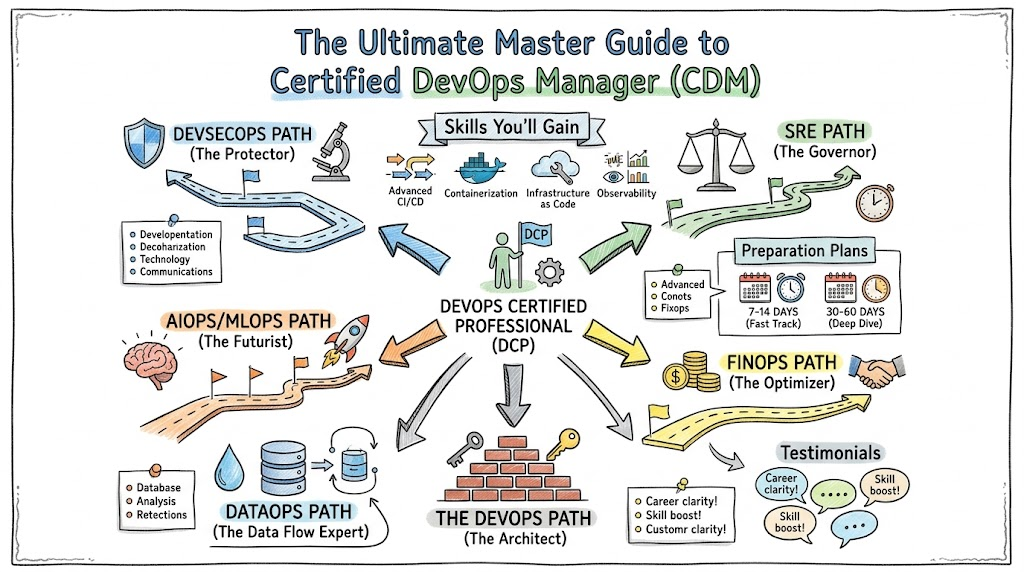
Skills You’ll Gain
- Advanced CI/CD: Building complex, multi-stage pipelines that include automated testing and security gates.
- Containerization & Orchestration: Mastering Docker for packaging and Kubernetes for managing container clusters at scale.
- Infrastructure as Code (IaC): Using Terraform and Ansible to automate the provisioning and configuration of servers.
- Observability: Setting up logging, tracing, and monitoring using Prometheus, Grafana, and the ELK stack.
- Security (DevSecOps): Implementing automated vulnerability scanning and secret management (e.g., HashiCorp Vault).
- Configuration Management: Ensuring server consistency across thousands of nodes.
Real-World Projects You Should Be Able to Do
- Zero-Downtime Migration: Move a legacy application to a containerized environment with no interruption to the end user.
- Automated Environment Provisioning: Create a “One-Click” solution to spin up identical Development, Staging, and Production environments.
- Self-Healing Clusters: Configure a Kubernetes cluster that automatically detects service failure, restarts containers, and scales up based on CPU/Memory load.
- GitOps Pipeline: Implement a system where any change to the Git repository is automatically reflected in the production infrastructure.
Certification Table
| Track | Level | Who it’s for | Prerequisites | Skills Covered | Recommended Order |
| DevOps | Intermediate | Software Engineers, SysAdmins | Basic Linux, Git | CI/CD, Docker, K8s, Terraform | 1st |
| DevSecOps | Advanced | Security Engineers, DevOps Engineers | DCP or equivalent | Vault, SonarQube, OPA, Aqua | 2nd |
| SRE | Advanced | Operations Engineers, Devs | DevOps skills, Python/Go | Error Budgets, SLIs/SLOs, Toil Reduction | 2nd |
| AIOps/MLOps | Specialized | Data Scientists, ML Engineers | Python, Basic DevOps | Model versioning, ML Pipelines, Monitoring | 3rd |
| DataOps | Specialized | Data Engineers, DBA | SQL, Cloud basics | Data Pipelines, ETL Automation | 3rd |
| FinOps | Management | Finance Pros, Tech Leads | Cloud basics | Cost optimization, Billing, Unit Economics | 2nd |
Preparation Plans for DCP
Getting certified is a marathon, not a sprint. Depending on your current workload and experience level, here is how you should structure your study time.
7–14 Days: The Fast Track (For Experienced Pros)
- Day 1-3: Refresh Linux internals (Process management, networking) and advanced Git (Rebase, Cherry-pick).
- Day 4-7: Deep dive into Kubernetes. Focus on Pods, Services, Ingress, and ConfigMaps.
- Day 8-11: Build 3 full CI/CD pipelines from scratch using Jenkins and GitLab CI.
- Day 12-14: Practice Infrastructure as Code using Terraform. Take at least two full-length mock exams.
30 Days: The Balanced Approach (For Working Engineers)
- Week 1: Fundamentals. Spend 1 hour/day on Shell scripting, Networking, and Version Control.
- Week 2: Containerization. Build Docker images for multiple languages (Java, Node, Python) and understand image optimization.
- Week 3: Configuration Management & IaC. Master Ansible playbooks for server hardening and Terraform for cloud provisioning.
- Week 4: Monitoring and Security. Set up Prometheus/Grafana and integrate SonarQube into your pipelines.
60 Days: The Deep Dive (For Beginners/Career Switchers)
- Month 1: Focus on the “Foundations.” Learn how web servers work, understand the Linux filesystem, and get comfortable with the command line.
- Month 2: Focus on “Implementation.” Dedicate one week each to: CI/CD tools, Docker/K8s, IaC (Terraform), and Observability. Use the final 10 days solely for building an end-to-end “Capstone Project.”
Common Mistakes to Avoid
- The “Tutorial Hell” Trap: Don’t just watch videos. If you don’t type the commands yourself, you won’t remember them during the exam or on the job.
- Ignoring the Culture: DevOps is 80% culture and 20% tools. Don’t skip the sections on Agile, Scrum, and how to improve developer-operator collaboration.
- Skipping the Basics: Many candidates fail because they know Kubernetes but don’t understand basic Linux networking or SSH.
- Overcomplicating the Architecture: In the beginning, aim for a “Minimum Viable Pipeline.” You can add complexity later once you understand the core flow.
Choose Your Path: 6 Specialized Learning Tracks
1. The DevOps Path (The Architect)
This is the “Gold Standard.” You focus on the entire ecosystem and eventually move into a DevOps Architect or Platform Engineer role. You are the one who designs how the whole company builds and ships software.
2. The DevSecOps Path (The Protector)
Security is no longer a “bottleneck” at the end of the project. In this track, you learn how to automate security checks (SAST, DAST) so that every build is verified for vulnerabilities before it ever touches production.
3. The SRE Path (The Governor)
Site Reliability Engineering is about treating operations as a software problem. You focus on high availability, disaster recovery, and “Error Budgets”—the science of how much downtime is acceptable versus the speed of new features.
4. The AIOps/MLOps Path (The Futurist)
Data science is booming, but deploying AI models is incredibly difficult. This track teaches you how to automate the training, versioning, and deployment of Machine Learning models.
5. The DataOps Path (The Data Flow Expert)
Data is the new oil, but only if it’s clean and accessible. This track focuses on automating data pipelines, ensuring that data engineers and analysts have the infrastructure they need to work efficiently.
6. The FinOps Path (The Optimizer)
The cloud is expensive. FinOps is a cultural practice that brings financial accountability to the variable spend model of the cloud. You learn how to save companies millions by optimizing their cloud usage.
Role → Recommended Certifications Mapping
| Role | Foundation | Intermediate / Core | Advanced / Specialized |
| DevOps Engineer | DCP | CKA (Certified Kubernetes Administrator) | AWS Certified DevOps Engineer |
| SRE (Site Reliability Engineer) | DCP | SRE Certified Professional | Chaos Engineering Certification |
| Platform Engineer | DCP | HashiCorp Certified: Terraform Associate | CKA |
| Cloud Engineer | DCP | AWS/Azure/GCP Solutions Architect | — |
| Security Engineer | DCP | DevSecOps Certified Professional | CISSP (Optional) |
| Data Engineer | DCP | DataOps Certification | Big Data Specialty |
| FinOps Practitioner | Cloud Practitioner | FinOps Certified Practitioner | — |
| Engineering Manager | DCP | FinOps (Budget Management) | Leadership Training |
Next Certifications to Take
The tech world never stops moving. Once you have earned your DCP, you should look toward these three options to stay ahead of the curve:
- Same Track (Deepening Expertise):If you want to stay in core DevOps, go deeper into the tools. Become a Certified Kubernetes Administrator (CKA) or a HashiCorp Certified: Terraform Associate.
- Cross-Track (Broadening Skills):Expand your horizons. If you are a DevOps pro, take a DevSecOps or SRE certification. This makes you a “T-Shaped” professional who can solve problems across different departments.
- Leadership Track:If you aspire to become a VP of Engineering or CTO, look into FinOps and Agile Leadership. Understanding the “Business of Technology” is what separates senior leaders from individual contributors.
Training Providers for DevOps Certified Professional (DCP)
DevOpsSchool
A premier institution known for its deeply practical approach. They offer one of the most comprehensive DCP training programs, featuring 24/7 lab access, real-time project work, and a curriculum that is updated every quarter to reflect industry changes.
Cotocus
This provider specializes in high-end corporate training and consulting. They are excellent for senior professionals looking to implement DevOps at an enterprise scale, providing deep architectural insights alongside the DCP certification.
Scmgalaxy
One of the oldest names in the DevOps community. They provide an extensive library of resources, tutorials, and community support, making them a great choice for those who want a strong community-driven learning experience.
BestDevOps
They offer highly curated, boutique training sessions that focus on the most in-demand toolsets. Their trainers are active industry practitioners who bring current, real-world problems into the classroom.
DevSecOpsSchool.com
The definitive home for “Security-as-Code.” Focuses on HashiCorp Vault, Snyk, and automated compliance.
SRESchool.com
Dedicated to the mathematical side of reliability—Error Budgets, Service Level Objectives (SLOs), and Chaos Engineering.
AIOpsSchool.com
The frontier of the industry, teaching how to use Machine Learning to automate log analysis and predictive system scaling.
DataOpsSchool.com
Bridging the gap between Big Data and DevOps, focusing on the automation of data pipelines and ETL reliability.
FinOpsSchool.com
A critical track for management, focusing on cloud cost transparency, unit economics, and reducing “cloud waste.”
FAQs: Career & Outcomes
1. How difficult is the DCP exam?
It is designed to be challenging but fair. It requires a mix of theoretical knowledge and practical implementation. If you have completed the labs and understand the “why” behind the tools, you will be well-prepared.
2. How long does the certification remain valid?
While the knowledge is lifelong, it is recommended to refresh your certification or move to an advanced track every 2 years to stay current with tool versions.
3. Will this certification help me if I have a gap in my career?
Yes. A fresh DCP certification shows recruiters that your skills are current and that you have the discipline to master modern technologies.
4. Is there a specific sequence I should follow?
Start with DCP. It is the foundation. Once you have the “DevOps mindset,” you can branch into Security, SRE, or Cloud-specific certs.
5. Does it matter if I am from a non-CS background?
Not at all. Many of the best DevOps engineers come from diverse backgrounds. As long as you have the logic and the willingness to learn Linux and automation, you can succeed.
6. Can I get a job in the US or Europe with this?
Yes. The DCP is built on global industry standards. DevOps is a “universal language” in tech, and this credential is recognized internationally.
7. How much time should I dedicate daily to preparation?
If you are working full-time, 1.5 to 2 hours of focused study (ideally with 70% lab time) is the sweet spot for most engineers.
8. What kind of salary hike can I expect?
While it depends on your location and experience, certified professionals in the DevOps space often see an immediate 20% to 50% jump in their total compensation package.
9. Do I need to learn coding for DCP?
You don’t need to be a “Software Developer,” but you do need to be comfortable with “Scripting” (Bash/Python) and “Declarative Code” (YAML/JSON).
10. Is the exam proctored?
Yes, most reputable providers use online proctoring to ensure the integrity and value of the certification.
11. What if I am a manager? Is this too technical for me?
No. It provides the technical grounding you need to manage your team effectively. You don’t need to be the “fastest coder,” but you must understand the workflow.
12. Does the DCP cover “Soft Skills”?
Yes. A significant portion of the program is dedicated to the cultural aspects—how to break down silos, manage stakeholder expectations, and lead a transformation.
FAQs: DevOps Certified Professional (DCP) Specifics
1. Is the DCP certification globally recognized?
Absolutely. It is designed to meet the requirements of top-tier tech firms across India, North America, Europe, and the Middle East.
2. Are there retakes available?
Yes, if you do not pass on the first attempt, there is a standard waiting period and retake policy.
3. Does the DCP training include real-time projects?
Yes. You are expected to complete several “Capstone Projects” that simulate real-world production environments before receiving your certification.
4. How does DCP compare to AWS DevOps Engineer certification?
AWS certs focus on “How to do DevOps on AWS.” DCP focuses on “How to do DevOps period.” DCP is broader and covers more open-source tools.
5. Can I take the DCP exam without taking the training?
While possible for those with extensive experience, the training is highly recommended because it covers the specific “Body of Knowledge” required for the professional level.
6. Is there a community for DCP holders?
Yes, once certified, you gain access to an exclusive alumni network for job referrals and technical collaboration.
7. What is the format of the exam?
The exam consists of multiple-choice questions, scenario-based analysis, and sometimes practical lab-based tasks.
8. Is the training live or recorded?
DevOpsSchool offers both, but the live-instructor-led sessions are highly recommended for the DCP track.
Conclusion
The journey to becoming a DevOps Certified Professional is one of the smartest investments you can make in your career today. The “Great Separation” between developers and operators is over. The future belongs to those who can navigate the entire stack—from the first line of code to the final monitored metric.
Whether you are looking to land a new role at a FAANG company, earn a promotion at your current firm, or simply build more reliable software, the DCP framework provides the roadmap. Don’t just watch the industry change from the sidelines—get certified, get hands-on, and lead the transformation.

This was a really helpful and easy-to-follow guide on the Certified DevOps Manager (CDM). I liked how it doesn’t just focus on tools but also talks about the bigger picture—like leadership, team collaboration, and aligning DevOps with business goals. It gives a clear idea of what it actually means to move into a managerial role in DevOps, which a lot of people struggle to understand. The points around culture, metrics, and real-world impact made it feel practical rather than just theoretical. Overall, a solid read for anyone curious about growing beyond technical roles in DevOps.
This was a really insightful and well-put-together guide, especially for anyone trying to understand what stepping into a DevOps Manager role actually looks like. I liked how the blog focuses on the shift from hands-on technical work to leading strategy, teams, and overall delivery processes, which is something many professionals struggle with. It clearly shows that this role is more about building culture, managing performance, and aligning engineering work with business goals rather than just tools. Overall, it’s a practical and easy-to-follow read for anyone planning to grow into leadership in DevOps.
I gained clarity on DevOps leadership, governance, and transformation strategy, and I will apply these insights to lead efficient, scalable enterprise delivery operations.
Developing strategic leadership capabilities in modern software environments enhances my management proficiency while building essential organizational skills for successful personal growth and future professional career advancement.
Well-structured guide that provides valuable insights into DevOps leadership and management practices.
Really enjoyed reading this post. It offers a practical perspective on DevOps leadership and highlights the importance of collaboration, automation, and strategic planning for managing successful teams and projects.