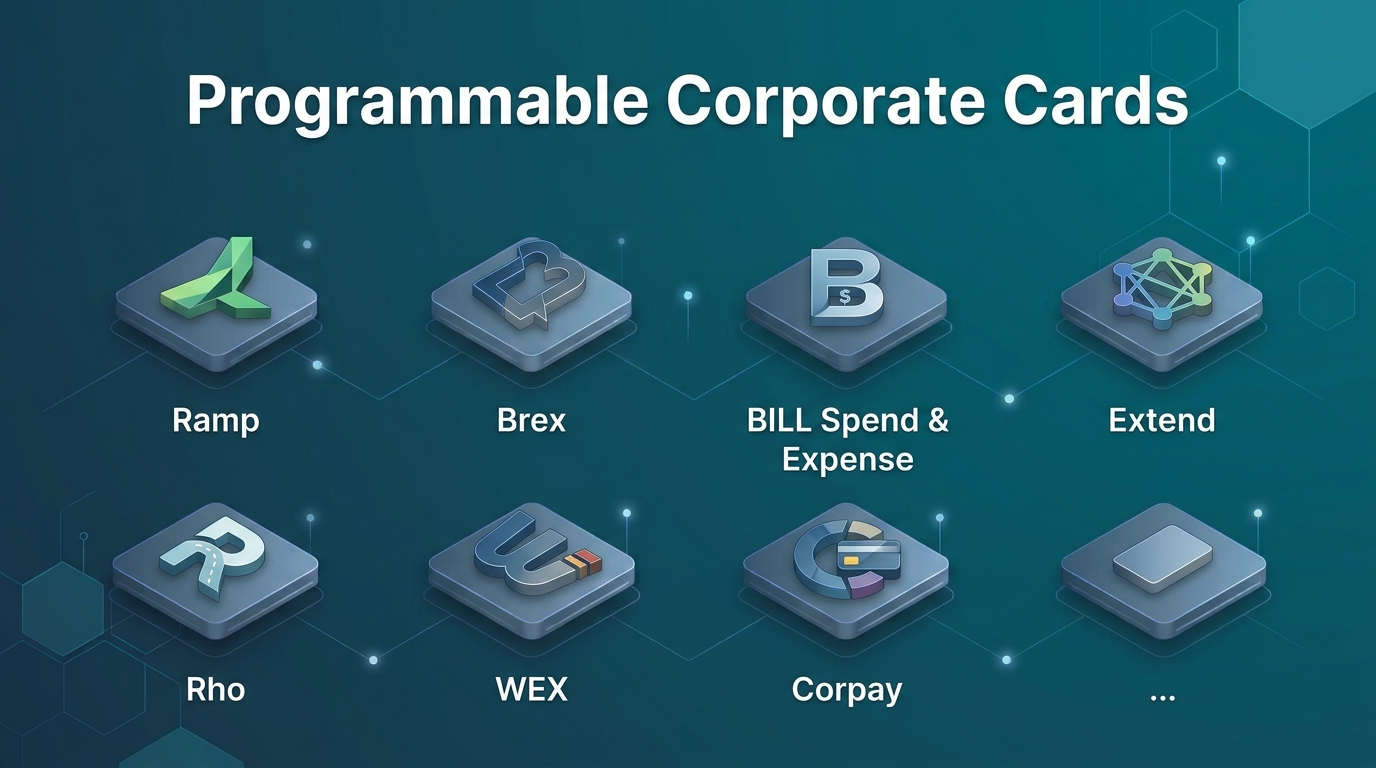
Traditional commercial bank credit cards operate on a disconnected, high-friction model: a finance manager applies for physical cards with shared credit limits, distributes them to team leads, and waits 30 days for a paper statement—only to discover that an ex-employee’s subscription is still billing or an ad account quietly blew past its quarterly budget.
Modern corporate card management tools pair commercial charge cards with programmable software controls—allowing finance leaders to issue unlimited virtual and physical cards, assign dynamic merchant-locked limits, enforce real-time receipt collection, and push categorized transactions directly into accounting software at the moment of swipe. Evaluating corporate card platforms requires distinguishing between modern fintech charge-card platforms, traditional commercial banking card overlays, global multi-currency card issuers, and fuel/fleet-specialized card programs.
Five Core Capabilities of Modern Corporate Card Management Platforms
Commercial credit cards with an online banking portal are standard; modern corporate card management platforms deliver five technical and operational capabilities:
- Programmable Virtual Cards With Granular Spend Controls: Instantly generating single-use or vendor-locked virtual cards with custom spending limits (e.g., exact daily, monthly, or total caps), restricted merchant categories (MCC codes), and automatic expiration dates—preventing unexpected subscription price hikes or unauthorized recurring charges.
- Real-Time Automated Receipt Capture and Text Prompts: Triggering an immediate SMS, Slack message, or mobile notification the second a card is swiped—allowing employees to reply directly with a receipt photo, auto-extracting line items via OCR, and auto-matching the documentation before the cardholder forgets the expense.
- Underwriting Model and Working Capital Flexibility: Differentiating between traditional personal-guarantee cards and business-underwritten corporate charge cards—evaluating whether the platform extends credit lines based on live bank cash balances, annual recurring revenue (ARR), or traditional financial statement audits.
- Multi-Entity and Global Local-Currency Issuance: Issuing physical and virtual cards in local currencies across international subsidiaries (USD, EUR, GBP, CAD) with direct clearing on local banking rails—eliminating costly 1.5% to 3% foreign transaction fees for distributed global teams.
- Continuous Accounting Sync and ERP Field Mapping: Mapping transactions automatically to GL accounts, departments, projects, and vendor entities in QuickBooks, Xero, NetSuite, or Sage Intacct—reconciling daily card clearing accounts so month-end close requires hours instead of days.
Leading Corporate Card Management Platforms
Ramp
Ramp has established itself as a leading corporate card and financial automation platform for US-based businesses. Combining zero-fee corporate charge cards with automated receipt matching, proactive spend programs, automated Accounts Payable (bill pay), and vendor contract intelligence, Ramp focuses on helping businesses reduce waste. Its software automatically flags duplicate software subscriptions, identifies price increases on vendor renewals, and achieves high receipt compliance through SMS-based capture and direct Gmail/Outlook receipt scrapers.
US startups, mid-market companies, and non-profit organizations seeking automated accounting reconciliation and working-capital efficiency gravitate toward Ramp. Its primary constraint is that corporate underwriting and bank-account connections focus primarily on US-domiciled entities, though cards operate globally.
Brex
Brex was built specifically to solve corporate card and cash management needs for high-growth technology companies and global multi-entity enterprises. Offering corporate cards with high credit limits (underwritten based on cash balances and venture funding without personal guarantees), Brex stands out for its global card issuance in local currencies across 50+ countries, high-yield business treasury accounts, integrated travel booking, and deep enterprise ERP connectors (including NetSuite and Workday).
Global scale-ups, venture-backed companies, and multi-subsidiary international enterprises requiring cards denominated in local currencies for overseas teams benefit substantially from Brex’s global infrastructure.
BILL Spend & Expense (formerly Divvy)
BILL Spend & Expense combines credit-line access for small-to-mid-sized businesses with a proactive budget-first card allocation model. Instead of setting flat card limits, finance managers create departmental or project budgets (e.g., “Field Marketing – $5,000/month”) and allocate funds dynamically to employee cards from those buckets—preventing employees from spending if a budget pool is depleted.
Small-to-mid-sized businesses that want tight, proactive budget guardrails—or organizations already using BILL for accounts payable automation—gain an integrated spend and card ecosystem with no software subscription fees.
Traditional Commercial Bank Card Overlays (Extend, Rho, SVB, Amex)
Many established businesses prefer to keep their existing primary banking relationships (JPMorgan Chase, Bank of America, American Express, Wells Fargo) while gaining modern virtual card capabilities:
- Extend is a virtual card platform that connects directly to existing commercial cards from major issuers (such as Amex, BMO, Regions, or Comdata)—allowing companies to generate virtual cards and enforce receipt collection without opening a new line of credit or changing banks.
- Rho delivers an integrated corporate card, commercial banking, and AP platform built for mid-market businesses wanting dedicated account management and high-yield operational treasury.
Fleet and Specialized Mobility Cards (WEX, Fleetcor / Corpay)
When corporate cards are used primarily for commercial vehicle fleets, fuel purchases, and maintenance, standard corporate cards fail to capture level-3 line-item data. WEX and Corpay provide specialized fleet cards that require drivers to enter vehicle odometer readings and employee IDs at the fuel pump—preventing fuel theft, tracking fuel economy, and automating IFTA tax accounting.
Corporate Card Management Tools Comparison
| Platform | Primary Architectural Role | Credit Underwriting Basis | Global & Multi-Currency Breadth | Accounting & ERP Integration | Best Fit |
|---|---|---|---|---|---|
| Ramp | Automated corporate card & spend management | Cash balance & business financials (No personal guarantee) | Primarily US entities (Global acceptance, cards in USD) | Direct real-time sync with NetSuite, Intacct, QBO, Xero | US-based startups & mid-market companies optimizing spend |
| Brex | Global corporate card & treasury platform | Cash balances, revenue & venture equity | High (Local-currency issuance across 50+ countries) | NetSuite, Workday, QuickBooks, Sage Intacct | Multi-entity global scale-ups & international companies |
| BILL Spend & Expense | Budget-enforced corporate cards & credit lines | Traditional business credit underwriting | Primarily US-focused | Native sync with BILL AP, QuickBooks, NetSuite, Xero | Small-to-mid-sized businesses wanting proactive budget controls |
| Extend | Virtual card software overlay for existing banks | Uses existing commercial bank credit line (Amex, etc.) | Dependent on underlying commercial bank terms | Webhooks, CSV & accounting integrations | Companies wanting virtual cards without switching their bank |
| Rho | Full-stack commercial banking, cards & AP | Business financials & cash underwriting | Primarily US commercial banking & cards | NetSuite, QuickBooks, Sage Intacct | Mid-market companies wanting banking, cards & AP in one relationship |
| WEX / Corpay | Specialized commercial fleet & fuel cards | Commercial fleet credit underwriting | Multi-country fuel network acceptance | Fleet management tools, ERP & accounting ledgers | Commercial fleets needing pump-level fuel tracking & odometer data |
Common Corporate Card Management Pitfalls to Avoid
- Using Shared Physical Cards for Multiple SaaS Subscriptions: Issuing a single physical card to manage twenty distinct software vendors creates an operational hazard: if that card is compromised or expires, all twenty critical business tools stop functioning simultaneously. Always issue a unique, merchant-locked virtual card with a dedicated monthly limit for every SaaS service.
- Overlooking Credit Limit Fluctuations on Dynamic Underwriting: Fintech charge cards that underwrite credit lines dynamically based on live bank balances can automatically reduce your daily or monthly limit during payroll disbursement periods. Ensure your business maintains an adequate cash buffer or negotiates underwriting terms that accommodate cash flow timing.
- Ignoring Receipt Compliance Policies at Setup: Automated receipt prompts are effective only if accompanied by automated enforcement. Configure settings that temporarily restrict cardholder limits if receipts remain missing past a designated grace period (e.g., 7 or 14 days).
Selecting the Right Corporate Card Management Tool
Choose your corporate card platform based on your operating geography, existing banking agreements, and fleet needs:
- For US Startups and Mid-Market Businesses Seeking High Automation: Standardize on Ramp for advanced automated accounting reconciliation, vendor contract tracking, and receipt management.
- For Multi-Subsidiary and International Organizations: Deploy Brex to issue cards denominated in local foreign currencies across international operations.
- For Businesses Committed to Their Existing Commercial Bank: Use Extend to layer modern virtual card controls and receipt workflows over your current American Express or bank lines.
- For Commercial Vehicle and Logistics Operations: Choose WEX or Corpay to enforce pump-level driver ID and odometer controls.
