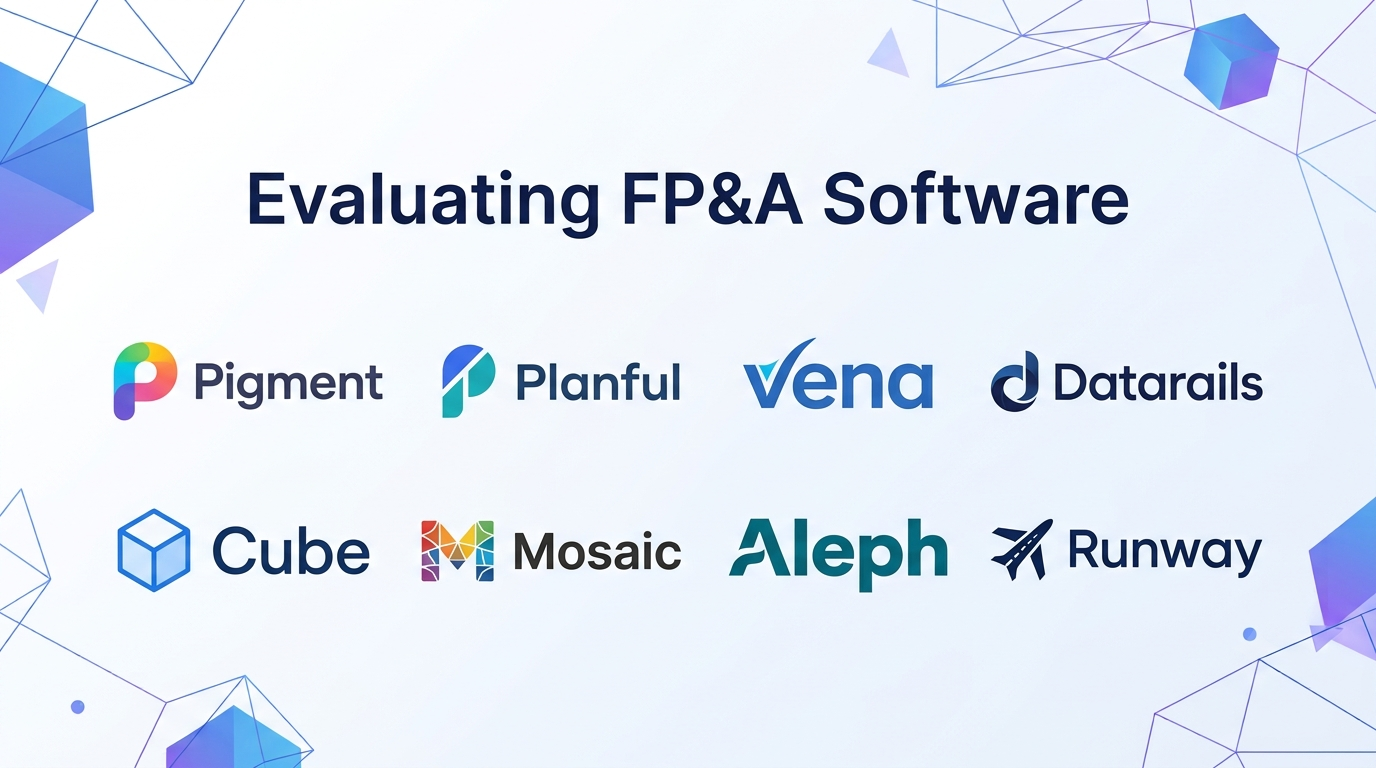
Every scaling finance team hits the same Excel breaking point: a 45-tab master budget workbook named FY_Forecast_v19_FINAL_BoardEdit.xlsx takes forty seconds to recalculate, a single broken VLOOKUP corrupts departmental headcount projections, and answering a board member’s simple question—“What happens to our cash runway if enterprise sales slip by one quarter and we pause ten engineering hires?”—requires two days of manual copy-pasting.
Financial Planning & Analysis (FP&A) software replaces fragile linked spreadsheets with a centralized multi-dimensional modeling engine—pulling live actuals from ERP, HRIS, and CRM systems to power rolling forecasts, driver-based headcount planning, scenario modeling, and board reporting. Evaluating FP&A platforms requires distinguishing between Excel-native overlay platforms, modern cloud web-modeling suites, and enterprise connected-planning engines.
Five Core Capabilities of Modern FP&A Platforms
When evaluating FP&A software for mid-market or enterprise finance teams, inspect five architectural foundations:
- Multi-Dimensional OLAP / Cube Calculation Engine: Modeling revenue, COGS, headcount, and OpEx across arbitrary dimensions (Entity, Department, Region, Product Line, Version: Actual vs. Budget vs. Rolling Forecast) without manually maintaining thousands of linked spreadsheet cell formulas.
- Bi-Directional ERP, HRIS, and CRM Data Pipelines: Automated scheduled syncs with NetSuite, Sage Intacct, QuickBooks, SAP (actuals), Workday, Rippling, BambooHR, Gusto (roster-level salaries, benefits, payroll taxes, start dates), and Salesforce / HubSpot (pipeline coverage and ARR cohorts).
- Granular Workforce and Headcount Planning: Modeling employee-by-employee compensation, merit increases, bonus accruals, employer payroll taxes, benefits caps, and new-hire ramp schedules—the single largest expense line item for most modern companies.
- Instant Multi-Scenario Branching and Variance (BvA) Analysis: Cloning a baseline forecast into Best-Case, Downside, and Hiring-Freeze scenarios in seconds, while automatically generating Budget-vs.-Actuals (BvA) variance commentaries for department heads.
- Excel Fidelity vs. Web Collaboration Balance: Providing either native two-way Excel add-ins (preserving keyboard shortcuts and custom formatting that finance analysts love) or intuitive browser-based grids with role-based departmental permissions so budget owners collaborate without breaking core formulas.
Leading Financial Planning & Analysis (FP&A) Software
Pigments
Pigment is a modern, enterprise-grade integrated business planning platform designed to unify Finance, Revenue Operations, and HR planning inside one high-speed modeling engine. Known for handling massive multi-dimensional datasets cleanly, intuitive visual dependency graphs, collaborative workflow sign-offs, and fast scenario branching, Pigment has rapidly become a top choice for scaling mid-market and enterprise organizations replacing legacy spreadsheets or rigid older planning tools.
High-growth scale-ups and enterprises wanting cross-functional planning (connecting sales capacity planning directly to financial P&Ls and headcount budgets) favor Pigment, accepting structured implementation timelines and enterprise annual pricing.
Planful
Planful delivers a comprehensive, mature cloud FP&A platform covering structured budgeting, rolling forecasts, workforce planning, cash-flow forecasting, and financial consolidation. Offering both a structured web interface and a strong Excel add-in (Spotlight), Planful balances out-of-the-box financial templates with enterprise workflow governance—making it particularly popular among mid-market finance teams seeking predictable implementation timelines without building models completely from scratch.
Vena Solutions and Datarails (Excel-Native FP&A Platforms)
Many finance leaders discover that forcing analysts and department managers to abandon Excel entirely creates adoption resistance. Vena and Datarails solve this by keeping native Microsoft Excel as the user interface while replacing fragile local workbooks with a centralized cloud database, version control, audit trails, and automated ERP/HRIS connectors:
- Vena Solutions combines a centralized OLAP cube database with native Excel templates, structured workflow approvals, and strong mid-market reporting and consolidation capabilities.
- Datarails targets SMB and lower-mid-market finance teams (typically running QuickBooks, Xero, or NetSuite) who want to keep their existing custom Excel models intact while automating data consolidation, version control, and web-based executive dashboards.
Cube and Mosaic (Agile Mid-Market FP&A Suites)
- Cube takes a spreadsheet-first, low-friction approach—connecting bi-directionally to both Microsoft Excel and Google Sheets via a multi-dimensional cloud data layer that typically deploys in weeks rather than months, ideal for lean FP&A teams of one to five people.
- Mosaic (part of HiBob) focuses specifically on B2B SaaS and technology companies—offering pre-built SaaS metric canvases (ARR waterfalls, Net Dollar Retention, CAC payback, Magic Number) alongside automated ERP, CRM, and HRIS data ingestion for fast executive reporting.
Aleph and Runway (Next-Gen Modern Finance Platforms)
- Aleph acts as a unified financial data hub and Excel/Sheets add-in—eliminating manual CSV data prep by syncing ERP, HRIS, CRM, and billing data directly into clean tables and spreadsheets with rapid self-serve setup.
- Runway reimagines financial modeling around a modern, human-readable visual interface—allowing founders, department leads, and FP&A teams to build driver-based models with plain-English formulas, interactive hiring plans, and collaborative scenario sliders without opaque cell coordinates.
FP&A Software Comparison
| Platform | Modeling Interface | Core Architectural Strength | ERP / HRIS / CRM Integration | Target Company Size | Best Fit |
|---|---|---|---|---|---|
| Pigment | Modern web canvas + Excel sync | High-scale multi-dimensional cross-functional planning (Finance, RevOps, HR) | Deep enterprise connectors (NetSuite, SAP, Workday, Salesforce) | Mid-market scale-ups & enterprises | Organizations uniting Finance, Sales & HR planning in one platform |
| Planful | Structured web UI + Excel add-in | Comprehensive budgeting, workforce planning & structured close workflows | Broad ERP, HRIS & CRM connectors | Mid-market & upper mid-market | Established finance teams wanting structured templates & governance |
| Vena Solutions / Datarails | Native Excel UI backed by cloud database | Preserves existing Excel models & shortcuts with database governance | NetSuite, Sage Intacct, Dynamics, QuickBooks, BambooHR | SMB (Datarails) to Mid-market (Vena) | Finance teams unwilling to abandon native Excel modeling |
| Cube | Excel & Google Sheets + lightweight web app | Fast deployment (weeks) & seamless two-way spreadsheet sync | NetSuite, Intacct, QuickBooks, Xero, Rippling, Salesforce | Lean mid-market & Series A–C startups | Small FP&A teams needing fast multi-dimensional control |
| Mosaic / Runway | Modern SaaS-metric web canvases | Pre-built SaaS KPIs (Mosaic) / Plain-English visual modeling (Runway) | Stripe, NetSuite, Salesforce, HubSpot, Rippling, Gusto | Venture-backed startups & mid-market tech | Tech/SaaS teams prioritizing speed, executive visuals & founder collaboration |
| Aleph | Automated data hub + Excel/Sheets add-ins | Eliminates manual data prep & CSV exports with fast implementation | 150+ accounting, HRIS, CRM & billing connectors | SMB & mid-market finance teams | Lean teams spending too much time cleaning raw ERP/HRIS exports |
Common FP&A Implementation Pitfalls to Avoid
- Over-Engineering 200 Micro-Drivers in Phase One: Modeling office coffee spend down to per-employee espresso capsules adds maintenance overhead without moving EBITDA. Focus granular driver modeling on the 5 to 8 line items that drive 85% of your P&L—typically revenue retention/pipeline, headcount compensation, cloud/COGS infrastructure, and paid marketing.
- Ignoring Messy CRM and HRIS Master Data Before Syncing: If department names in BambooHR (
Eng,Engineering,R&D) do not match NetSuite department codes, automated Budget-vs.-Actuals variance reports will break immediately. Standardize a single cross-system dimension mapping table before connecting pipelines. - Buying Heavy Enterprise Platforms Without Dedicated Model Ownership: Complex modeling suites require an internal FP&A analyst or RevOps builder who owns formula architecture; otherwise, every minor business change forces expensive external consultant tickets.
Selecting the Right FP&A Software
Match your FP&A platform to your team’s spreadsheet culture, data complexity, and company stage:
- For Lean Finance Teams Wanting Fast Deployment Without Leaving Spreadsheets: Choose Cube, Aleph, or Datarails to automate ERP/HRIS data pulls directly into Excel and Google Sheets.
- For Venture-Backed Tech and SaaS Companies: Evaluate Runway (for collaborative plain-English visual modeling) or Mosaic (for turnkey SaaS ARR/cohort analytics).
- For Mid-Market Teams Needing Structured Governance and Excel Familiarity: Standardize on Vena Solutions or Planful.
- For Large Scale-Ups and Enterprises Uniting Finance, Sales, and Workforce Planning: Invest in Pigment for multi-dimensional scale and cross-functional collaboration.
