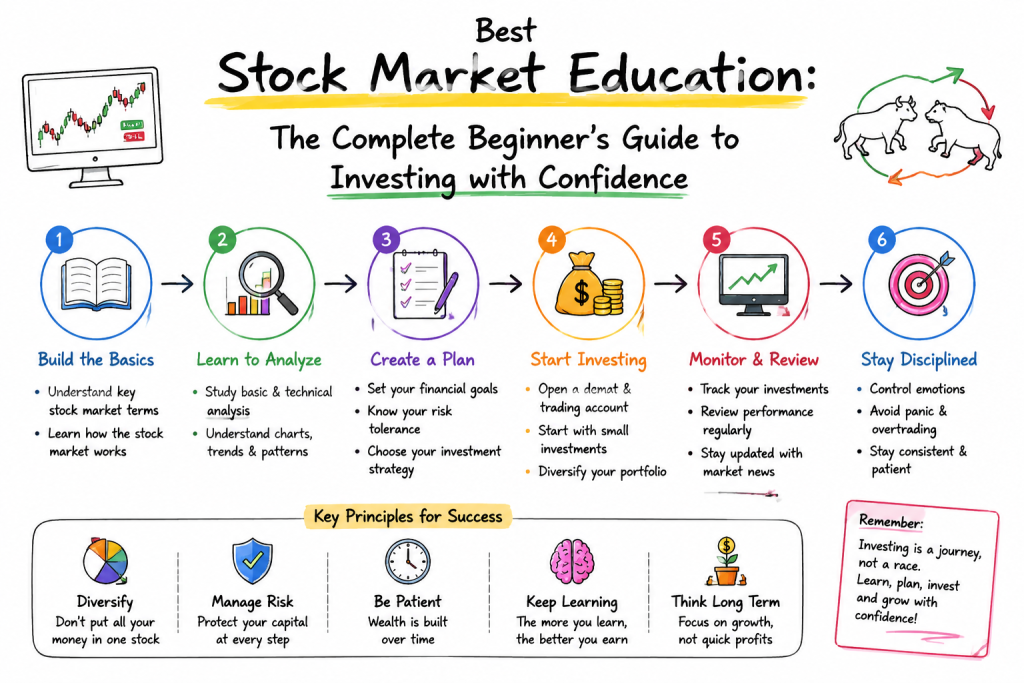
Introduction
The stock market has become one of the most popular ways to build long-term wealth. Yet many people hesitate to invest because they believe it is too complex or risky. The truth is that successful investing begins with proper stock market education rather than guessing or following tips from social media.
Whether you’re a student, a working professional, or someone planning for financial freedom, understanding how the stock market works can help you make informed decisions. Learning the basics allows you to identify quality companies, manage risk, and invest with confidence instead of emotion.
This comprehensive guide explains everything beginners need to know—from understanding stocks and stock exchanges to learning fundamental analysis, technical analysis, stock research, and IPO evaluation.
What Is Stock Market Education?
Stock market education is the process of learning how financial markets operate, how companies raise capital, how investors buy and sell shares, and how investment decisions are made using research and analysis.
A good stock market education covers:
- Stock market basics
- Share market terminology
- Investment principles
- Risk management
- Portfolio diversification
- Fundamental analysis
- Technical analysis
- IPO evaluation
- Market psychology
- Long-term wealth creation
Instead of chasing quick profits, educated investors focus on making consistent and informed decisions.
Understanding the Stock Market
The stock market is a marketplace where investors buy and sell shares of publicly listed companies.
When you purchase a share, you become a partial owner of that company. If the company performs well over time, the value of your investment may increase. Some companies also reward shareholders through dividends.
Stock prices change every day due to several factors including:
- Company performance
- Economic conditions
- Interest rates
- Industry trends
- Investor sentiment
- Global events
Understanding these factors is the first step toward becoming a successful investor.
Share Market for Beginners
For beginners, the share market may seem confusing because of unfamiliar terms and constant price movements.
However, the basic process is straightforward.
Step 1: Learn the Basics
Understand key concepts such as:
- Shares
- Equity
- Market capitalization
- Dividends
- Stock exchanges
- IPOs
Step 2: Open a Trading and Demat Account
A trading account helps you buy and sell shares, while a Demat account stores your investments electronically.
Step 3: Start Small
New investors should begin with a manageable amount and gradually increase investments as they gain experience.
Step 4: Focus on Learning
Avoid investing based on rumors or market hype.
Why Stock Market Education Is Important
Learning before investing offers several benefits.
Better Decision Making
Education enables investors to analyze companies instead of depending on speculation.
Lower Investment Risk
Knowledge helps identify poor-quality businesses and avoid common mistakes.
Improved Financial Planning
Investors understand how to align investments with long-term financial goals.
Emotional Control
Educated investors are less likely to panic during market fluctuations.
Learn Stock Market Step by Step
Understand Different Investment Options
Learn the differences between:
- Stocks
- Mutual funds
- ETFs
- Bonds
- Index funds
Study Business Fundamentals
Successful investing requires understanding how companies generate profits.
Key metrics include:
- Revenue
- Earnings
- Profit margins
- Cash flow
- Debt levels
Follow Financial News
Keeping up with economic developments helps investors understand market movements.
Practice Before Investing
Many platforms offer virtual trading that allows beginners to gain experience without risking real money.
Stock Market Investing for Beginners
Long-term investing focuses on owning quality businesses rather than trying to predict daily market movements.
Some important principles include:
Invest Regularly
Systematic investing builds wealth gradually.
Diversify Investments
Avoid investing all your money in one company or sector.
Stay Patient
Markets fluctuate in the short term but often reward disciplined investors over longer periods.
Review Your Portfolio
Regular reviews ensure investments continue to match your financial goals.
Understanding Stock Market Analysis
Stock market analysis helps investors determine whether a stock is worth buying, holding, or selling.
There are two major approaches:
- Fundamental Analysis
- Technical Analysis
Most experienced investors combine both methods depending on their investment strategy.
Fundamental Analysis of Stocks
Fundamental analysis evaluates a company’s financial health and future growth potential.
Important factors include:
Revenue Growth
Consistent revenue growth often indicates expanding business operations.
Earnings Growth
Increasing profits generally reflect effective management.
Debt Levels
Companies with manageable debt are usually more financially stable.
Return on Equity (ROE)
ROE measures how efficiently a company generates profits from shareholders’ investments.
Price-to-Earnings (P/E) Ratio
The P/E ratio helps compare stock valuations within the same industry.
Fundamental analysis is especially useful for long-term investors.
Technical Analysis for Beginners
Technical analysis studies historical price movements and trading volume to identify trends.
Common concepts include:
Support
A price level where buying interest often increases.
Resistance
A price level where selling pressure usually appears.
Trend Lines
Trend lines help identify upward or downward market direction.
Moving Averages
Moving averages smooth price data to reveal long-term trends.
Relative Strength Index (RSI)
RSI measures whether a stock appears overbought or oversold.
Technical analysis is commonly used by traders for entry and exit decisions.
How to Perform Stock Market Research
Research reduces uncertainty and improves investment decisions.
A practical research process includes:
- Study the company’s business model.
- Review financial statements.
- Analyze industry trends.
- Compare competitors.
- Evaluate management quality.
- Examine future growth opportunities.
- Assess risks.
Good research focuses on facts rather than opinions.
IPO Analysis for Beginners
An Initial Public Offering (IPO) allows a private company to sell shares to the public for the first time.
Before investing in an IPO, consider:
- Company background
- Business model
- Revenue growth
- Profitability
- Industry outlook
- Competitive advantages
- Valuation
- Risk factors
Reading the company’s prospectus provides valuable insights into its operations and financial health.
Common Mistakes Beginners Should Avoid
Many new investors repeat similar mistakes.
Avoid:
- Investing without research
- Following stock tips blindly
- Trying to time the market
- Ignoring diversification
- Selling during market panic
- Investing money needed for short-term expenses
Learning from these mistakes helps improve long-term investment success.
Building Good Investing Habits
Successful investing depends more on discipline than luck.
Develop habits such as:
- Reading financial news regularly
- Studying annual reports
- Tracking investment performance
- Continuing financial education
- Staying focused on long-term goals
Consistency often produces better results than chasing short-term gains.
Frequently Asked Questions
Is stock market investing suitable for beginners?
Yes. Beginners can start successfully by learning the fundamentals, investing gradually, and focusing on long-term wealth creation.
How long does it take to learn the stock market?
Basic concepts can be learned within a few weeks, while mastering investing is an ongoing process that improves with continuous learning and experience.
Which is better: fundamental or technical analysis?
Both serve different purposes. Fundamental analysis helps evaluate company quality, while technical analysis helps identify potential buying and selling opportunities.
How much money do I need to start investing?
Many investors begin with small amounts. The key is consistency rather than the initial investment size.
Why is stock market research important?
Research helps investors understand business performance, evaluate risks, and make informed investment decisions instead of relying on speculation.
Conclusion
Stock market education is the foundation of successful investing. Understanding market basics, learning fundamental and technical analysis, conducting thorough stock research, and evaluating IPOs can significantly improve your confidence as an investor.
Rather than searching for shortcuts or guaranteed returns, focus on building knowledge, developing disciplined investing habits, and making informed decisions. Over time, continuous learning and patience can help you navigate market fluctuations and work toward your long-term financial goals.

Really helpful article! I liked how it explains what to look for in SEO reporting software without making it complicated. The tips are practical and easy to understand, especially for anyone trying to choose the right tool. Thanks for sharing such useful insights
I really enjoyed reading this article. It explains stock market basics in a way that’s easy to understand, especially for someone who is just starting their investment journey. I also liked the emphasis on learning before investing and managing risks wisely. Thanks for sharing such practical and beginner-friendly information
I really enjoyed reading this guide. Investing can seem confusing when you’re just starting out, but this article explains the basics in a simple and easy-to-follow way. I especially liked that it encourages learning and making informed decisions instead of chasing quick profits. Thanks for sharing such a helpful resource
This is an excellent guide for anyone who wants to start investing in the stock market with confidence. I really liked how the article explains key concepts like risk management, diversification, and fundamental investing in a simple and beginner-friendly way. It encourages learning before investing, which is essential for making informed financial decisions.